The Solar Panel Warranty Transfer: What Happens When You Sell Your Home

Selling a house with solar on the roof raises a question that rarely appears on a listing flyer: what happens to the warranties? Buyers want lower bills. They also want to know who pays if a panel fails, an inverter drops offline, or a roof penetration leaks five years after closing. That worry is reasonable. A solar system is a long-lived asset, and most of its value sits in remaining product coverage, performance guarantees, and workmanship protection. When those documents stay current and transferable, the system looks like an asset. When they are missing, expired, or locked to the original owner, the same array can look like a risk.
Transfer Your Solar Warranty Before You Sell – Call Now
This guide explains what actually happens to solar warranties at sale, how a clean transfer works, and why the paperwork matters as much as the panels themselves.
The Homeowner Concern in Plain Language
Most owners paid cash or financed an owned system. They were told the panels carry 25-year coverage. They assumed that promise would travel with the house the same way a new roof warranty sometimes does. Then listing season arrives, and three problems appear at once:
- The original installer folder is incomplete.
- No one is sure whether the manufacturer or the installer must be notified.
- The buyer’s agent asks for proof that coverage will survive closing.
None of those problems means the system is defective. They mean the paper trail was never treated as part of the asset. Warranties are contracts. Contracts do not always move by silence. Some follow the equipment at the original address. Others require a form, a short deadline, or a modest fee. A few workmanship policies are written only for the first owner.
The reassuring fact is this: reputable panel product and performance warranties are designed to follow the system. The work is administrative, not mysterious. Handle it before closing and both sides walk away protected.
The Different Warranties on One Roof
A residential array is rarely covered by a single page. Treat each layer separately.
- Product (equipment) warranty. Protects against manufacturing defects in the modules themselves. Typical term is 10 to 25 years, often 25 on quality brands.
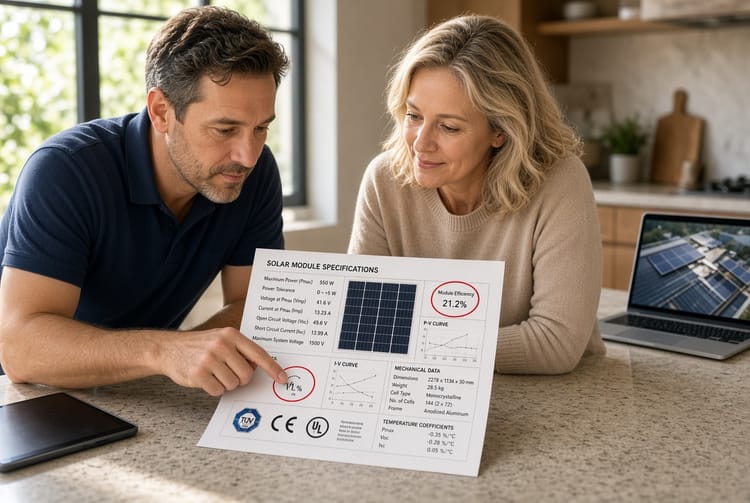
- Performance (power-output) warranty. Promises the array will still produce a stated share of original output at year 25—commonly in the mid-80s to low-90s percent range, depending on the brand. This is the long-horizon promise buyers care about.
- Inverter or microinverter warranty. Inverters wear faster than glass modules. Coverage is often 10 to 25 years. Transfer rules can be stricter than panel rules.
- Battery warranty, if storage is present. Frequently 10 years, sometimes with a change-of-ownership form and a short window after sale.
- Workmanship / installation warranty. Issued by the contractor. Covers mounting, wiring, roof penetrations, and labor quality. Terms vary widely—1 to 10 years is common; some firms go longer. This layer is the one most likely to need a formal transfer or to weaken if the original company has closed.
- Roof-penetration or leak coverage. Sometimes bundled with workmanship. Buyers ask about this first after rain.
Manufacturer coverage generally survives an installer change or even an installer bankruptcy. Workmanship coverage is only as durable as the company that signed it. That distinction is the single most important fact in a sale conversation.
What Happens When You Sell
When title changes, the hardware stays on the roof. Coverage does not automatically rewrite itself in every manufacturer’s database.
In practice:
- Panel product and performance warranties usually remain tied to the installed equipment at that address. Many brands treat the remaining term as transferable. “Transferable” is not the same as “no paperwork.” Some still want the new owner registered so a future claim is not delayed.
- Inverter and battery warranties more often require a form, proof of sale, and sometimes a processing fee.
- Installer workmanship warranties follow the contract. Some allow a one-time transfer within 30 to 60 days after closing. Others require written notice and an inspection. If the installer is gone and no successor assumed the labor promise, that layer may end even if the modules remain covered.
- Leased systems and power-purchase agreements are not warranty transfers in the same sense. They are contract assignments. The buyer must be approved by the third-party owner. That process is separate from manufacturer coverage and can slow a sale if started late.
Owned systems with clean documents are the simplest path. Leased systems can still close, but the conversation is about assuming monthly payments and assignment fees, not only remaining warranty years.
How to Transfer Coverage Without Drama
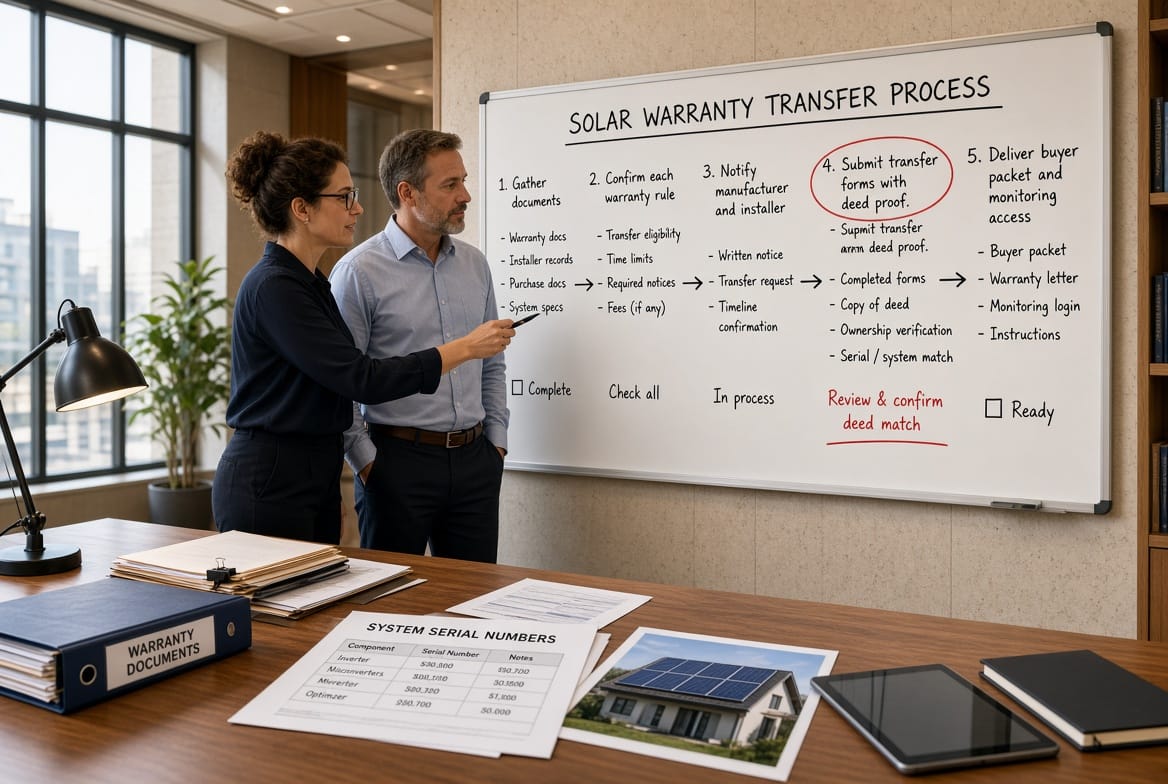
Start early—ideally when you decide to list, not the week of closing. Deadlines of 30 to 90 days after sale are common. Missing the window is the avoidable risk.
1. Build the system file
Collect:
- Original installation contract and paid invoice
- Manufacturer warranty certificates for panels, inverter, and battery
- Serial-number list that matches the roof
- Permit, inspection, and interconnection paperwork
- Monitoring-platform login and production history
- Installer contact information and any service records
- Proof the system is owned, not leased (or the lease/PPA itself if it is third-party owned)
If folders are incomplete, call the original installer first. Responsible companies keep job files and can reissue copies.
2. Read each warranty, not the brochure
Confirm whether transfer is automatic, notification-only, fee-based, or one-time. Note any requirement that the equipment remain at the original address. Moving panels to another property is a different event and can void coverage.
3. Notify the right parties
- Installer: workmanship transfer and often the first stop for forms.
- Panel manufacturer: owner-of-record update when required.
- Inverter and battery makers: separate portals are normal.
- Utility: interconnection and net-metering account name change is not a warranty step, but buyers expect it in the same packet.
4. Submit the transfer package
Typical contents:
- Completed manufacturer or installer transfer form
- Recorded deed or closing statement
- New owner name, address, and contact details
- Original install date and system specifications
Processing often takes two to four weeks after a complete file arrives. Panel transfers are frequently free. Inverter, battery, or labor transfers may carry a modest administrative fee. Budget for it in closing credits if the contract allows.
5. Hand the buyer a complete packet
Do not leave the new owner hunting for logins. Include certificates, serials, service history, installer phone numbers, and written confirmation that notices were filed. A future claim should be a phone call, not a research project.

Why the Transfer Matters for Resale Value
Owned solar already supports price in many markets because it lowers operating cost. Appraisers and buyers still discount uncertainty. A transferable warranty answers the question every cautious purchaser asks: who pays if something fails after I move in?
Clear remaining coverage does three practical things:
- It supports the premium associated with owned systems rather than leased ones.
- It reduces inspection-period friction. Agents can point to remaining performance years instead of debating unknown repair cost.
- It protects the story of the asset. A 7-year-old array with 18 years of performance warranty left is easier to value than the same array with no registered owner and no workmanship path.
Buyers are not only purchasing kilowatt-hours. They are purchasing a documented promise. When that promise is organized, solar reads as infrastructure. When it is not, solar reads as homework.
Leased or PPA systems can still sell, but the value conversation shifts to assignment approval, remaining term, and monthly payment. Do not blur those facts with manufacturer warranties. Honesty here prevents failed contingencies.
Risks That Catch Sellers Off Guard
Stay alert to these risks:
- Missed notification windows. Coverage that was transferable can lapse for the new owner if no one files.
- Installer no longer in business. Module warranties usually survive. Labor and leak promises may not. Disclose that gap and, if useful, offer a pre-listing inspection by a licensed solar contractor.
- Serial numbers that do not match documents. Claims stall when the roof and the paper disagree.
- Unregistered original system. Some brands required registration after install. Fix that before listing if possible.
- Assuming “25 years” means every component. Inverters and batteries often expire sooner.
- Confusing ownership. A UCC filing or lease is not the same as a cash-owned array. Title companies will find it. Disclose early.
None of these risks is a reason to hide the system. They are reasons to organize it.
What Buyers Should Request Before Closing
If you are on the other side of the table, ask for documents, not verbal assurances:
- Proof of ownership or a complete assignment path for any lease
- Panel, inverter, and battery warranty terms with transfer status
- Workmanship and roof-penetration coverage, plus installer status
- Production data from the monitoring portal
- Permit and interconnection records
- Confirmation that transfer forms will be filed by a stated date
A short professional inspection is inexpensive insurance. It confirms the hardware matches the file and flags obvious workmanship issues while the seller can still help.
A Practical Seller Timeline
- At listing: assemble the file; confirm transfer rules; note any fees.
- Under contract: schedule form completion; share the packet with the buyer’s agent.
- At closing: deliver originals or certified copies; collect recorded-deed proof.
- Within the brand deadline: file remaining manufacturer notices; send the buyer written confirmation.
That sequence is ordinary project management. It is also the difference between a smooth appraisal conversation and a last-minute credit demand.
Keep Perspective
Solar warranties exist because equipment lasts decades and homes change hands. Manufacturers expect resale. The process is built for it. Your job is not to become a warranty lawyer. Your job is to treat the certificates as part of the house, the same way you would treat a recent HVAC invoice.
When the file is complete, the transfer is filed, and the buyer can see remaining coverage in writing, the system does what it was installed to do: lower bills and support value. Uncertainty is what discounts a sale. Paperwork removes that uncertainty.
Closing Thought and Next Step
A solar array without a transferable record is only half an asset. A solar array with documented product coverage, a clear performance remaining term, and a completed workmanship transfer is a finished one. Start with the installer, finish the forms, and give the next owner a file they can actually use.
Understand your solar warranties before selling.
Protect Buyer Confidence—Confirm Warranty Transfer Today