The Solar Panel Warranty Guide: What to Look For
A solar panel system is a long-term investment. Quality arrays are built to produce electricity for 25 to 30 years or longer. That timeline is reassuring only when the paperwork behind the hardware is equally strong. A warranty is not a slogan on a quote. It is a legal promise about defects, output, labor, and who pays when something goes wrong.
Ask About Warranty Coverage Today
Homeowners often hear one phrase: “25-year warranty.” That phrase can hide three contracts, three responsible parties, and three expiration dates. This guide explains those layers so you can review coverage with confidence before you sign.
Why Warranty Language Matters More Than Marketing
Solar equipment sits on a roof through heat, cold, wind, and rain. Most panels age slowly rather than fail suddenly. The real question is not whether anything will ever happen. It is this: if a panel is defective, if output falls faster than promised, or if an installation error causes a leak, who repairs it, who pays for labor, and how long does that protection last?
A strong warranty package does three things:
- Identifies the manufacturer responsible for the panel itself
- Sets a minimum power output over time
- Holds the installer accountable for mounting and wiring
If any layer is short, vague, or missing, your out-of-pocket risk rises even when the equipment looks premium on day one.
The Three Warranties You Must Separate
Treat every proposal as a stack of coverage, not one blanket promise.
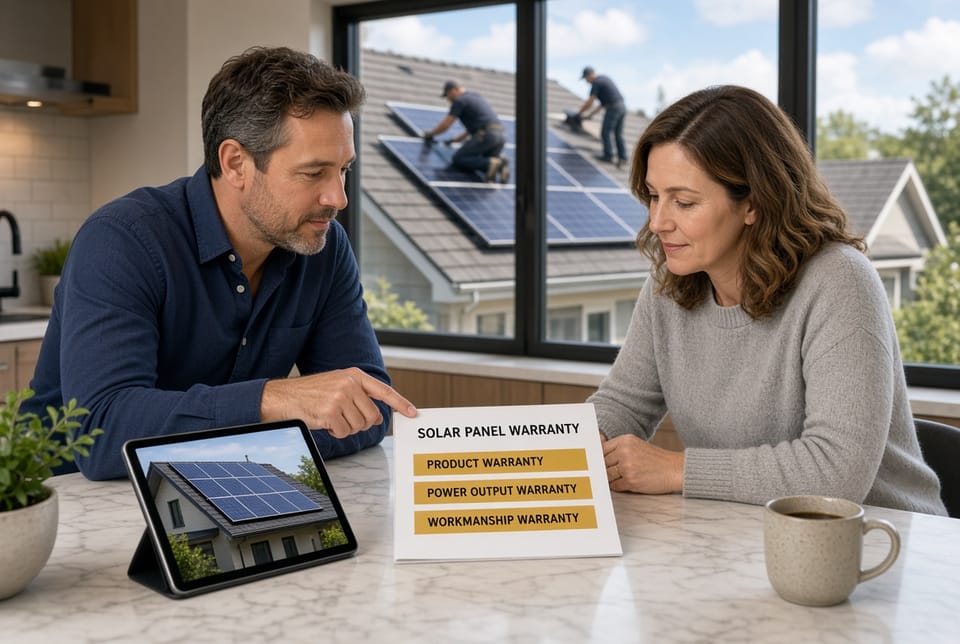
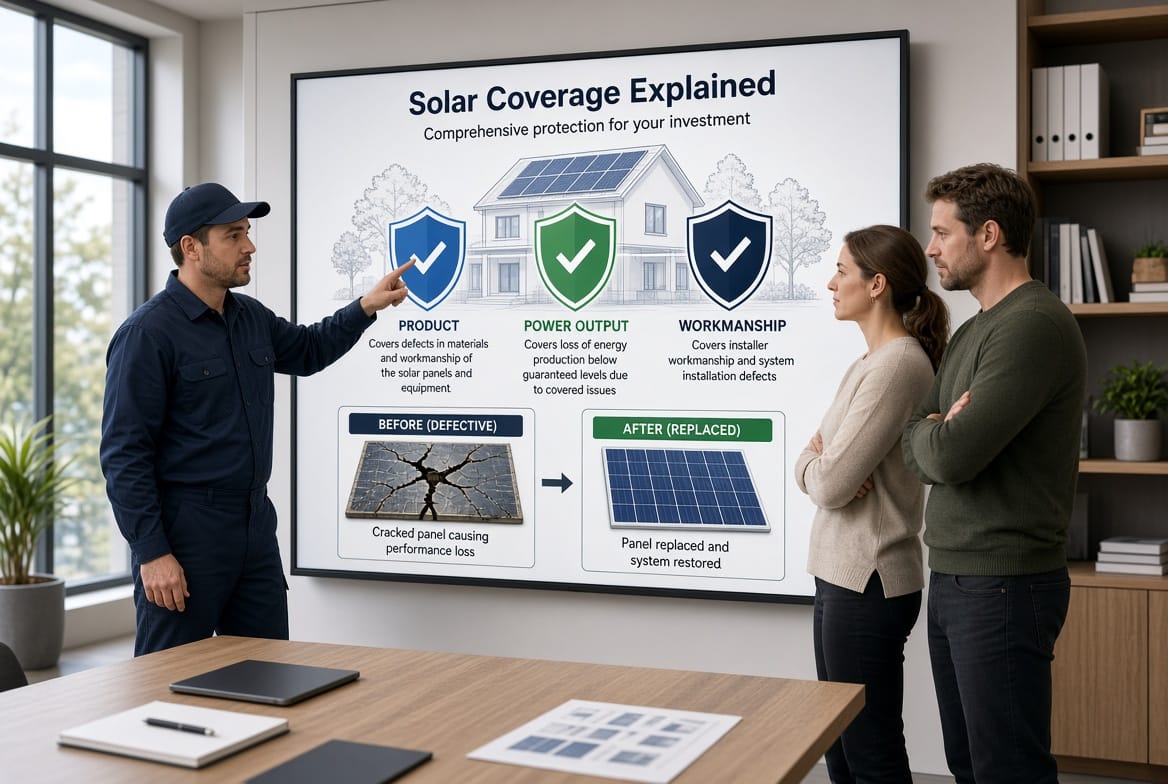
- Product warranty (defects): Covers manufacturing and material problems in the panel.
- Power output warranty (degradation): Guarantees a minimum percentage of rated production as the panel ages.
- Workmanship warranty (installation): Covers mounting, flashing, wiring, and roof penetrations.
These warranties usually start on the commissioning date, but they do not expire together. A 25-year performance promise does not automatically include 25 years of free labor.
Product Warranty: Protection Against Defects
The product warranty, sometimes called a materials or equipment warranty, addresses physical problems caused by how the panel was made. It is issued by the panel manufacturer, not by the salesperson who presented the quote.
Typical issues that fall under a product warranty include:
- Cell or laminate failure inside the module
- Delamination of the panel layers
- Defective junction boxes or connectors
- Frame corrosion tied to manufacturing quality
- Glass or backsheet problems that originate in production, not from impact
Industry practice for reputable residential modules has moved toward 25-year product coverage on many premium lines. Some value panels still carry shorter terms, often 10 to 15 years. A longer product term matters because a defective module in year 18 is expensive if the part is no longer covered.
What a Product Warranty Usually Does Not Cover
A product warranty is not a catch-all insurance policy. It generally does not cover:
- Storm impact, hail beyond stated limits, or other casualty events
- Damage from poor handling, unauthorized repairs, or unlicensed installation
- Cosmetic issues that do not affect function
- Normal aging that stays within the performance curve
- Labor, crane time, roof access, or shipping unless a separate clause says otherwise
That last point is critical. Many manufacturers will supply a replacement module and still leave you paying to remove the old panel and install the new one. Ask, in writing, whether labor reimbursement exists and for how many years. A 25-year parts promise with two years of labor support is not the same as 25 years of complete service.
Who Must Install the Equipment
Most manufacturers require a licensed, authorized installer. A do-it-yourself mount or an uncertified contractor can void coverage even if the panel itself is defective. Keep proof of authorization, permits, and serial-number registration. Registration windows are easy to miss and hard to fix later.
Power Output Warranty: The Degradation Promise
Panels do not stay at nameplate output forever. They lose a small amount of production each year. That process is called degradation. The power output warranty, also called a performance warranty, is the manufacturer’s promise that output will not fall below a stated floor.
A modern performance warranty is usually linear. After a slightly larger first-year adjustment, guaranteed output declines by a set percentage each year until year 25 or year 30. Older “step” warranties promised one number at year 10 and a lower number at year 25, which left a weaker middle period. Linear terms are clearer and typically more protective.
Typical ranges you should expect to see:
- First-year guaranteed output often near 97% to 99% of rated power
- Annual degradation after year one often in the 0.25% to 0.55% range
- Year-25 guaranteed output commonly 84% to 92% of original rating
- Some premium lines extend performance coverage to 30 years
Many quality panels degrade near 0.5% per year in the field, which means a well-made module can still produce close to 88% of original output after 25 years. The warranty is the floor, not the expected average. You want that contractual floor close to real-world performance, not a weak 80% promise that leaves a large gap.
How a Performance Claim Actually Works
A performance warranty is useful only if you can prove underperformance. That usually requires production data, evidence that the shortfall is in the modules rather than shading, soiling, snow, or inverter trouble, and a comparison against the manufacturer’s published degradation curve.
Monitoring access matters. If you cannot export interval data, a claim becomes a negotiation instead of a measurement. Confirm who owns the portal, how long data is stored, and whether you can download it without the original installer.
Performance Warranty Versus a Production Guarantee
Do not confuse the manufacturer’s output warranty with an installer’s production guarantee. The first is about the panel’s rated watts over time. The second, when offered, is about estimated kilowatt-hours for your specific roof. A production guarantee should state a number, a measurement method, a remedy formula, and exclusions. Vague language such as “designed to produce” is not a guarantee.
Workmanship Warranty: The Installation Layer
The workmanship warranty is the installer’s promise about craft. Manufacturers make panels. Installers attach them to your roof, penetrate flashing, run conduit, land circuits, and commission the system. Most homeowner problems in the first several years are installation issues, not factory defects.
A useful workmanship warranty should address:
- Roof leaks at penetrations and flashing
- Improper mounting, rail alignment, or attachment torque
- Wiring, grounding, and conduit defects
- Incorrect inverter or optimizer configuration caused by the crew
- Labor to diagnose and correct those installation errors
Terms vary widely. Some companies offer one or two years. Many reputable installers offer 5 to 10 years. A smaller group offers longer workmanship coverage. Length alone is not enough. The warranty is only as reliable as the company that must still exist to honor it.
Roof Integrity Is Part of the Deal
If a crew creates a leak, you need written language that covers roof repair, not just a promise to “look at the array.” Ask whether leak coverage lasts for the full workmanship term and whether it includes interior damage caused by an installation penetration. Silence on roof work is a risk, not a minor omission.
What Happens If the Installer Closes
Manufacturer product and performance warranties generally survive if the local installer disappears. Workmanship coverage usually does not, unless the contract assigns it to a successor or a third-party administrator. Ask who honors labor claims if the original company is sold or dissolved. Get a name, not a shrug.
What to Check Before You Sign
Do not sign from a highlight sheet. Request the actual warranty PDFs for the panels, inverter, racking, and installer labor. Then verify the following points in writing.
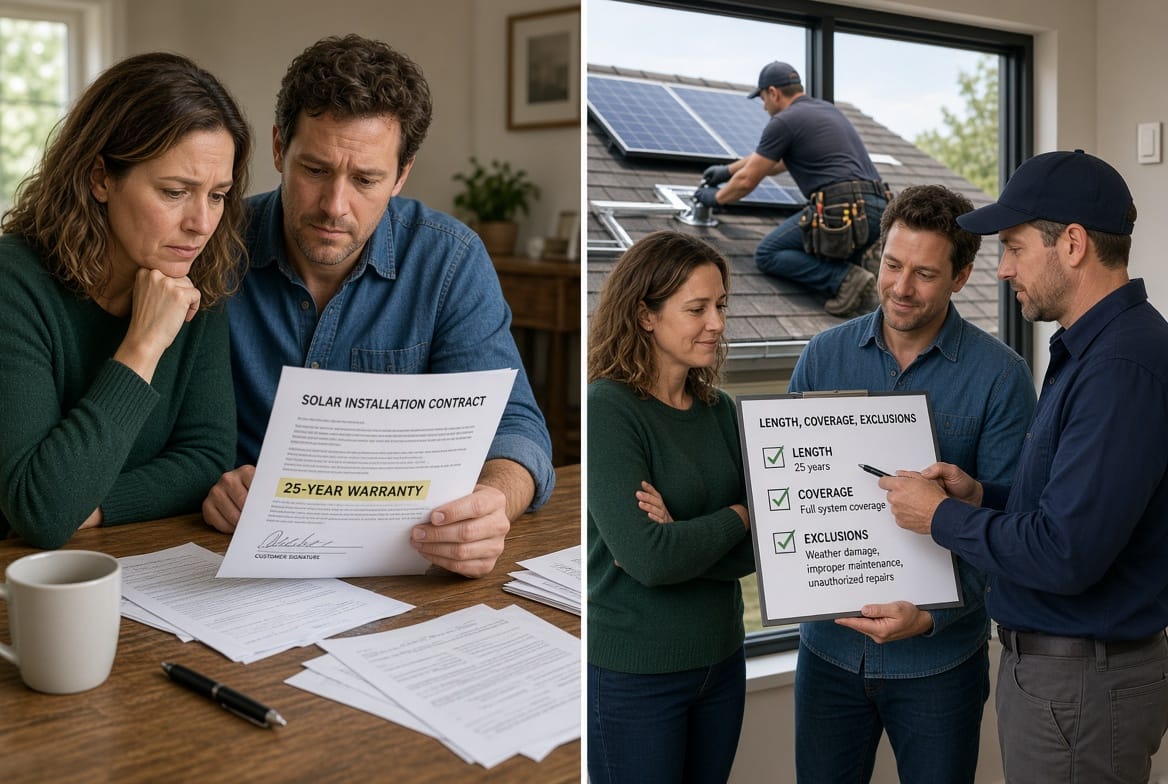
Length
- Product term for the exact module model on the proposal
- Performance term and the year-25 or year-30 output percentage
- Workmanship term, including roof-penetration coverage
- Inverter term, which is often shorter than the panel term on string equipment and longer on many microinverters
Coverage
- Whether a failed panel is replaced with a new or refurbished module
- Whether labor, shipping, lift rental, and disposal are included
- Whether a performance shortfall is remedied by extra modules, a refund, or another stated method
- Whether monitoring hardware and data access last through the claim window
Exclusions
Read the exclusion list slowly. Common items include extreme weather beyond stated design limits, flooding, unauthorized modification, relocation of the array, pest damage, salt-air or agricultural chemical exposure, and failure to follow maintenance guidance. Some clauses require manufacturer-certified service for all future work.
Transferability
A transferable warranty supports resale. Confirm whether product and performance coverage transfer to a buyer, any transfer fee, any deadline after closing (often 30 to 90 days), whether the system must remain at the original address, and whether workmanship coverage transfers at all. A warranty that dies at sale is weaker than it looks, especially if you may move before year 15.
Claim Process and Paper Trail
Ask how a claim is opened, what photos and serial numbers are required, how long a response should take, and whether there is a trip charge or deductible. Keep the contract, as-built drawings, permit sign-off, commissioning report, and serial-number list in one file.
Red Flags That Deserve a Pause
Walk away or renegotiate if you see any of the following:
- A quote that says “25-year warranty” with no split between product, performance, and labor
- No written workmanship term for roof penetrations
- Performance language that quotes an 80% floor when comparable premium options guarantee more
- Labor coverage that expires in the first couple of years with no manufacturer labor program behind it
- Transfer rules that are “available on request” instead of printed
- Pressure to sign before you receive the full warranty documents
- An installer who cannot show manufacturer authorization for the brand being sold
These issues do not mean solar is a poor investment. They mean the paperwork is incomplete. Complete paperwork is how a long-lived system stays a low-stress asset.
How to Compare Two Quotes Fairly
When proposals look similar on price and panel count, score the warranties as if they were part of the equipment. A stronger package usually includes a 25-year product warranty, a linear performance warranty with a high year-25 floor, clear labor language, and a workmanship term that covers the roof.
Compare the inverter separately. It is the component most likely to need service during the life of the array. A panel warranty does not repair a failed inverter. Confirm the inverter brand, term, and whether replacement labor is addressed.
Keep Coverage Alive After Installation
Warranties can be lost by missing the manufacturer registration deadline, allowing an unapproved contractor to modify wiring, ignoring documented maintenance requirements, losing serial numbers, or assuming homeowner insurance replaces the manufacturer warranty after a storm.
Insurance and warranty coverage occupy different lanes. Storm damage is often an insurance claim. A factory defect is a warranty claim. Keep both channels documented.
A Calm Way to Review the Fine Print
Read the documents the way a careful buyer reads a mortgage. Highlight the term, the remedy, the exclusions, and the claim address. Then ask your installer to answer remaining questions in the contract addendum. Verbal reassurance is not coverage.
You do not need to become an engineer. You need to confirm that defects, degradation, and installation quality are each assigned to a responsible party for a realistic number of years.
Understand Your Solar Warranty
A well-written warranty package turns a 25-year energy asset into a manageable household system. It tells you what is covered, what is excluded, and who shows up when a panel, an attachment point, or an output curve needs attention.
Review the product warranty for defects, the power output warranty for degradation, and the workmanship warranty for installation quality before you sign. If any layer is unclear, pause.
Get Clear Solar Warranty Answers – Call Now