The Solar Panel Efficiency: Understanding the Numbers
Solar panel efficiency is one of the first figures printed on every datasheet and one of the most misunderstood. It is not a marketing slogan. It is a measured percentage that tells you how much of the sunlight striking the face of a module is converted into usable electricity. When you understand that single number, you can judge system size, roof coverage, installed cost, and long-term value with far more confidence.
Get a Free Efficiency Review for Your Roof
This guide explains efficiency ratings in plain language, shows what the typical 15–22% range actually means for a home, and walks through how a few percentage points change the number of panels you need and the price you pay. The goal is simple: you leave knowing how to read the number and how to choose panels that fit your roof rather than a generic quote.
What Panel Efficiency Actually Means
Panel efficiency is the percentage of sunlight converted to electricity under standardized laboratory conditions. If a module is rated at 20%, twenty percent of the solar energy that hits its surface becomes direct current (DC) electricity. The remaining eighty percent is reflected, converted to heat, or otherwise unused.
That definition is precise and limited. The rating is determined under Standard Test Conditions (STC): 1,000 watts of irradiance per square meter, a cell temperature of 25°C, and a specific air-mass spectrum. Real roofs are hotter, sometimes shadier, and never perfectly aligned. The STC number is still the industry’s common language. It lets you compare one product with another on the same scale.
Efficiency is not the same as wattage. A 400-watt panel and a 400-watt panel from a different manufacturer can occupy different amounts of roof if their efficiencies differ. Efficiency is power per unit of area. Wattage is total power. You need both figures, but efficiency tells you how densely that power is packed.
Key terms worth remembering:
- Module efficiency — the rating printed on the spec sheet for the finished panel.
- Cell efficiency — the rating of the individual silicon cells inside; module efficiency is always a bit lower because of gaps, frames, and wiring.
- Temperature coefficient — how much output drops as the panel heats up; it is related to, but separate from, the headline efficiency number.
- Real-world yield — what you actually harvest after heat, soiling, wiring losses, and inverter conversion.
Understanding the distinction keeps expectations realistic and conversations with an installer productive.
Typical Efficiencies: The 15–22% Range
Residential silicon panels sold for homes commonly fall between 15% and 22%. That band is wide enough to matter.
- Standard panels (15–17%) — often older polycrystalline or entry-level monocrystalline products. They cost less per panel but need more surface area for the same kilowatt rating.
- Mainstream monocrystalline (18–20%) — the workhorse range for many rooftop jobs. Good balance of output, appearance, and price.
- Premium panels (18–22%, and the upper end of that band) — higher-grade monocrystalline cells, better anti-reflective coatings, and tighter manufacturing tolerances. They produce more watts from each square foot.
The image later in this article lists those bands clearly. The important point is not to chase the highest possible laboratory figure. It is to match the rating to available roof plane, shading, and budget.
A 16% panel and a 21% panel facing the same sun do not deliver the same energy per square meter. The higher-efficiency module simply converts a larger share of the same light. Over a 25-year warranty period that difference compounds into more kilowatt-hours and, on a constrained roof, the difference between a system that offsets most of your bill and one that does not.
How Efficiency Ratings Are Determined and Why They Can Drift
Manufacturers flash-test every module (or a statistically valid sample) at the factory. The resulting nameplate efficiency is what appears on the label and the spec sheet. Independent laboratories and certification bodies confirm that the test protocol is followed.
Several factors cause the number you see on paper to differ from the energy you harvest:
- Heat reduces output. Most silicon panels lose a fraction of a percent of power for every degree above 25°C.
- Partial shading on even one cell can pull down a whole string unless module-level electronics are used.
- Dust, pollen, and snow block light until they are cleaned or melt.
- Inverter and wiring losses typically take another 3–8% off the DC total.
- Orientation and tilt that are less than ideal reduce annual production even if the panel itself is highly efficient.
None of these factors make the published efficiency “wrong.” They mean a professional design must apply realistic derates. A reputable installer will show you both the STC rating and an estimated annual production in kilowatt-hours for your address. That second number is the one that pays the electric bill.
Risk to watch: treating the highest efficiency number as a guarantee of the highest savings. A poorly sited 22% array can underperform a well-sited 18% array. Efficiency is one variable, not the only variable.
How Efficiency Changes System Size
This is where the percentage becomes visible on the roof.
Suppose you need an 8-kilowatt system. A lower-efficiency 16% panel of typical residential size might require roughly 24–26 modules and a larger contiguous roof area. A 21% panel of similar physical dimensions might deliver the same 8 kW with 18–20 modules and noticeably less square footage.
Fewer modules mean:
- Less racking and flashing
- Shorter homerun wiring
- Faster installation labor
- More leftover roof for a future addition, a skylight, or simply a cleaner look
- Greater chance the array fits on the best-facing plane instead of spilling onto a less productive slope
On a large, unshaded ranch roof the difference may be modest. On a modest Cape, a townhouse, or a roof broken up by vents and valleys, the difference can decide whether the system you want is even possible.
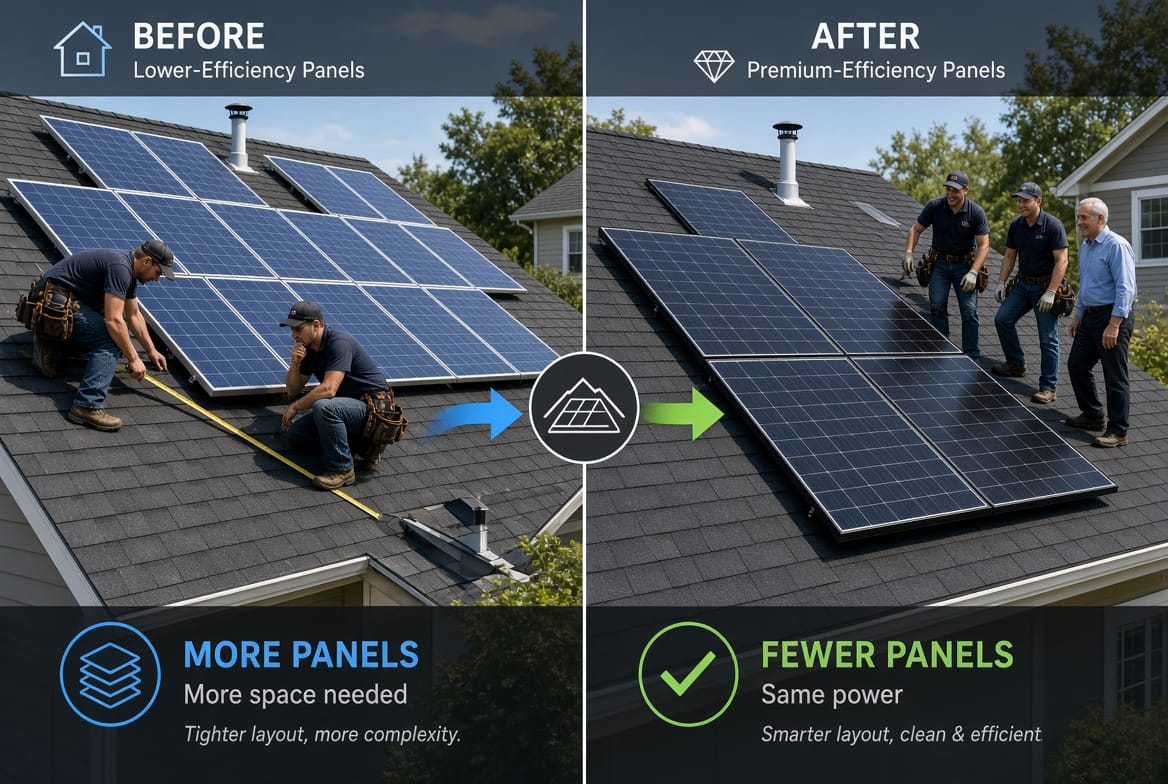
The diagram above is the practical translation of the spec-sheet percentage. Efficiency is not an abstract lab curiosity. It is the reason one design needs twenty-four rectangles and another needs eighteen.
How Efficiency Affects Cost
Higher-efficiency modules usually cost more per panel. That is expected. The better question is what happens to total installed cost and cost per watt.
On an open roof with no space limit, a lower-efficiency panel can sometimes produce a lower price per watt because the modules themselves are cheaper. Labor, racking, and electrical work still scale with the number of pieces, so the savings are not dollar-for-dollar.
On a space-constrained roof the math often reverses:
- You may be able to install a larger system (more total kilowatts) in the same footprint, spreading fixed costs—permits, interconnection, inverter, project management—across more watts.
- You avoid a second roof plane that would have required extra staging, extra flashing, and extra labor.
- You reduce the chance of a change-order when the first layout does not fit.
In other words, the premium you pay for efficiency can be offset, and sometimes more than offset, by reductions in balance-of-system cost. The only way to know which path is cheaper for your house is a site-specific proposal that lists both module cost and full installed price.
Reassuring reality: you do not have to buy the most expensive panel on the market to get a strong result. Mainstream 18–20% products already deliver far more power per square foot than panels from a decade ago. Premium 21–22% products earn their keep when the roof is small, complex, or when you want maximum offset without covering every available shingle.
Reading the Spec Sheet Like a Professional
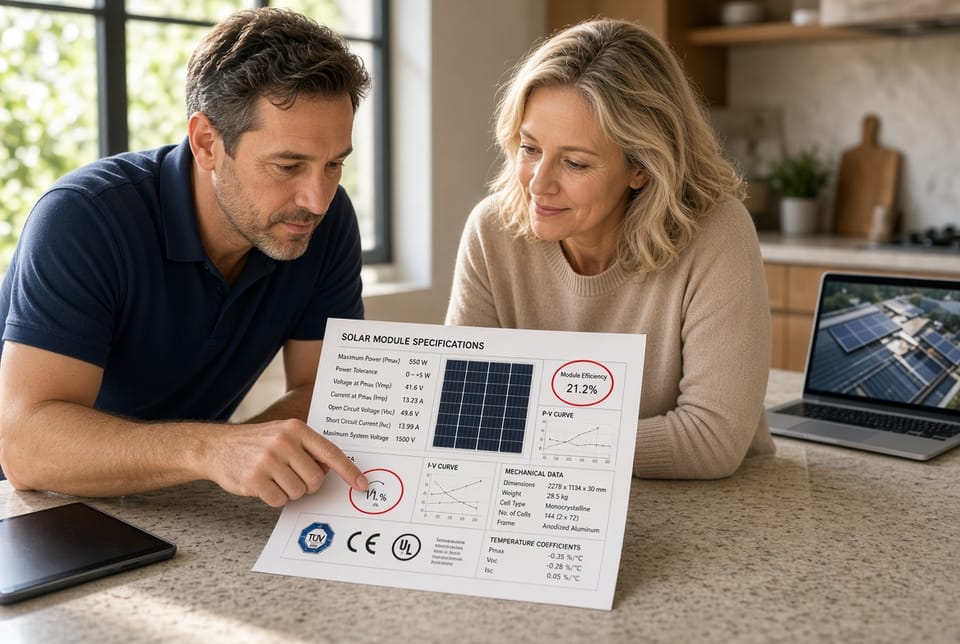
Every legitimate module comes with a datasheet. The efficiency figure is usually on the first page, often next to maximum power (Pmax), open-circuit voltage, and dimensions.
Look for these companion numbers at the same time:
- Power tolerance — a small plus/minus range that tells you how tightly the factory bins the product.
- Temperature coefficient of Pmax — a more negative number means more loss on hot days.
- Dimensions and weight — needed to confirm the panel will physically fit and that the roof structure can carry it.
- Warranty — product warranty (materials and workmanship) and performance warranty (how much output is guaranteed after 25 or 30 years).
- Certification marks — UL, IEC, and similar listings that confirm safety and test protocol.
A consultant who can sit with you and walk through that sheet is doing the job correctly. The opening image of this article is exactly that conversation: two people turning a column of numbers into a decision.
When Higher Efficiency Is Worth It — and When It Is Not
Higher efficiency is usually the better choice when:
- Usable roof area is limited
- The best-facing plane is small or interrupted
- You want a high percentage of bill offset without ground-mount or additional structures
- Aesthetics matter and you prefer fewer, darker, more uniform modules
- Future expansion (EV charger, heat pump, more occupancy) is likely and you want to preserve remaining roof
Lower or mid-range efficiency can be entirely appropriate when:
- The roof is large, simple, and unshaded
- Budget per watt is the primary constraint and space is abundant
- The project is a ground-mount or commercial canopy where land or structure cost is low
There is no universal “best” percentage. There is a best match for the building, the load, and the homeowner’s priorities.
Common risk: buying on efficiency alone and ignoring degradation rate, warranty strength, and installer workmanship. A well-installed 19% system with a strong performance guarantee will out-earn a poorly installed 22% system. Choose the panel and the team.
Putting the Numbers to Work on Your Roof
The path from datasheet to installed array is straightforward when it is done in order:
- Establish how much annual energy you want to produce (or what bill offset you want).
- Measure usable, reasonably unshaded roof area and note orientation.
- Compare candidate modules by both wattage and efficiency so you see panel count and footprint.
- Request full-system pricing, not module-only pricing.
- Review estimated first-year production and the 25-year performance curve.
- Confirm electrical, structural, and permitting details with a licensed installer.
That sequence keeps the conversation grounded. Efficiency is the lever that changes how much power fits in a given rectangle of shingles. It is not a substitute for good design.
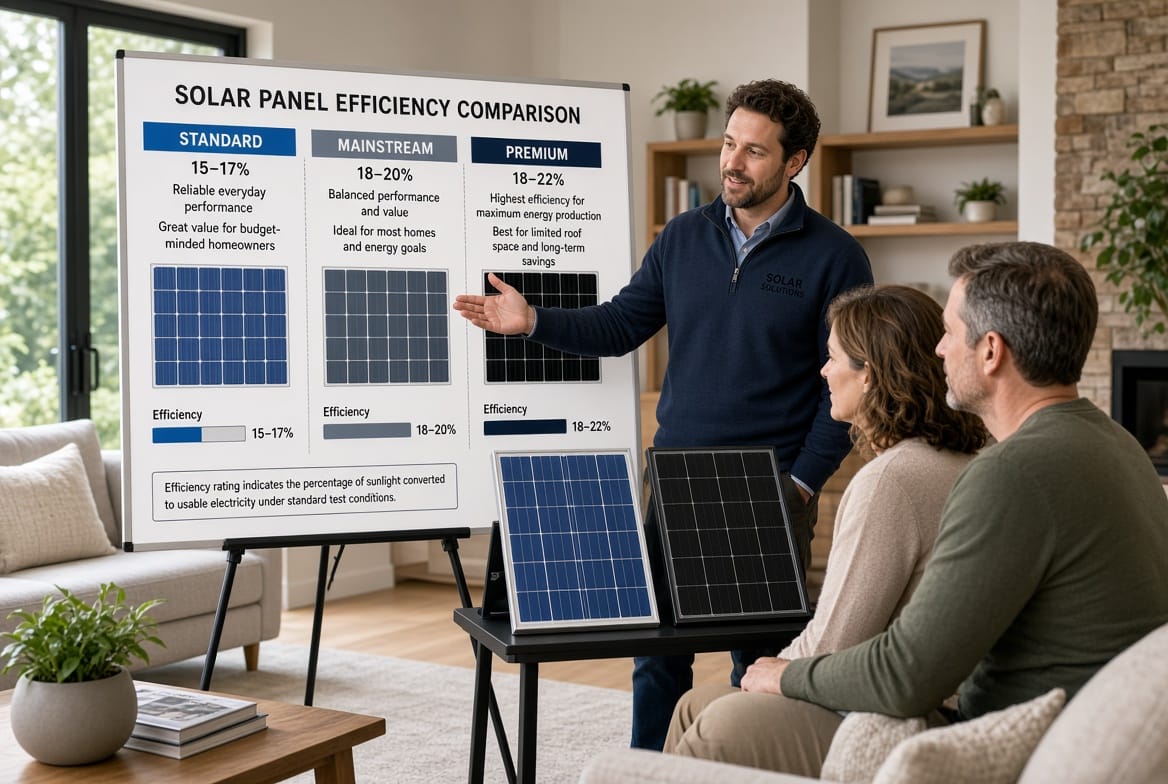
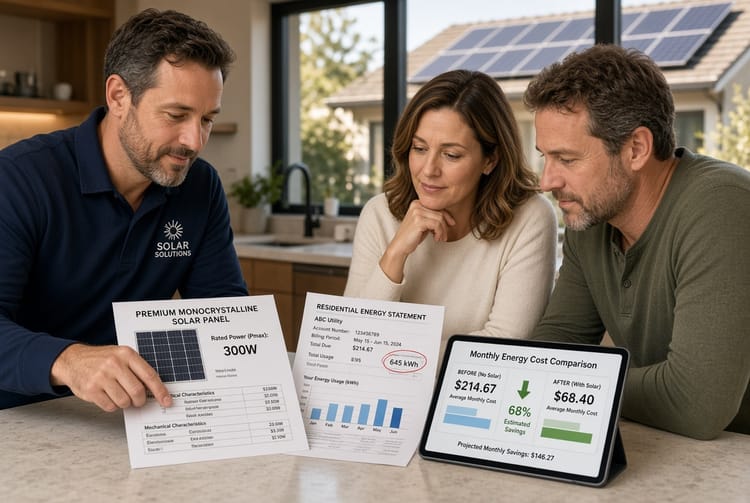
The supporting visual above is the short version of everything in this article: three ranges, two people making a decision, one roof that has to work.
A Clear, Confident Next Step
Efficiency ratings are not mysterious once they are defined. They measure the share of sunlight turned into electricity. Typical residential products sit between 15% and 22%. A few points of efficiency can shrink the array, protect a tight roof, and change the balance between module price and total installed cost.
You do not need to become an engineer. You need a clear spec sheet, a realistic production estimate, and an installer who will explain both.
Choose efficient panels for your roof. Ask about options that fit your space, your usage. A short conversation can turn the numbers on the datasheet into a system that actually belongs on your house.
Call Now for Panels That Fit Your Roof and Budget