The Solar Panel Output: Understanding Watts, Kilowatts, and Kilowatt-Hours

If you are considering solar, you will quickly meet three terms that appear on every quote, every panel sticker, and every utility bill: watts, kilowatts, and kilowatt-hours. They look similar. They are not the same. Confusing power with energy is one of the most common reasons homeowners either undersize a system or overestimate first-year savings.
Get Your Solar Production Estimate – Call Now
This guide explains each term in plain language, shows how they connect to solar production, and shows how they translate into lower bills. The goal is simple: when a proposal lists a 300W panel, a 5kW system, or 500 kWh per month, you should know exactly what that means for your roof and your wallet.
Understanding output is not a technical luxury. It is the difference between a system that matches your usage and a system that leaves you still buying expensive grid power.
Why These Three Units Matter for Solar
Utilities do not bill you for how “strong” electricity is at one instant. They bill you for energy used over time. Solar systems are sold by capacity (how much power they can produce at peak) and evaluated by production (how much energy they actually deliver across days, months, and years).
When those two ideas get mixed together, quotes become hard to compare. A larger number on a datasheet does not automatically mean larger savings. Watts tell you the size of the engine. Kilowatt-hours tell you how far the car actually traveled.
Once you can separate power from energy, you can:
- Read a panel specification without guessing
- Compare system sizes fairly
- Match production to your monthly usage
- Spot proposals that promise more than physics supports
- Ask better questions before you sign
That clarity is protective. It keeps expectations realistic and savings measurable.
What Watts Measure: Instant Power
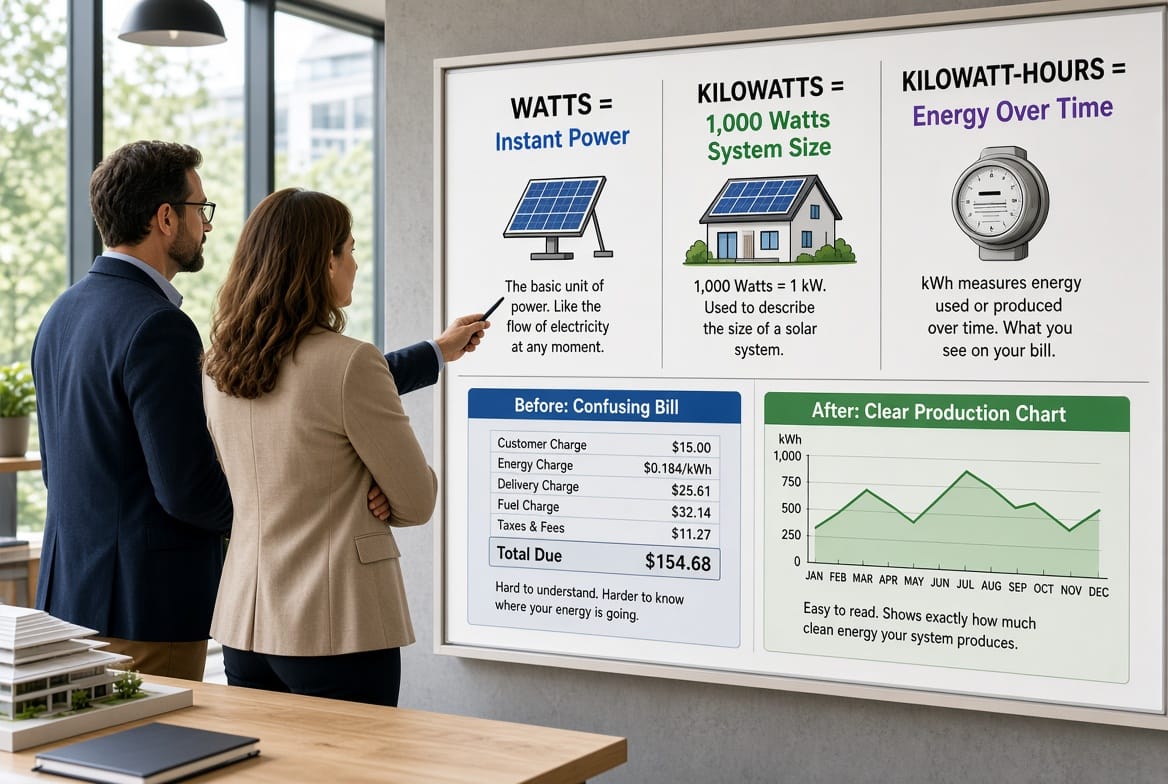
A watt (W) is a unit of power. Power is the rate at which energy is produced or consumed at a given moment. Think of it as speed, not distance.
A typical modern residential module is often rated around 300W to 400W under standard test conditions. That rating means: in defined laboratory light and temperature, the panel can deliver that much power right then. It does not mean the panel produces 300 watt-hours every hour of every day. Weather, angle, shade, heat, and time of day all change real output.
Key point: Watts describe capability at an instant. They do not describe how much electricity you will have at the end of the month.
On appliances, watts work the same way. A 1,500W space heater draws 1,500 watts while it is running. A 60W bulb draws far less at the same moment. Neither number, by itself, tells you the cost for a full evening. Cost depends on how long the device runs.
In solar, the panel wattage is the building block. Add the watt ratings of every module on the roof and you get the system’s total power capacity before converting to kilowatts.
Risks of stopping at watts alone:
- Assuming a higher-watt panel always produces more energy in your climate
- Ignoring temperature losses that reduce real-world watts
- Comparing one 400W panel to an entire system as if they were the same kind of number
Watts are essential. They are not the finish line.
What Kilowatts Measure: System Size
A kilowatt (kW) is simply 1,000 watts. The prefix kilo- means thousand. Installers use kilowatts because a whole-home array would look clumsy if written only in watts.
Examples:
- Ten 300W panels = 3,000W = 3kW
- A common residential array around 5kW = 5,000W
- A larger home might use an 8kW to 12kW system
Kilowatts describe the system’s peak power rating—the size of the solar “engine.” A 5kW system can produce 5 kilowatts of power under strong, favorable conditions. It does not automatically produce 5 kilowatt-hours every hour, all day, every day.
This is where many first-time buyers pause. The system size on a contract is almost always in kW. Your bill is almost always in kWh. They are related, but they answer different questions:
- kW answers: How large is the system?
- kWh answers: How much energy did it actually generate or how much did the home use?
A professionally designed array uses kW as the starting specification, then models expected kWh for your roof, your shading, your orientation, and your local sun. Capacity without a production estimate is incomplete.
Authoritative reminder: Two homes can both install 5kW and still see different annual energy totals. Roof direction, tilt, trees, snow, soiling, inverter efficiency, and regional sunlight hours all change results. System size is necessary. It is not sufficient by itself.
What Kilowatt-Hours Measure: Energy Over Time
A kilowatt-hour (kWh) is a unit of energy. Energy is power multiplied by time.
If a device uses 1kW of power for one hour, it consumes 1 kWh.
If a solar system delivers 1kW of power for one hour, it produces 1 kWh.
This is the unit on your electric bill. This is also the unit that determines solar savings. You do not pay for watts sitting unused. You pay for kilowatt-hours delivered by the utility—and you offset those charges when your array produces kilowatt-hours of its own.
A simple relationship:
Energy (kWh) ≈ Power (kW) × Time (hours) × real-world factors
Those real-world factors matter. Peak sun is not 12 hours of full-rated output. A location with strong solar resource might average the equivalent of about four to six “peak sun hours” on a good day, not a continuous full-power day from sunrise to sunset. Equipment also has small conversion losses.
So a 5kW system on a strong-sun day might produce on the order of 20–30 kWh, not 5 kWh and not 120 kWh. The exact figure depends on site conditions. That daily total, added across a billing cycle, becomes monthly solar production in kWh.
Why this unit is the one that protects your budget:
- Your usage is measured in kWh
- Utility rates are usually priced per kWh
- Net metering, credits, and payback models all run on kWh
- Battery sizing conversations also start from kWh of stored energy
If you remember only one distinction, remember this: watts and kilowatts are power; kilowatt-hours are energy. Power is the rate. Energy is the result over time.
How the Three Units Work Together on a Real Roof
Follow one example all the way through.
Start with a module: a 300W panel.
That is 0.3kW of rated power.
Install enough modules to build a 5kW system.
That is about seventeen 300W panels (17 × 300W = 5,100W, commonly described as a 5kW class system).
Now convert capacity into expected energy. If that array sees the equivalent of five strong peak-sun hours on a given day, a simplified starting estimate is:
5kW × 5 hours = 25 kWh that day, before losses.
Apply realistic derating for heat, wiring, inverter conversion, soiling, and imperfect orientation—often a reduction into a range rather than a single perfect number—and daily production might land lower, then rise again on clearer, cooler days. Over a month, those daily totals become a production figure you can compare with household use.
If the home uses about 500 kWh per month, a system that reliably produces near that amount can offset a large share of the bill. If the home uses far more than the array can generate, the homeowner still buys the difference from the utility. If the array produces more than the home uses during sunny months, credits or export rules determine the value of the extra kWh.
This is the practical chain:
- Panel watts define each module.
- Added watts become system kilowatts.
- System kilowatts, multiplied by productive hours and adjusted for site conditions, become kilowatt-hours.
- Those kWh offset the kWh on the bill and create savings.
Every honest proposal should let you follow that chain without leaps of faith.
Typical Numbers You Will See in Quotes
These examples are teaching tools, not a promise for every address. Local sun, roof, and equipment change results. They do show the scale of each unit.
- 300W panel: one module’s rated power. Useful for counting how many panels fit on a roof plane.
- 5kW system: a mid-size residential array. Useful for comparing overall capacity between bids.
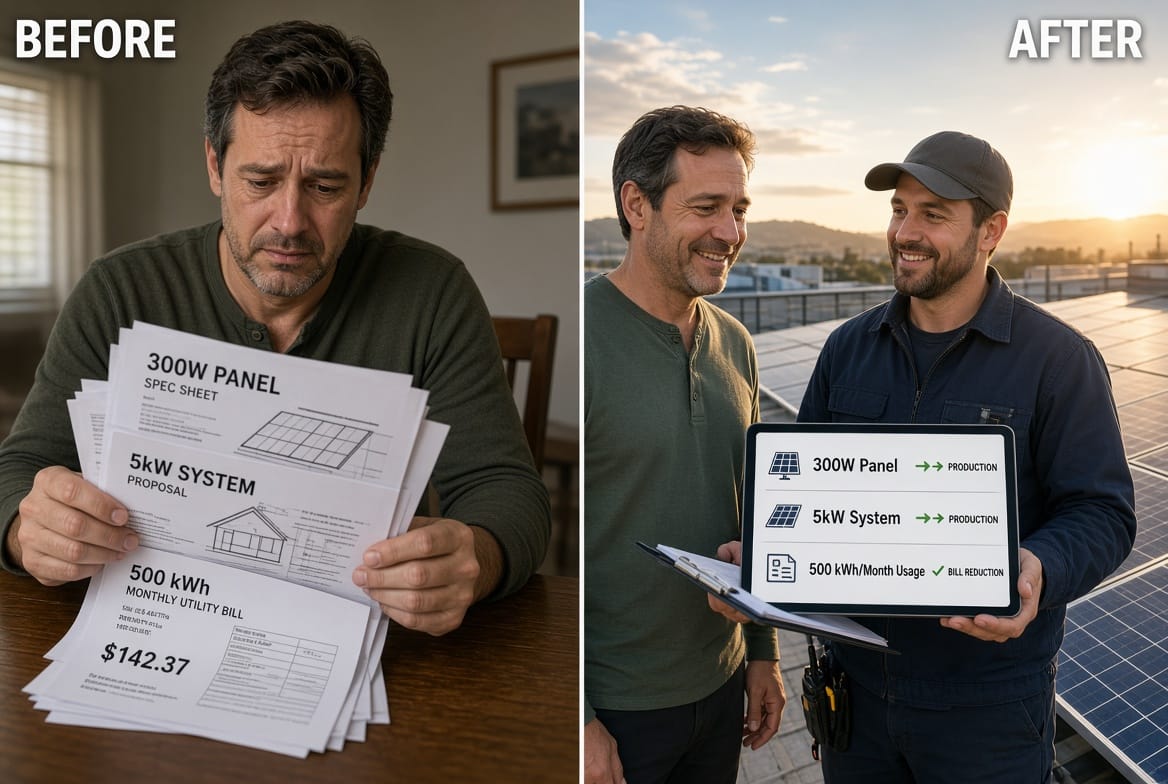
- 500 kWh/month usage: a household energy total. Useful as the target your production estimate should be measured against.
A 300W panel is a component. A 5kW system is a complete generating plant on a small scale. 500 kWh is a month of living: refrigeration, lighting, laundry, cooling or heating, electronics, and everything else that ran long enough to add up.
When a salesperson emphasizes only the panel wattage, ask for expected annual and monthly kWh. When a proposal emphasizes only system kW, ask how that capacity was modeled into production for your roof. When a bill shows 500 kWh, ask what percentage of that usage the design is intended to cover in year one and in later years as panels slowly age.
Reassuring truth: you do not need to become an engineer. You only need to demand that each number is labeled as power or energy and connected to your usage.
From Production to Savings
Savings come from kilowatt-hours you no longer buy, plus any export credits your utility allows. The retail rate per kWh turns production into dollars.
If electricity costs a given amount per kWh, then every kWh generated on the roof and used in the home avoids that charge. Time-of-use rates, minimum bills, demand charges, and net-metering rules can change the exact dollar result, but the foundation stays the same: more matched kWh generally means more avoided cost.
This is why a production estimate matters more than a glossy panel photo. Two systems with the same kW rating can produce different kWh if one roof faces a better direction, has less shade, uses a more efficient inverter layout, or sits in a sunnier microclimate. The better-producing system usually creates stronger savings, even if the nameplate kilowatts look identical.
Watch for these risks:
- Quotes that show only system size and skip modeled kWh
- Lifetime savings that assume perfect weather every year
- Ignoring gradual output decline over decades
- Comparing a winter bill to a summer production estimate without seasonal context
- Treating battery backup as if it increased generation rather than stored existing energy
A careful estimate uses your usage history, roof geometry, local weather patterns, and equipment specifications. That is how watts on a sticker become confidence on a contract.
Factors That Change Real Output
Nameplate ratings assume standard test conditions. Roofs do not. Several variables move actual kWh away from a simple multiplication:
- Sun hours and season. Winter days are shorter and often weaker. Summer can deliver more energy even when heat slightly reduces panel efficiency.
- Orientation and tilt. A well-aimed roof collects more usable light than a poorly aimed one.
- Shade. A little shade can cut far more production than the shaded area suggests, depending on string design and module electronics.
- Temperature. Panels are tested at a set temperature. Hot roofs can reduce instantaneous watts.
- Soiling and snow. Dust, pollen, and snow block light until they are cleared or melted.
- Inverter and wiring. Conversion from DC to household AC is efficient but not perfect.
- System aging. Output declines slowly over many years. Quality equipment and warranties address this, but year-one and year-twenty production are not identical.
None of these factors makes solar unpredictable in a serious design process. They are why professional modeling exists. A good estimate does not pretend the sky is a laboratory. It uses local data so kilowatt-hours are forecast with discipline.
Common Mix-Ups—and How to Avoid Them
Mix-up 1: “My panels are 300W, so I get 300 kWh.”
No. 300W is power. 300 kWh would be a large energy total, closer to a substantial share of some monthly bills, not the output of one module.
Mix-up 2: “A 5kW system makes 5 kWh.”
Not as a full description. 5kW is capacity. 5 kWh is a small energy quantity—what 5kW would produce in a single hour at full output, not a daily or monthly result.
Mix-up 3: “Higher watts always mean I should buy that panel.”
Higher module wattage can mean fewer panels for the same kW, which helps on tight roofs. It does not automatically beat a well-designed array with strong production modeling.
Mix-up 4: “If my bill is 500 kWh, I must install exactly 500 kW.”
That would be a commercial-scale plant. Household systems are measured in a handful of kilowatts that accumulate kilowatt-hours across many hours and days.
Avoiding these errors is mostly a labeling habit: ask whether a number is W, kW, or kWh, and ask for the time period attached to any energy figure.
How to Use This Knowledge Before You Buy
Bring your recent utility bills. They already speak the language that matters: kWh. Then request a production estimate that shows expected energy by month, not only a single annual headline. Compare that estimate with your usage pattern. Ask how shade, azimuth, and equipment losses were handled. Ask what happens to savings if actual sun is a little weaker than the model.
You are not being difficult when you ask those questions. You are matching power ratings to energy results. That is the professional way to buy solar.
A trustworthy discussion will feel calm and specific. It will treat watts as the module rating, kilowatts as system size, and kilowatt-hours as the production and billing unit that creates savings. If a conversation cannot keep those three straight, pause.
Understand Your Solar Output
You do not need to memorize formulas. You need a clear map:
- Watts measure instant power on each panel.
- Kilowatts scale that power to the full system.
- Kilowatt-hours measure energy over time—the unit that appears on bills and determines solar production and savings.
When those definitions are solid, quotes become comparable, expectations stay honest, and the system on your roof has a job you can measure.
Understand your solar output. A specialist can translate your bill’s kWh, your roof’s capacity in kW, and your panel options in watts into a straightforward picture of expected generation and savings.
Call Today to Match Solar Output to Your Bill