The Solar Panel Microcracks: Causes, Detection, and Performance Impact

You’ve invested in solar to save money and reduce your carbon footprint. But what if tiny, invisible fractures inside your panels are silently stealing your energy production?
Call Now for Microcrack-Free Solar Panels
Microcracks are one of the most underestimated quality concerns in the solar industry. They start small — thinner than a human hair — but over time, they can slash your system’s efficiency by 10–30% or even lead to complete cell failure.
The good news? With the right knowledge, you can detect, prevent, and avoid microcrack damage before it costs you thousands.
Let’s break down exactly how microcracks form, how they impact performance, and what reputable manufacturers do to stop them.
What Exactly Is a Solar Microcrack?
A microcrack is a sub-millimeter fracture in a solar cell — the dark blue or black wafer inside your panel that converts sunlight into electricity.
- Most microcracks are invisible to the human eye.
- They often start at the cell’s edge or near busbars (the metal ribbons collecting current).
- Under normal operation, vibrations and temperature changes make them grow over time.
Think of it like a hairline crack in a smartphone screen — you don’t see it at first, but one day the touchscreen stops working.
How Do Microcracks Form? (3 Main Culprits)
1. Manufacturing Defects
Even Tier 1 factories sometimes produce cells with residual stress from rapid cooling.
- Thin wafers (down to 150–170 microns) are more fragile.
- Poor soldering of busbars creates hotspots that later crack the silicon.
Key risk: Low-cost brands often buy “B-stock” cells — those with pre-existing micro-damage.
2. Rough Handling During Transport & Installation
Solar panels are tough, but not indestructible.
- Dropping a pallet just 2 inches can generate microcracks.
- Walking on panels during installation is a major cause (contractors should never step on modules).
- Using impact tools (like nail guns) near panel edges transmits shock through the glass.
3. Thermal & Mechanical Stress Over Time
Your rooftop experiences daily temperature swings.
- Panels expand in the sun, contract at night.
- Uneven mounting (poor rail alignment) twists the frame → cracks cells.
- Hail, snow loads, or high winds accelerate microcrack propagation.
Reassuring fact: High-quality panels are tested for thermal cycling (up to 600 cycles from -40°C to +85°C) to ensure crack resistance.
The Hidden Performance Impact: What Microcracks Actually Do
A cracked cell doesn’t just stop producing — it hurts its neighbors.
Here’s the science:
Solar cells are connected in series like Christmas lights. When a microcrack separates part of a cell, that section becomes electrically isolated. The rest of the cell still works, but current must flow around the crack, increasing resistance.
Real-world consequences:
- Power loss: 5–30% depending on crack severity and location.
- Hotspots: Cracked areas overheat (up to 150°C), degrading the backsheet and encapsulant.
- Accelerated aging: Microcracks let moisture in → corrosion → complete cell failure in 3–5 years.
Worst-case scenario: A fully separated cell becomes a dead resistor, dragging down the entire string’s output.
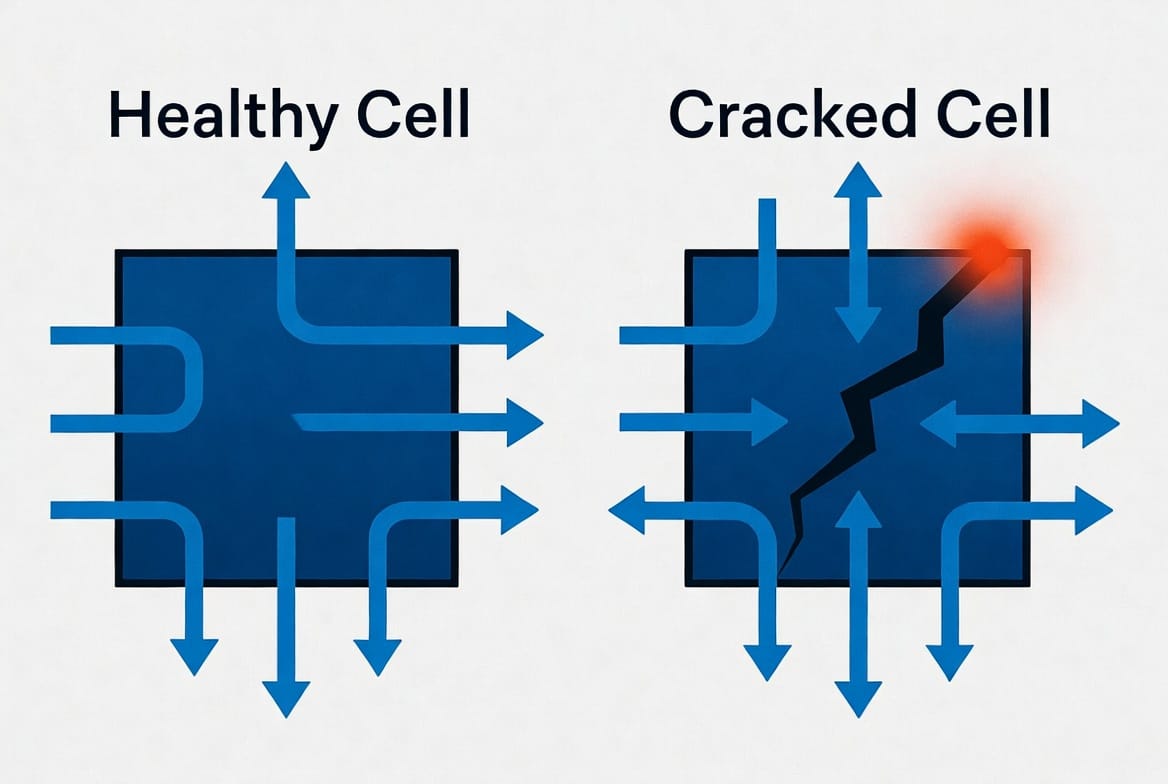
As you can see in the diagram above, the obstruction isn’t minor — it’s a bottleneck for your entire solar array.
Can You See Microcracks Without Special Tools?
No — not with the naked eye.
But there are two reliable detection methods:
✅ Electroluminescence (EL) Imaging
- The gold standard.
- A technician runs current backward through the panel (it glows like an infrared LED).
- Cracks appear as black lines on a glowing cell background.
- Requires factory testing or specialized field service.
✅ Thermography (IR Camera)
- Detects hotspots from crack-related resistance.
- Works during normal operation on a sunny day.
- Less precise than EL — small cracks may not show heat yet.
Warning: A visual inspection of the glass reveals nothing. Don’t trust a contractor who says “it looks fine.”
How Do Quality Manufacturers Address Microcracks?
Reputable brands don’t ignore microcracks — they engineer against them.
1. Stronger Cell Designs
- Half-cut cells: Smaller cells are mechanically tougher and localize crack damage.
- Multi-busbars (9–12+): More metal ribbons bridge over cracks, preserving current flow.
- Flexible encapsulants (EVA/POE) absorb thermal stress instead of transferring it to cells.
2. 100% Electroluminescence Testing
Top-tier factories test every single panel before shipping.
- Automated EL cameras flag any cell with cracks over a set length.
- Panels that fail are rejected or downgraded (not sold as A-grade).
3. Reinforced Packaging & Handling Protocols
- Corner blocks and edge protectors during shipping.
- “No-step” warning labels clearly printed on frames.
- Installation manuals that mandate suction cups instead of walking.
7 Red Flags That Your Panels Might Have Microcracks
You don’t need an EL camera to suspect trouble. Watch for:
- Unexplained production drops (compared to your monitoring app).
- Visible snail trails — dark, meandering lines on cells (caused by cracks allowing moisture to react with silver paste).
- One or two cells looking darker than neighbors under sunlight.
- Hotspot discoloration (browning or yellowing backsheet).
- Micro-inverter alerts saying “cell mismatch” or “shading” when there’s no shade.
- Lower voltage than usual from a string of panels.
- Performance warranty claim denied due to “mechanical damage” — some manufacturers blame installers.
Pro tip: Ask for EL test reports before accepting delivery of any commercial solar order.
Prevention: How to Avoid Microcracks Entirely
You can’t eliminate all risk — but you can reduce it by 90% with these steps.
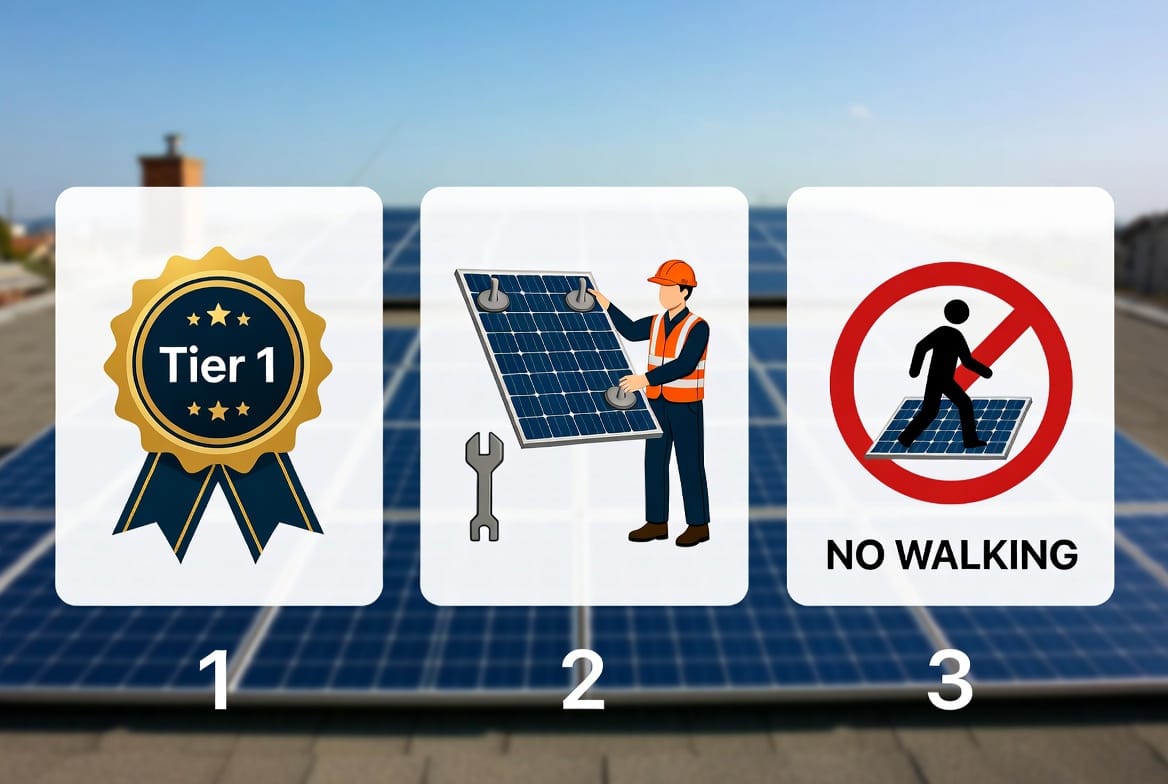
✔️ Buy Tier 1 Panels Only
Tier 1 doesn’t guarantee zero cracks, but it does guarantee:
- Automated EL testing on 100% of modules.
- Lower cell thickness variation (less residual stress).
- Transparent warranty terms (they won’t blame “handling” for every failure).
✔️ Demand Professional Installation
- Installers must use panel suction lifters — no lifting by junction boxes.
- No walking on panels — ever. Rope access or rolling ladders only.
- Torque drivers set to spec (overtightening clamps warps frames).
✔️ Transport & Storage Rules
- Panels stay vertical on pallets, never flat-stacked.
- Forklifts drive slowly over warehouse speed bumps.
- No stacking more than 2 pallets high.
✔️ Inspect Before and After Installation
If your installer has a portable EL camera (rare but available), ask for:
- Pre-install EL scan of each panel.
- Post-install EL scan of any panel that was dropped or knocked.
Does Your Warranty Cover Microcracks?
It depends — and this is where most homeowners get burned.
- Performance warranties (25 years) cover output loss but often exclude microcracks as “cosmetic” or “mechanical damage.”
- Product warranties (10–12 years) may cover cell failure but only if the crack completely kills the cell — not partial loss.
- Workmanship warranties from installers rarely cover hidden cracks unless they performed EL testing.
Read the fine print: Some manufacturers explicitly say microcracks are not a defect unless they cause >5% power loss at the time of factory testing.
Your best protection: Choose brands that advertise “crack-resistant cell technology” and offer a 30-year linear performance warranty with clear language on microcracks.
When Should You Replace a Panel with Microcracks?
One cracked cell in a 60-cell panel might only cost you 2–5% production. Replacement may not pay off.
But if you see:
- Multiple cracked cells in the same panel.
- A hotspot exceeding 20°C above ambient.
- Visible snail trails spreading across months.
Then replace that module. Otherwise, the heat damage will take out adjacent cells and void your entire string’s output.
Rule of thumb: If the panel is under 10 years old and you have a warranty claim — fight for it. If it’s older, replacing one panel (cost ~$200–300) is often worth restoring full production.
Final Take: Microcracks Are Real — But Avoidable
Solar microcracks aren’t a myth, and they aren’t just “normal wear and tear.” They are a quality control failure that starts in the factory or on the roof.
The authoritative bottom line:
- All panels can develop microcracks, but quality panels are tested, reinforced, and warrantied against them.
- Detection requires EL or thermal imaging — never guess.
- Prevention is cheaper than replacement by a factor of 10.
You deserve a solar system that performs for 25+ years without hidden degradation.
Choose Quality. Choose Transparency.
Don’t settle for panels that might crack within five years. Ask your supplier:
- “Do you provide EL test images for my specific order?”
- “Does your warranty explicitly cover microcrack-related power loss?”
- “Is walking on panels prohibited in your installation contract?”
If they hesitate — walk away.
Call us today to discuss microcrack-resistant panel options.
We’ll help you select Tier 1 modules, vet your installer’s handling practices, and even arrange post-install EL imaging.
Stop Hidden Power Loss – Call Now