The Solar Panel Lifecycle: From Manufacturing to Recycling
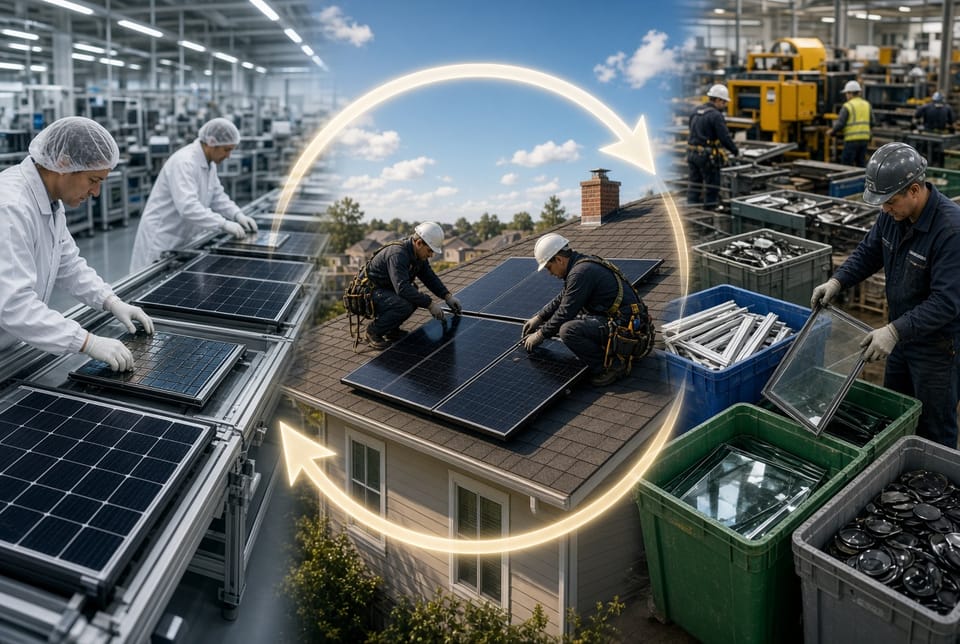
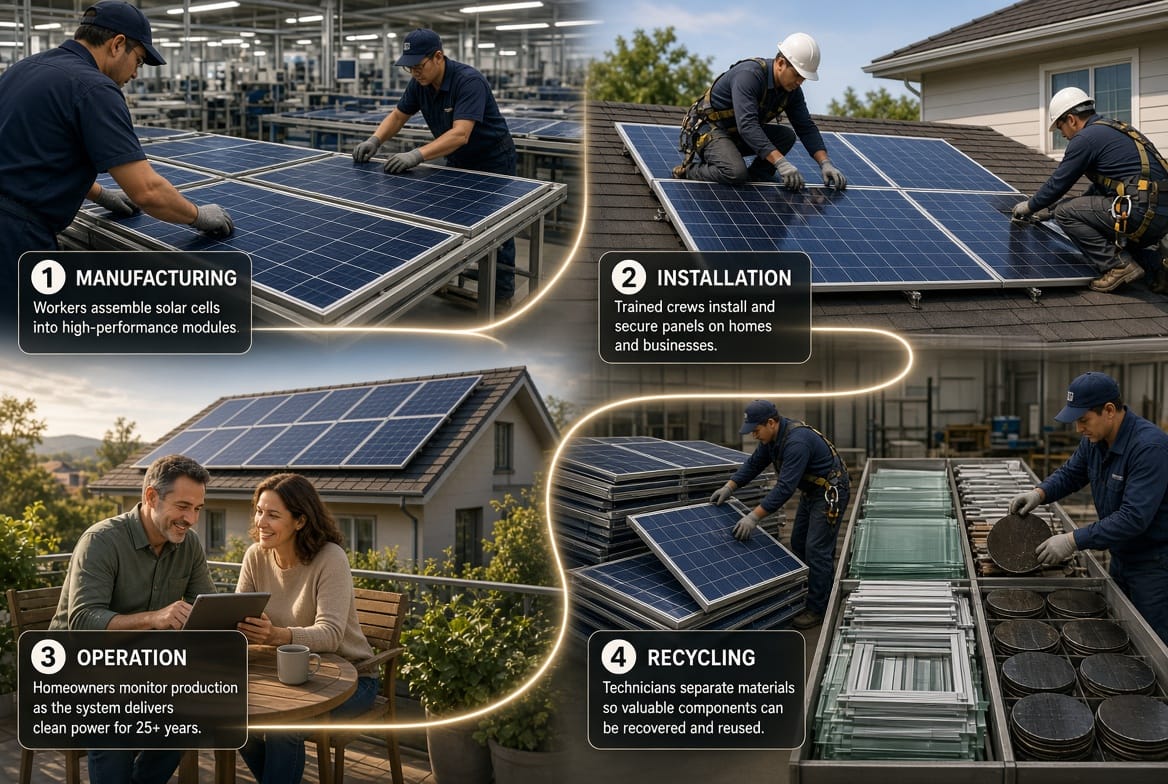
Solar power is no longer an experimental alternative. It is a proven, long-duration energy asset that families and businesses rely on for 25 years or more. Understanding the full solar panel lifecycle—manufacturing, installation, operation, and recycling—helps homeowners choose systems with confidence and plan for a sustainable end-of-life rather than landfill waste.
Call Today to Plan Solar From Install to Recycling
A modern crystalline silicon panel is more than a black rectangle on a roof. It is a carefully engineered product built from abundant materials, designed to generate electricity for decades, and increasingly designed so its glass, aluminum, and silicon can return to the supply chain. When those stages are managed well, solar delivers both energy independence and a smaller material footprint.
This article explains each stage in practical terms so you can evaluate quality, durability, and recycling readiness before you buy.
How Solar Panels Are Manufactured
Most panels on residential and commercial roofs today are crystalline silicon modules. The journey begins with one of Earth’s most common elements: silicon, typically sourced from quartz.
Manufacturers first convert quartz into metallurgical-grade silicon, then purify it into solar-grade polysilicon. High purity matters because even tiny impurities reduce cell efficiency. The purified silicon is melted and grown into large ingots—either single-crystal (monocrystalline) or multi-crystal structures. Those ingots are squared and sliced into thin wafers with diamond wire saws.
Each wafer then becomes a working solar cell through a precise sequence:
- Surface texturing to trap more sunlight
- Doping to create the p-n junction that generates current
- Anti-reflective coating to cut light loss
- Printed metal contacts, commonly silver on the front and aluminum on the rear
- Electrical testing and sorting by performance
Finished cells are connected into strings, layered with encapsulant (typically EVA or POE), covered by low-iron tempered glass, protected on the back with a polymer backsheet or a second sheet of glass, and locked into an anodized aluminum frame. A junction box and wiring complete the module. Quality lines add electroluminescence scans, flash testing, and certification before shipment.
By weight, a typical panel is mostly protective structure rather than semiconductor:
- Glass — about 70–76%
- Polymers and encapsulant — roughly 8–11%
- Aluminum frame — about 8–15%
- Silicon cells — about 3–5%
- Copper — about 1%
- Silver and trace metals — well under 0.1%
That composition is important later. The materials that last longest on a roof are also the materials recyclers can recover in the highest volumes.
Energy used in manufacturing is real, especially during silicon purification. The reassuring offset is the energy payback period: a quality panel commonly generates more electricity than was required to make it within about one year of operation, then continues producing clean power for decades.
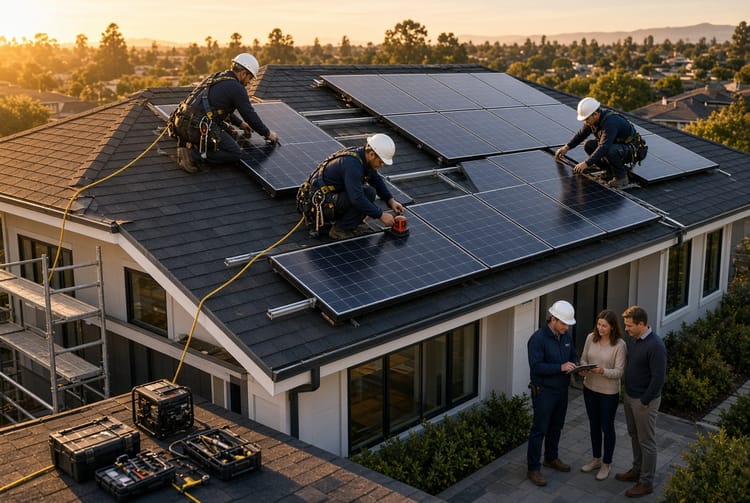
Professional Installation Sets the System Up for Decades
Manufacturing quality only pays off if installation is done correctly. Poor racking, inadequate flashing, undersized wiring, or ignored roof conditions can shorten system life even when the modules themselves are excellent.
A professional installation typically includes:
- Roof and structural review
- Shade analysis and array layout
- Code-compliant racking and weather-tight flashing
- Proper grounding, conduit, and inverter pairing
- Permitting, inspection, and utility interconnection
- Monitoring setup so production can be tracked from day one
Installers who treat the roof as a long-term building system—not just a mounting surface—protect both the home and the array. Correct tilt, secure attachments, and clean electrical work reduce hot spots, water intrusion, and premature component stress.
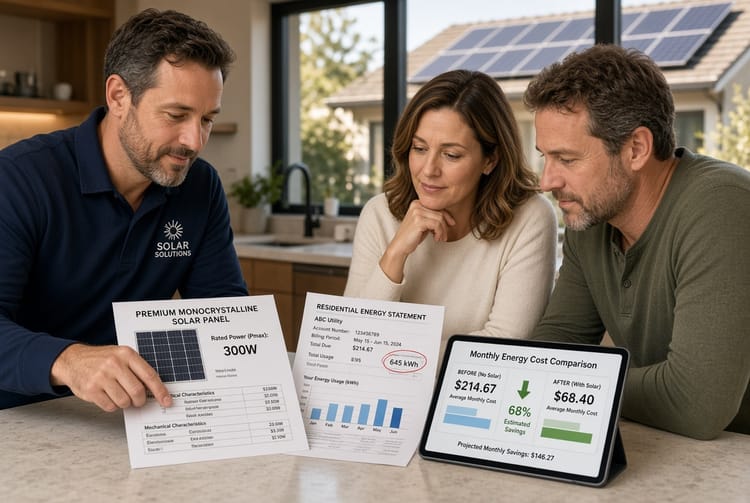
Once commissioned, the system should operate quietly in the background. The homeowner’s role is mostly observation: watch production data, keep debris off the array when needed, and schedule service if output drops unexpectedly.
Operation: 25+ Years of Quiet Power
The operating phase is the longest and most valuable part of the lifecycle. Most manufacturers provide a 25-year performance warranty, and many premium modules now extend performance coverage toward 30 years. That warranty period is a commercial guarantee, not a hard stop. Well-built panels often continue producing usable electricity after the warranty expires.
Output declines slowly through degradation, not sudden failure. Field studies commonly place the median annual loss for crystalline silicon panels near 0.5% per year. Premium N-type and TOPCon products can degrade more slowly. In practical terms:
- After 10 years, many systems still deliver about 95% of original output
- After 25 years, many still deliver about 85–92%
- After 30 years, a quality array can remain commercially useful
What actually ages the system is usually not the silicon itself first. Thermal cycling, moisture, UV exposure, and mechanical load affect encapsulant, solder joints, connectors, and inverters. Inverters typically need replacement sooner than panels. Monitoring helps catch string issues, shading from new tree growth, or soiling before they become expensive.
Routine care is straightforward:
- Review monthly production against expected seasonality
- Clean panels only when soiling is visibly reducing output
- Keep vents, junction boxes, and pathways accessible
- Address roof work before it forces an emergency panel removal
- Plan inverter service on a known replacement cycle
The result is one of solar’s strongest advantages: after installation, the asset keeps working with very little daily attention while offsetting utility costs and reducing grid demand.
End-of-Life Recycling: Glass, Aluminum, and Silicon Recovery
Every durable product eventually reaches end-of-life. For solar, that moment may arrive at 25, 30, or even 40 years, depending on performance, roof replacement timing, or a decision to upgrade to higher-efficiency modules. The question is not whether panels will someday come down. The question is whether their materials are recovered.
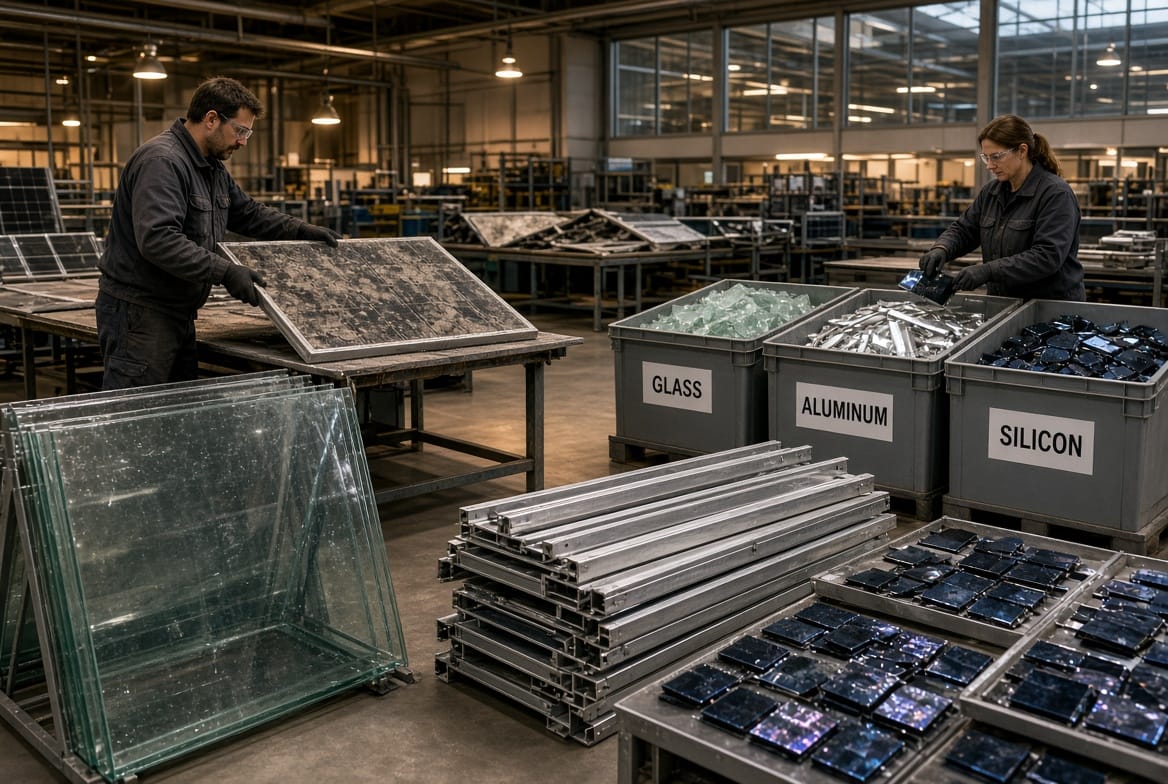
A crystalline silicon module is highly recyclable by mass. Specialized processors typically follow a staged approach:
- Remove the aluminum frame and junction box
- Separate the front glass
- Break down the laminate that holds cells in place
- Recover silicon, copper, and silver
- Sort remaining polymers for energy recovery or further processing
Aluminum is the easiest high-value stream. Frames unbolt or shear off cleanly and enter well-established scrap markets at recovery rates often above 95%. Glass, which dominates panel weight, can be recovered at high rates when processors keep it clean rather than mixing it with encapsulant residue. Recycled glass can return to new glass products or other industrial uses.
Silicon recovery is more technical because cells are thin and bound inside cross-linked encapsulant. Modern thermal, mechanical, and chemical routes can recover a large share of the silicon and then purify it for reuse in new cells or other industrial silicon products. Copper ribbons and wiring also recycle readily. Silver is present in tiny amounts, but it carries outsized value, which is why advanced recyclers focus on clean metal recovery rather than simple shredding.
Not every retired panel currently follows this path. In some markets, landfill disposal remains cheaper in the short term than full material recovery. That gap is the industry’s next responsibility—not a reason to reject solar, but a reason to choose installers and manufacturers who already plan for take-back and recycling.
Why Recycling Matters
Recycling matters because solar is scaling rapidly. Millions of panels installed in the 2000s and 2010s will reach retirement in the 2030s and 2040s. Global end-of-life volume is projected to grow from a relatively small stream today into tens of millions of tonnes over the coming decades. That is still a modest waste stream compared with ordinary municipal and electronic waste, but it is large enough to require a planned circular system.
Responsible recycling protects three things at once:
- Material value — aluminum, glass, silicon, copper, and silver do not need to be mined again at the same intensity
- Environmental control — intact modules are stable in use; crushed panels in unmanaged landfills raise avoidable questions about trace metals and plastics
- Industry credibility — clean energy should not create a second waste problem after solving the first
There is also a practical homeowner benefit. Asking about recycling before installation clarifies who is responsible when a roof is replaced, a system is upgraded, or a panel is damaged. A company that can explain take-back options today is more likely to support you 25 years from now.
Design is improving as well. Better encapsulants, easier-to-remove frames, and higher-purity recovery processes are making closed-loop reuse more realistic. The goal is not perfect zero-waste overnight. The goal is a lifecycle in which manufacturing, generation, and recovery are treated as one system.
Choosing Solar With the Full Lifecycle in Mind
A smart solar decision looks beyond first-year production estimates. It considers module quality, installer workmanship, monitoring, inverter planning, and a credible path for end-of-life recycling.
When you compare proposals, ask direct questions:
- What performance warranty and product warranty come with the modules?
- What degradation rate does the manufacturer publish?
- Who handles damaged or decommissioned panels?
- Is recycling available through the installer or a certified partner?
- How will roof replacement be managed if it happens before year 25?
Those questions separate a short-term equipment sale from a long-term energy partnership. Solar is most valuable when it is treated as infrastructure: built carefully, operated for decades, and recovered responsibly.
The technology already works. The remaining task is to keep the lifecycle as clean as the electricity it produces.
Choose solar with a sustainable lifecycle.
Start a Cleaner Solar Lifecycle – Call Now