The Solar Panel Inverter Types: String vs. Micro vs. Power Optimizer
Choosing the right solar panel inverter is one of the most important decisions homeowners and business owners make when investing in clean energy. The inverter converts the direct current (DC) electricity generated by your solar panels into the alternating current (AC) that powers lights, appliances, and equipment. Selecting among string inverters, microinverters, and power optimizers directly influences system efficiency, resilience under partial shading, long-term reliability, and overall return on investment.
Call Now for a Free Solar Inverter Consultation
This comprehensive guide compares the three leading inverter technologies in clear, practical terms. You will understand how each works, where each excels, and how to match the technology to your unique site conditions. With the right choice, your solar system delivers consistent performance for decades while protecting your investment against common challenges such as shade, panel mismatch, and future expansion needs.
Understanding the Core Role of Solar Inverters
Every solar installation relies on an inverter as its operational heart. Solar panels produce DC power, yet homes and the utility grid operate on AC. The inverter performs this essential conversion while also managing system monitoring, safety shutdowns, and maximum power point tracking (MPPT).
Modern inverters go far beyond simple conversion. They optimize energy harvest, communicate performance data to owners and installers, and support rapid shutdown requirements for firefighter safety. The architecture you select—centralized or distributed—determines how effectively the system handles real-world variables such as morning shade from trees, afternoon chimney shadows, or slight differences in panel orientation.
Key performance factors influenced by inverter choice include:
- Energy harvest under varying light conditions
- Tolerance to partial shading or soiling
- System expandability for future panel additions
- Monitoring granularity (panel-level versus system-level)
- Upfront cost versus lifetime value
A thoughtful selection process begins with understanding the three primary technologies available today.
String Inverters: The Cost-Effective Central Solution
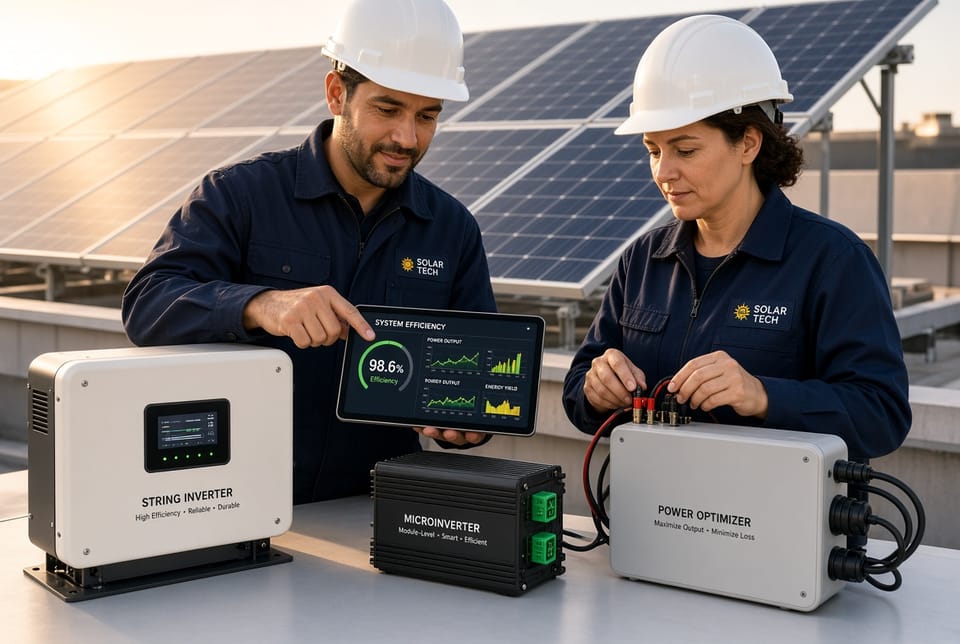
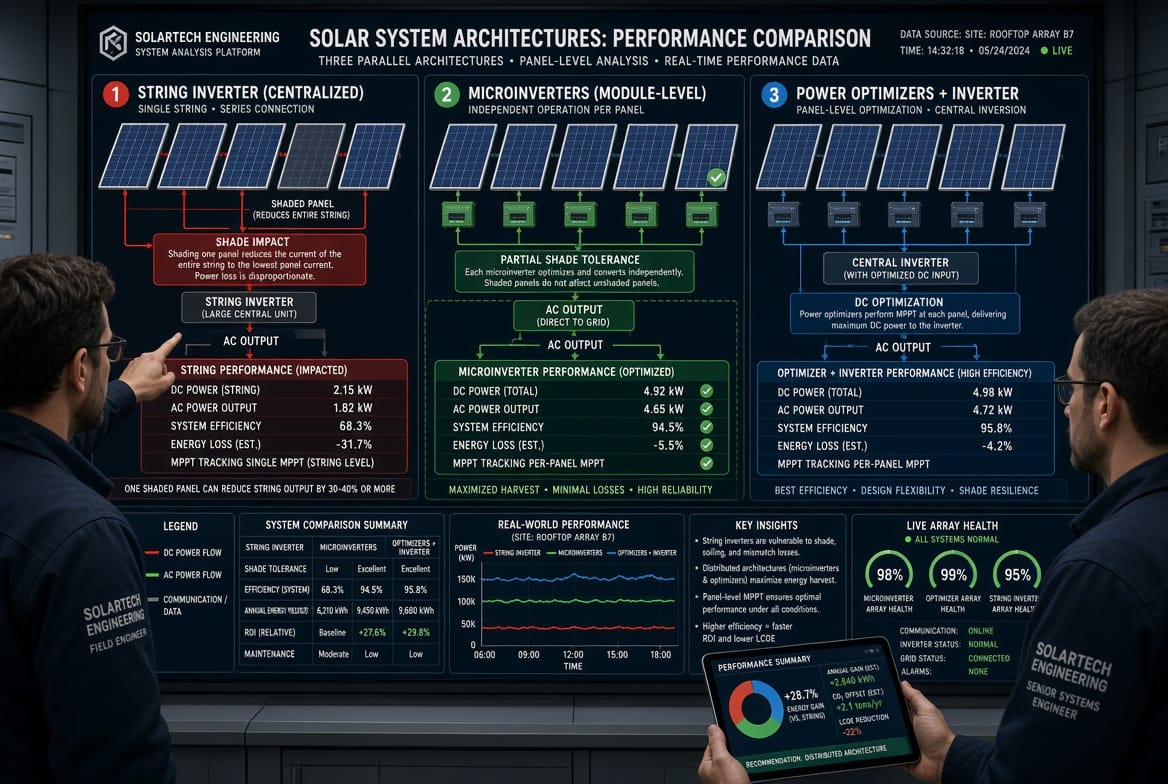
String inverters represent the traditional and still widely used approach. In this design, multiple solar panels are wired together in series to form a “string.” The combined DC output of the entire string travels to a single centralized inverter, typically mounted on a wall near the main electrical panel or outdoors in a weather-protected enclosure.
Because only one inverter serves the whole array, string inverters deliver the lowest upfront equipment cost. Installation is straightforward, and the technology has decades of proven field performance. High-quality units from established manufacturers offer excellent conversion efficiencies, often exceeding 97 percent under ideal conditions, along with robust warranties of 10 to 12 years that can frequently be extended.
How String Inverters Operate
Panels connected in series share the same current. The string inverter continuously searches for the maximum power point of the entire string. When every panel receives uniform sunlight and operates at similar temperatures, this centralized MPPT works efficiently and extracts nearly optimal energy.
Advantages of String Inverters
- Lower initial cost makes them attractive for budget-conscious projects and large, unshaded rooftops
- Simplified wiring and fewer electronic components reduce potential points of failure
- Centralized location eases maintenance and eventual replacement
- Proven reliability with extensive real-world data
Considerations and Limitations
The series connection creates a notable vulnerability: the performance of the entire string is limited by its weakest panel. Even modest shade on one module can reduce output across the whole string—sometimes dramatically. Panel mismatch caused by manufacturing tolerances, aging, or different tilt angles produces the same effect. Monitoring is typically system-level only, so identifying an underperforming panel requires additional diagnostic tools.
String inverters remain an excellent choice for open fields, south-facing roofs free of chimneys or trees, and installations where minimizing capital expense is the priority. When site conditions are favorable, they provide dependable, cost-effective power conversion for many years.
Microinverters: Panel-Level Independence for Maximum Resilience
Microinverters take the opposite approach. Instead of one large inverter for the array, a small inverter is installed directly beneath each solar panel. Each module therefore converts its own DC electricity to AC right at the source. The AC power then travels through standard wiring to a combiner box and onward to the main service panel.
This distributed architecture delivers several powerful benefits. Because every panel operates independently, shade or debris on one module has virtually no impact on its neighbors. Each microinverter performs its own MPPT, ensuring every panel harvests the maximum available energy under its specific conditions.
How Microinverters Deliver Superior Shade Performance
When a tree branch casts a shadow across part of the roof, only the affected panels reduce output. The remaining modules continue producing at full capacity. This panel-level optimization often results in 5 to 25 percent higher annual energy yield on complex or partially shaded roofs compared with traditional string systems.
Key Benefits of Microinverters
- Exceptional shade tolerance and immunity to panel mismatch
- Panel-level monitoring that lets owners and service technicians see the exact output of every module
- Inherent rapid-shutdown compliance for enhanced safety
- Modular design that simplifies future system expansion—simply add another panel and its microinverter
- Longer warranties, commonly 25 years, matching typical panel warranties
Practical Considerations
The primary trade-off is higher equipment cost. Purchasing one inverter per panel increases the initial investment. Installation labor can also be slightly higher because each unit must be mounted and connected. In very large commercial arrays the sheer number of microinverters may present maintenance logistics, although failure rates for quality brands remain low.
For residential rooftops with dormers, vents, nearby trees, or multiple orientations, microinverters frequently deliver the highest lifetime energy production and the greatest peace of mind.
Power Optimizers: The Intelligent Hybrid Approach
Power optimizers combine the best attributes of both previous technologies. A compact DC-to-DC optimizer is attached to each solar panel. These devices condition and maximize the power output of their individual modules, then send the optimized DC electricity to a central string inverter for final conversion to AC.
This hybrid design retains the cost advantages of a single central inverter while providing panel-level maximum power point tracking and monitoring. The result is strong shade tolerance, detailed performance visibility, and efficient overall conversion.
How Power Optimizers Bridge the Gap
Each optimizer continuously adjusts voltage and current so the panel operates at its ideal power point. The conditioned DC strings then feed a high-efficiency central inverter. Because the optimizers mitigate mismatch and shade effects before the power reaches the inverter, the central unit can operate closer to its peak efficiency more of the time.
Strengths of the Power Optimizer Solution
- Best of both worlds: panel-level optimization paired with a lower-cost central inverter
- Excellent performance on partially shaded or multi-orientation roofs
- Module-level monitoring and rapid-shutdown capability
- Easier future expansion than pure string systems
- Generally lower equipment cost than a full microinverter array
Situations Where Optimizers Shine
Homeowners who want advanced performance without the highest microinverter price often find power optimizers the ideal middle path. The technology also suits commercial projects seeking granular monitoring while controlling capital expenditure.
Potential drawbacks include the added complexity of two sets of electronics (optimizers plus inverter) and the need to ensure compatibility between the chosen optimizer brand and the central inverter. High-quality paired systems from major manufacturers eliminate most of these concerns and come with comprehensive warranties.
Side-by-Side Comparison of the Three Technologies
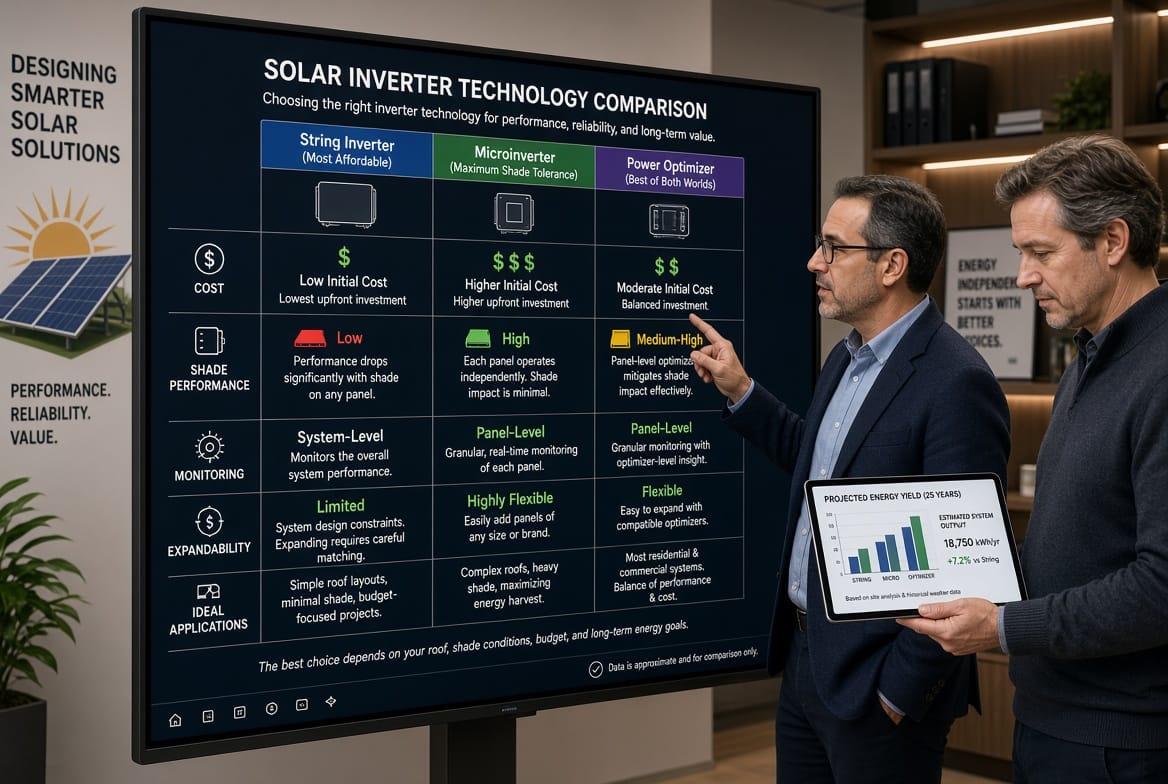
Selecting the optimal inverter requires matching technology characteristics to site-specific conditions and financial goals. The following comparison highlights the decisive differences:
- Upfront Cost: String inverters are the most economical; power optimizers sit in the middle; microinverters carry the highest equipment cost.
- Shade and Mismatch Tolerance: Microinverters lead, followed closely by power optimizers; string inverters are most sensitive.
- Monitoring Detail: Microinverters and power optimizers both offer panel-level data; string inverters typically provide system-level only.
- System Expandability: Microinverters excel; power optimizers are flexible; string systems may require careful redesign.
- Maintenance Access: Central string inverters and optimizers concentrate electronics in accessible locations; microinverters are distributed across the roof.
- Warranty Length: Microinverters commonly match the 25-year panel warranty; string and optimizer systems usually start at 10–12 years with extension options.
Matching the Right Technology to Your Project
Begin by evaluating your roof or ground-mount site. Open, uniformly oriented arrays with minimal shade usually achieve excellent results with a string inverter, maximizing budget efficiency. Complex residential roofs featuring multiple planes, dormers, or nearby trees benefit dramatically from microinverters or power optimizers.
Next consider your long-term plans. If you anticipate adding panels in future years, the modular nature of microinverters or the flexibility of optimizers simplifies expansion. Owners who value detailed performance insights and rapid identification of any underperforming module will appreciate the panel-level monitoring inherent in both distributed technologies.
Budget remains important, yet lifetime energy production often outweighs initial savings. A slightly higher investment in microinverters or optimizers can generate substantially more kilowatt-hours over 25 years on a challenging site, improving the overall financial return.
Professional site assessment remains essential. Qualified installers use advanced modeling software that incorporates satellite imagery, shade analysis, and production simulations to quantify the expected difference among the three options for your specific property. This data-driven approach removes guesswork and ensures the selected technology aligns with both technical requirements and financial objectives.
Long-Term Reliability, Safety, and Support
All three inverter types from reputable manufacturers meet rigorous safety standards and support the rapid-shutdown functions required by modern electrical codes. Quality components, proper installation, and routine monitoring form the foundation of multi-decade performance.
Regular system checks—whether through manufacturer apps or professional service visits—allow early detection of any issues. Because microinverters and power optimizers provide module-level data, diagnosis is faster and more precise. String systems rely more heavily on infrared scanning or clamp-meter testing during maintenance visits.
Warranty coverage and manufacturer support networks further influence long-term confidence. Choosing established brands with strong North American service infrastructure ensures parts availability and technical assistance when needed.
Making Your Decision with Confidence
The solar industry offers mature, reliable solutions for virtually every site condition and budget. String inverters deliver proven, economical performance where conditions are ideal. Microinverters unlock maximum energy harvest and resilience on complex roofs. Power optimizers elegantly combine panel-level intelligence with central conversion efficiency.
By understanding these differences and partnering with experienced professionals, you can select the inverter architecture that best protects your investment and maximizes clean-energy production for decades to come.
Choose the right inverter for your system. Speak with a knowledgeable solar advisor who can evaluate your property, model production outcomes, and recommend the optimal technology.
Call Now to Select the Best Inverter for Your System