The Raccoon Latrine: Health Hazards and Professional Cleanup
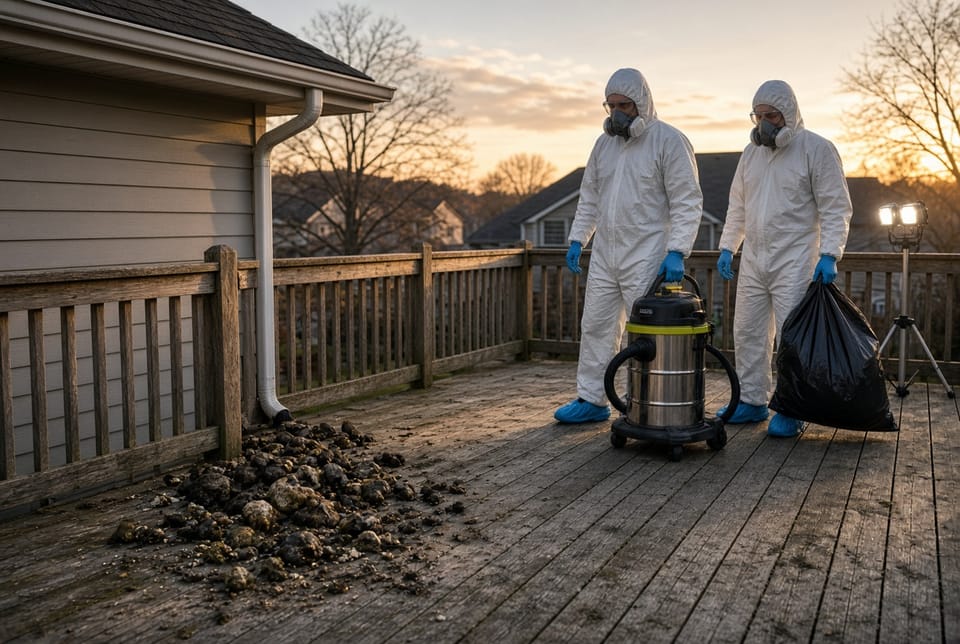
A quiet pile of droppings on a deck, attic insulation, or roof may look like nothing more than a wildlife inconvenience. In reality, a raccoon latrine is one of the most serious environmental health hazards a homeowner can encounter. Raccoons do not scatter waste at random. They return to the same sites again and again, creating communal toilets that can hold millions of microscopic roundworm eggs. Those eggs do not wash away with rain or die from ordinary household cleaners. They wait.
Get Professional Roundworm Cleanup Today
This article explains exactly what a raccoon latrine is, why the parasite Baylisascaris procyonis is so dangerous, and why professional cleanup with HEPA vacuuming is the responsible, protective choice for families, children, and pets. The goal is not to create fear. The goal is clarity: the risk is real, the solution is established, and trained technicians can restore a property safely.
What Is a Raccoon Latrine?
A raccoon latrine is a preferred communal defecation site. One raccoon—or several animals sharing the same territory—will repeatedly deposit feces in the same spot. Over days, weeks, or even years, the waste accumulates into a concentrated pile of material at different stages of weathering.
Raccoons favor flat, slightly elevated, or sheltered surfaces. The behavior is consistent enough that experienced wildlife technicians can often predict where a latrine will form once they understand how the animals are using a property. The pile is not “just poop.” It is an environmental reservoir. Adult worms living in a raccoon’s intestines can produce more than 100,000 eggs per day. A single animal may shed millions of eggs. When multiple raccoons use the same site, the load multiplies.
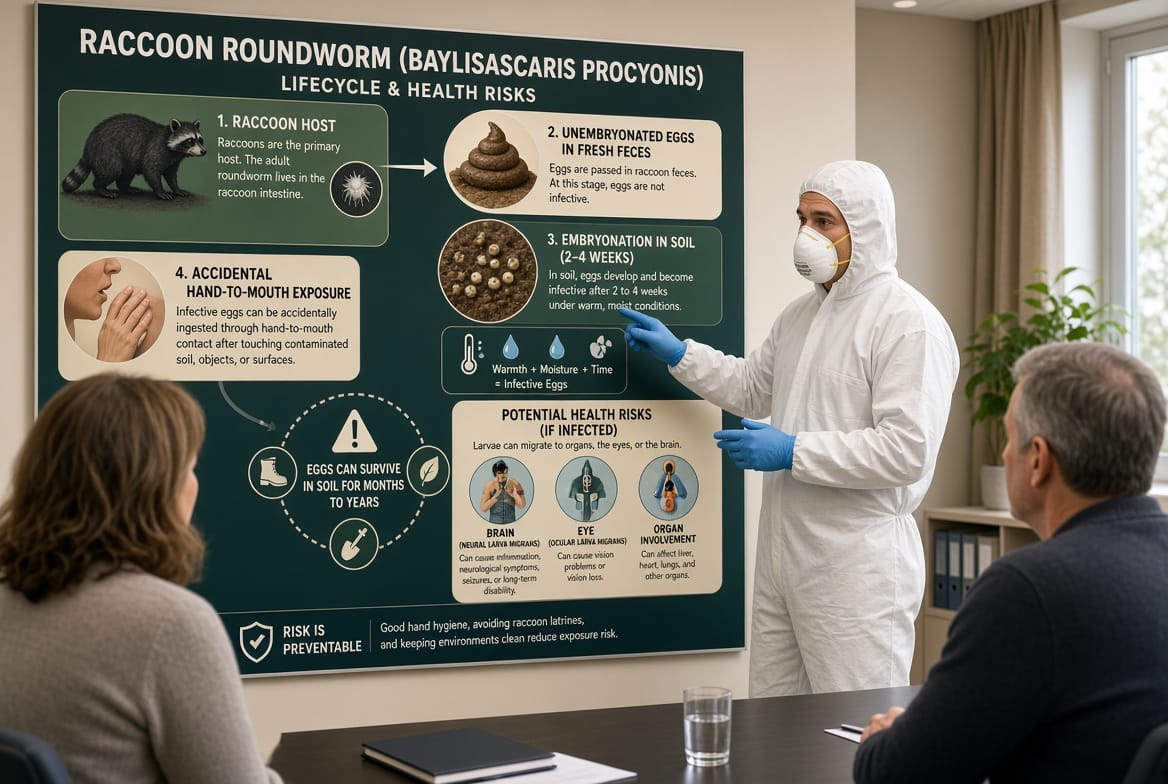
Fresh droppings are not immediately infectious. That fact is important and also easily misunderstood. Eggs require two to four weeks in the environment to embryonate and become infective. After that window, they can remain viable for years in soil, wood, insulation, and dust. Prompt, correct removal is therefore both a health measure and a race against the parasite’s development clock.
How to Recognize a Raccoon Latrine
Raccoon droppings are typically tubular, about the diameter of a dime or nickel, with blunt ends. Color varies with diet. Seeds, berry skins, or insect parts are often visible. Older material may look like dried debris or crumbling leaf litter, which is why homeowners sometimes miss a latrine until the odor or volume becomes obvious.
Look for:
- Repeated deposits stacked in one concentrated location rather than scattered single droppings
- Piles on raised or flat surfaces such as decks, roof sections, attic flooring, or woodpiles
- Staining, dark residue, or a persistent musky odor near chimneys, vents, or roof valleys
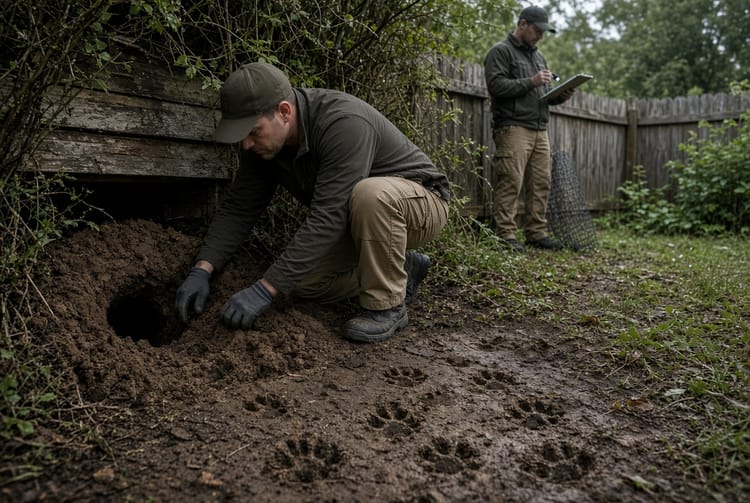
- Tracks, torn insulation, or entry points nearby that confirm raccoons have been living or traveling through the structure
A single isolated dropping in the yard is not automatically a latrine. A recurring pile in the same corner of a deck or the same bay of an attic almost always is.
Where Latrines Form Around Homes
Urban and suburban raccoons have adapted their natural habits to human structures. Common sites include:
- Roofs, especially low-slope sections, valleys, and areas beside chimneys or HVAC units
- Decks, porches, and the joists or soil beneath them
- Unsealed attics, soffits, and insulation cavities
- Garages, sheds, haylofts, and storage buildings
- Woodpiles, fallen logs, large rocks, fence lines, and tree forks
- Sandboxes and play areas when they remain uncovered
Roof and attic latrines are especially concerning. Rain can wash material into gutters and down onto walkways. Dry droppings can crumble into dust that moves with air currents. Children playing below or family members entering an attic can encounter contamination they never saw form.
The Hidden Threat: Raccoon Roundworm
The primary reason a raccoon latrine is treated as a biohazard is Baylisascaris procyonis, commonly called raccoon roundworm. The adult worm lives in the raccoon’s intestine. Infected raccoons often show no illness of their own. Prevalence in wild raccoon populations is frequently high.
People and many other animals are accidental, or paratenic, hosts. When an infective egg is swallowed, it hatches. The larva does not remain in the intestine the way it would in a raccoon. Instead it penetrates the gut wall and begins to migrate through tissue. That wandering is called larva migrans. Depending on where the larvae travel, the result can be:
- Neural larva migrans — invasion of the brain or spinal cord
- Ocular larva migrans — damage to the eye that can cause vision loss
- Visceral larva migrans — involvement of organs such as the liver or lungs
Documented human cases are uncommon. When they occur, they can be devastating. Children, toddlers, and anyone with pica or developmental differences who may put soil or objects in the mouth carry the highest risk. Pets can also be affected. The rarity of diagnosed cases should never be read as permission to ignore a latrine. The severity of the worst outcomes is precisely why public-health guidance emphasizes careful removal.
How People Become Exposed
Infection requires ingestion of infective eggs. That usually happens through contaminated hands, soil, insulation dust that later reaches the mouth, toys, or food-contact surfaces. Eggs have a sticky outer coat that helps them cling to fingers, shoes, tools, and clothing.
Disturbing dry material is a critical mistake. Sweeping, leaf-blowing, or using an ordinary shop vacuum can lift particles into the air. Even if inhalation itself is not the proven primary route of Baylisascaris infection, aerosolized dust increases the chance that eggs land on skin, lips, or household surfaces. In confined spaces such as attics, the same dust may also carry bacteria and fungal spores.
Other pathogens can travel with raccoon waste and urine as well, including bacteria that cause gastrointestinal illness and organisms associated with urine exposure. The roundworm eggs remain the headline risk because they are uniquely durable and uniquely dangerous if they reach the central nervous system.
Why Ordinary Cleaning Does Not Solve the Problem
Homeowners often reach first for bleach, all-purpose disinfectant, or a household vacuum. Those tools fail against this parasite for several reasons:
- Most chemicals do not kill the eggs. Bleach, quaternary ammonium products, and standard household disinfectants do not reliably destroy Baylisascaris eggs. Heat does.
- Eggs are hardy and sticky. They persist in soil and porous materials for years. A surface that “looks clean” can still hold viable eggs.
- Standard vacuums recirculate particles. Without true HEPA filtration and sealed equipment, vacuuming can spread contamination instead of capturing it.
- The visible pile is rarely the entire footprint. Raccoons walk, urinate, and nest beyond the latrine itself. Insulation, decking, and dust in surrounding bays may also be contaminated.
- Attic and roof work is physically hazardous. Poor footing, heat, confined space, and electrical or structural issues compound the biological risk.
Heat above approximately 144°F (62°C) can kill eggs. That is why boiling water, steam, or carefully controlled flame is discussed for hard outdoor surfaces. Those methods are not practical or safe on insulation, finished interiors, or many household materials. Physical removal plus high-efficiency capture of remaining particles is therefore the core of indoor remediation.
Why Professional Cleanup With HEPA Vacuuming Is Essential
A licensed wildlife or biohazard remediation team treats a raccoon latrine as contaminated material, not as ordinary dirt. The difference is method, equipment, and containment.
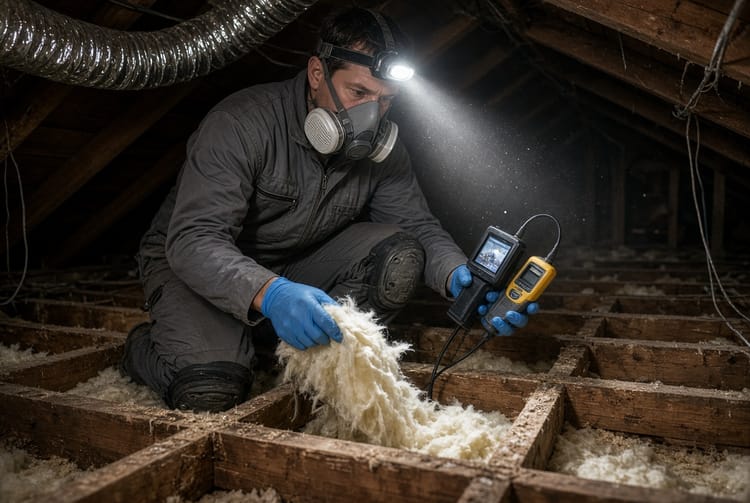
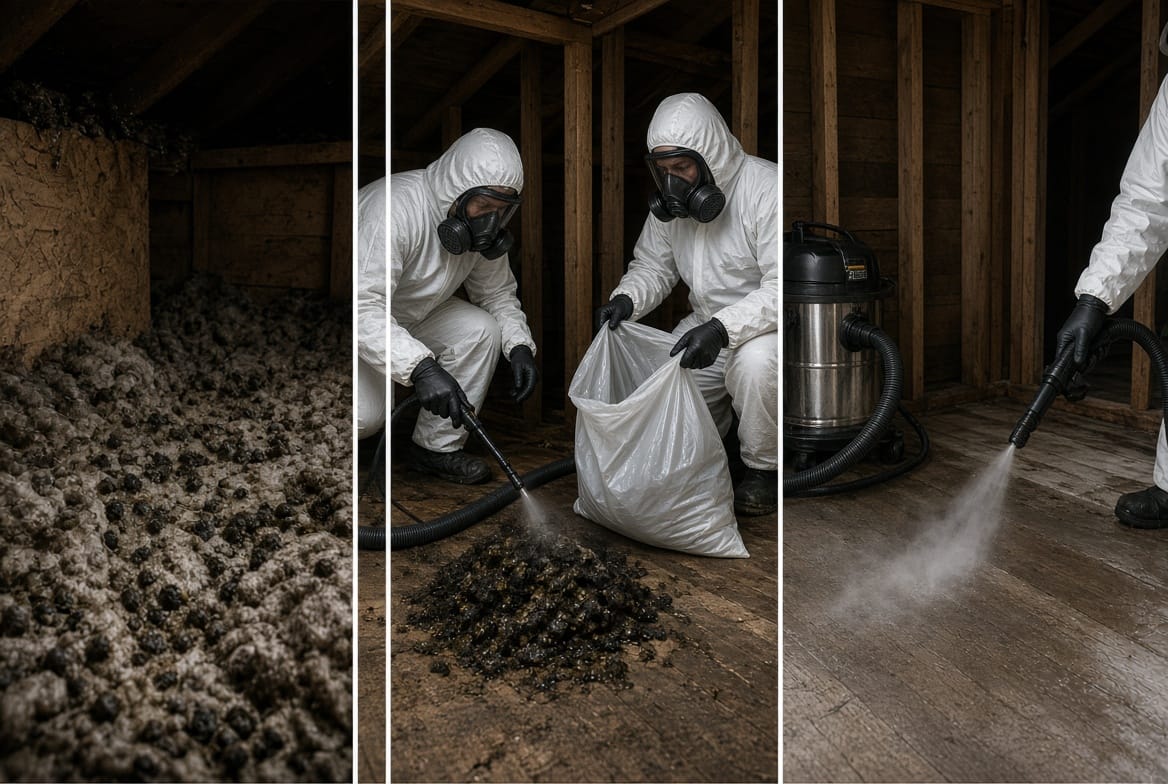
Personal protective equipment is non-negotiable. Technicians use disposable coveralls, gloves, washable or disposable footwear protection, eye protection, and a properly fitted respirator (commonly N95 or better in confined spaces). The point is to prevent eggs from reaching skin, clothing that will re-enter the living space, or the airway.
Physical removal comes first. Visible feces and contaminated substrate are wetted to suppress dust, then collected into heavy-duty bags. Material is double-bagged and removed by the shortest exterior route for landfill disposal according to local rules. In attics, soiled insulation is often removed rather than “cleaned in place,” because eggs lodge in porous fibers.
HEPA vacuuming follows. A true HEPA filter captures 99.97 percent of particles at 0.3 microns. Roundworm eggs are substantially larger than that threshold, so a sealed professional unit can collect residual dust and fragments that hand removal leaves behind. This step is not a substitute for removing the bulk waste. It is the controlled way to finish surfaces after the pile is gone. Ordinary shop vacuums and leaf blowers do the opposite: they launch particles.
Disinfection and heat where appropriate. After removal and HEPA work, hard, non-porous surfaces may be treated with hot water, steam, or other approved methods. Enzyme or antimicrobial products can help with odor and organic residue, but they are not a magic kill-step for the eggs. Professionals understand which surfaces can accept heat and which require removal instead.
Containment and air control. In interior jobs, crews may isolate the work zone, use negative air, and prevent contaminated dust from migrating into living areas through vents or stairwells. That discipline is difficult to improvise with consumer tools.
The reassuring truth is that a well-executed professional cleanup converts a long-lived environmental hazard into a managed, documented project. Families do not need to become parasitologists. They need a team that already knows the protocol.
What a Thorough Job Includes
A complete service typically covers more than scooping the obvious pile:
- Inspection of all likely latrine and satellite sites, including roof, attic, crawl space, and under-deck areas
- Identification of entry points so raccoons cannot simply return and re-contaminate the same spot
- Removal of feces and affected porous materials
- HEPA vacuuming of remaining surfaces and dust
- Targeted heat or surface treatment on suitable materials
- Proper bagging and disposal
- Guidance on exclusion, chimney caps, vent screening, and sanitation that removes food and shelter attractants
Cleanup without exclusion is incomplete. A clean surface that remains easy for raccoons to reach will become a latrine again.
Protecting Children, Pets, and Daily Life
Until professionals finish the work, keep people and pets away from the site. Do not let children play in nearby soil, sand, or deck areas. Do not allow dogs to investigate the pile. Wash hands after any outdoor activity. Cover sandboxes. Bring in pet food at night. Secure garbage.
If someone may have had direct contact with older raccoon feces, especially a young child, contact a physician promptly and describe the exposure. Early medical evaluation matters because treatment decisions are time-sensitive when ingestion is known or strongly suspected. That conversation belongs with a doctor, not with internet speculation.
Pets that may have eaten feces or hunted animals that ate eggs should be discussed with a veterinarian. Dogs can occasionally act as hosts and, in some circumstances, shed eggs of their own.
Prevention After the Latrine Is Gone
Lasting safety depends on making the property less attractive:
- Repair roof and soffit openings, screen vents, and cap chimneys
- Remove or tightly store outdoor food sources
- Elevate or enclose woodpiles
- Trim branches that give raccoons an easy bridge onto the roof
- Inspect decks and attics periodically, especially after you know raccoons have been in the neighborhood
A property that no longer offers den space or a convenient elevated platform is far less likely to host a new communal toilet.
A Serious Hazard With a Clear Remedy
A raccoon latrine is not a cosmetic problem and it is not a do-it-yourself weekend project when the site is large, indoor, or dry and dusty. It is a concentrated deposit of parasite eggs that can remain infectious for years. The science is consistent: eggs take two to four weeks to become dangerous, chemicals generally fail, heat and physical removal succeed, and careless disturbance spreads risk.
Professional teams exist for exactly this scenario. They arrive with PPE, sealed HEPA vacuums, containment practices, and a method that treats the waste as the biohazard it is. Homeowners who step back and call for that help are not overreacting. They are protecting the people who live in the house.
Raccoon droppings are a biohazard.
Protect Your Family from Raccoon Biohazards