The Lawn Starter Fertilizer: Giving New Seed a Boost
Establishing a new lawn from seed is one of the most rewarding—and most vulnerable—projects a homeowner or property manager can undertake. The first few weeks decide whether those tiny seeds become a dense, resilient turf or remain a patchy disappointment. One planting practice consistently separates successful new lawns from struggling ones: the correct use of starter fertilizer.
Give New Grass a Strong Start – Call Now
A well-chosen starter fertilizer supplies the precise nutrients young grass needs at the exact moment it begins to grow. Applied at seeding time, it focuses energy on root development rather than forcing weak top growth. The result is seedlings that anchor quickly, draw moisture and nutrients more efficiently, and stand a far better chance of surviving heat, drought, and foot traffic.
This guide explains exactly what starter fertilizer is, why its high-phosphorus formulation matters, when to apply it, and how to select the right formula for your soil and grass type. Follow these principles and you give new seed the strongest possible start.
What Starter Fertilizer Actually Is
Starter fertilizer is a specialized blend formulated for newly planted turf—whether you are seeding a bare lot, overseeding thin areas, or installing sod. Unlike regular lawn-maintenance fertilizers that emphasize nitrogen for leaf color and density, a true starter product prioritizes phosphorus.
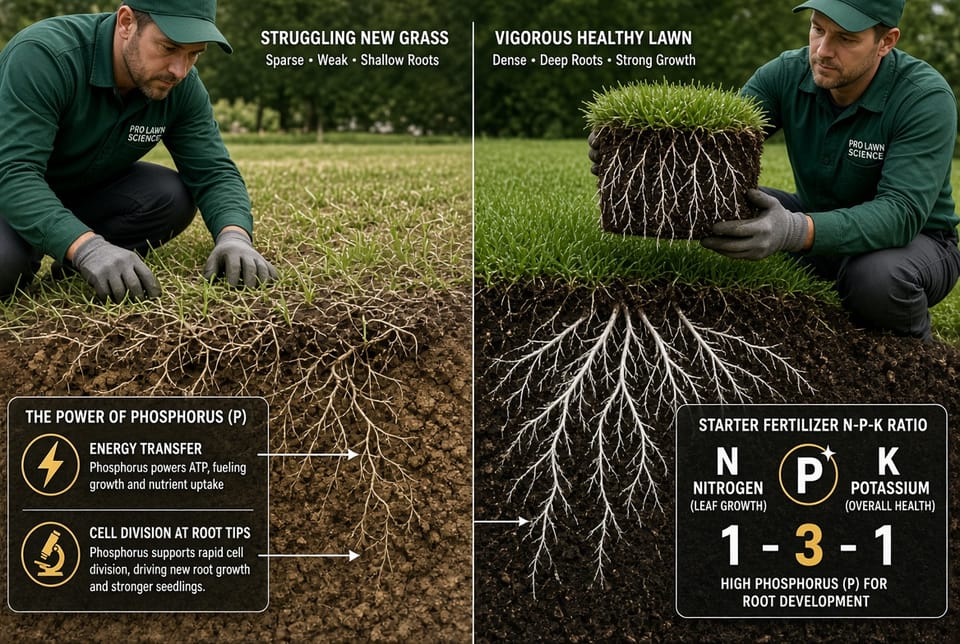
On every fertilizer bag you will see three numbers known as the N-P-K ratio. They represent the percentage by weight of nitrogen (N), phosphorus (P), and potassium (K). In a starter fertilizer the middle number is typically equal to or higher than the first. Common examples include 10-20-10, 12-18-8, 18-24-12, and 24-25-4. The elevated phosphorus drives early root formation; moderate nitrogen supports modest top growth without overwhelming the seedling; potassium aids overall plant vigor and stress tolerance.
Phosphorus is relatively immobile in soil. Young grass plants have only a tiny root system and cannot forage far for nutrients. Placing phosphorus in the immediate seed zone gives those first roots an immediate, accessible supply of the energy they need for cell division and elongation.
Think of starter fertilizer as the foundation of a house. You would never build walls before the footer is set. In the same way, you should never push leafy growth before the root system can support it.
Why Phosphorus Powers Root Development
Phosphorus plays several irreplaceable roles inside a germinating grass plant. It is a core component of ATP, the molecule that transfers energy within cells. It supports the rapid cell division that occurs at root tips. It helps move sugars produced in the first tiny leaves down into the developing root system. Without adequate phosphorus at this stage, seedlings produce short, sparse roots that cannot keep pace with evaporative demand or compete with weeds.
A strong early root system delivers three lasting advantages:
- Faster establishment and quicker fill-in of bare spots
- Improved drought tolerance once the lawn matures
- Greater ability to recover from the first mowing and from environmental stress
University extension research has long shown that newly planted turf benefits from a modest phosphorus boost precisely because immature roots explore only a small volume of soil. Once the lawn is established, the same high-phosphorus rates are rarely needed and can even become environmentally counterproductive.
When to Apply Starter Fertilizer
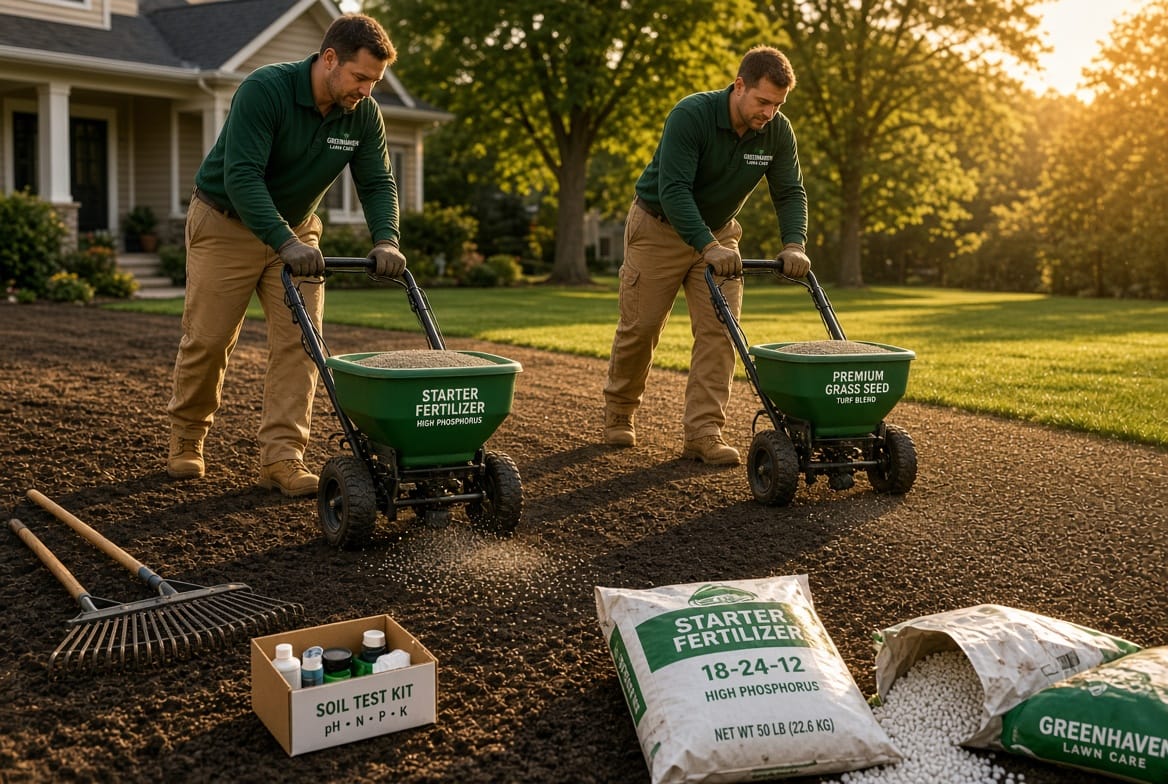
Timing is non-negotiable. Starter fertilizer belongs at seeding time—on the same day you spread the seed or immediately beforehand. The goal is to place the nutrients in the top inch of soil where the first roots will form.
For cool-season grasses (Kentucky bluegrass, tall fescue, perennial ryegrass, fine fescue) the ideal window is late summer through early fall. Soil temperatures are still warm enough for rapid germination, yet air temperatures are cooling, reducing stress on young plants. Spring seeding is possible but carries higher weed pressure and summer-heat risk.
For warm-season grasses (Bermuda, zoysia, St. Augustine) wait until late spring when soil temperatures consistently exceed 65 °F. Applying too early in cold soil wastes product because roots cannot take up the nutrients efficiently.
Never apply starter fertilizer to an already-established lawn as a routine feeding; the extra phosphorus is unnecessary and increases runoff risk. Likewise, skip application during drought or when heavy rain is forecast within 24 hours.
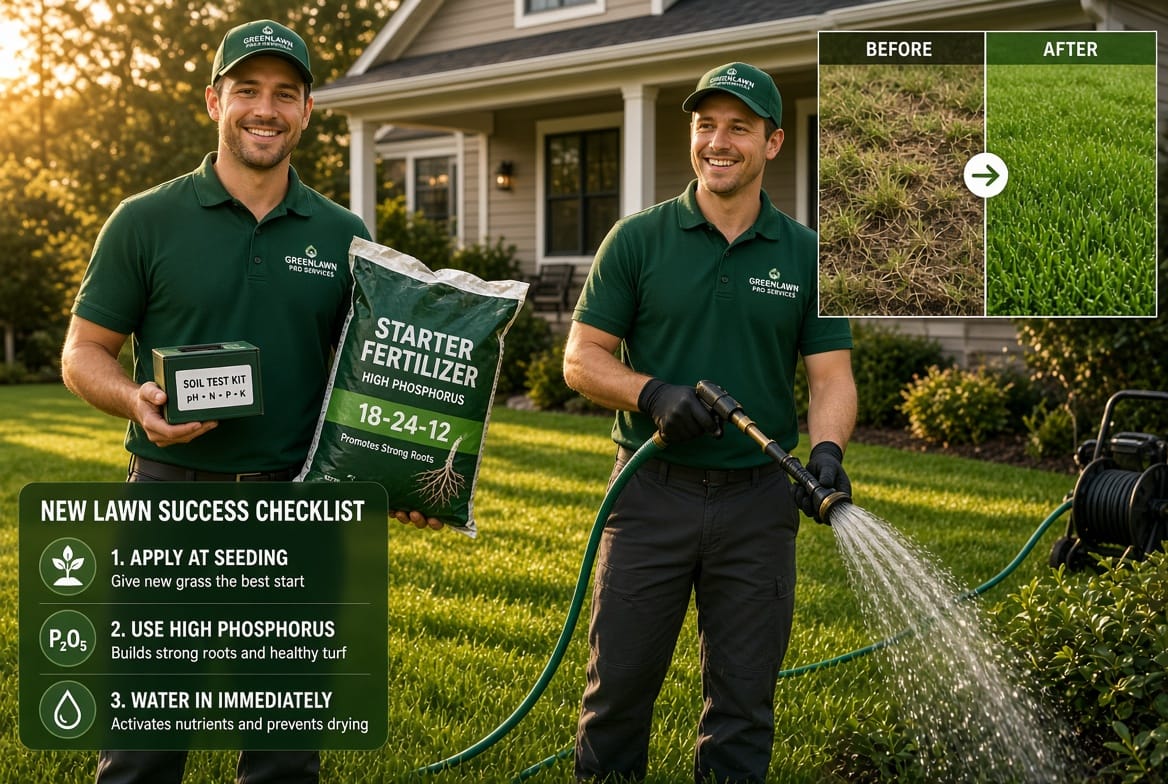
Lightly rake or incorporate the granules into the top ½–1 inch of prepared soil. Then water immediately so the nutrients begin dissolving into the seed zone.
How to Choose the Right Formula
Selecting the correct starter fertilizer begins with a soil test. A simple laboratory or mail-in kit reveals existing phosphorus levels, pH, and organic-matter content. If your soil already tests high in phosphorus, a high-P starter may offer little additional benefit and could suppress beneficial mycorrhizal fungi. In that case a more balanced or lower-phosphorus product plus good soil biology may be wiser.
When a test is not available, a phosphorus-forward starter remains the safer default for most new seedings, especially on sandy or recently graded sites that have lost topsoil.
Key selection criteria:
- N-P-K balance: Look for a middle number that is equal to or greater than the first number. Avoid high-nitrogen maintenance fertilizers (for example 24-0-10) at seeding; they force top growth the seedling cannot support.
- Application rate: Most quality starters are designed to deliver 0.5 to 1 pound of actual nitrogen per 1,000 square feet. Never exceed 1 pound of nitrogen at this stage; higher rates raise the risk of seedling burn.
- Release type: A combination of quick-release and slow-release nitrogen gives an immediate boost without a sudden salt spike.
- Soil texture and grass species: Sandy soils leach nutrients faster and may need a slightly higher rate or a second light feeding later. Slow-establishing species such as Kentucky bluegrass benefit from the extra phosphorus more than fast-germinating ryegrass.
- Organic versus synthetic: Bone meal or other organic phosphorus sources release more slowly and carry lower burn risk but require more product by weight. Synthetic starters act faster and are easier to meter precisely.
Always read the product label. Different analyses require different pounds of product to deliver the same amount of nutrient. Calculate your lawn square footage first, then match the bag rate.
Step-by-Step Application for Best Results
Proper technique multiplies the value of even the best product.
- Prepare the seedbed: remove debris, loosen compacted soil, and correct grade so water neither ponds nor runs off.
- Conduct or review a soil test and adjust pH if needed (most grasses prefer 6.0–6.8).
- Calculate the exact area and the precise amount of starter fertilizer required.
- Calibrate your spreader—both drop and broadcast types work, but overlap passes slightly for even coverage.
- Apply the fertilizer and seed in close succession, then lightly rake so both make contact with soil.
- Water immediately with a gentle spray until the top inch is moist. Keep the surface consistently damp (not soggy) until germination.
- After the first mowing (usually when grass reaches 3–4 inches), wait another 4–6 weeks before applying a higher-nitrogen maintenance fertilizer.
Risks and Common Mistakes to Avoid
Even a well-intentioned application can go wrong. The two most frequent errors are over-application and using the wrong product.
Excess fertilizer creates a high-salt environment that draws moisture out of tender roots and can kill seedlings outright. Always stay within the 0.5–1 pound nitrogen-per-1,000-square-foot guideline. Spills or uneven spreading produce brown circles that take weeks to recover.
Using a high-nitrogen “turf builder” instead of a true starter fertilizer produces thin, upright growth with inadequate roots. The young lawn looks green for a short time, then collapses under the first dry spell.
Phosphorus runoff is another concern. Keep granules off hard surfaces and never apply immediately before a heavy rain. In some regions local ordinances restrict phosphorus use except at establishment; a soil test documents the legitimate need.
Finally, neglecting seed-to-soil contact or inconsistent watering after application wastes both seed and fertilizer. The nutrients must be in solution and the seed must stay moist for germination to occur.
Aftercare That Protects Your Investment
Once the grass is up, resist the urge to fertilize again too soon. Most starter products feed the lawn for four to six weeks. The next application should shift toward nitrogen to encourage density and color. Continue regular, light watering, raise the mowing height slightly for the first few cuts, and keep traffic off the new turf until it knits firmly.
A second soil test the following year will tell you whether additional phosphorus is ever needed. In most established lawns it is not.
Give New Grass a Strong Start
A new lawn is an investment of time, seed, and hope. Starter fertilizer, applied at the right moment with the right formula, is the single most effective way to protect that investment. High phosphorus placed in the seed zone builds the deep, branching roots that turn fragile seedlings into durable turf.
When the job feels larger than a weekend project, or when you want the certainty of professional calibration and timing, expert help makes the difference. Give new grass a strong start.
Get Starter Fertilizer Applied Right – Call Now