The Coyote Den: Managing Pups and Adults on Your Property
Spring is the season when a quiet backyard can change overnight. What looked like unused space under a deck, behind a shed, or along a brushy fence line may suddenly become a coyote den. Adult coyotes are raising pups, food demand rises, and property owners begin noticing sightings, tracks, and, in the worst cases, missing pets. This is a seasonal issue, not a random one. Understanding coyote denning behavior, recognizing early warning signs, and applying humane management can protect your family, your animals, and the wildlife itself.
Protect Pets From Coyotes – Call Wildlife Experts
This guide explains how dens form, where they hide, what signs to watch for, and how professional wildlife services resolve the problem without panic or guesswork.
Why Spring Changes Everything
Coyotes breed in late winter. After a gestation period of about two months, pups arrive in spring, most often from March through May depending on the region. During this window, a breeding pair needs a hidden, stable nursery. The den is not a permanent home. It is a temporary shelter used while newborns are blind, helpless, and unable to travel.
That seasonal timing is why property conflicts spike in spring and early summer:
- Adults hunt more often and may appear during daylight.
- Protective behavior increases near the den and the surrounding territory.
- Small pets left outdoors become easier targets because coyotes need more food for a growing litter.
- Quiet, unused corners of suburban lots suddenly look like ideal cover.
The situation is manageable. A den on your property does not mean you have lost control of your land. It means a family of coyotes found shelter and a food source. Remove those advantages and the site loses its value.
Coyote Denning Behavior: How Adults and Pups Use Your Property
A coyote den is a concealed cavity used primarily for pup rearing. The female typically selects and prepares the site. The male helps provision food. Both adults defend the area more intensely while young are present.
Key points of denning behavior:
- The den is temporary. Families usually leave the underground or under-structure site once pups are mobile, often by early to midsummer.
- Pairs keep backup dens. If one site is disturbed, adults may move pups to another cavity within the same territory.
- Protection extends beyond the hole. Adults may defend a wide buffer around the den, not just the entrance.
- Activity peaks at dawn and dusk, but hungry adults raising pups can appear at any hour.
- Pups stay close at first. They remain inside for the earliest weeks, then begin playing near the entrance before traveling with adults.
This is why a homeowner may see an adult coyote repeatedly using the same path, hear more yips or howls, or notice worn ground near a single hidden opening. The animals are commuting between hunting areas and a nursery.
Hidden Locations: Where Dens Appear on Residential Property
Coyotes choose cover over exposure. They want drainage, concealment, and a low chance of being interrupted by people or dogs. On developed lots, that often means human structures.
Common den sites include:
- Spaces under sheds, decks, porches, and raised foundations
- Thickets, ivy banks, brush piles, and overgrown fence lines
- Enlarged burrows originally dug by groundhogs, foxes, or other animals
- Hollows under fallen logs, tree roots, rock outcrops, or culverts
- Quiet corners of vacant lots, construction edges, and drainage features
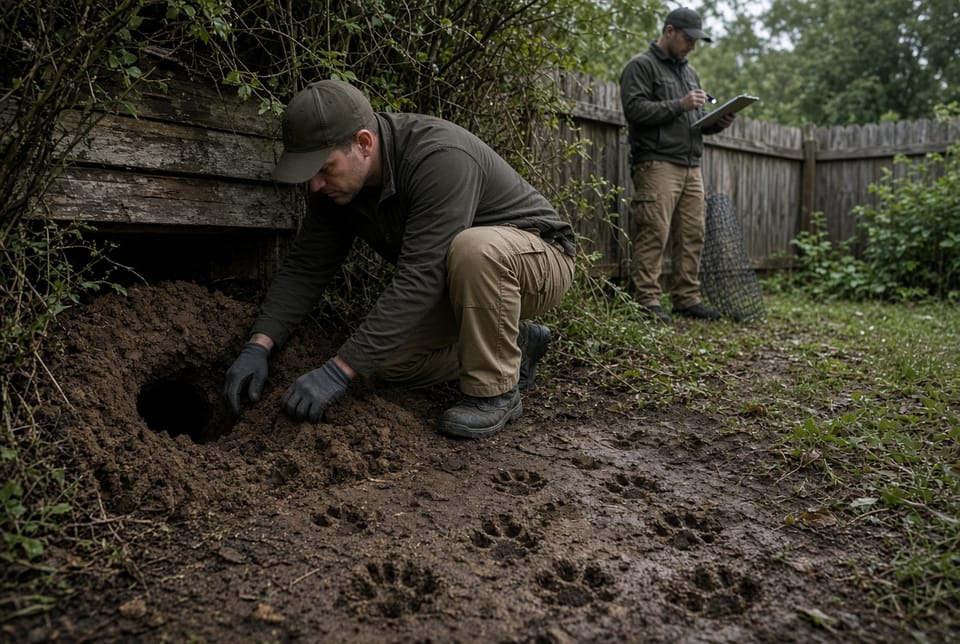
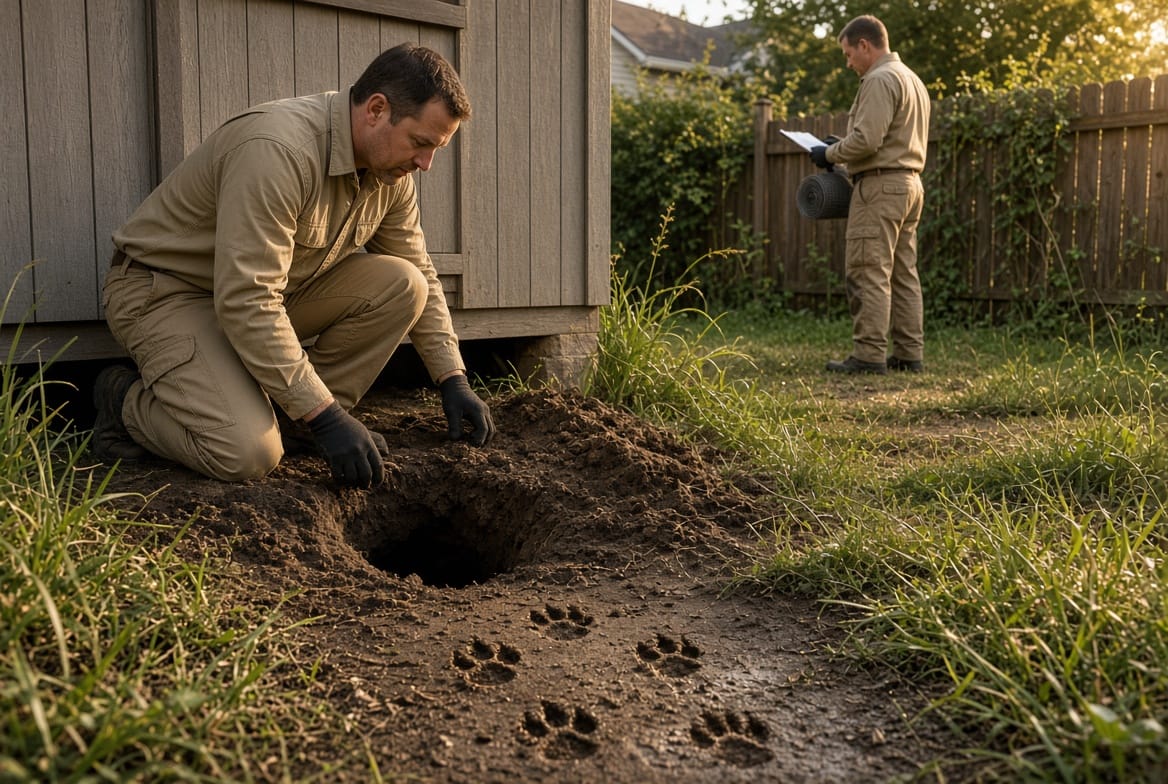
The entrance is often modest—roughly one to two feet across—and easy to miss until tracks or a soil mound give it away. Vegetation may hide the opening. A well-used site can show packed dirt, scattered soil, and a trail leading in and out.
Never crawl toward an opening or try to seal it while occupancy is uncertain. Pups can be trapped inside. Adults can become defensive. Confirmation and closure belong to trained wildlife professionals.
Signs of a Coyote Den: Sightings, Tracks, and Missing Pets
Early identification prevents a seasonal nuisance from becoming a household emergency. Watch for a pattern, not a single event.
Sightings
Repeated coyote sightings near the same structure, hedge, or hillside are more significant than one distant glimpse. Adults raising young often travel predictable routes. You may see:
- An adult appearing at dawn or dusk along a fence or drainage line
- A coyote pausing, watching, then disappearing into cover
- Increased daytime activity during peak pup-rearing weeks
- A pair using the same corridor across several days
A single crossing of a distant field is not proof of a den. Regular use of your yard, crawl space, or outbuilding is.
Tracks
Coyote tracks are one of the most reliable field signs. They are typically oval and compact, with four toes and visible claw marks. Compared with many dog prints, they often look longer than they are wide and follow a relatively straight travel line.
Look for tracks:
- In soft soil, mud, sand, or dust near sheds and decks
- Along fence lines, garden edges, and worn paths
- In clusters around one opening rather than scattered at random
- Mixed with smaller prints once pups begin emerging
Tracks of mixed sizes near one cavity are a strong indicator that adults and pups are sharing the site.
Missing Pets and Other High-Risk Signs
The most urgent warning is a change involving companion animals. During denning season, coyotes increase hunting pressure. Small dogs and outdoor cats are at the highest risk, especially at night or when left unsupervised.
Other supporting signs include:
- Scat on trails, near junctions, or close to structures
- Worn vegetation and freshly dug soil at an entrance
- Night vocalizations that seem closer than usual
- Pets acting anxious near a particular corner of the yard
- Livestock or poultry losses on rural and semi-rural lots
Missing pets should never be treated as a coincidence when other den signs are present. Secure animals immediately and arrange a professional inspection.
The Real Risks of Leaving a Den Undisturbed
A den is not automatically a crisis, but ignoring confirmed activity creates avoidable problems.
Pet safety is the first concern. Adults provisioning pups are opportunistic. A small animal in the travel path can be taken quickly.
Protective encounters are the second. Most conflicts involve dogs near a den, not unprovoked attacks on people. A leashed or loose dog that approaches the nursery may trigger charging, escorting, or vocal displays.
Habituation is the third. If trash, pet food, fallen fruit, or accessible compost remains available, coyotes learn that the property is reliable. That lesson outlasts one litter.
Structural use is the fourth. Dens under decks and sheds can lead to odor, soil disturbance, and repeated return visits in later seasons if access is never closed.
The goal is not hostility toward wildlife. The goal is to make the property unsuitable as a nursery and cafeteria.
Humane Management: Start With Attractants
Effective control begins with removal of attractants. Trapping alone cannot succeed if the yard continues to feed and shelter the animals.
Take these steps immediately:
- Bring pet food and water bowls indoors.
- Secure garbage in wildlife-resistant containers and store bins where coyotes cannot tip them.
- Clean grills, pick up fallen fruit, and manage bird seed that spills onto the ground.
- Do not leave pets outside overnight or unattended at dawn and dusk.
- Control rodents around outbuildings; they are a secondary food source.
- Keep livestock and poultry enclosed from dusk to dawn.
These changes reduce the reason adults keep returning. They also protect pets while a longer plan is put in place.
Deterrence Around an Active Den
If a den is suspected or confirmed, humane deterrence can encourage a family to relocate—especially when pups can still be moved by the adults. Persistence matters. One noisy afternoon is rarely enough.
Professional and property-level deterrence may include:
- Increased human activity near the unused structure or brush line
- Bright lighting aimed at the entrance after dark
- Sound devices or a radio used carefully and legally
- Making the immediate area less private and less comfortable
- Supervised hazing at a safe distance when an adult appears in the open: stand tall, make noise, and do not run
Do not attempt to flood, poison, smoke out, or collapse a den. Those actions can injure pups, violate local rules, and leave animals underground. Do not place your hands, pets, or children near the opening.
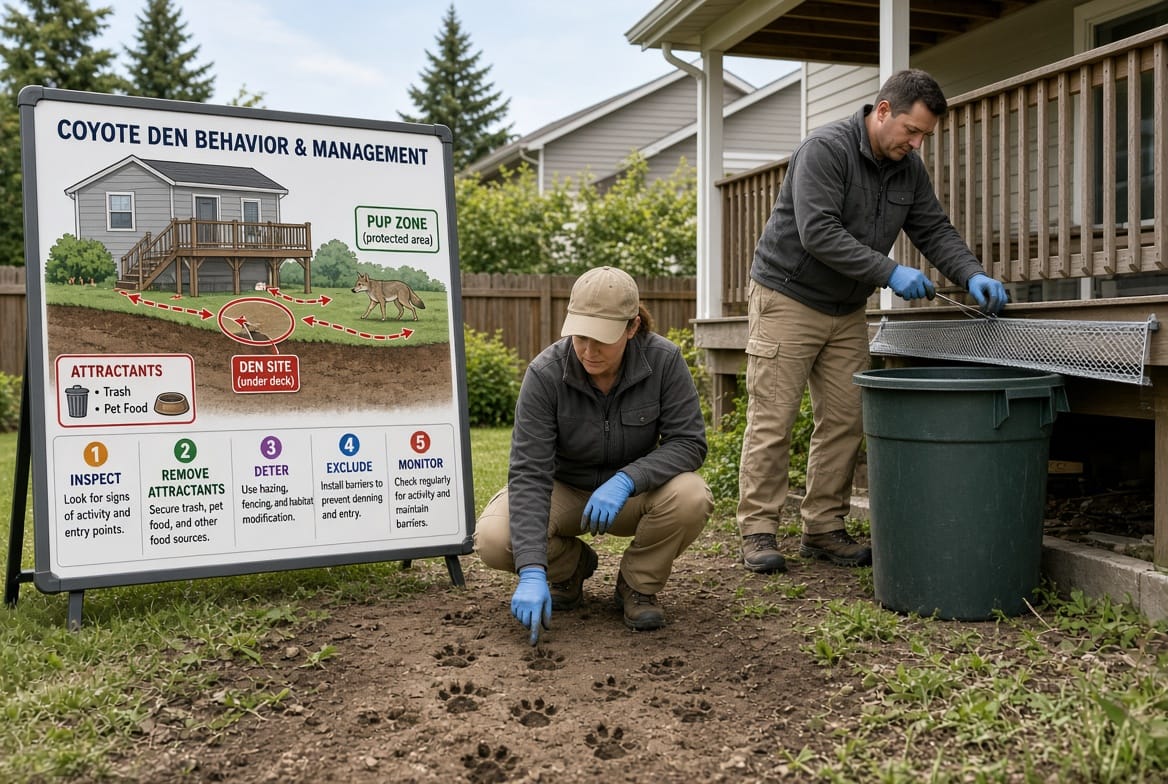
Deterrence works best as part of a full plan: inspect, remove food, apply pressure, confirm vacancy, then close access.
When Professional Trapping and Wildlife Services Are Necessary
Some properties need more than attractant control. Call licensed wildlife services when:
- A den is under a structure used by people or pets
- Pets have been attacked, injured, or are missing
- Coyotes are lingering near play areas, walkways, or livestock
- Home deterrence has failed
- You cannot confirm whether pups are still inside
- Local regulations require a licensed operator for capture or exclusion
Professional trapping, when legal and appropriate, is a targeted tool—not a first guess and not a do-it-yourself project. Coyotes are intelligent, scent-aware, and difficult to capture correctly. Untrained sets can catch the wrong animal, miss the problem animals, or leave dependent pups behind.
A qualified team typically:
- Inspects the lot for dens, tracks, scat, and travel corridors.
- Identifies whether adults, pups, or both are using the site.
- Builds a site-specific plan that may combine exclusion, deterrence, and lawful trapping.
- Monitors equipment on a strict schedule.
- Confirms the den is vacant before sealing crawl spaces and openings.
- Advises on fencing, landscaping, and long-term prevention.
This sequence protects people, pets, and the animals. It also prevents the common mistake of closing a hole while young are still inside.
After the Den: Closing Access and Preventing a Return
Once activity has stopped, prevention keeps the next season from repeating the same story.
- Install sturdy exclusion barriers under decks, sheds, porches, and mobile homes.
- Clear brush piles and dense cover against foundations where practical.
- Repair gaps in fencing and consider coyote-resistant fence toppers on properties with repeated pressure.
- Keep dogs leashed in known travel areas, especially from spring through midsummer.
- Maintain the no-food rule year-round, not only during denning season.
Coyotes will continue to live in the broader landscape. That is normal and, in many ecosystems, useful. The standard for a home is simpler: your structures should not serve as dens, and your yard should not serve as a feeding station.
A Reassuring Standard for Property Owners
Finding a coyote den can feel alarming. In practice, most cases follow a clear pattern: spring timing, a hidden cavity, visible signs, and a food or shelter advantage. Address those pieces in order and the property becomes ordinary again.
You do not need to confront adults at the entrance. You do not need to guess whether pups are present. You need a calm inspection, humane methods, and complete follow-through. That is the difference between a seasonal scare and a solved problem.
Seasonal Checklist for Managing Pups and Adults
Use this list through spring and early summer:
- Inspect quiet structures monthly for new openings and soil mounds.
- Look for tracks after rain, when prints are easiest to read.
- Note the time and location of every sighting.
- Keep cats indoors and small dogs supervised.
- Remove every outdoor food source the same day you notice activity.
- Stay away from suspected dens.
- Call professionals if signs persist or pets are at risk.
- Seal access only after vacancy is confirmed.
- Recheck the site after storms and landscaping work.
A short routine is more effective than a dramatic one-time reaction.
The Bottom Line
Coyote denning is a spring behavior built around hidden locations and the needs of pups. The adults are doing what the season requires. Your responsibility is to keep that behavior off decks, out of crawl spaces, and away from pets. Recognize sightings, tracks, and missing-pet risk early. Remove attractants. Apply deterrence correctly. Use professional trapping and exclusion when the site, the law, or the safety of animals demands it.
Handled this way, a den is a seasonal project with a clear end point—not a permanent change to your property.
Manage coyotes humanely on your property. For inspection, den confirmation, exclusion, and professional wildlife services.
Secure Your Yard From Coyotes – Call Specialists