The Window Solar Heat Gain: Choosing Low-E Coatings

Solar heat gain through windows is one of the most overlooked yet powerful factors affecting home comfort and energy bills. Every ray of sunlight that enters your living space carries both visible light and invisible infrared energy. When that energy becomes trapped inside, rooms overheat in summer and force air-conditioning systems to work harder. In winter the same windows can either welcome beneficial warmth or allow expensive heated air to escape. The key energy factor that measures this effect is the Solar Heat Gain Coefficient (SHGC). Selecting the right Low-E coatings lets you control SHGC precisely so your windows work with your climate instead of against it.
Choose the Right Low-E Coating for Your Climate – Call Now!
This guide explains exactly what Low-E coatings do, the two main types available, and how to match them to hot, cold, or mixed climates. The goal is simple: give you the knowledge to make a confident, long-term decision that lowers utility costs and improves daily comfort.
Understanding Solar Heat Gain and Why It Matters
Windows are the weakest thermal link in most building envelopes. Glass readily transmits short-wave solar radiation. Once that radiation strikes interior surfaces it converts to long-wave infrared heat that cannot easily pass back out. The result is unwanted heat buildup in warmer months and rapid heat loss when outdoor temperatures drop.
The Solar Heat Gain Coefficient quantifies how much solar radiation actually enters as heat. An SHGC of 0.30 means 30 percent of the sun’s energy striking the window becomes interior heat. A lower number reduces cooling demand; a higher number can provide free passive heating in cold weather. U-factor, the companion rating, measures heat transfer in either direction. Together these two numbers determine whether a window helps or hurts your energy budget.
Choosing the wrong SHGC can produce two common problems:
- Excessive summer heat gain that raises cooling costs and creates hot spots near glass.
- Insufficient winter solar gain that forces heating systems to run longer.
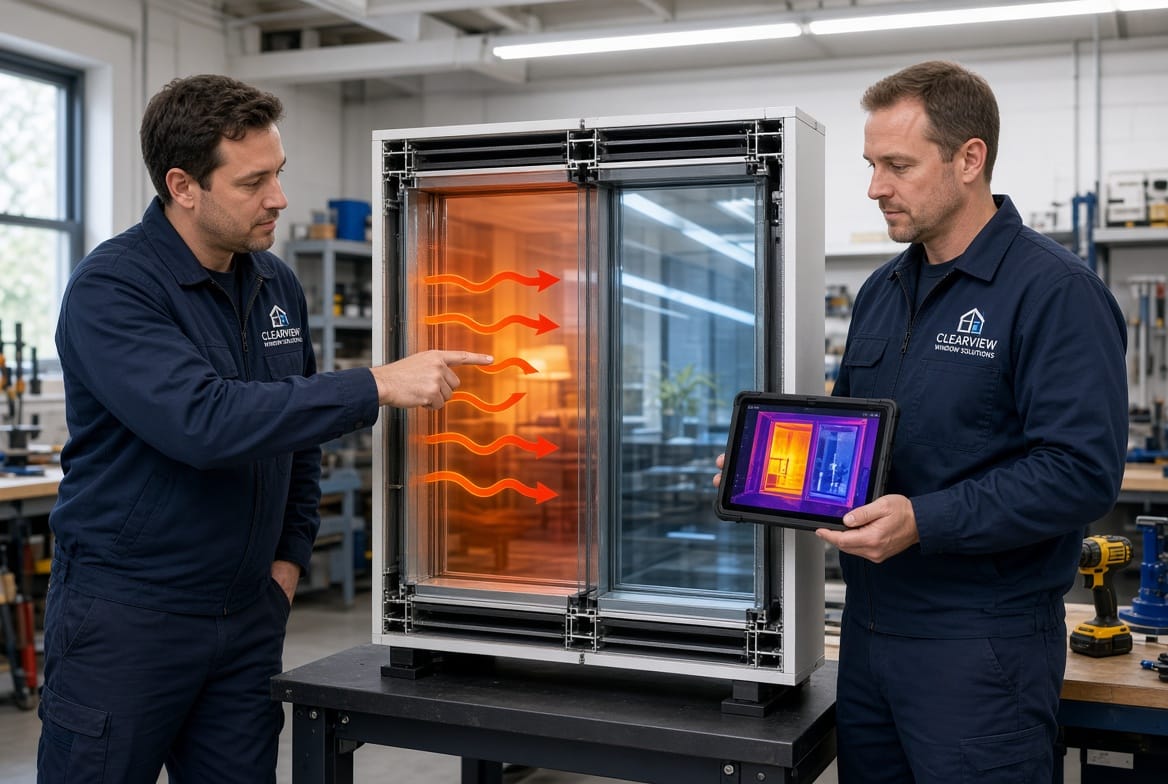
Low-E coatings solve both issues by selectively reflecting infrared energy while still allowing abundant visible light. When specified correctly they deliver year-round performance without sacrificing views or daylight.
What Low-E Coatings Actually Do
Low-emissivity (Low-E) coatings are microscopically thin, virtually invisible metallic layers applied to glass. They work on a simple principle: materials with low emissivity reflect far-infrared radiation rather than absorbing and re-radiating it.
In practical terms the coating performs two complementary jobs:
- It reduces solar heat gain by reflecting a large portion of the sun’s infrared energy before it enters the room.
- It reduces heat loss by reflecting interior warmth back inside during cold weather.
Most modern Low-E products also block a high percentage of ultraviolet rays that fade furniture, flooring, and artwork. Visible light transmittance remains high, so rooms stay bright and inviting.
The coating is typically placed on one of the inner surfaces of an insulated glass unit (IGU). Placement and the number of silver or metal-oxide layers determine the exact SHGC and U-factor the finished window will achieve. Because the layer is only a few atoms thick it does not alter the appearance of the glass in any dramatic way; most homeowners notice only a slight reduction in glare and a more even indoor temperature.
When Low-E glass is combined with argon or krypton gas fill and warm-edge spacers, the overall window assembly can cut heating and cooling energy use by 15 to 30 percent compared with older clear-glass units. That reduction is both measurable on utility bills and immediately noticeable as more consistent room temperatures.
Two Primary Types of Low-E Coatings
Not all Low-E coatings are created equal. Manufacturers use two distinct application methods that produce different performance profiles and durability characteristics.
Hard-Coat (Pyrolytic) Low-E
Hard-coat Low-E is applied while the glass is still hot during the float-glass manufacturing process. The metallic oxides fuse permanently with the glass surface, creating an extremely durable layer that can even be used on exposed single-pane applications in some cases.
Typical characteristics include:
- Higher SHGC values, often in the 0.40–0.70 range.
- Slightly higher U-factors than the best soft-coat products.
- Excellent scratch resistance and long-term stability.
- Lower manufacturing cost.
Hard-coat products are frequently chosen when passive solar heating is desirable or when budget constraints exist. They remain a solid performer in colder climates where winter sun is an asset.
Soft-Coat (Sputtered) Low-E
Soft-coat Low-E is applied in a vacuum chamber after the glass has cooled. Multiple microscopically thin layers of silver and metal oxides are stacked to achieve very precise spectral control.
Typical characteristics include:
- Lower SHGC values, commonly 0.20–0.40 and sometimes below 0.20 for high-performance “solar-control” versions.
- Superior U-factors that minimize heat transfer in both directions.
- Greater number of coating options (single-silver, double-silver, triple-silver).
- Must be protected inside a sealed IGU because the coating is more delicate.
Soft-coat technology currently dominates the high-efficiency window market because it offers the widest range of SHGC and visible-light combinations. Homeowners in hot or mixed climates almost always benefit from a quality soft-coat product.
Neither type is universally “better.” The correct choice depends entirely on local climate, window orientation, and the home’s overall energy goals.
Matching Low-E Coatings to Your Climate
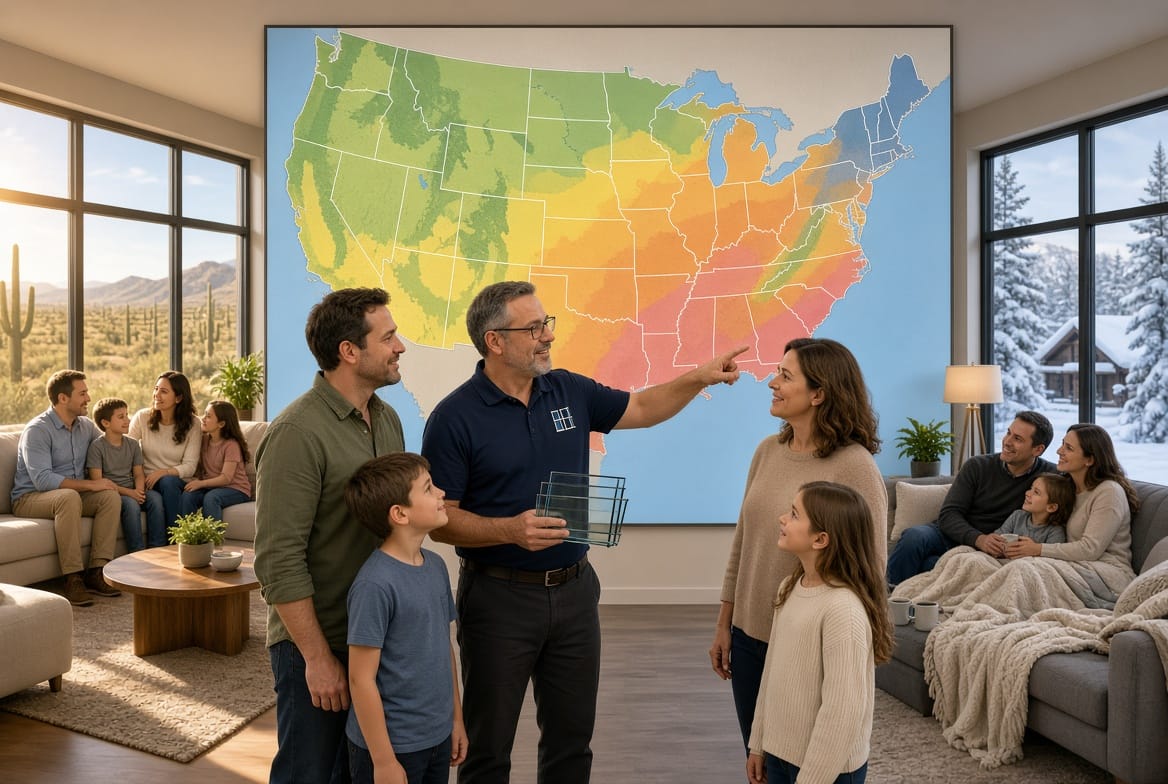
Climate is the single most important variable when selecting SHGC. A coating that keeps a Phoenix home comfortable will leave a Minneapolis home chilly in January. The following guidelines provide a reliable starting point.
Hot Climates (High Cooling Demand)
Regions with long, intense summers and mild winters—much of the southern and southwestern United States—need low SHGC windows. Target an SHGC of 0.25 or lower, preferably using double- or triple-silver soft-coat Low-E.
Benefits in hot climates:
- Dramatically lower air-conditioning loads.
- Reduced glare and hot spots near west- and south-facing glass.
- Protection of interior furnishings from UV damage.
A low-SHGC soft-coat window can cut cooling energy use by 20 percent or more compared with standard clear glass. Pair it with a low U-factor to keep nighttime heat from entering as well.
Cold Climates (High Heating Demand)
Northern states and high-elevation locations benefit from higher SHGC coatings that admit winter sun while still providing excellent insulation. An SHGC between 0.35 and 0.55 is often ideal, achieved with either a well-designed hard-coat or a selectively tuned soft-coat product.
Advantages in cold climates:
- Free passive solar heating on sunny winter days.
- Lower heating bills without sacrificing insulation.
- Comfortable glass surfaces that reduce drafts.
The key is combining the higher SHGC with a very low U-factor so that the heat gained during the day is not lost at night.
Mixed and Moderate Climates
Many parts of the country experience both hot summers and cold winters. In these zones a balanced SHGC of 0.25–0.40 usually delivers the best annual energy performance. Orientation also matters: south-facing glass can accept a slightly higher SHGC for winter gain, while west-facing glass should stay lower to limit late-afternoon overheating.
A qualified window consultant can model your specific house, taking into account overhangs, shading, and local weather data, to refine these general ranges into an exact specification.
Additional Performance Factors to Consider
While SHGC and coating type are central, several supporting details influence real-world results:
- Visible Light Transmittance (VLT) should remain above 40 percent in most homes so rooms do not feel dark.
- Gas fills (argon or krypton) and low-conductivity spacers further improve U-factor.
- Frame material and installation quality affect overall performance as much as the glass itself.
- South-facing windows in cold climates can be sized larger when high-SHGC Low-E is used, increasing passive-solar benefit.
Professional energy modeling software can quantify these interactions for your exact home, removing guesswork.
Avoiding Common Selection Mistakes
Homeowners sometimes choose the lowest possible SHGC everywhere, assuming “more efficient is always better.” In heating-dominated climates that decision can increase rather than decrease annual energy use. Conversely, selecting a high-SHGC coating in a cooling-dominated climate produces uncomfortable rooms and high summer bills.
Another frequent error is focusing solely on the glass while ignoring frame and installation. Even the best Low-E unit underperforms if it is poorly sealed or installed in a thermally inefficient frame.
Working with an experienced window consultant eliminates these risks. A short on-site evaluation identifies orientation, shading, existing window condition, and local climate data so the recommendation is tailored rather than generic.
Long-Term Value of the Right Low-E Choice
Windows are a 20- to 30-year investment. The incremental cost of a properly specified Low-E coating is modest compared with the lifetime energy savings, improved comfort, and reduced fading of interior furnishings. Many utility companies and government programs also offer rebates for high-performance windows, further improving payback.
Beyond dollars, the daily experience changes: rooms stay closer to the thermostat setting, glare is reduced, and the home feels more consistent from season to season. Those intangible benefits often matter as much as the utility-bill reduction.
Take the Next Step Toward Climate-Smart Windows
The difference between an ordinary window and a high-performance Low-E window is the difference between fighting your climate and working with it. By understanding solar heat gain, the two coating technologies, and the SHGC ranges that suit hot versus cold regions, you now have the information needed to specify glass that actually delivers on its promises.
Choose the right Low-E coating for your climate. A brief professional consultation removes any remaining uncertainty and ensures the windows you install will perform for decades.
An experienced advisor will review your home’s orientation, local weather patterns, and energy goals, then recommend the precise Low-E specification that balances comfort, daylight, and efficiency. The right coating is waiting—make the call and start enjoying lower bills and more comfortable rooms this season.
Call Today for Your Free Low-E Window Consultation