The Wet Drywall Drying: When to Cut vs. When to Save
Water intrusion turns ordinary drywall into a critical decision point that can determine the speed, cost, and long-term health of your entire restoration project. When moisture reaches gypsum board, the clock starts ticking. Some panels can be rescued with precise cutting, aggressive airflow, and controlled drying. Others must be removed completely to eliminate hidden contamination and prevent mold. Understanding the difference protects both your property and your budget.
Expert Wet Drywall Assessment – Call for Free Evaluation
This guide walks you through the exact decision-making framework used by professional water damage teams. You will learn how to evaluate clean water versus contaminated water, how limited soaking differs from deep saturation, and why timing and technique decide whether drywall stays or goes.
Understanding the Stakes of Wet Drywall
Drywall is porous. Once water penetrates the paper facing and gypsum core, it creates an ideal environment for microbial growth. Left untreated, even a small wet spot can expand into widespread structural and indoor-air-quality problems. The good news is that modern restoration science has clear thresholds. Not every wet panel requires demolition. The key is rapid, accurate assessment followed by the right action.
Professional restoration prioritizes two goals:
- Preserve as much original material as possible when conditions allow
- Eliminate any material that poses a contamination or mold risk
Balancing these goals requires experience, moisture meters, thermal imaging, and a clear understanding of water categories.
Water Categories That Drive Every Decision
The type of water that contacted the drywall is the single most important factor.
Category 1 – Clean Water
This originates from broken supply lines, rainwater through an open window, or overflow from a clean sink. It contains no significant contaminants. Drywall exposed only to Category 1 water has the highest chance of being saved if drying begins quickly.
Category 2 – Gray Water
Water from washing machines, dishwashers, or toilet overflow with urine (no feces) carries moderate contamination. Salvage becomes less certain and usually requires more aggressive cutting and antimicrobial treatment.
Category 3 – Black Water
Sewage, floodwater from rivers or streets, or any water that has contacted organic waste is considered black water. Drywall that has absorbed Category 3 water is almost never salvageable. The porous gypsum acts like a sponge for pathogens and toxins. Removal is the only safe option.
When the water source is unknown, treat it as Category 3 until proven otherwise. Safety always comes first.
Salvageable Drywall: The Conditions That Allow Drying
Drywall can often be saved when these conditions are met simultaneously:
- The water is confirmed Category 1 clean water
- Exposure time is under 48 hours
- Moisture has not fully saturated the gypsum core
- The paper facing remains intact and free of staining or delamination
- The framing behind the drywall is still sound
- Proper drying equipment can be placed for continuous airflow
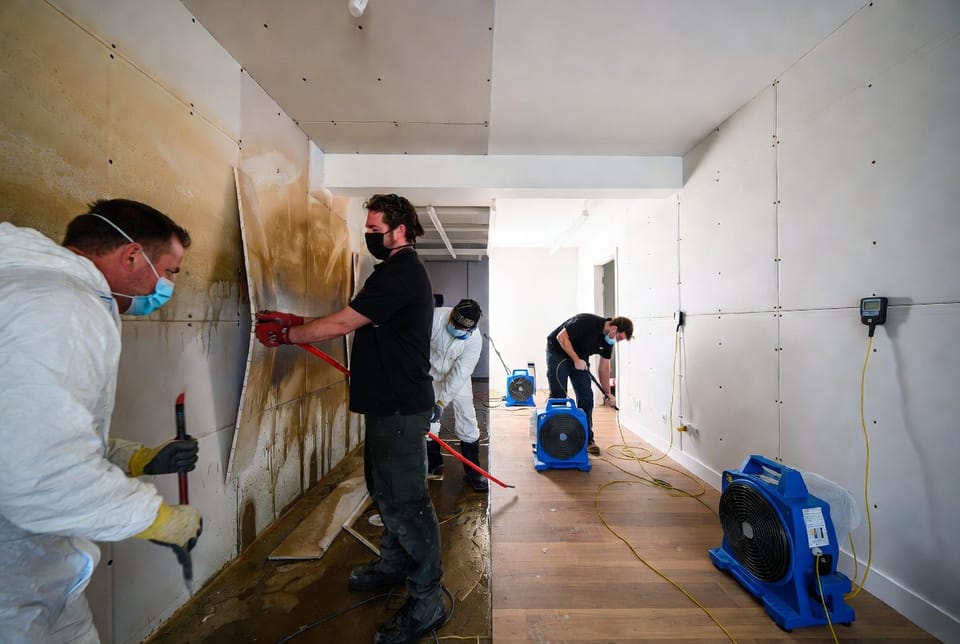
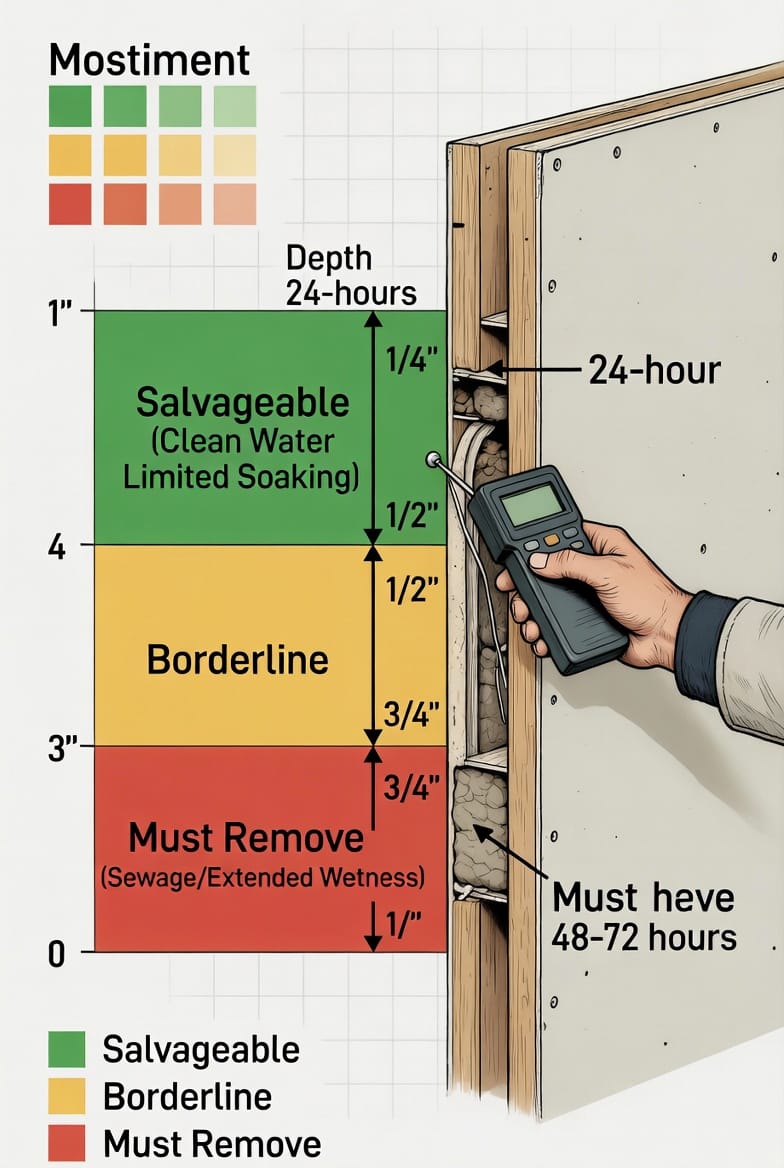
In these situations technicians create controlled ventilation openings, remove baseboards or sections of trim, and position high-velocity air movers and dehumidifiers. The goal is to lower the moisture content of the drywall below 16 percent — the threshold at which mold growth becomes unlikely.
Limited soaking is critical. If only the lower 12–18 inches of a wall is wet and the upper portions remain dry, targeted cutting of the wet band followed by drying of the remaining board frequently succeeds. The intact upper drywall continues to protect the cavity while the lower section is replaced or dried.
Non-Salvageable Drywall: Clear Signs You Must Cut and Remove
Certain conditions make drying unsafe or ineffective. Remove the drywall when any of the following are present:
- Confirmed or suspected sewage water or floodwater
- Visible mold growth or musty odor already present
- Extensive soaking that has caused the gypsum to soften, crumble, or swell
- Delamination of the paper facing
- Water that has wicked more than halfway up the wall height
- Wet insulation behind the drywall that cannot be dried in place
- Exposure lasting longer than 48–72 hours without active drying
In these cases the drywall has become a reservoir for contaminants. Attempting to dry it risks spreading spores into the air and leaving hidden moisture in the wall cavity. Complete removal, thorough cleaning of the framing, and installation of new drywall is the only reliable path to a healthy result.
The Step-by-Step Decision Process Used by Professionals
Experienced teams follow a consistent sequence:
- Stop the water source and extract standing water immediately.
- Identify the water category through source investigation and, when necessary, laboratory testing.
- Map moisture with pin and pinless meters plus infrared cameras to locate hidden wet areas.
- Assess the drywall surface for staining, softness, and paper integrity.
- Inspect the wall cavity by carefully removing a small section or baseboard to check insulation and framing.
- Calculate drying potential based on ambient temperature, relative humidity, and available equipment.
- Decide cut versus save and document the rationale for the homeowner and insurance.
This systematic approach removes guesswork. Homeowners who attempt to dry wet drywall without proper tools and knowledge often discover mold weeks later, turning a manageable repair into a larger remediation project.
Techniques That Successfully Dry Salvageable Drywall
When the decision is made to save the material, speed and controlled airflow are essential.
Technicians typically:
- Score and remove the bottom 12–24 inches of wet drywall to create a continuous air path
- Open small inspection holes higher on the wall if needed for monitoring
- Place industrial air movers so that air travels across both the face and the back of the remaining board
- Deploy commercial dehumidifiers sized to the cubic footage of the space
- Monitor moisture content daily and adjust equipment until readings stabilize below safe levels
- Apply antimicrobial treatments only when residual risk exists and after drying is complete
The process usually takes 3–5 days of continuous operation. Once dry, the removed sections are replaced with new drywall, taped, and finished to match the existing walls. The result is a seamless repair that retains as much original material as possible.
Hidden Risks of Trying to Save the Wrong Drywall
Attempting to dry non-salvageable material creates several serious problems:
- Mold colonies can establish within 24–48 hours inside the gypsum and paper
- Contaminants from sewage become permanently embedded and later aerosolized
- Softened drywall loses structural integrity and can fail under normal loads
- Insurance coverage may be reduced if improper drying leads to secondary damage
- Indoor air quality suffers long after the visible water is gone
These risks explain why professional assessment is non-negotiable. A trained technician can determine in minutes what might take a homeowner days of uncertainty and potential exposure.
Cost and Time Considerations in the Cut-or-Save Decision
Saving drywall almost always costs less than full replacement when conditions allow. Labor for controlled drying is typically lower than the combined cost of demolition, disposal, new materials, and refinishing. However, the savings disappear if mold develops later and requires full remediation.
Time is equally important. Properly dried drywall can return a room to use within a week. Full removal and rebuild often extends the project by several additional days. Homeowners who act within the first 24 hours after water intrusion give themselves the greatest chance of the faster, less expensive outcome.
When Insurance and Documentation Matter
Most homeowners’ policies cover sudden and accidental water damage. Detailed documentation of the decision process — moisture readings, photographs of water category indicators, and the rationale for cutting versus drying — strengthens claims and speeds reimbursement. Professional restoration companies routinely provide this documentation as part of their service.
Practical Tips for Homeowners While Waiting for Help
Until a restoration team arrives:
- Do not turn on HVAC systems that could spread moisture or contaminants
- Avoid using household fans that simply move moist air around the space
- Keep children and pets away from wet areas
- Photograph the damage from multiple angles for insurance
- Note the exact time the water was discovered
These simple steps protect both the property and the people living in it.
Final Decision Framework Summarized
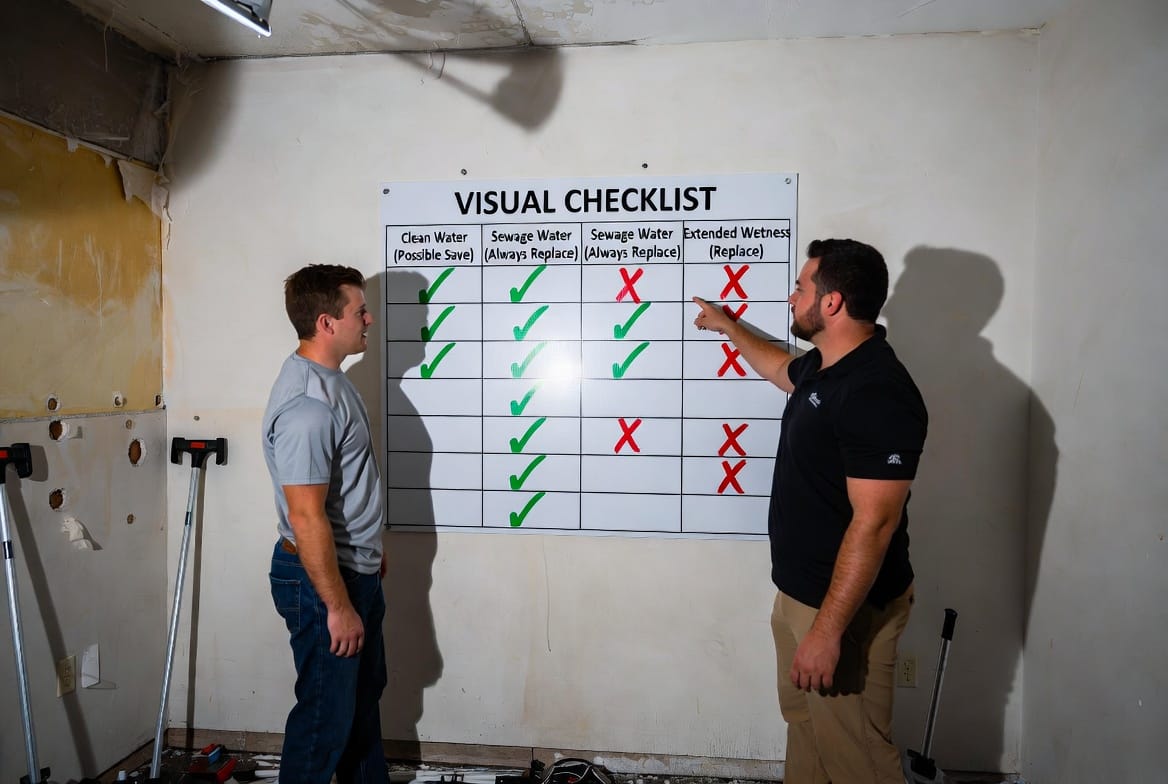
Save the drywall when:
- Water is clean (Category 1)
- Exposure is recent (under 48 hours)
- Soaking is limited and surface integrity remains good
- Professional drying equipment can be deployed immediately
Cut and remove the drywall when:
- Water is sewage or otherwise contaminated
- Soaking is deep or extensive
- Mold or musty odor is already present
- The material has begun to soften or delaminate
There is no middle ground that is safe for long-term occupancy. The correct choice, made quickly and executed correctly, protects both the structure and the health of everyone who lives or works in the building.
Water damage does not have to mean total loss of interior finishes. With accurate evaluation and the right response, many wet drywall sections can be successfully dried and retained. When conditions make saving impossible, clean removal followed by proper reconstruction restores the space to better-than-original condition.
Save drywall when possible. The difference between a quick recovery and a prolonged reconstruction often comes down to one professional assessment. Trained technicians are available around the clock to evaluate your specific situation, protect your property, and guide you through the safest, most cost-effective path forward.
Professional Water Damage Inspection – Call Today