The Flooded Carpet Padding: Why It Must Be Replaced
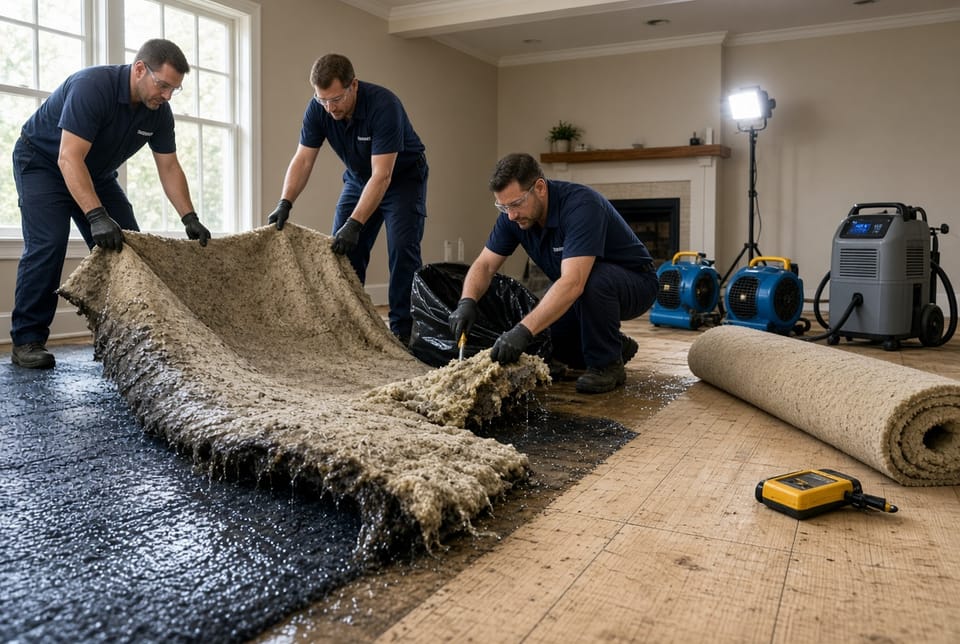
When water reaches a carpeted room, the first thing most people notice is the visible carpet. It looks dark. It feels heavy. It smells damp. What they cannot see is the layer doing the most damage: the carpet padding underneath. That hidden cushion is the reason a “simple leak” so often becomes a mold problem, a musty odor that will not leave, and a floor that never quite feels right again.
Stop Hidden Mold Under Your Carpet – Call Now
If your home has flooded carpet padding, replacement is not an upsell. It is a critical restoration step. Wet padding holds moisture, promotes mold, and cannot be dried reliably while it remains trapped between carpet and subfloor. The professional process is straightforward and protective: remove the wet padding, dry and treat the subfloor, then install new padding and reset or replace the carpet.
This guide explains why that step matters, what happens if it is skipped, and how a complete restoration should be done. If padding in your home is already wet, do not wait. Replace wet carpet padding. Call for restoration at (855) 321-3350.
Why Carpet Padding Is the Hidden Problem After Water Damage
Carpet is a system, not a single surface. The face fibers sit on a backing. The backing sits on padding, also called underlay or cushion. The padding sits on the subfloor—usually plywood, OSB, or concrete.
Padding exists to add comfort, reduce noise, and protect the carpet. Those same qualities make it a poor survivor after a flood, burst pipe, overflowing appliance, or sewer backup.
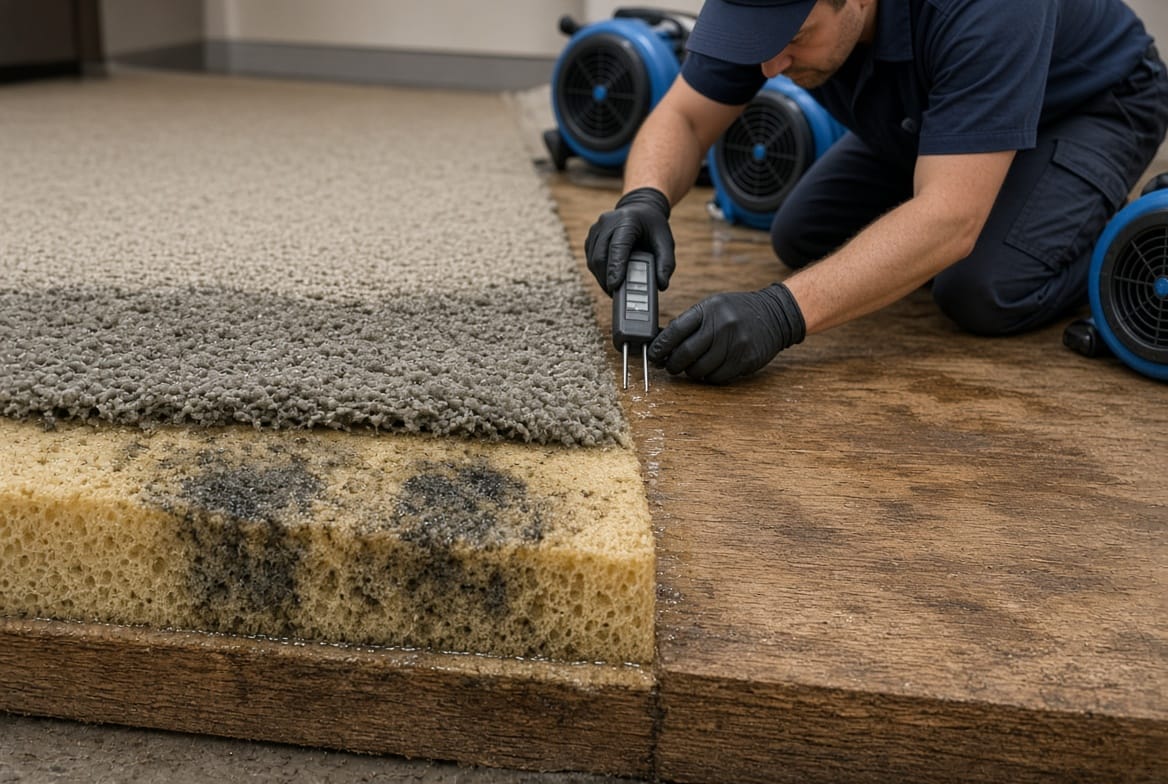
Most residential padding is rebond foam, polyurethane foam, or fiber. These materials are highly porous. They are designed to compress and rebound. They are not designed to shed water. Once water reaches them, they behave like a dense sponge: they absorb quickly, swell, lose loft, and hold liquid in thousands of tiny pockets.
That is the first reason replacement is so often required. The water you extract from the top of the carpet is not the same as the water still locked inside the pad.
Why Wet Carpet Padding Holds Moisture
Air needs a path. Wet padding almost never has one.
After a flood, the pad is sandwiched:
- A heavy, wet carpet above it
- A solid subfloor below it
- Walls, tack strips, furniture, and baseboards around it
That sandwich blocks evaporation. Surface fans can make the carpet feel drier while the padding remains saturated. Moisture meters routinely show this gap: the face fiber reads closer to normal, the pad and subfloor still read elevated moisture.
Even after aggressive extraction, padding can retain water in its core. Foam cells collapse. Fiber pads mat. Water travels laterally under furniture and into closets, then sits where nobody is looking. Cooler floor temperatures slow drying even more. In basements and interior rooms with poor airflow, trapped moisture can linger for days or weeks.
A pad that “looks dry” at the edge can still be wet in the middle. A room that “smells okay” on day two can smell like mildew on day six. That delayed odor is often the first public sign that hidden moisture never left.
Key risk: leftover moisture does not stay in the pad. It migrates into the subfloor, tack strips, baseboard bottoms, and wall plates. The pad becomes a reservoir that keeps feeding water into the structure.
Why Wet Padding Promotes Mold
Mold needs three things: moisture, organic material, and time. Flooded carpet padding supplies all three.
Padding is dark, sheltered, and often slightly warm from room air. It holds water against wood or dusty concrete. Dust, skin cells, and organic binders in foam or fiber give mold something to feed on. Under typical indoor conditions, microbial growth can begin within 24 to 48 hours on damp materials.
Once growth starts in padding, it is not a surface stain you can wipe away. Hyphae move into the foam. Spores collect in the pile above and the dust below. The first clues are often:
- A musty, sour, or earthy odor
- Dark spotting on the pad or carpet backing
- Persistent dampness underfoot
- Allergy-like symptoms that worsen in the room
By the time the smell reaches the living space, the pad has already become a hidden mold reservoir. Cleaning the carpet face does not reach that reservoir. Spraying a household disinfectant on the surface does not sterilize saturated foam. Leaving the pad in place while “waiting to see” is how a water incident becomes an indoor air quality problem.
Health and comfort risk: mold and bacteria from wet padding can affect occupants with asthma, allergies, or reduced immunity. Even when no one feels ill, the odor alone can make a room feel unlivable.
Why Wet Carpet Padding Cannot Be Dried Reliably
Homeowners often ask a reasonable question: If we run enough fans, can we save the pad?
In a very small, clean-water spill found immediately, a technician may evaluate a limited drying attempt. That is the exception, not the rule. In most real-world floods and leaks, wet carpet padding cannot be dried thoroughly enough to trust.
Here is why drying in place fails:
- Limited airflow. Air movers dry surfaces. They struggle to move air through compressed foam pressed to a floor.
- Uneven saturation. Water pools at seams, under sofas, along walls, and in low spots. One dry corner does not prove the whole room is dry.
- Material breakdown. Once foam is soaked, it often crushes, crumbles, or delaminates. Even if moisture later drops, the pad no longer supports the carpet evenly.
- Contamination. Padding absorbs more than water. It holds sediment, bacteria, soap residue, and odor compounds. You can remove liquid. You cannot reliably “un-soak” contamination from a porous cushion.
- No practical verification. You cannot inspect every square inch of pad without lifting the carpet. If you have to lift it anyway, replacement is usually faster, cleaner, and safer.
Industry practice reflects this reality. Restoration teams routinely discard wet padding even when the carpet itself can be cleaned and reused. The pad is the inexpensive, high-risk layer. Keeping it to “save money” often costs more later in mold remediation, odor treatment, and second-round flooring work.
What Happens If You Leave Wet Padding in Place
Skipping replacement can look cheaper for a week and expensive for a year. Common consequences include:
- Persistent musty odor that returns after cleaning
- Mold growth in the pad, carpet backing, and baseboards
- Soft, lumpy, or collapsed cushion underfoot
- Carpet delamination, when the backing separates from the face
- Subfloor cupping, staining, or decay in wood assemblies
- Secondary water damage along walls and under cabinets
- Insurance or resale issues if hidden moisture is later discovered
A room can look finished and still be wet underneath. That is the danger of treating carpet as the whole job. The floor is only restored when the foundation under the carpet is dry, clean, and rebuilt with new cushion.
Clean Water, Gray Water, and Black Water
Not every flood is equal. The source of the water changes the urgency.
- Category 1 / clean water comes from a supply line, tub overflow of potable water, or similar source. Speed still matters. Clean water that sits becomes contaminated.
- Category 2 / gray water includes appliance discharge, some toilet overflows, and water that has picked up contaminants.
- Category 3 / black water includes sewage, outdoor flooding, and water with dangerous pathogens.
Porous padding exposed to gray or black water should be removed. It cannot be sanitized like a hard surface. Even with clean water, prolonged saturation usually takes the pad past the point of safe reuse.
Time is part of the category. Water that began clean can degrade as it sits in dust, soil, and household bacteria. That is another reason the first 24 to 48 hours are so important.
The Critical Process: Remove, Dry the Subfloor, Install New Padding
Replacement is not just “rip it out and drop new foam.” Done correctly, it is a controlled restoration sequence.
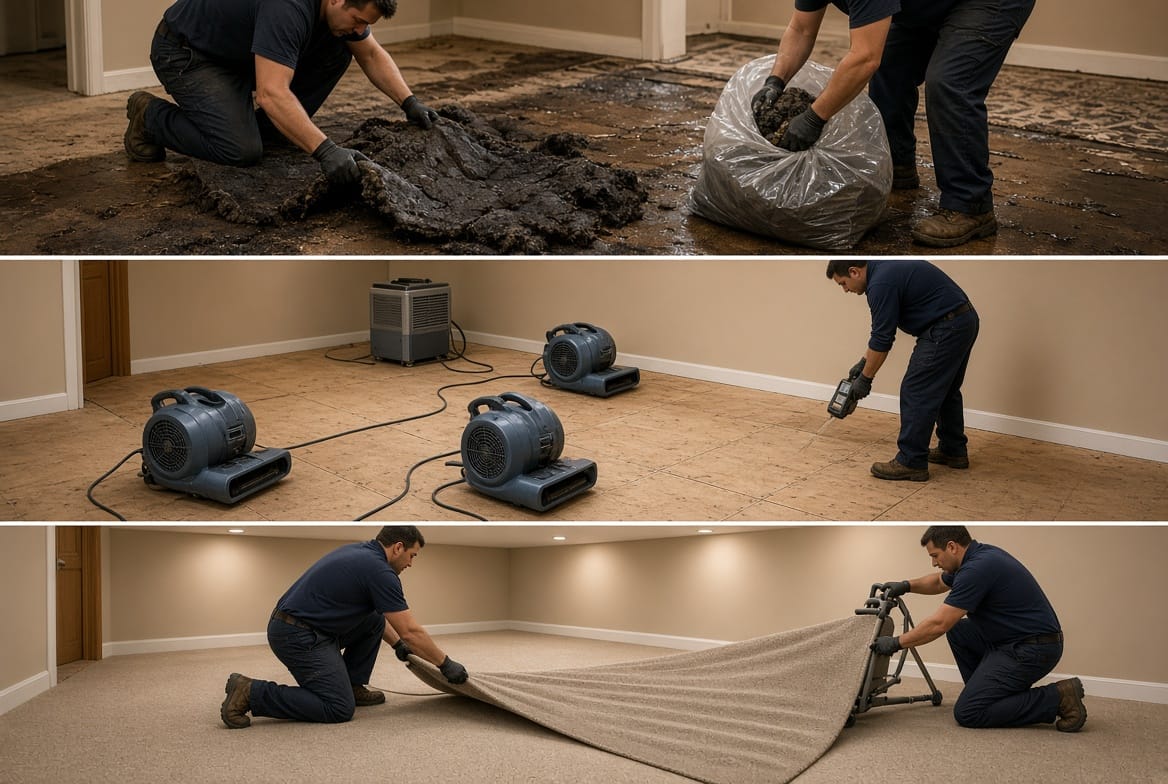
1. Stop the source and extract standing water
The first job is to stop the leak, overflow, or intrusion and remove standing water. Restoration teams use truck-mount or portable extractors to pull bulk moisture from the carpet before it travels farther. Furniture is blocked or removed so wet legs and hidden edges can be reached.
2. Lift the carpet and remove the wet padding
Technicians release the carpet from tack strips, fold or roll it back, and cut the padding into manageable sections. Saturated pad is bagged and removed from the living space. This step does three things at once: it eliminates the sponge, it exposes the floor, and it lets the team inspect hidden damage.
If the water was contaminated, containment and disposal procedures matter. Wet pad should not be dragged through clean rooms.
3. Inspect tack strips, baseboards, and the subfloor
With the pad gone, problems that were invisible become obvious:
- Stained or swollen wood
- Rusted fasteners
- Wet drywall bottoms
- Debris packed against the floor
- Elevated moisture readings
Damaged tack strips are replaced. Wet baseboard or wall materials are addressed so moisture is not boxed back in.
4. Dry the subfloor completely
This is the step that protects the new installation. Air movers create high-velocity airflow across the exposed floor. Dehumidifiers lower room humidity so evaporated moisture leaves the building instead of condensing elsewhere. On wood subfloors, drying continues until moisture readings return to a normal, documented range. On concrete, surface moisture and vapor conditions are checked before new materials go down.
Rushing this step is how new padding gets installed over a still-damp floor. That mistake recreates the original problem.
5. Clean and treat the exposed floor
After extraction and drying, the subfloor is cleaned. Where appropriate, an antimicrobial treatment is applied to reduce remaining microbial load. The goal is a floor that is not only dry, but also ready for new materials.
6. Install new padding and reset the carpet
New padding is cut to fit, kept slightly back from tack strips, and seamed correctly. Then the saved carpet—if it is clean, structurally sound, and appropriate for reuse—is cleaned, dried, and re-stretched. If the carpet itself is contaminated, delaminated, or too damaged, new carpet is installed over the new pad.
The result should feel uniform, smell clean, and stay dry.
Can the Carpet Be Saved If the Padding Cannot?
Often, yes—especially after clean water that is handled quickly. Synthetic carpet fibers hold less water than foam. A professional team can extract, clean, disinfect, dry, and reinstall many carpets once the pad is gone and the subfloor is verified dry.
The carpet should be replaced when:
- The water was sewage or outdoor floodwater
- Wetness lasted long enough for mold or odor to set in
- The backing is separating
- The carpet was already worn or due for replacement
- Cleaning cannot restore appearance or hygiene
Think of it this way: save the carpet when it is safe to save it. Replace the padding almost every time it has been truly flooded.
What You Should Do in the First Hours
Quick action reduces loss, even before a crew arrives.
- Stop the water source if it is safe to do so.
- Turn off electricity to wet areas if water reached outlets or appliances.
- Remove small furnishings and lift wet items off the carpet.
- Avoid using a household vacuum that is not rated for water.
- Do not run a heater at the wet floor in a way that can cook moisture into the pad.
- Do not sprinkle perfume, powder, or random cleaners to hide the smell.
- Do not assume a dry-looking surface means the pad is safe.
Then call professionals who can measure moisture, classify the water, and remove the pad before mold takes hold. Replace wet carpet padding. Call for restoration at (855) 321-3350.
Why Professional Restoration Matters
A flooded floor is easy to underestimate because the damage is partly invisible. Professionals bring more than extra fans. They bring:
- Moisture mapping to find wet zones under furniture and along walls
- Extraction equipment that removes water the carpet is still holding
- Controlled drying for the subfloor, not just the room air
- Decisions based on water category, time, and material condition
- Proper disposal of contaminated padding
- Documentation that helps insurance claims and future buyers
DIY drying can reduce some surface moisture. It rarely proves the pad and subfloor are dry at every point. It also rarely addresses contamination. The authoritative approach is simple: remove the layer that cannot be trusted, dry the structure, and rebuild with clean materials.
Cost Thinking: Replacement Is Usually the Protective Choice
New padding costs far less than a second restoration. Mold remediation, odor removal, subfloor repair, and full carpet replacement are the expensive outcomes. Homeowners sometimes keep wet pad because it feels wasteful to throw away something that “might dry.” In practice, the pad’s job is finished once it has been flooded. New cushion restores comfort, hygiene, and performance.
A complete job also protects indoor air. Families should not have to live over a damp, collapsing foam layer while hoping the smell fades.
Aftercare Once New Padding Is In
After installation, keep humidity controlled. Fix the original leak. Check adjacent rooms for moisture that traveled sideways. Watch for any return of odor during the first weeks. A properly dried subfloor and new pad should remain stable. If a musty smell appears after the work, that is a signal to recheck hidden cavities, not to spray the carpet and wait.
The Bottom Line
Flooded carpet padding is not a cosmetic detail. It is a moisture reservoir, a mold platform, and a material that cannot be dried with confidence in most water-loss situations. Leaving it in place risks odor, microbial growth, uneven flooring, and damage to the subfloor.
The critical step is replacement, done in the right order:
- Remove the wet padding
- Dry and treat the subfloor until readings are normal
- Install new padding and reset or replace the carpet
That sequence restores the floor instead of hiding the problem under a cleaner-looking surface.
If water has already reached your carpet, act while the window is still open. Replace wet carpet padding. A trained team can extract water, pull the damaged pad, dry the structure, and put a clean floor back under your feet before a soaked cushion becomes a lasting indoor hazard.
Save Your Home from Wet Carpet Damage – Call Now