The Washing Machine Motor Coupling: Why the Agitator Won't Spin
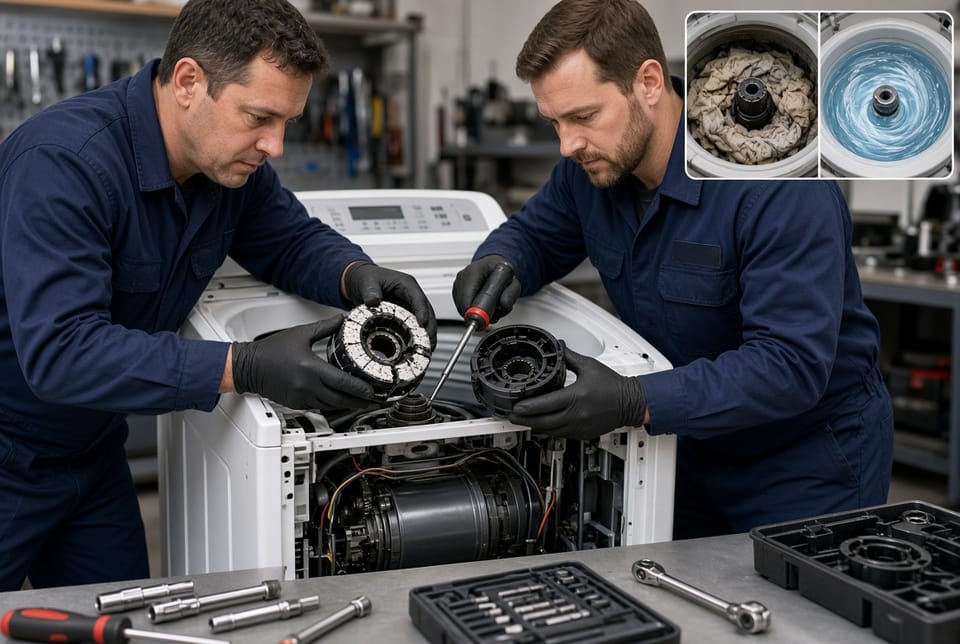
A washing machine that fills, drains, and hums yet never actually washes is one of the most frustrating appliance failures a household can face. Clothes come out as dirty as they went in. The tub sits still. The motor sounds busy. In a large number of top-load machines, the culprit is a small, inexpensive part called the motor coupling.
Get Your Washer Washing Again – Call Now!
This article explains exactly what the motor coupling does, why it fails, how to recognize the classic symptoms, and how most homeowners can replace it themselves. The goal is straightforward: restore agitation without guesswork or unnecessary expense.
What the Motor Coupling Actually Does
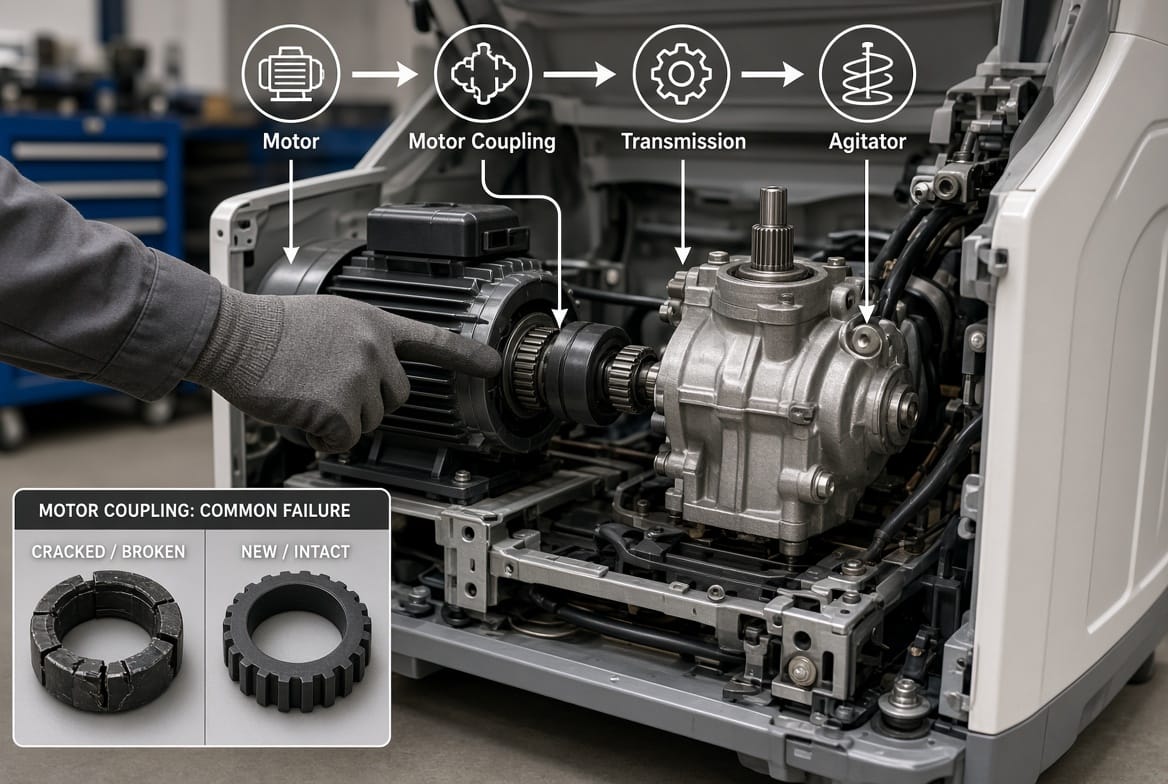
The motor coupling is the mechanical link between the washer’s electric motor and the transmission (sometimes called the gearbox). The motor produces high-speed rotation. The transmission converts that rotation into the slower, reversing motion the agitator needs to slosh water and detergent through the load.
The coupling itself is usually a three-piece assembly: two splined hubs (one on the motor shaft, one on the transmission shaft) and a flexible rubber or plastic center piece that absorbs shock and slight misalignment. When the motor turns, the coupling transfers that torque to the transmission. When the coupling is intact, the agitator moves. When the coupling is broken, the motor can spin freely while the transmission and agitator remain motionless.
This design is common in many Whirlpool, Kenmore, Maytag, and similar direct-drive top-load washers manufactured over the last several decades. The part is deliberately sacrificial. It is cheaper and easier to replace than a burned-out motor or a damaged transmission.
Why Motor Couplings Fail
Several everyday conditions stress the coupling until it cracks or shears:
- Overloading. Packing the tub beyond the manufacturer’s limit forces the agitator to work against too much resistance. The coupling absorbs the extra torque and eventually splits.
- Unbalanced loads. A single heavy item (a wet bath mat or a pair of jeans) thrown to one side creates repeated shock loads every time the machine tries to agitate.
- Age and material fatigue. The rubber or plastic center piece hardens, becomes brittle, and finally fractures after years of heat, moisture, and vibration.
- Foreign objects. Coins, underwire, or small hardware that work their way under the agitator can jam movement and snap the coupling.
- Previous neglect. A machine that has been allowed to vibrate excessively or that has a worn tub bearing puts extra strain on every drivetrain component, including the coupling.
Failure is rarely sudden in the sense of “it worked perfectly yesterday and is dead today.” Most couplings develop hairline cracks first. The machine may still agitate weakly for a few cycles before the center piece finally separates.
Classic Signs the Motor Coupling Has Failed
The symptom pattern is distinctive and easy to distinguish from other washer problems:
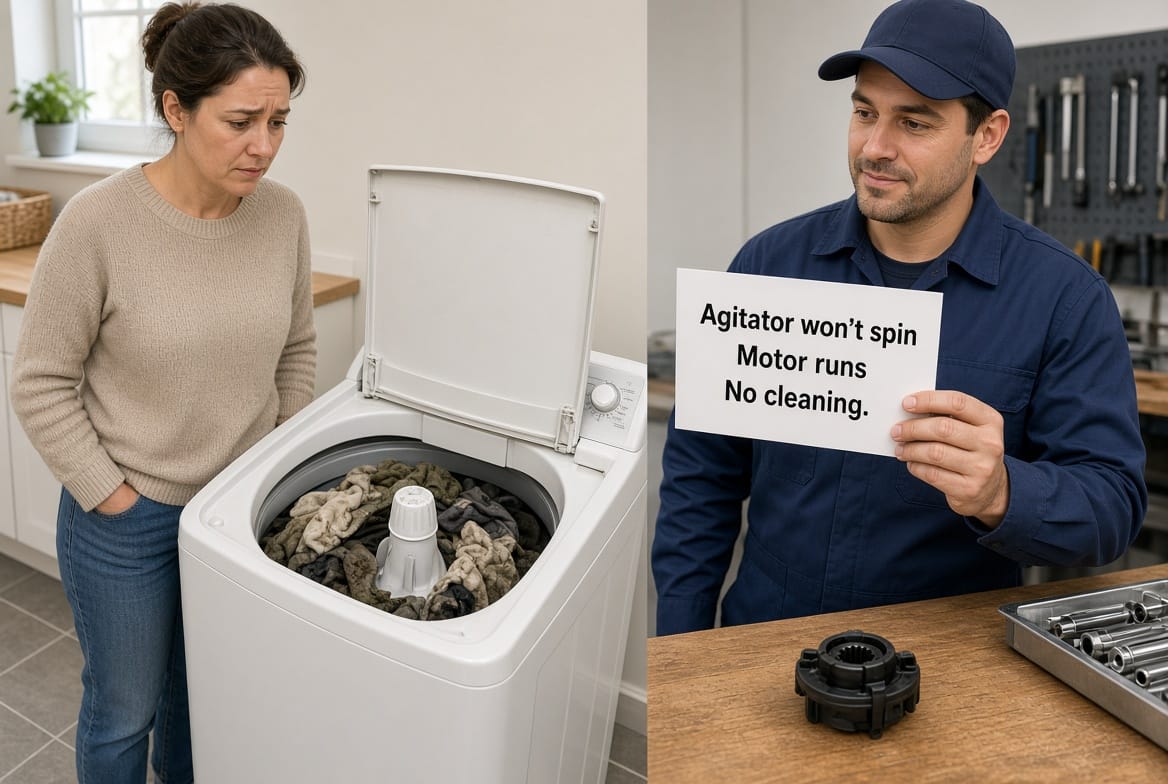
- The motor runs or hums during the wash cycle, yet the agitator will not spin.
- The tub may fill and drain normally.
- Clothes remain dirty because there is no mechanical action to move water through the fabric.
- You may hear a clicking, grinding, or “free-wheeling” sound from the bottom of the machine.
- In some models the basket itself also stays still; in others the basket can still be turned by hand while the agitator cannot.
- The machine may complete a full cycle without ever agitating, then simply drain and spin (or attempt to spin) at the end.
If the motor is silent and nothing moves, the problem is more likely a lid switch, timer, or motor itself. If the motor is clearly running and the agitator is dead, the coupling is the first part to inspect.
Confirming the Diagnosis Before You Buy Parts
Unplug the washer. For most direct-drive models you can access the coupling from the bottom or by removing the cabinet. Lay the machine on its back (protect the floor and the control panel). Remove the pump and motor mounting bolts. Once the motor is free, the coupling is visible between the motor and the transmission.
A failed coupling will show obvious damage: the rubber or plastic center will be cracked, missing pieces, or completely separated. The two hubs may still be on their shafts. If the coupling looks intact, check the motor start capacitor, the transmission, and the agitator dogs before assuming the coupling is the only issue. In the majority of “motor runs, agitator dead” cases, however, the coupling is the failed part.
Replacement couplings are inexpensive and widely available. Buy the exact match for your model number; the spline count and diameter must be correct.
Replacing the Motor Coupling — A Realistic DIY Job
Most homeowners with basic tools can complete this repair in 45–90 minutes.
Safety first. Disconnect power and water. Have a helper if the machine is heavy. Work on a padded surface so the cabinet and console are not scratched.
Tools typically needed:
- Socket set or nut drivers
- Phillips and flat screwdrivers
- Pliers
- Towels and a shallow pan for residual water
- The new coupling kit (usually includes the two hubs and the center piece)
Basic sequence:
- Remove the rear panel or cabinet clips so you can reach the motor.
- Disconnect the wiring harness and the pump hoses if they block access.
- Unbolt the motor from the transmission. Support the motor so it does not drop.
- Slide the old coupling off both shafts. Clean any debris from the shafts and the mounting area.
- Press the new hubs onto the motor and transmission shafts (they are usually a firm press-fit).
- Align the center piece and reassemble the motor to the transmission. Tighten the mounting bolts evenly.
- Reconnect hoses and wiring. Stand the machine upright, level it, and restore power and water.
- Run an empty rinse-and-spin cycle first, then a short wash with a small load to confirm agitation has returned.
The job is mechanically simple. The only parts that require care are the electrical connectors and the pump hoses; a leak after reassembly is almost always a hose that was not fully seated.
If at any point you encounter seized bolts, a motor that will not separate cleanly, or uncertainty about wiring, stop and call a technician. Forcing parts can turn a $20 repair into a $200 transmission replacement.
When Professional Service Makes Sense
DIY is appropriate when:
- You can safely tilt or move the machine.
- The model uses a standard direct-drive coupling.
- You are comfortable with basic disassembly.
Call a professional when:
- The washer is a front-loader or a newer impeller-style machine that does not use this type of coupling.
- You see oil leaking from the transmission (the gearbox itself may be damaged).
- The motor smells burned or will not start even after the coupling is replaced.
- You simply prefer not to work underneath a heavy appliance.
A broken coupling stops agitation. That is the entire problem in most of these cases. Once the new coupling is in place, the washer should agitate normally again.
Keeping the Next Coupling Alive Longer
A few habits dramatically extend the life of the replacement part:
- Respect the load-size limit printed on the washer lid.
- Mix large and small items so the load stays balanced.
- Check pockets before every wash.
- Do not habitually use extra-high water levels with small loads; the extra sloshing increases stress.
- Level the machine so it does not walk or rock during agitation.
These steps cost nothing and protect every component in the drivetrain, not just the coupling.
Final Advice
A failed motor coupling is one of the most common, most predictable, and most inexpensive repairs in the appliance world. The motor runs, the agitator stays still, and clothes do not get clean. Replacing the coupling restores the mechanical connection between motor and transmission and returns the machine to normal function.
If you would rather have the work done for you, or if the diagnosis is not as clear-cut as the classic symptoms described here, professional help is a phone call away.
A broken coupling stops agitation. The fix is well understood, the part is inexpensive, and the washer can be back in service the same day.
Professional Motor Coupling Replacement – Call Now