The Tree Topping Damage: Why This Practice Destroys Trees and Creates Hazards
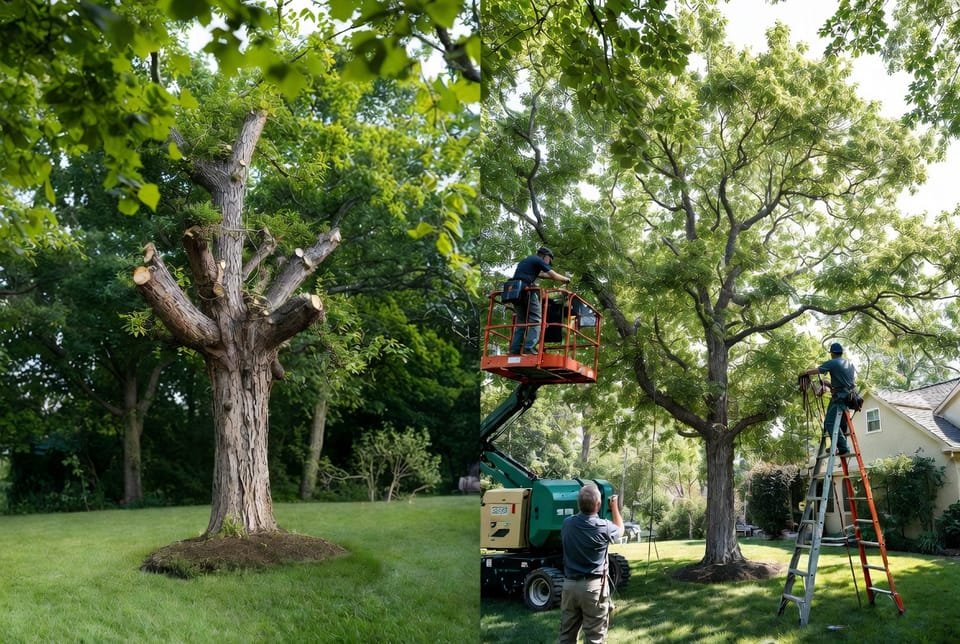
Tree topping remains one of the most damaging and widespread mistakes in residential tree care. Homeowners often request it thinking it will control size or reduce storm risk, yet the opposite occurs. Tree topping – the severe cutting of main branches back to stubs – weakens trees, invites disease, and creates serious safety hazards.
Protect Your Trees from Topping Damage – Call for Expert Pruning
At our professional tree service, we see the long-term consequences daily. Trees that once stood strong become liabilities after improper cuts. Understanding why topping destroys trees empowers you to make better decisions and protect your landscape investment.
What Exactly Is Tree Topping?
Tree topping involves removing large sections of the upper canopy by cutting main branches or the central leader back to arbitrary stubs, often leaving branch collars and leaving no natural taper. Unlike selective pruning, topping disregards the tree’s natural growth patterns and vascular system.
This practice frequently targets large shade trees such as oaks, maples, elms, and poplars. Property owners mistakenly believe drastic height reduction prevents limbs from falling on roofs or power lines. In reality, it triggers a cascade of biological responses that make the tree far more dangerous over time.
Key characteristics of topping include:
- Cuts made between nodes rather than at branch unions
- Removal of 50% or more of the tree’s foliage in one session
- Creation of multiple upright sprouts (epicormic shoots) from latent buds
- Exposed large wound surfaces without protective callus formation
The Devastating Biological Impact on Trees
Trees possess sophisticated defense mechanisms developed over millions of years. Topping bypasses these systems entirely. When you remove the main leader and large limbs, the tree loses its primary source of energy production – the leaves.
In response, the tree frantically pushes out vigorous but weakly attached new growth. These epicormic sprouts grow extremely fast, often reaching 10-15 feet in a single season. However, they attach only to the outer layers of wood rather than the strong central core, creating weak branch attachments prone to failure.
Bold risks of topping include:
- Rapid decay entry: Large cuts expose heartwood, allowing fungi and bacteria to penetrate deeply. Decay can spread downward into the trunk within just a few years.
- Sunburned bark: Sudden removal of the protective canopy exposes previously shaded bark to intense sunlight, causing cracking and further infection points.
- Starvation stress: Severe leaf loss reduces photosynthesis, depleting stored energy reserves and weakening the entire vascular system.
- Increased storm vulnerability: The dense cluster of new sprouts catches wind like a sail, exerting tremendous force on the weakened attachment points.
Research from arboricultural organizations consistently shows that topped trees often decline faster than untouched specimens. Many never regain structural integrity.
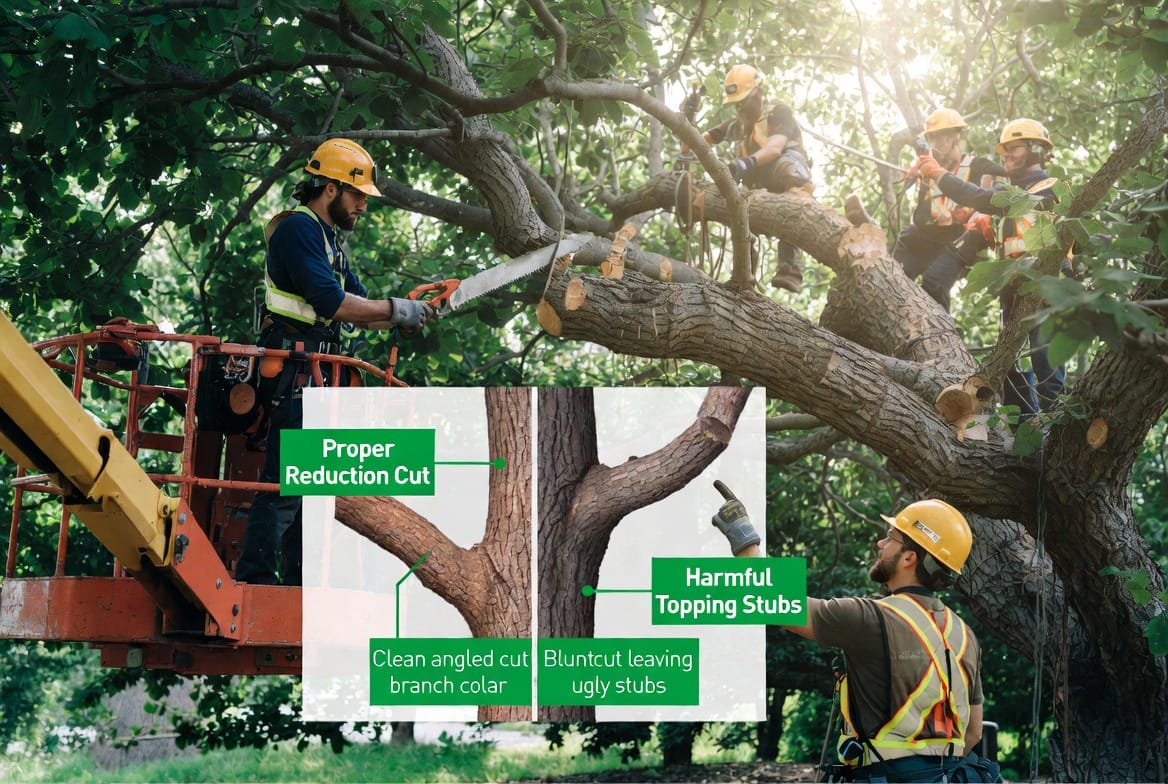
Why Topped Trees Become Major Safety Hazards
The hazards extend far beyond aesthetics. Topped trees frequently develop hidden structural defects that homeowners cannot easily detect until failure occurs.
Weakly attached sprouts become heavy as they mature, especially when laden with rain or snow. During high winds, these limbs snap at the original cut point, sending large sections crashing down. Insurance claims for damage from previously topped trees have risen significantly in many regions.
Additional long-term hazards:
- Hidden internal decay: External wounds may appear healed while the interior trunk rots, compromising load-bearing capacity.
- Increased lightning attraction: Dense upright sprout clusters can act as natural lightning rods.
- Root system decline: Chronic stress from repeated topping diverts energy from root development, reducing anchorage and increasing uprooting risk.
- Costly future removals: Many topped trees eventually require complete removal due to irreversible damage, far exceeding the cost of proper maintenance.
Property values also suffer. Healthy, well-structured trees enhance curb appeal and can increase home values by thousands of dollars. Topped trees create an eyesore that signals neglect.
Proper Pruning Techniques: The Professional Approach
Fortunately, certified arborists follow science-based methods that enhance tree health while achieving your goals. Proper pruning respects the tree’s biology and promotes strong, sustainable growth.
Reduction Pruning
This technique reduces the overall size of the tree by making cuts back to a lateral branch that is at least one-third the diameter of the removed limb. Reduction cuts maintain the tree’s natural shape and preserve its protective canopy.
Thinning
Selective removal of interior branches improves light penetration and air circulation. Thinning reduces wind resistance without drastically changing the tree’s silhouette.
Cleaning
Removal of dead, diseased, or crossing branches prevents decay spread and improves safety. This essential maintenance should occur regularly.
Raising
Elevation of the lower canopy provides clearance for buildings, vehicles, or pedestrians while preserving the tree’s health.
Professional arborists also consider the species, age, and location of each tree. Timing matters significantly – most deciduous trees respond best to dormant season pruning, while some species have specific seasonal requirements.
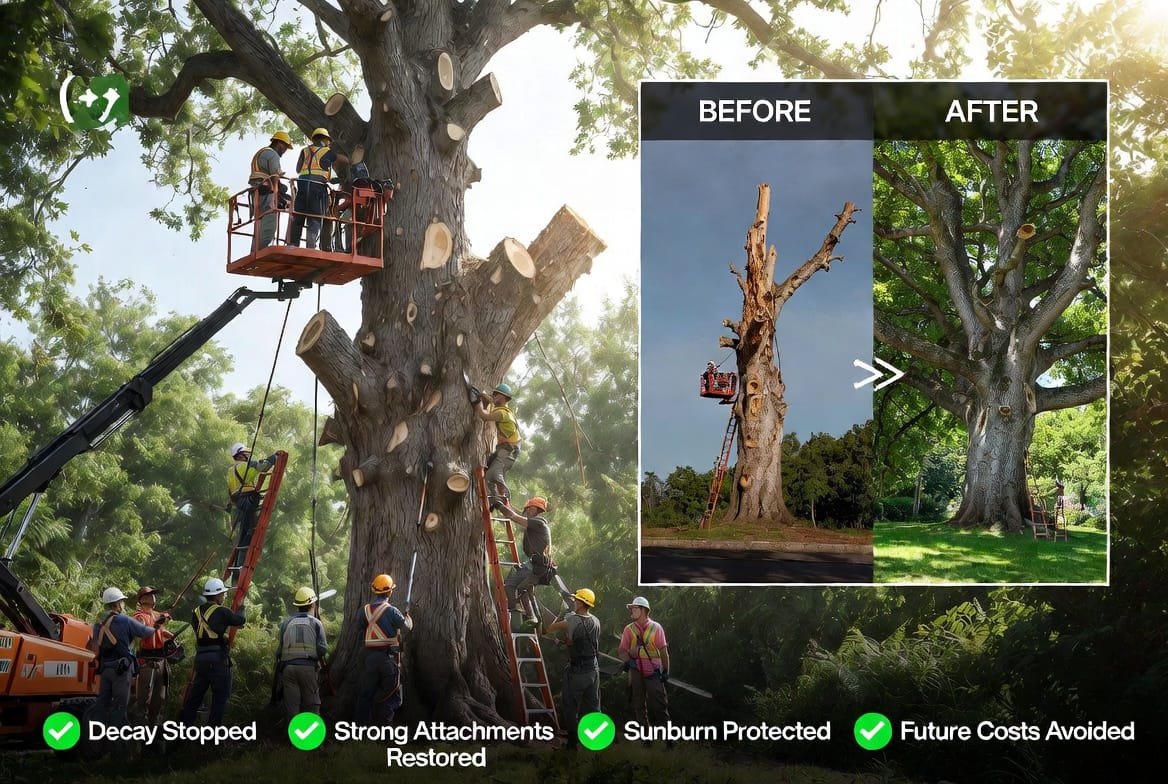
The Long-Term Benefits of Professional Tree Care
Investing in proper pruning yields multiple returns. Healthy trees provide superior shade, reducing cooling costs in summer. They improve air quality by absorbing pollutants and releasing oxygen. Strong root systems help prevent soil erosion and manage stormwater.
Well-maintained trees also resist pests and diseases better than stressed specimens. This resilience means fewer emergency calls and lower long-term maintenance expenses.
Our certified team evaluates each tree individually, developing customized care plans that balance your needs with the tree’s biological requirements. We never recommend topping because we understand its destructive consequences.
Common Myths About Tree Topping
Myth 1: Topping makes trees safer.
Reality: It creates more hazards through weak regrowth and structural failure.
Myth 2: Trees grow back stronger after topping.
Reality: New growth is faster but significantly weaker and more prone to breakage.
Myth 3: All tree services perform topping.
Reality: Reputable, ISA-certified arborists refuse topping and educate clients on better alternatives.
Myth 4: Topping controls root growth.
Reality: Severe pruning actually stimulates compensatory root growth that can damage foundations and sidewalks.
Protecting Your Trees for Future Generations
Trees represent significant investments that can live for decades or even centuries with proper care. The decisions you make today determine whether your landscape remains an asset or becomes a liability.
Regular professional inspections catch potential problems early. Scheduled maintenance pruning keeps trees within bounds without resorting to drastic measures. When performed correctly, pruning actually extends a tree’s lifespan and enhances its beauty.
Never Top Your Trees – Choose Professional Solutions Instead
Tree topping destroys the very trees we value for beauty, shade, and environmental benefits. The practice creates hazards, invites decay, and leads to expensive future problems.
Protect your property and your trees by working with qualified professionals who understand proper pruning techniques. Our experienced team delivers safe, effective solutions that preserve tree health while meeting your landscape goals.
Let us help you maintain strong, beautiful, and safe trees for years to come.
Get Professional Tree Pruning Before It’s Too Late – Call Now