The Tree Cabling and Bracing: Supporting Weak Trees for Longevity
Valuable landscape trees represent decades of growth, shade, beauty, and environmental benefit. When structural weaknesses appear, many property owners assume removal is the only option. Tree cabling and bracing offer a proven preservation strategy that supports compromised trees, reduces the risk of sudden failure, and allows them to continue thriving for years. These techniques do not hide defects; they manage load and movement so the tree can remain a safe, living asset.
Call Today for Expert Tree Removal & Assessment
This approach focuses on preservation rather than replacement. A properly supported tree can continue providing canopy cover, habitat, and property value long after an unsupported tree would have been lost to splitting or collapse.
Understanding Weak Tree Structure
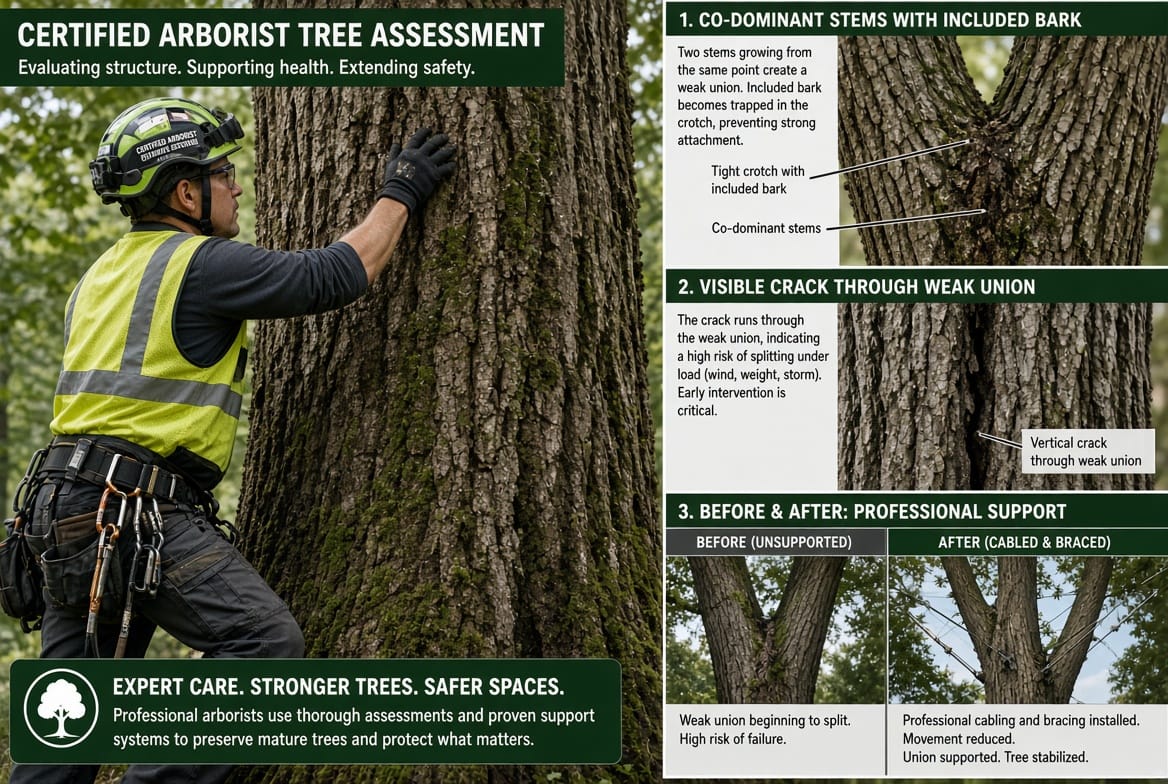
Trees develop strength through even growth and proper branch attachment. Problems arise when two or more stems grow closely together from the same point, creating a weak union. In these cases the wood does not form a strong overlapping connection. Instead, bark becomes trapped between the stems—a condition known as included bark. The result is a natural fault line that can split under wind, ice, or the tree’s own increasing weight.
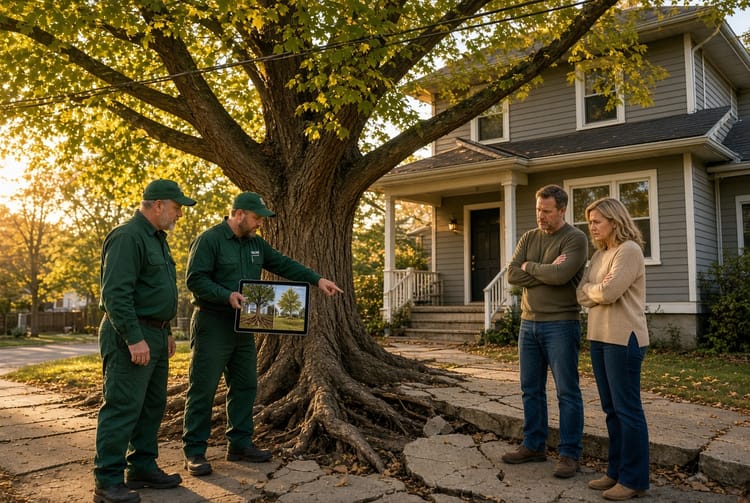
Co-dominant stems are among the most common structural defects. Two leaders of similar diameter compete for the same space, leaving little room for a strong collar of wood to form. Over time the union may crack, and the split can travel downward through the trunk. Visible cracks, leaning leaders, or a history of branch failure all signal that the tree’s architecture can no longer support itself without help.
Without intervention the risk escalates. A sudden split can send large sections of the canopy onto roofs, vehicles, or walkways. Tree cabling and bracing address this vulnerability directly by sharing the load and limiting excessive movement at the weak point.
What Cabling and Bracing Actually Do
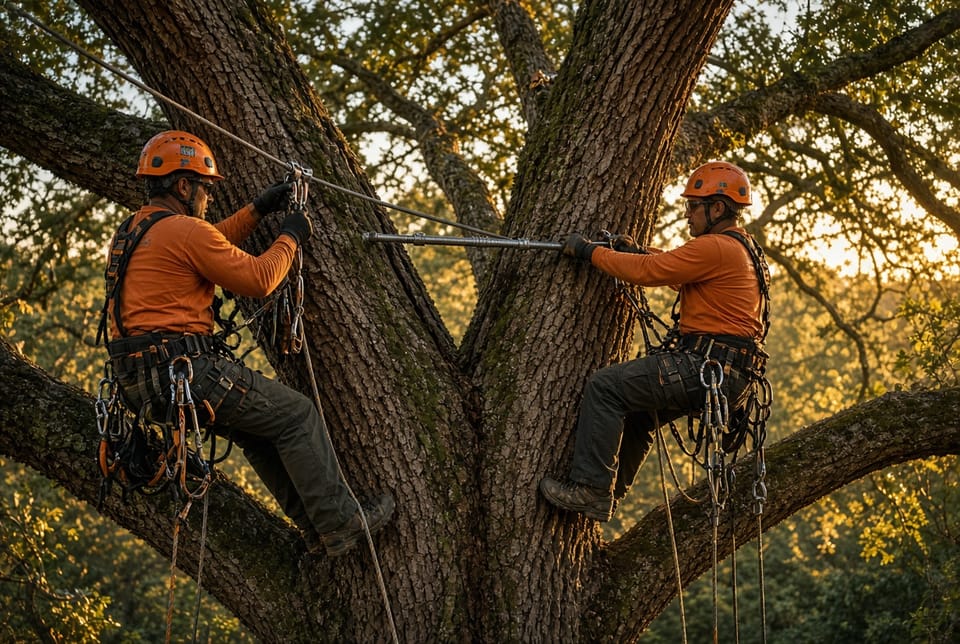
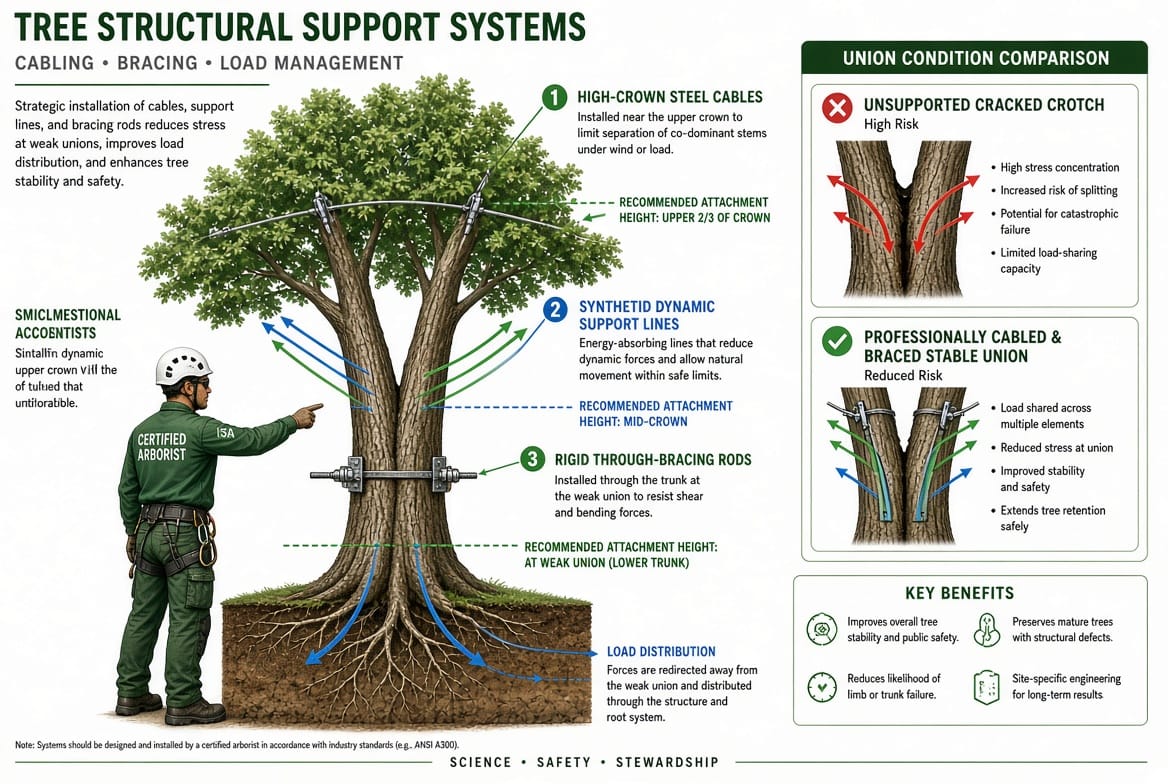
Cabling uses high-strength steel cables or synthetic systems installed high in the crown. The cables connect two or more stems or branches so that when wind or gravity pulls one leader, the other shares the force. This reduces the leverage that would otherwise tear the union apart. Modern dynamic cabling systems allow a controlled amount of movement, which helps the tree continue developing adaptive wood while still preventing catastrophic splitting.
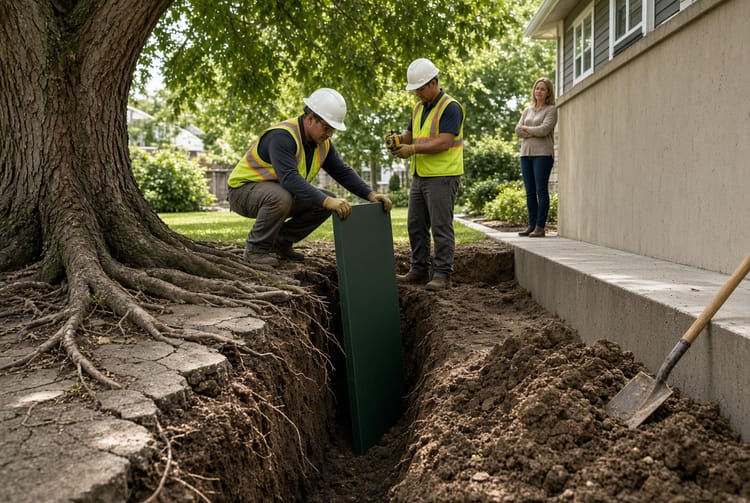
Bracing employs rigid metal rods that pass through the trunk or co-dominant stems at the point of weakness. The rods act like internal stitches, holding the two sides of a potential split tightly together. Bracing is especially useful when a crack is already present or when the union sits lower in the tree where cabling alone cannot provide enough resistance.
Together these systems:
- Support weak unions that lack natural strength
- Prevent or limit splitting along included bark or existing cracks
- Redistribute mechanical stress during storms
- Allow the tree to remain standing and functional
- Buy time for the tree to produce additional reaction wood
The goal is not to make the tree rigid. A healthy tree needs some flexibility. Professional systems are designed to work with the tree’s natural movement rather than against it.
When Cabling and Bracing Become Necessary
Not every tree with a double leader requires hardware. Assessment by a qualified professional determines whether support is the right choice. Common situations that warrant tree cabling and bracing include:
- Co-dominant stems of similar size that form a narrow, V-shaped crotch
- Presence of included bark that prevents proper wood fusion
- Visible cracks or seams running through the union or down the trunk
- A history of large limb failure in the same tree or nearby trees of the same species
- Trees of high landscape or historic value where removal would create a significant loss
- Species known for brittle wood or poor compartmentalization that still occupy important locations
Early intervention produces the best results. Installing support while the tree is still relatively healthy gives it the greatest chance to adapt and continue growing. Waiting until a major split has already occurred often reduces the options available and may make preservation impractical.
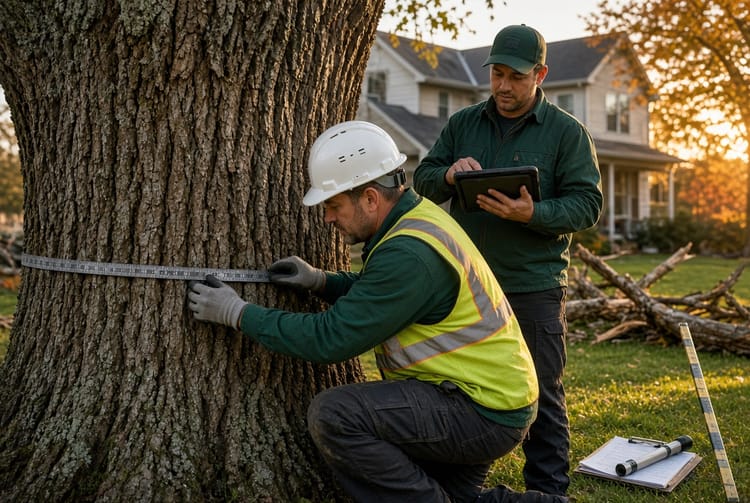
A thorough evaluation considers the tree’s species, age, overall vigor, location relative to targets (homes, streets, play areas), and the specific nature of the defect. Only after this assessment should hardware be specified.
Professional Installation Standards
Successful tree cabling and bracing depends on correct hardware selection, precise placement, and proper tensioning. These are not do-it-yourself projects. Incorrectly installed systems can create new stress points, girdle living tissue, or fail under load—sometimes causing more damage than the original defect.
A certified arborist begins with a climbing or aerial inspection to map the exact location of weaknesses. Hardware is then chosen according to the size of the stems, expected loads, and whether a static or dynamic system is appropriate. Cables are typically attached with specialized bolts or lag hooks placed high enough to provide mechanical advantage yet low enough to remain within living wood that can respond. Bracing rods are drilled and installed so they pass through sound wood on both sides of the union and are secured with washers and nuts that will not crush the bark.
After installation the system is tensioned to the correct specification—tight enough to share load, yet not so tight that it restricts growth or creates new wounds. All hardware is documented, and the tree is scheduled for periodic inspection. As the tree grows, cables may need adjustment or replacement; braces are monitored for corrosion or loosening.
Professional work also includes consideration of the tree’s future. Support systems are one part of a larger preservation plan that may include pruning to reduce end-weight, soil care to improve vigor, and regular monitoring. The combination of mechanical support and good cultural practices gives the tree its best chance at longevity.
Benefits of Preservation Through Support
Removing a large, healthy-appearing tree is often expensive and emotionally difficult. Tree cabling and bracing can keep that tree in place while managing risk. The benefits extend beyond the individual specimen:
- Retention of mature canopy that would take decades to replace
- Continued shade, cooling, and stormwater interception
- Preservation of property value associated with established trees
- Reduced likelihood of sudden failure that could damage structures or injure people
- Opportunity for the tree to develop additional supporting wood over time
These systems are not a guarantee of immortality. Every tree eventually declines. However, many supported trees remain safe and attractive for ten, twenty, or more additional years—time that allows owners to plan for eventual succession planting if needed.
The reassuring reality is that structural weakness does not automatically equal imminent death. With professional support, many trees that look destined for the chipper can continue serving their landscape role.
Recognizing the Signs That Support May Be Needed
Property owners can watch for several visible indicators that a professional assessment is warranted:
- Two or more main stems of similar diameter arising from one point
- A tight V-shaped crotch rather than a wide U-shaped attachment
- Bark that appears pinched or missing between stems (included bark)
- Vertical cracks or seams at the union or running down the trunk
- Recent large branch failures, especially during moderate weather
- A noticeable lean that has increased over time
- Fungal fruiting bodies or cavities near the base of a co-dominant stem
Any of these signs should prompt a call for evaluation rather than immediate removal. An arborist can determine whether cabling and bracing will meaningfully reduce risk or whether other measures (or removal) are more appropriate.
Ongoing Care After Installation
Support hardware is not “set and forget.” Trees grow, hardware weathers, and storms test every system. Annual or biennial inspections confirm that cables remain properly tensioned, braces have not loosened, and no new defects have developed. If the tree adds significant caliper, attachments may need to be relocated or supplemented.
Pruning remains important. Reducing the length and weight of long, heavy limbs lessens the force the support system must resist. Soil health, mulching, and irrigation during drought also help the tree maintain the vigor needed to respond to its new mechanical environment.
When these practices are followed, tree cabling and bracing become a reliable component of long-term tree care rather than a one-time repair.
Choosing Preservation Over Premature Removal
Many trees that appear structurally compromised still possess strong vitality and significant remaining lifespan. Removing them solely because of a weak union discards years of growth and the benefits that growth provides. Professional support offers a middle path: manage the risk, keep the tree, and monitor its condition.
The decision always begins with a thorough assessment. An experienced arborist evaluates not only the defect but the tree’s overall health, the surrounding targets, and the realistic expectations for the support system. When the numbers and the biology align, cabling and bracing become one of the most effective tools available for tree preservation.
Save valuable trees with cabling and bracing.
Get Professional Tree Removal When Support Isn’t Enough