The Teeth Whitening Options: In-Office vs. At-Home
A brighter smile remains one of the most requested improvements in modern dentistry. Coffee, tea, red wine, tobacco, certain medications, and the natural aging process all contribute to extrinsic and intrinsic stains that dull the appearance of enamel. Patients today face a clear choice between in-office professional whitening and at-home whitening systems. Both approaches rely on peroxide-based chemistry to break down stain molecules, yet they differ dramatically in concentration, speed, supervision, cost, and expected outcome. Understanding those differences allows you to select the method that matches your timeline, budget, sensitivity profile, and desired shade change.
Choose the Right Whitening Method – Call Now!
This guide examines the two primary pathways in detail, outlines realistic results, lists advantages and limitations, and helps you decide which option—or combination—best serves your goals. A dentist evaluation remains the safest first step before any whitening begins.
Why Teeth Lose Their Natural Brightness
Tooth color is not uniform. The outer enamel layer is semi-translucent and covers the yellowish dentin beneath. Over time, chromogens from food and drink bind to the enamel surface (extrinsic stains). Deeper discoloration can occur inside the tooth structure itself (intrinsic stains) from trauma, tetracycline use during tooth development, or excessive fluoride. Daily brushing removes some surface debris, but it cannot reverse established stain molecules.
Whitening agents—primarily hydrogen peroxide or carbamide peroxide—penetrate enamel and oxidize those molecules, rendering them colorless. The higher the concentration and the longer the contact time (within safe limits), the more noticeable the change. Professional supervision ensures the agent stays on enamel and away from gums and root surfaces.
How Professional In-Office Whitening Works
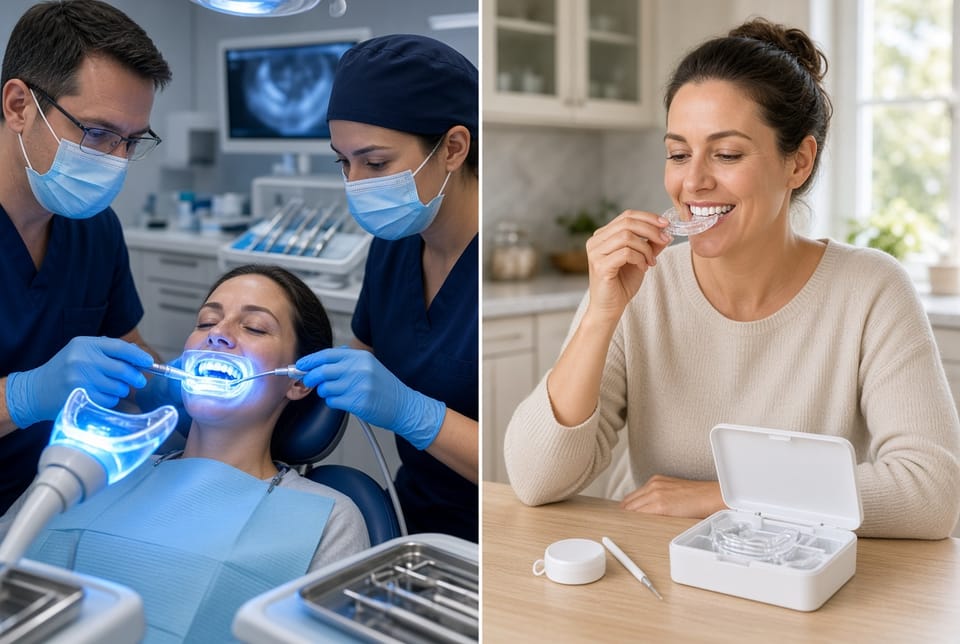
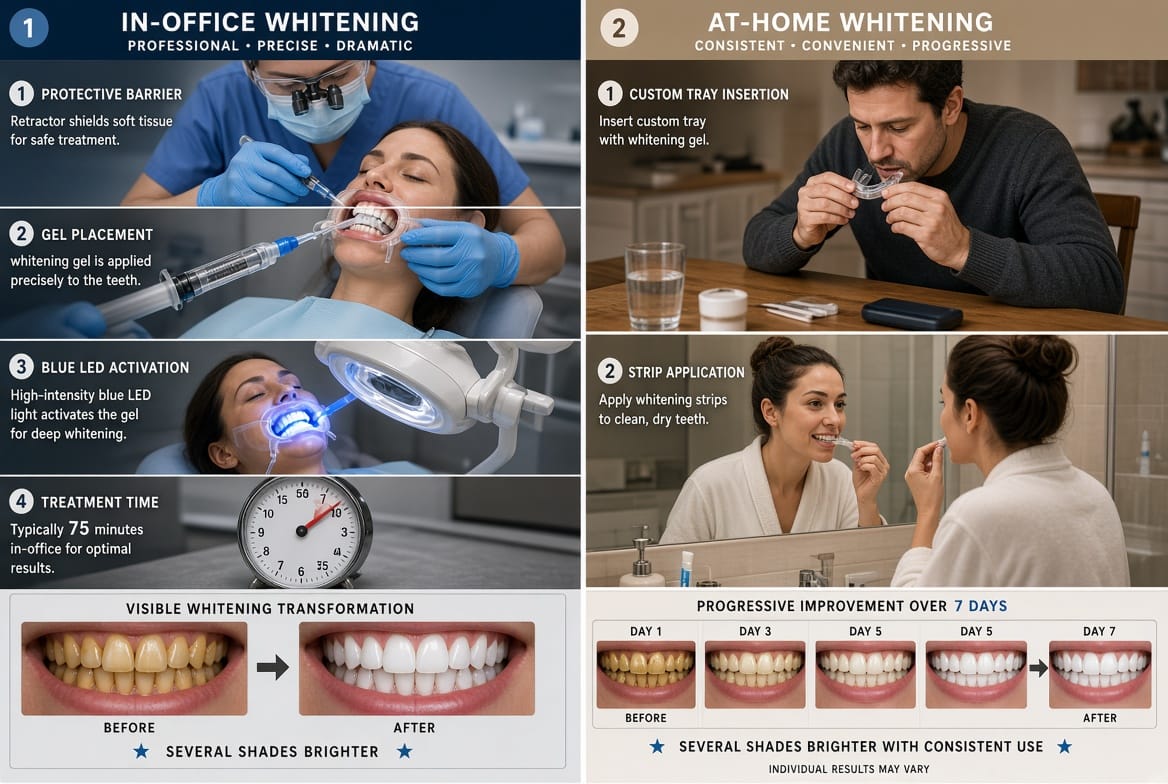
In-office whitening, sometimes called chairside or power bleaching, uses the strongest professionally approved gels, typically 25–40 percent hydrogen peroxide. The appointment usually lasts 60–90 minutes and produces visible results before you leave the office.
The sequence is methodical. After a comprehensive exam and cleaning, the dentist isolates the teeth with a liquid rubber dam or resin barrier to protect gingival tissue. A high-concentration gel is applied in several 15-minute cycles. Many offices activate the gel with a specialized LED or plasma light that may accelerate the oxidation reaction, although research shows the light itself is secondary to the peroxide concentration. Between cycles the gel is refreshed. Most patients see a shift of three to eight shades in a single visit.
Because the process is fully supervised, the dentist can immediately address any tooth sensitivity or soft-tissue irritation. Desensitizing agents or lower-concentration touch-up gel can be applied on the spot. The result is the fastest, most dramatic change available in a controlled clinical setting.
Advantages of In-Office Treatment
- Immediate, highly visible results after one appointment.
- Highest peroxide concentrations used under professional isolation.
- Real-time monitoring of enamel and gum health.
- Customized shade matching and ability to treat isolated dark teeth.
- Reduced risk of uneven application or chemical burns.
Limitations of In-Office Treatment
- Higher fee, commonly several hundred to over a thousand dollars per session.
- Temporary post-treatment sensitivity that usually resolves within 24–48 hours.
- Results are not permanent; maintenance is still required.
- Not ideal for patients with extensive restorations, active decay, or untreated gum disease.
At-Home Whitening: Custom Trays and Over-the-Counter Products
At-home options fall into two broad categories: dentist-dispensed custom trays and widely available over-the-counter products.
Custom take-home trays begin with impressions or digital scans of your teeth. A laboratory fabricates thin, precisely fitting vinyl trays. The dentist then supplies a lower-concentration gel—usually 10–20 percent carbamide peroxide or 3–10 percent hydrogen peroxide—and detailed wear instructions. Patients typically wear the trays 30–60 minutes daily (or overnight with certain formulations) for one to two weeks. Shade improvement is gradual, often two to four shades, and can be extended if additional gel is purchased.
Over-the-counter strips, pens, and paint-on gels contain even lower peroxide levels. Popular strip systems adhere to the front surfaces of the teeth for 30 minutes once or twice daily over 7–14 days. Results are milder and less uniform because the strips do not adapt perfectly to every tooth contour. Whitening toothpastes and rinses offer only modest surface stain removal and should not be considered equivalent to peroxide bleaching.
Advantages of At-Home Systems
- Significantly lower cost, especially for store-bought strips.
- Convenience of treating at your own schedule.
- Gentler daily exposure that some patients find more comfortable.
- Ability to perform periodic touch-ups without another office visit.
- Custom trays provide better gel distribution than generic strips.
Limitations of At-Home Systems
- Slower visible change—days to weeks rather than one hour.
- Greater chance of uneven results or missed spots.
- Higher risk of gum irritation if trays or strips are poorly fitted or overused.
- Limited effectiveness on deep intrinsic stains.
- Users may be tempted to exceed recommended time, increasing enamel dehydration and sensitivity.
Direct Comparison: Speed, Cost, Comfort, and Longevity
The most practical way to decide is to weigh four variables that matter to nearly every patient.
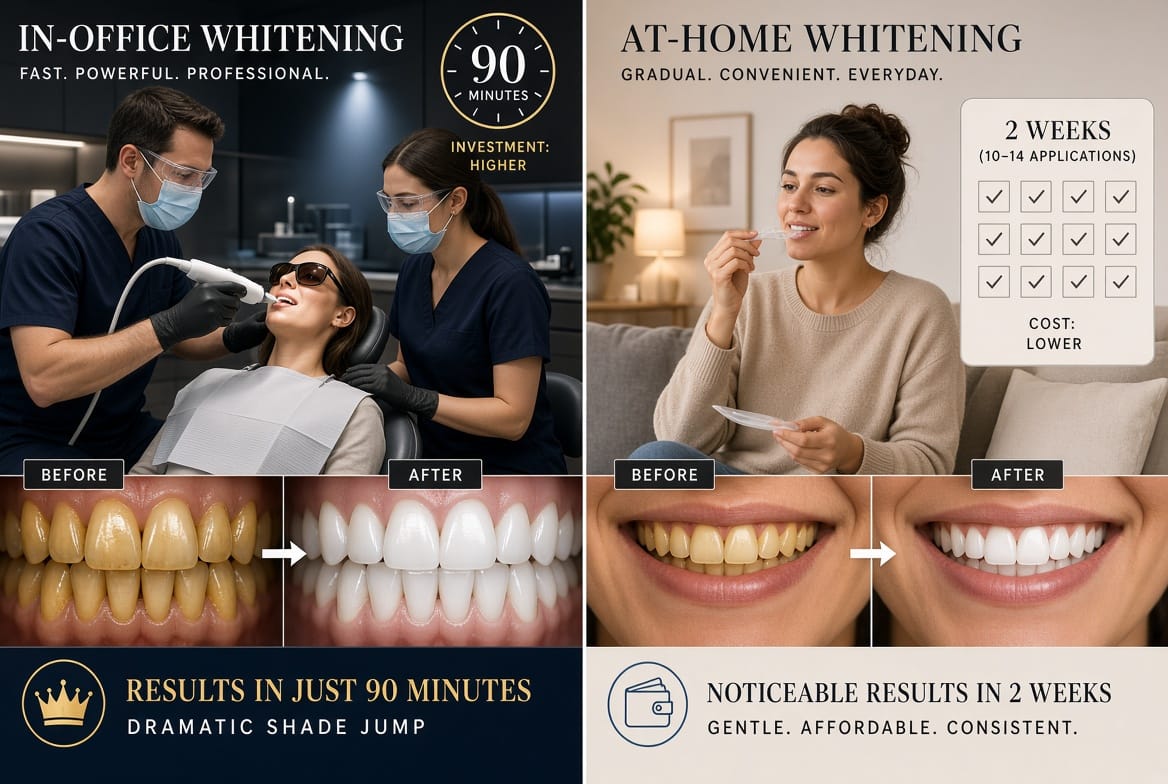
Speed of results favors in-office care. A single 90-minute visit can accomplish what two weeks of nightly tray use might achieve. Patients preparing for a wedding, interview, or photograph often choose the chairside route for this reason.
Cost favors at-home systems. A professional session typically costs several times more than a quality custom-tray kit and many times more than a box of strips. However, the per-shade improvement is usually greater with in-office treatment, so the value calculation is not purely dollar-for-dollar.
Comfort and sensitivity vary by individual. Higher-concentration in-office gels can produce a sharper, shorter episode of sensitivity. Lower-concentration home products spread the same chemistry over many days, which some patients experience as milder but longer-lasting tingling. Both methods can be paired with potassium-nitrate desensitizers or fluoride varnish to reduce discomfort.
Longevity of the new shade is similar once the desired color is reached. Dietary habits, oral hygiene, and smoking determine how quickly stains return. Most dentists recommend touch-up treatments every 6–12 months regardless of the original method.
Patients with existing white fillings, crowns, or veneers should understand that bleaching agents do not change the color of restorative materials. An in-office evaluation identifies these limitations in advance and prevents disappointment.
Who Should Choose Which Method?
Ideal candidates for in-office whitening include individuals who want the fastest possible change, have moderate-to-heavy staining, prefer professional oversight, or have a specific deadline. Those with a history of significant sensitivity may still proceed if the dentist uses a reduced-concentration protocol or applies desensitizing agents first.
Ideal candidates for at-home whitening include budget-conscious patients, those with mild-to-moderate surface stains, people who prefer gradual change, and anyone who can commit to consistent daily use. Custom trays from a dental office generally outperform generic strips in both comfort and uniformity.
A hybrid approach is also common: an in-office “jump-start” session followed by a short course of take-home trays to refine and maintain the shade. Your dentist can design this combination after examining enamel thickness, existing restorations, and gum health.
Safety Considerations and Common Risks
When performed according to instructions, both methods are considered safe for enamel. The primary short-term side effect is transient tooth sensitivity, caused by temporary dehydration of the tooth and opening of dentinal tubules. This typically fades within a day or two. Soft-tissue irritation occurs if gel contacts the gums for prolonged periods—an event far less likely under professional isolation.
Overuse or extremely high concentrations can lead to enamel surface changes or increased porosity. That is why dentist-supervised products and recommended wear times exist. Pregnant or nursing patients, children whose teeth are still developing, and anyone with untreated cavities or periodontal disease should postpone whitening until those conditions are resolved.
A pre-whitening examination also screens for cracks, leaking restorations, or recession that could allow peroxide to reach the pulp and cause prolonged discomfort.
Maintaining Your New Shade
Whitening is not a one-time event. To prolong results:
- Minimize staining beverages or drink them through a straw.
- Rinse with water after consuming coffee, tea, or wine.
- Maintain twice-daily brushing with a non-abrasive toothpaste and daily flossing.
- Schedule professional cleanings every six months.
- Use dentist-provided touch-up gel for a few nights every several months.
Avoid charcoal or highly abrasive “whitening” pastes that can scratch enamel and actually make future staining easier.
Making the Final Decision
No single method is universally superior. The right choice depends on how quickly you want to see change, how much you are prepared to invest, how sensitive your teeth tend to be, and whether you value professional control or at-home flexibility. The most reliable starting point is a consultation that includes an oral examination, discussion of your shade goals, and review of any restorations that will not bleach.
Once those factors are clear, you can proceed with confidence knowing both in-office and at-home options have helped millions of patients achieve a noticeably brighter smile when used correctly.
Choose the right whitening method for your lifestyle and expectations.
Call Now for a Professional Whitening Consultation