The Teen Driver Insurance: Adding a New Driver to Your Policy

Adding a newly licensed teenager to an auto insurance policy is one of the most common family milestones in American households. A son or daughter earns a license, the household vehicle becomes shared transportation, and the family’s existing coverage must legally and financially account for the new driver. This transition is both exciting and consequential. Understanding how adding a teen driver changes premiums, which discounts can offset the increase, and which practical steps reduce long-term cost allows parents to protect their family without unnecessary financial strain.
Add a Teen Driver the Smart Way – Call Today
The moment is ordinary yet significant: the same policy that once covered two experienced adults now includes a driver with limited road time. Insurers treat this change as a measurable rise in risk. The goal of this article is to explain that risk clearly, show how premiums typically respond, outline the most reliable discounts, and give families a realistic plan for managing cost.
Why Adding a Teen Driver Is a Standard Life Event
Most families reach this point between ages 16 and 18. State licensing laws, high-school schedules, after-school jobs, and college commutes all push teenagers toward independent driving. Once the license is issued, the young driver must be listed on the household policy if they regularly use a family vehicle. Failing to add them can create coverage gaps, claim denials, or even policy cancellation.
This is not an unusual administrative task. It is a predictable stage of family life, comparable to adding a new home or changing jobs. The difference is that teen driving risk is statistically higher than adult risk. Inexperience, nighttime driving, peer passengers, and still-developing judgment produce more frequent and more costly claims. Insurers price that reality into the premium.
Parents who treat the addition as a planned financial event rather than a surprise invoice are in a stronger position. Early conversations with the insurer, a review of the current vehicles, and a look at available credits can keep the increase manageable.
How Adding a Teen Affects Premiums
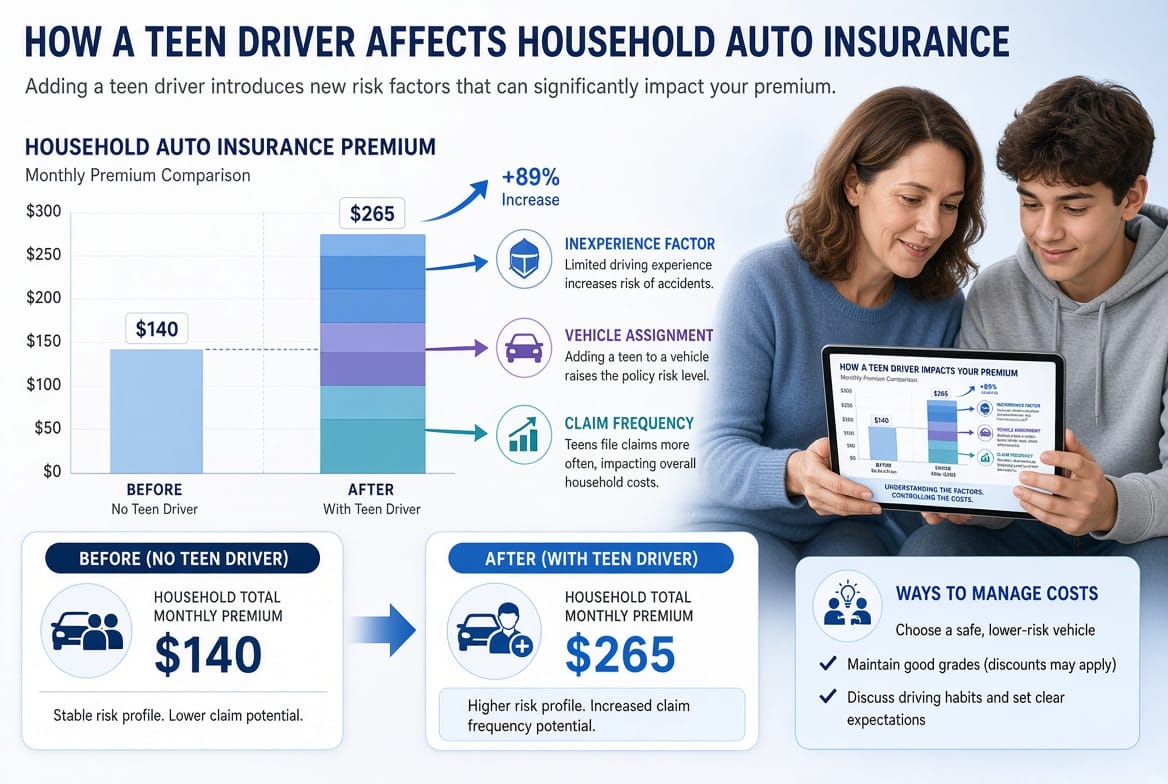
When a teen is added, the insurer recalculates the entire policy using the new driver’s age, gender (where legally permitted), driving record, and the vehicles they will operate. The result is almost always an increase. The size of that increase varies by state, insurer, vehicle, and the teen’s profile, but the direction is consistent: the household rate rises because the expected claim frequency and severity rise.
Several factors drive the change:
- Inexperience. New drivers have fewer miles and fewer hours behind the wheel. Statistical models assign them a higher probability of at-fault accidents.
- Vehicle assignment. If the teen is listed as the primary operator of a newer or higher-value car, the premium impact is larger than if they are assigned a modest, older vehicle.
- Coverage limits and deductibles. Higher liability limits or lower deductibles amplify the cost of the added risk.
- Household driving record. A clean adult record still helps, but it cannot fully offset the teen’s inexperience rating.
The increase is not a penalty; it is a reflection of loss data. Families who understand this distinction can focus on the levers they can control rather than treating the new premium as fixed.
Discounts That Can Offset the Increase
Insurers recognize that not every teen presents identical risk. Several well-established discounts reward safer behavior, better preparation, and ongoing monitoring. The most common and widely available credits include:
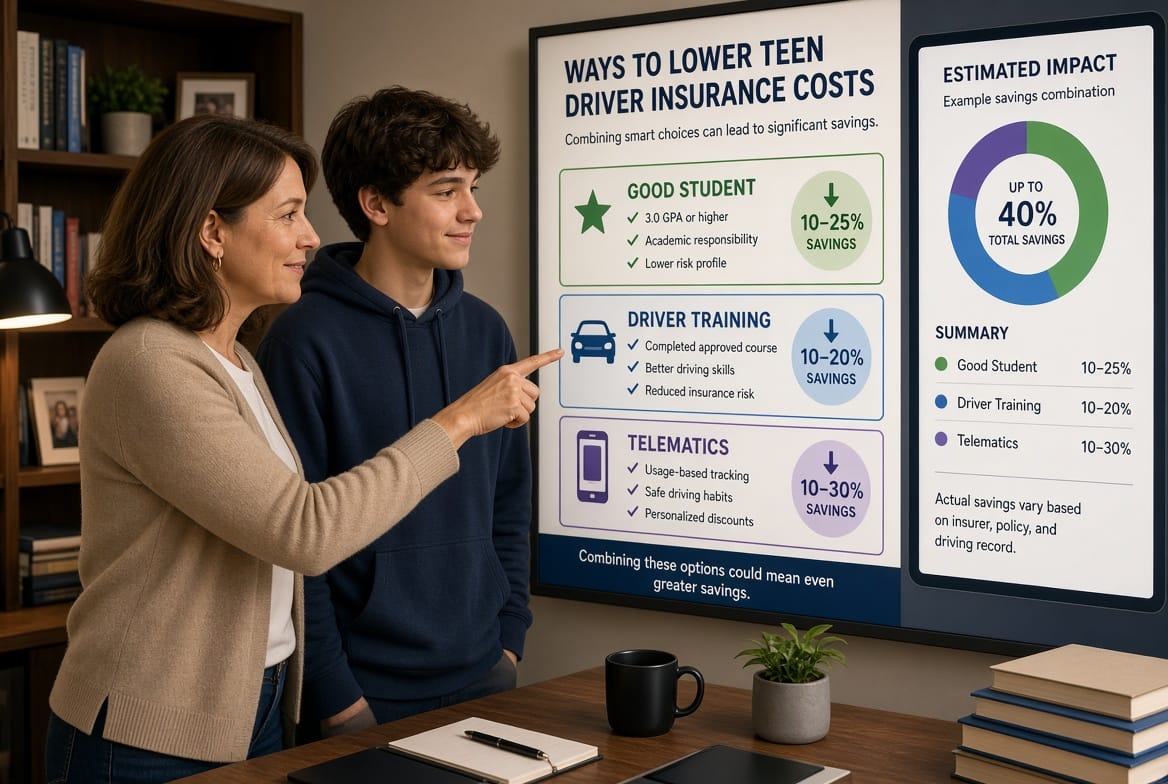
- Good Student Discount. Many carriers reduce the teen’s portion of the premium when the student maintains a B average or better (or equivalent GPA). Documentation—report cards or transcripts—is usually required and must be renewed periodically.
- Driver Training / Defensive Driving Discount. Completion of a state-approved driver education course or an accredited defensive-driving program often qualifies the teen for a credit. Some states mandate the course for licensure; others treat it as optional but still reward it.
- Telematics / Usage-Based Discount. A plug-in device or smartphone app records speed, braking, acceleration, and time of day. Safe driving habits can produce a meaningful credit after a monitoring period. Parents and teens should review the privacy terms before enrollment.
- Multi-car and Multi-policy Credits. Adding the teen does not erase existing household discounts. Bundling auto with home or renters coverage, or keeping multiple vehicles on one policy, continues to lower the overall rate.
- Good Driver / Accident-Free Credits. Once the teen accumulates a clean record, additional credits may become available at renewal.
These discounts are not automatic. They require documentation, timely submission, and sometimes a waiting period. The combined effect can noticeably reduce the net increase that would otherwise appear on the bill.
Practical Tips to Reduce Teen Driver Insurance Costs
Families who approach the addition systematically can keep costs lower without sacrificing necessary protection. Consider the following steps:
- Assign the teen to the least expensive appropriate vehicle. A reliable older sedan or compact car generally costs less to insure than a new SUV or sports model. Safety ratings still matter; choose a vehicle with strong crash-test results.
- Raise deductibles where cash flow allows. A higher comprehensive and collision deductible lowers the premium. Keep liability limits adequate to protect household assets.
- Enroll in telematics early. Many programs offer an initial discount for signing up and a further adjustment based on actual driving data. Consistent safe habits can produce ongoing savings.
- Maintain academic and training records. Keep copies of report cards and course-completion certificates ready for each renewal.
- Review the policy at every renewal. Rates, discounts, and underwriting guidelines change. An annual conversation with the agent or insurer can uncover new credits or better vehicle assignments.
- Set household driving rules. Nighttime curfews, passenger limits, and phone-use policies reduce both crash risk and the chance of future rate increases from tickets or claims.
- Compare options when appropriate. Loyalty has value, but a periodic market check ensures the current carrier remains competitive after the teen is added.
None of these steps eliminates the increase, but together they can keep it within a range most families can plan for.
Setting Expectations and Communicating with the Teen
Premium discussions work best when they are factual rather than punitive. Explain that insurance pricing reflects real-world loss experience, not a judgment of the individual teen. Share the specific discounts the family is pursuing and the behaviors that preserve those discounts. When the teen understands that grades, training, and driving habits have a direct financial effect, they are more likely to treat the privilege of driving as a shared responsibility.
Parents should also confirm that the teen is listed correctly and that all household vehicles are assigned according to actual use. Errors in listing can produce coverage problems later.
Long-Term Perspective
The first year after a teen is added is usually the most expensive. As the young driver accumulates a clean record, completes additional training, and ages into the next rating band, the relative cost often declines. Families who stay organized—keeping documentation current, reviewing the policy annually, and using available monitoring tools—typically see the premium stabilize.
Adding a teen driver is a common life event, not a crisis. With clear information about how premiums are calculated, which discounts apply, and which practical steps reduce cost, parents can add the new driver with confidence.
Manage teen driver insurance costs.
Ask About Good-Student & Training Discounts – Call