The Student Away at School Discount: Lowering Rates When Your Teen Goes to College

Sending a teenager off to college is one of those milestone moments that mixes pride with a quiet list of new expenses. Tuition, housing, meal plans, and textbooks already stretch the budget. What many parents overlook is a lesser-known opportunity sitting inside their auto insurance policy: the student away at school discount. This rate reduction exists because insurers recognize a simple fact of life. When a young driver lives more than 100 miles from home and leaves the family car behind, the risk of a claim drops sharply. They drive far less — mostly during holiday breaks and summer — and that lower exposure can translate into real savings on the household premium.
Claim Your Student Away-at-School Discount – Call Now!
This article walks through exactly how the discount works, why insurers offer it, the precise conditions that must be met, and the practical steps to claim it. The goal is straightforward: help families keep more money in their pockets while their student focuses on classes instead of commuting.
Why Distance and Vehicle Absence Matter to Insurers
Auto insurance pricing rests on risk. Actuaries study millions of claims and look for patterns that predict future losses. A 17- or 18-year-old with a license who drives every day to school, work, or social events sits in a higher-risk category. The same young driver who moves into a dorm 150 miles away and does not keep a vehicle on campus suddenly changes that profile.
Most of the time the student is not behind the wheel at all. The family car stays in the driveway at home. Occasional holiday trips home or summer use still occur, yet the overall miles driven drop dramatically. Insurers respond by adjusting the rating factors applied to that driver. The result is often a noticeable reduction in the premium portion attributed to the away student.
The most common threshold is 100 miles or more from the primary residence. Some carriers use a slightly higher figure, but 100 miles is the widely accepted distance that signals the student is not a daily local driver. Equally important is the absence of a car registered or principally garaged at the college address. If the student takes a vehicle to campus, the discount usually disappears because the exposure remains high.
How the Discount Actually Lowers the Rate
When an insurer applies the away-at-school status, several rating elements shift:
- The student’s annual mileage estimate is reduced.
- The primary vehicle’s use classification may change from “commute” or “pleasure with high-risk young driver” to a lower-use category.
- Some companies remove or lower the youthful-driver surcharge that would otherwise apply for full-time local use.
- In multi-car households, the vehicle the student no longer drives can sometimes be reassigned to a lower-risk operator or placed on a different usage tier.
These adjustments compound. A family that previously paid a steep surcharge for a newly licensed teen can see that surcharge shrink once the teen is away and car-free on campus. The savings are not theoretical; they appear on the next renewal or mid-term endorsement once the proper documentation is on file.
Eligibility Requirements in Clear Terms
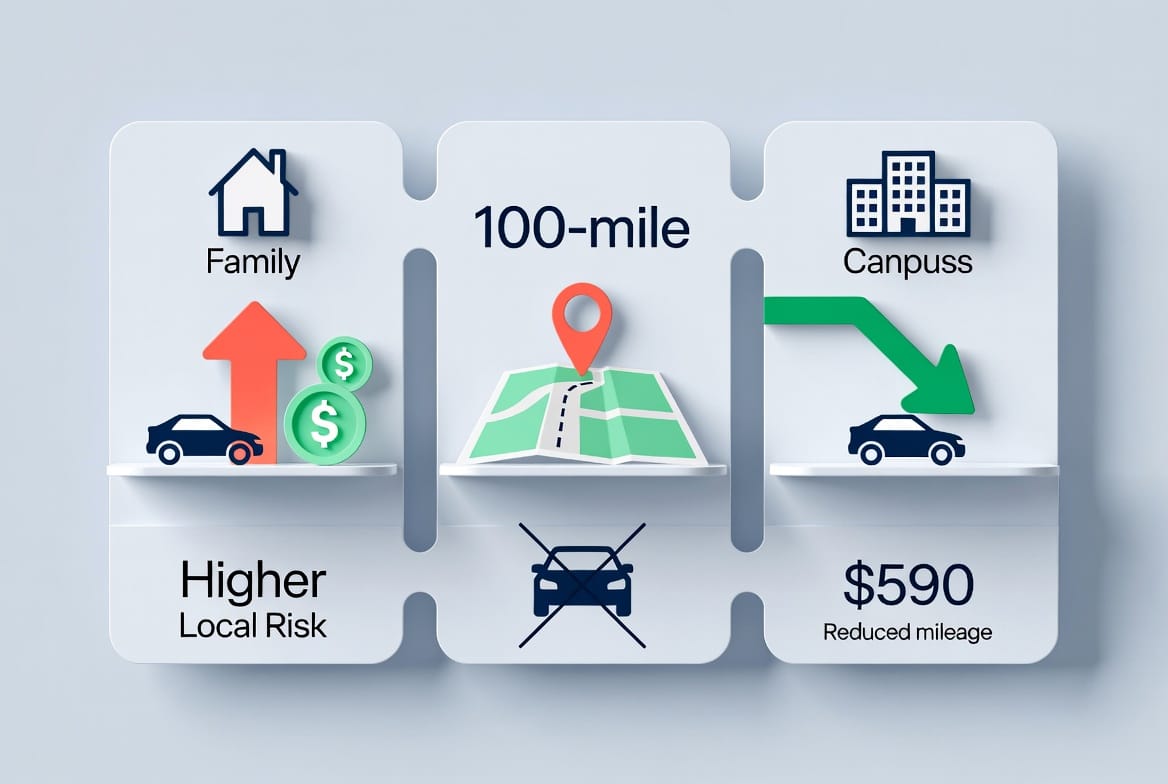
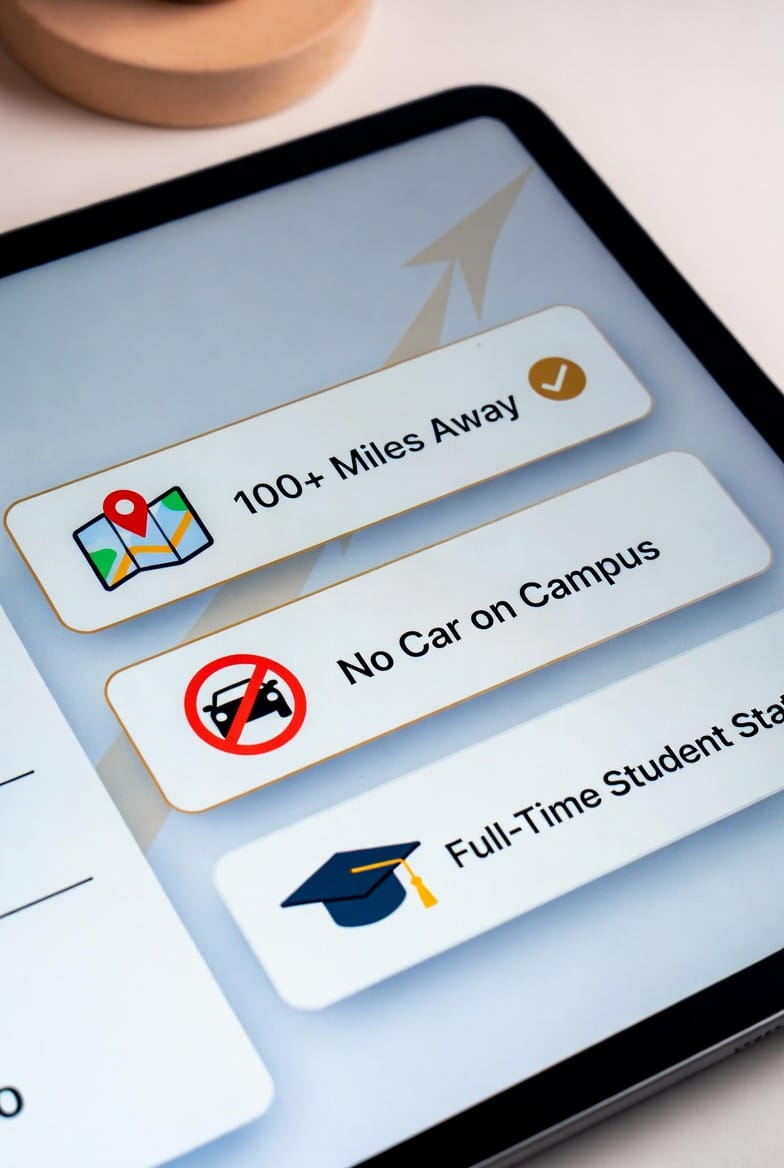
Not every college student automatically qualifies. Carriers look for three core conditions that must be met at the same time:
- The student attends school more than 100 miles from the family’s primary residence.
- No vehicle is kept, registered, or principally garaged at the college location.
- The student maintains full-time student status (usually defined as 12 or more credit hours for undergraduates).
Some insurers add secondary checks such as a clean driving record or continued good-student academic standing, but the distance-plus-no-car rule is the foundation. Part-time students or those living in off-campus apartments with a vehicle nearby rarely qualify. Likewise, a student who returns home every weekend with the family car defeats the reduced-mileage premise.
Parents sometimes worry that listing a student as “away” creates a coverage gap. That fear is unfounded when the policy is structured correctly. The student remains a listed driver on the family policy and is still covered when operating any insured vehicle during visits home. The discount simply reflects the lower overall exposure; it does not remove protection.
Practical Steps to Apply for the Discount
Securing the rate reduction is usually straightforward once the right information is gathered. Begin by contacting the insurance agent or company service line and stating that a household driver is now a full-time student living more than 100 miles away without a car on campus. Most carriers will request:
- The name and address of the college or university.
- Confirmation of full-time enrollment (a class schedule or registrar letter is often sufficient).
- A statement that no vehicle is kept at the school address.
- Updated annual mileage estimates for the household vehicles.
Some companies accept verbal confirmation and follow up with a simple form; others prefer written documentation. Once the information is verified, the underwriter applies the away-at-school rating factor. The change can take effect immediately or at the next billing cycle, depending on the carrier’s endorsement rules. In either case, the premium adjustment appears on the subsequent invoice.
It is wise to mark the calendar for each semester. If the student transfers schools, moves closer to home, or brings a car to campus, the discount status must be updated. Likewise, when the student graduates or leaves school permanently, the rating factor reverts and the premium may rise again. Keeping the insurer informed prevents surprises and maintains accurate coverage.
Common Misconceptions That Cost Families Money
Several myths keep parents from asking about this discount. One frequent belief is that the student must be completely removed from the policy. That is incorrect and potentially dangerous. Removing a licensed driver can create uninsured-motorist exposure if the student later operates a vehicle. The proper approach is to keep the student listed while applying the away-at-school factor.
Another misconception is that only “good students” with high GPAs qualify. While a separate good-student discount often exists and can be stacked, the away-at-school discount stands on its own distance and vehicle criteria. Academic performance is not the primary trigger.
A third myth claims the discount is available only from certain large national carriers. In reality, regional and independent insurers also offer versions of the rating credit. The exact name may differ — “distant student,” “away-from-home,” or “campus discount” — yet the underlying principle remains the same.
Stacking Opportunities and Additional Savings
Families should not stop at the away-at-school discount. Many carriers allow it to combine with other credits:
- Good-student academic discount (usually requiring a B average or better).
- Multi-policy bundling with homeowners or renters insurance.
- Safe-driver or claims-free discounts.
- Paperless billing or automatic-payment credits.
- Telematics programs that reward low-mileage or safe-driving behavior when the student is home.
Asking the agent to review the entire policy for every available credit often uncovers additional reductions. The cumulative effect can be substantial, especially for households with more than one young driver.
Timing Considerations Across the Academic Calendar
The optimal moment to request the discount is shortly after the student moves into campus housing and before the next policy renewal. Mid-term endorsements are common, so there is rarely a need to wait months. Conversely, if the student returns home for an extended period — a full summer, a gap semester, or a study-abroad program that brings them closer than 100 miles — the insurer should be notified so the rating can be adjusted accurately.
Parents of students who attend school year-round or remain on campus through the summer should confirm whether the discount continues. Some carriers maintain the reduced rate as long as the primary residence remains the family home and no vehicle is based at school. Others treat continuous campus living as a different exposure and may reclassify the driver.
Documentation Best Practices
Keep a simple digital folder labeled “Auto Insurance – Student Status.” Inside it store:
- Current class schedules or enrollment verification letters.
- Campus housing contracts that list the college address.
- Any correspondence with the insurer confirming the discount.
- Updated declarations pages that reflect the revised premium.
Having these documents ready speeds up annual reviews and simplifies conversations if a claims adjuster ever questions the student’s location at the time of a loss.
Real-World Impact on Family Budgets
Consider a typical two-parent household with one newly licensed teen. Before college the youthful-driver surcharge may add several hundred dollars per six-month term. Once the student moves more than 100 miles away and leaves the car at home, that surcharge can shrink by 15 to 40 percent or more, depending on the carrier’s rating tables and the student’s prior record. Over four years of college the cumulative savings often reach into the thousands of dollars — money that can offset textbooks, travel costs, or simply reduce financial stress.
The discount also provides peace of mind. Parents know the policy still protects the student during holiday drives and summer months, yet they are not paying full local-driver rates for months when the student is rarely behind the wheel.
Questions Worth Asking Your Agent
When you call, use clear language:
- “Our son/daughter is now a full-time student living more than 100 miles from home and does not keep a car on campus. Can we apply the away-at-school or distant-student discount?”
- “What documentation do you need, and how quickly can the premium be adjusted?”
- “Does this discount stack with our existing good-student or multi-car credits?”
- “What happens if the student returns home for the summer or brings a vehicle to campus later?”
A knowledgeable agent will walk through the answers and process the endorsement without delay.
Final Advice: Save When Your Student Goes to College
College already represents a major investment. There is no reason to continue paying the same auto insurance rate that applied when your teenager drove every day to high school. The student away at school discount exists precisely for this life stage. By confirming the 100-mile distance, ensuring no vehicle stays on campus, and notifying the insurer promptly, families can lower their premiums while keeping full coverage in force.
Do not assume the discount is automatic. Policies do not update themselves when a student moves into a dorm. A short conversation with your agent or a call to the company is all that is required. The earlier the request is made, the sooner the savings begin.
If you are ready to review your policy for this and any other available credits, reach out today A few minutes of conversation can produce months or years of lower rates — a practical, tangible way to support your student’s education without stretching the family budget any further than necessary.
The transition to college changes many things. Auto insurance rates do not have to stay frozen at the high-school level. Take advantage of the reduced risk that comes with campus life, document the change, and keep more of your hard-earned money where it belongs: supporting the next chapter of your family’s story.
Unlock College Student Auto Insurance Savings – Call Now!