The Structural Drying Log: Tracking Progress for Insurance and Peace of Mind
Water damage is stressful. You’ve got soaked carpets, swollen baseboards, and a lingering fear of hidden mold. But here’s what most homeowners don’t realize: the water extraction is only half the battle.
Get Your Drying Log Today – Call Now!
The real question is: How do you know when your walls, floors, and subfloors are genuinely dry?
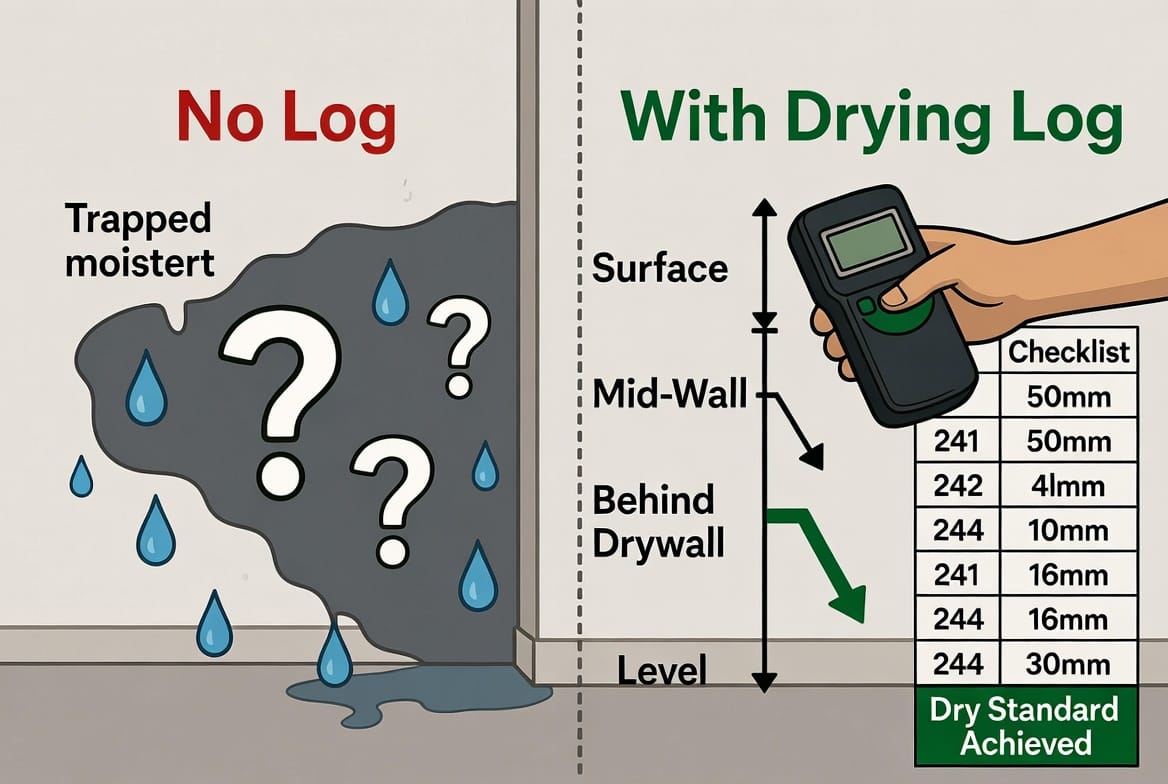
That’s where the structural drying log comes in. This simple but powerful document is your best friend for insurance claims, mold prevention, and peace of mind. Without it, you’re guessing. With it, you have scientific proof that the job is complete.
Let’s break down exactly what a drying log contains, why insurance adjusters demand it, and how to read one like a pro.
What Is a Structural Drying Log?
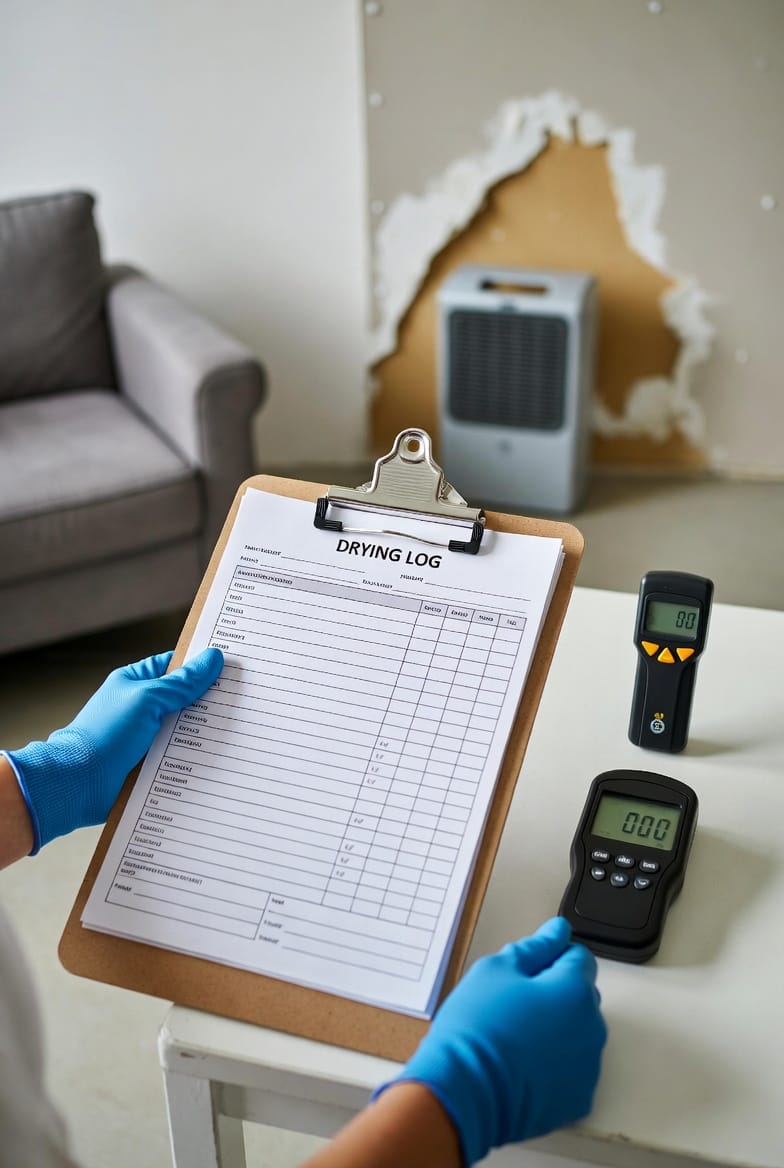
A structural drying log is a daily record kept by water damage restoration professionals. It tracks the drying progress of every affected material in your home — drywall, wood studs, concrete slab, subflooring, and even insulation.
Think of it as a medical chart for your house. Just as a doctor tracks your vitals over time, a restoration technician tracks moisture levels until they return to normal, dry standards.
Key reassurance: A reputable company will never declare a job complete without a fully filled drying log.
Why the Drying Log Matters More Than You Think
Most homeowners focus on visible drying — “the carpet feels dry, so we’re done.” That’s a dangerous mistake.
1. Insurance Claims Require Proof
Insurance adjusters don’t trust feelings. They trust data.
- Without a drying log, your claim for extra drying days or equipment rental may be denied.
- With a log, you show exactly when moisture dropped below 15% in wood or 75% relative humidity equivalent in concrete.
2. Mold Prevention
Mold needs three things: moisture, food (wood/drywall), and time.
- A drying log proves moisture was eliminated within the 24–48 hour window before mold can establish.
- No log = no proof you avoided mold risk.
3. Liability Protection
If mold appears six months later and you have no drying log, the restoration company can blame you (“homeowner didn’t let us finish”).
- A signed, dated log protects both you and the contractor.
What a Professional Drying Log Contains (7 Critical Elements)
Not all logs are equal. A good drying log includes the following — and you should demand every single one.
✅ 1. Date and Time of Each Reading
- Why: Moisture levels change throughout the day. Morning readings vs. evening matter.
- What to look for: Consistent daily entries — no skipped days.
✅ 2. Specific Location of Each Reading
- Not just “living room” but “living room, north wall, 24 inches from floor, between studs 2 and 3.”
- Pro tip: Look for a grid map or photo reference numbered to each reading spot.
✅ 3. Moisture Reading Values (With Unit Type)
- Wood: Percent moisture content (%MC) — dry is 6–12%.
- Drywall: Non-invasive meter readings (relative scale) — dry is under 15–17% on most meters.
- Concrete: Relative humidity (RH%) from in-situ probes — dry is under 75% RH for floor coverings.
✅ 4. Type of Moisture Meter Used
- Pin-type (penetrates surface) vs. pinless (scans below surface).
- Why it matters: Pinless meters can miss moisture deep inside wood. A good log notes both.
✅ 5. Equipment on Site and Run Hours
- Air movers (fans) — number and total run hours per day.
- Dehumidifiers — type (refrigerant or desiccant) and runtime.
- HEPA air scrubbers — if asbestos or mold is suspected.
✅ 6. Ambient Conditions (Temperature & Relative Humidity)
- Air temperature (°F or °C).
- Relative humidity of the room air.
- Why: Drying is faster when air is warm (70–90°F) and dry (below 50% RH). The log proves conditions were optimal.
✅ 7. Technician’s Signature & IICRC Certification Number
- The Institute of Inspection, Cleaning and Restoration Certification (IICRC) sets the standard.
- Never accept an unsigned log. Anonymous data is worthless.
How to Read a Drying Log (Step by Step)
You don’t need to be a restoration expert. Just follow these four checks.
Step 1: Look for the Baseline Reading
The first entry (day 1, hour 1) is your starting point.
- Wet wood often reads 25–40% MC.
- Wet drywall reads over 30% on a non-invasive meter.
If there’s no baseline reading — red flag. They can’t prove progress without a start point.
Step 2: Check for Daily Declining Trend
Each day, every location should show lower numbers.
- A drop of 3–5% per day in wood is normal.
- Stalled readings (same number for 2 days) mean equipment is insufficient or mispositioned.
Step 3: Verify Dry Standard Has Been Reached
The industry standard (IICRC S500) says:
- Wood: Less than 15% MC (or within 2% of nearby unaffected wood).
- Drywall: Less than 17% on non-invasive meter.
- Concrete slab: Less than 75% RH (for most floor coverings).
When every location hits dry standard for two consecutive days — the structure is dry.
Step 4: Confirm Final Sign-Off
The last page should have:
- Final moisture readings (all green/dry).
- Technician’s signature and date.
- A note that equipment was removed.
Warning: If a company says “we’ll come back later to finish the log” — don’t pay in full until that log is complete and signed.
What Happens When There’s No Drying Log?
Let me paint a real-world scenario.
A pipe bursts in your basement ceiling. You call a local “water extraction” company. They bring big fans, run them for two days, and tell you “feels dry, you’re good.” You pay $2,500.
Three months later: You smell a musty odor. You pull back the carpet — black mold on the concrete slab and bottom 6 inches of drywall.
You call your insurance. They ask: “Where’s the drying log showing moisture readings before and after?”
You have nothing. The company won’t return your calls. Insurance denies the mold claim because you can’t prove the structure was ever dried to standard.
Result: $10,000+ in mold remediation out of your own pocket.
This happens every day. Don’t let it happen to you.
What a Good Drying Log Looks Like (Your Checklist)
Here’s your quick-reference checklist — print this or save it for when a restoration technician arrives.
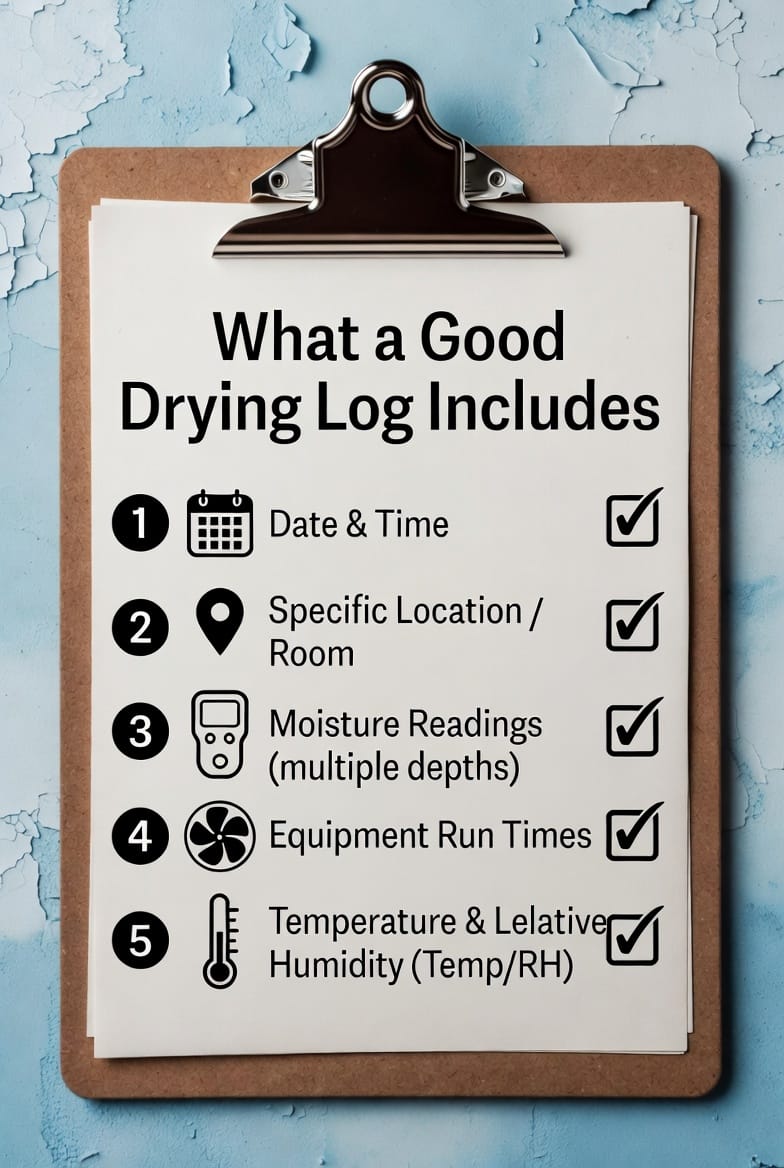
A complete drying log MUST include:
- [ ] Date and time of each visit
- [ ] Specific location (wall, floor, ceiling, with measurements)
- [ ] Moisture reading numbers before and after drying
- [ ] Type of moisture meter used (pin or pinless)
- [ ] Air mover count and daily run hours
- [ ] Dehumidifier type and run hours
- [ ] Room temperature and relative humidity
- [ ] Technician’s printed name, signature, and IICRC number
- [ ] Final sign-off confirming dry standard for 2 consecutive days
If any line is missing — ask why.
Why Professional Restoration Companies Insist on Logs
You might think a drying log is just “paperwork for paperwork’s sake.” It’s not.
Reputable companies (IICRC-certified) use logs because:
- They protect against lawsuits. A signed log proves they followed industry standards.
- They speed up insurance payments. Adjusters approve claims faster with clear data.
- They reduce callbacks. No more “you left moisture behind” complaints a year later.
- They prove when to stop. Running equipment an extra 3 days wastes energy. Stopping too early causes mold. The log tells the truth.
Reassuring fact: National franchise restoration brands (ServPro, Belfor, Paul Davis) all require drying logs as corporate policy. If a local company doesn’t use one — that’s a red flag.
Can You Keep Your Own Drying Log?
Yes — but with limits.
You can buy a pinless moisture meter ($40–150 on Amazon) and track readings yourself. But:
- You may not know where to test (moisture travels unpredictably in walls).
- You lack baseline dry standards (what’s normal for your region’s wood?).
- Insurance may not accept homeowner logs as professional documentation.
Best practice: Let a professional do the initial log. Then ask for a copy daily — and verify the numbers are dropping.
What to Say to Your Restoration Company
When they arrive, say this verbatim:
“I expect a daily structural drying log with moisture readings, equipment run times, and technician initials. I want a copy each day before you leave. And I will not sign a completion form until the final log shows dry standard for two consecutive days.”
A professional company will say: “Absolutely — that’s our standard process.”
A shady company will hesitate or say: “We don’t usually do that for small jobs.”
Hire someone else.
Emergency Situations: When You Need a Log Immediately
Some water losses are urgent — and the drying log becomes even more critical.
Category 3 water (sewage, floodwater) requires extraction, disinfection, and drying with hourly log checks for the first 24 hours.
Large commercial losses (offices, warehouses) often require third-party verification — an independent consultant reviews the drying log before insurance releases final payment.
Mold pre-existing conditions: If you already suspect mold, the drying log proves whether moisture came from the new leak or an old one — crucial for claim approval.
Bottom line: In any dispute, the drying log is the evidence. No log = no case.
Final Take: Documentation Is Your Peace of Mind
Water damage doesn’t end when the standing water disappears. It ends when every hidden pocket of moisture is dried to industry standards — and proven on paper.
The structural drying log transforms a chaotic, stressful event into a tracked, verifiable process. It protects you from mold, from denied insurance claims, and from contractors who cut corners.
You deserve more than “feels dry.” You deserve data.
Documentation Proves the Job Is Done
Don’t leave your home’s health to guesswork. Demand a professional drying log from start to finish — and review it like the important document it is.
Call today for professional water damage drying with proper documentation.
We provide daily logs, IICRC-certified technicians, and insurance-ready reports — so you get peace of mind and proof.
Demand Proof of Dryness – Call Today