The Dehumidifier Placement Strategy: Where to Put Units for Maximum Drying
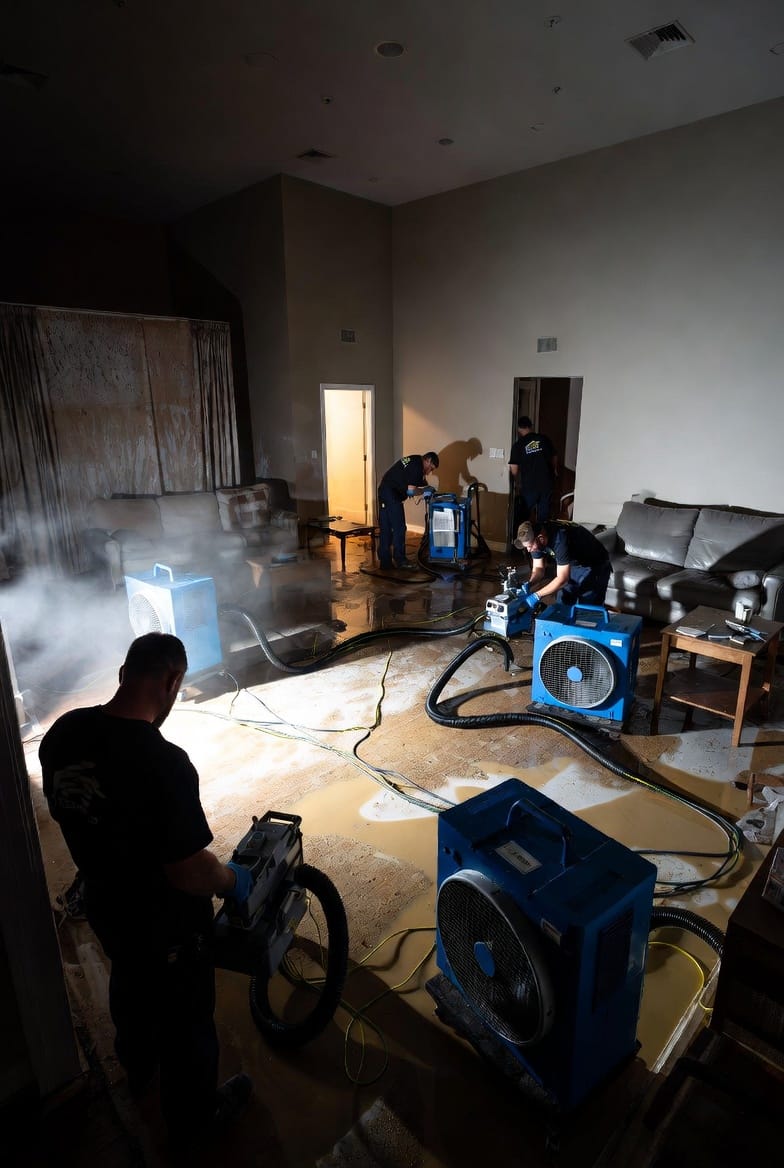
In the fast-paced world of water damage restoration, every minute counts. When moisture infiltrates a structure, the difference between swift recovery and costly secondary damage often hinges on one critical factor: dehumidifier placement. Proper positioning of dehumidifiers and complementary air movers is not just a technical detail — it is the cornerstone of an effective drying strategy that protects property, prevents mold growth, and restores normalcy with confidence.
Call Now for Faster Water Damage Drying
At its core, optimal dehumidifier placement leverages physics to create efficient moisture removal. Dehumidifiers pull moist air across refrigerated coils, condensing water vapor and expelling drier air. Yet without strategic positioning, even the most powerful units underperform. Central locations maximize coverage, while deliberate airflow patterns ensure no hidden pockets of humidity remain. This article delivers a complete, authoritative guide to dehumidifier placement strategy — designed specifically for restoration professionals and property owners seeking maximum drying results.
Rest assured: when equipment is placed correctly, drying times can be reduced by up to 50%, structural integrity is preserved, and long-term risks are minimized. Let’s explore exactly where to put units for superior performance.
Why Dehumidifier Positioning Determines Drying Success
Moisture behaves predictably in enclosed spaces. It rises, settles in low areas, and lingers in corners or behind walls if air movement is stagnant. Incorrect dehumidifier placement allows these patterns to persist, turning a manageable water intrusion into prolonged exposure that weakens framing, warps flooring, and invites microbial growth.
Strategic placement counters these risks head-on. By siting units in central locations, technicians create a powerful “pull” that draws humid air from every direction. Positioning away from walls prevents intake obstruction and allows full 360-degree airflow. Pairing dehumidifiers with air movers then establishes deliberate circulation patterns — essentially turning the entire room into a controlled drying chamber.
Key risk avoided: blocked exhaust or intake that forces units to recycle the same already-dried air, dramatically slowing progress. Professional teams know that thoughtful equipment positioning is the fastest route to verifiable dryness.
Core Principles of Optimal Dehumidifier Placement
Successful drying follows four non-negotiable principles. Adhering to these ensures every unit operates at peak efficiency:
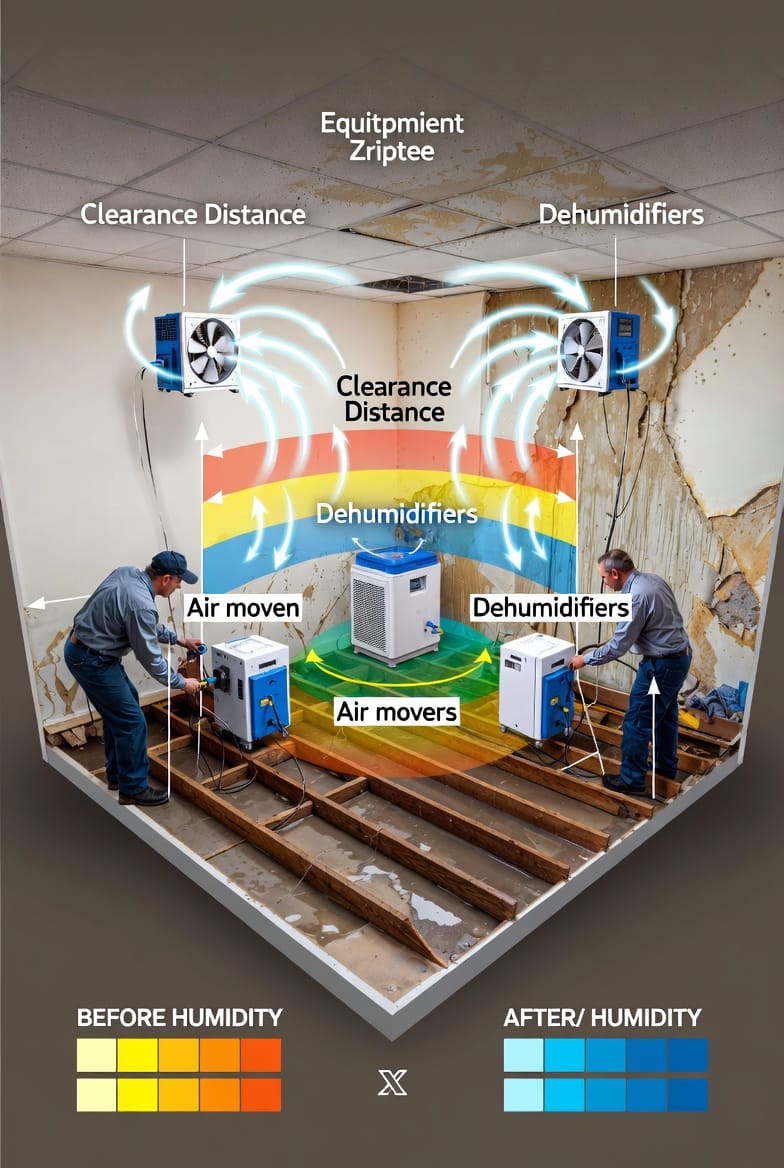
- Central locations deliver maximum coverage. Place dehumidifiers near the geometric center of the affected area rather than against walls or in corners. This positioning allows the unit to draw from the widest possible radius, eliminating moisture gradients.
- Maintain clearance from walls and obstacles. Keep at least 12–18 inches of open space around intake and exhaust vents. Proximity to walls restricts airflow and reduces drying capacity by as much as 30%.
- Elevate units for superior air intake. Raising dehumidifiers 12–24 inches on stable platforms improves access to warmer, moister air that naturally rises, enhancing condensation efficiency.
- Create balanced air circulation patterns with fans. Air movers should be angled to push air across surfaces and toward dehumidifier intakes, forming continuous loops that prevent dead zones.
These principles apply equally to residential homes, commercial buildings, and multi-story structures. In every case, central placement combined with engineered airflow accelerates evaporation while protecting vulnerable materials.
Step-by-Step Guide to Positioning Dehumidifiers and Air Movers
Follow this proven sequence for consistent, repeatable results:
- Assess the space thoroughly. Map the entire affected area, noting high-moisture zones via meters. Identify natural airflow paths and potential dead spots.
- Position dehumidifiers centrally. For rooms under 1,000 sq ft, one central unit often suffices. Larger spaces require multiple units spaced evenly to maintain uniform drying.
- Set up air movers to establish circulation. Place axial fans at 45-degree angles to walls, directing air across floors, up walls, and toward dehumidifier intakes. Create opposing airflow patterns that “scrub” surfaces continuously.
- Elevate and secure equipment. Use sturdy platforms or stands to lift dehumidifiers, ensuring unobstructed intake while protecting units from standing water.
- Allow full exhaust clearance. Direct dry-air output toward the room center or slightly upward to promote mixing rather than short-cycling.
- Monitor and rotate as needed. Check humidity readings every 4–6 hours. Reposition units or fans if readings reveal uneven drying.
This methodical approach transforms chaotic moisture removal into a precise, science-backed process. Property owners can rest easy knowing professionals following these steps achieve documented dryness faster than improvised methods.
Advanced Airflow Patterns for Complex Structures
Not every drying job is a simple rectangular room. Basements, open-concept homes, and multi-room layouts demand creative air circulation patterns.
In L-shaped or irregularly shaped spaces, technicians deploy “daisy-chain” configurations: one dehumidifier feeds drier air toward the next unit, creating a cascading drying effect. For crawl spaces or attics, low-profile units are placed centrally with high-velocity fans pushing air through narrow voids.
Pro tip: Use the “tornado effect” — position air movers to generate gentle circular airflow that lifts moisture from carpets and padding while directing it into dehumidifier intakes. This technique is particularly effective in high-ceiling areas where warm, moist air rises quickly.
Throughout the process, continuous monitoring with psychrometric tools confirms that relative humidity drops steadily and temperature remains within the ideal 70–85°F range for fastest evaporation.
Common Placement Mistakes That Slow Drying — and How to Avoid Them
Even experienced teams can fall into costly habits. Here are the most frequent errors:
- Pushing units against walls — blocks intake and reduces efficiency dramatically.
- Ignoring elevation — forces units to pull cooler, drier air near the floor instead of rising moisture.
- Overlooking exhaust direction — causes short-cycling where dry air is immediately re-intaken.
- Static fan placement — fails to adapt as drying progresses and moisture distribution changes.
- Neglecting clearance around multiple units — creates interference zones that cancel out airflow benefits.
By deliberately avoiding these pitfalls and embracing strategic dehumidifier placement, restoration projects stay on schedule and deliver superior outcomes.
Real-World Results: The Impact of Proper Equipment Positioning
Consider a typical residential flood scenario. When dehumidifiers are placed centrally with supporting air movers creating cross-room circulation, drying times drop from 7–10 days to 3–5 days. Structural materials retain integrity, and the risk of hidden mold behind drywall plummets.
In commercial settings — such as office buildings or retail spaces — the same principles scale beautifully. Larger capacity units positioned in traffic-flow centers, combined with industrial air movers, restore operations faster, minimizing business interruption.
Reassuring reality: these results are achievable every single time when the dehumidifier placement strategy is followed with precision.
Monitoring Progress and Making Dynamic Adjustments
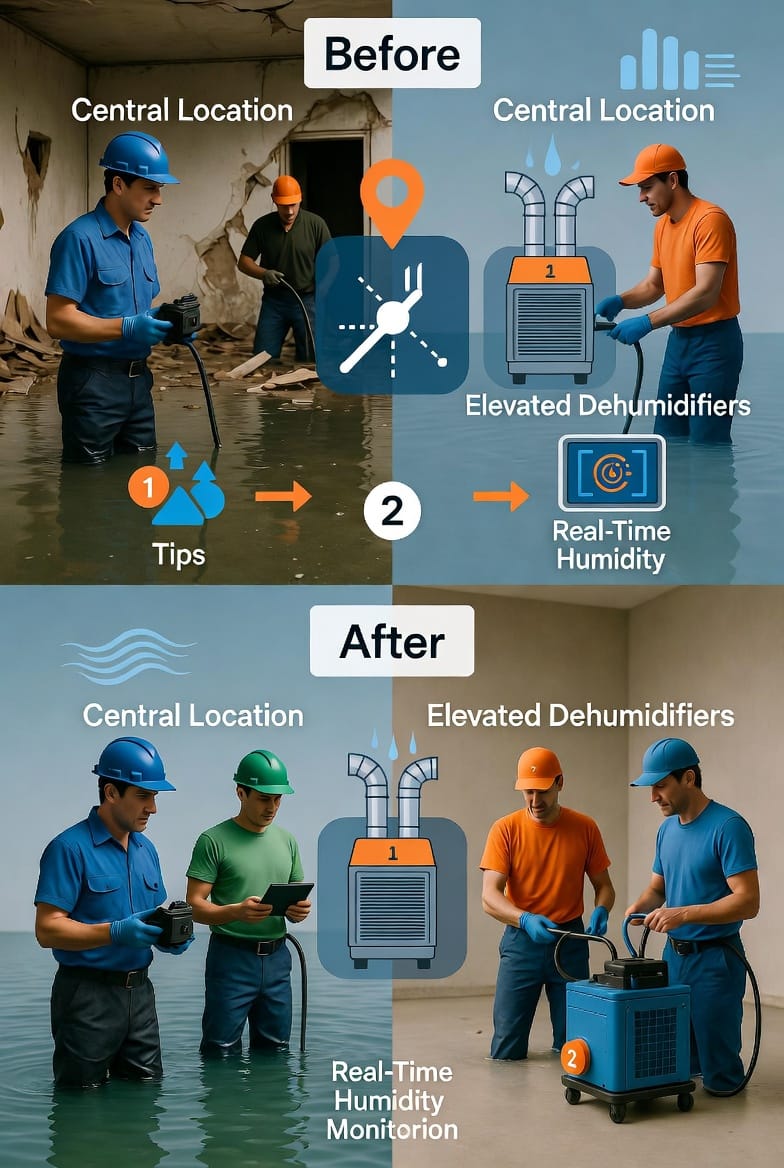
Drying is not a “set it and forget it” operation. Authoritative professionals take readings at multiple heights and locations every few hours. When data shows a lagging corner, a quick repositioning of an air mover or secondary dehumidifier restores balance instantly.
Modern equipment with built-in sensors further simplifies this process, providing real-time feedback that guides precise adjustments. The result is confidence that every cubic foot of air is being processed efficiently.
Conclusion: Speed, Safety, and Success Through Smart Placement
The dehumidifier placement strategy outlined here is more than best practice — it is the proven path to faster, safer, and more complete structural drying. Central locations, proper elevation, exhaust clearance, and engineered air circulation patterns work together to deliver results you can measure and trust.
Property owners and restoration teams alike benefit when equipment positioning receives the attention it deserves. Moisture is removed thoroughly, secondary damage is prevented, and peace of mind is restored.
Proper equipment placement speeds drying. For expert water damage restoration and professional drying services that get it right the first time.
Speed Up Your Drying Process – Call Professional Restoration Now