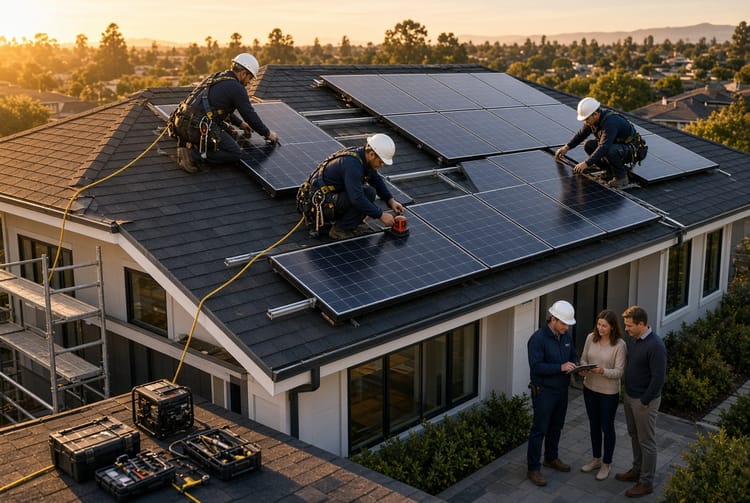
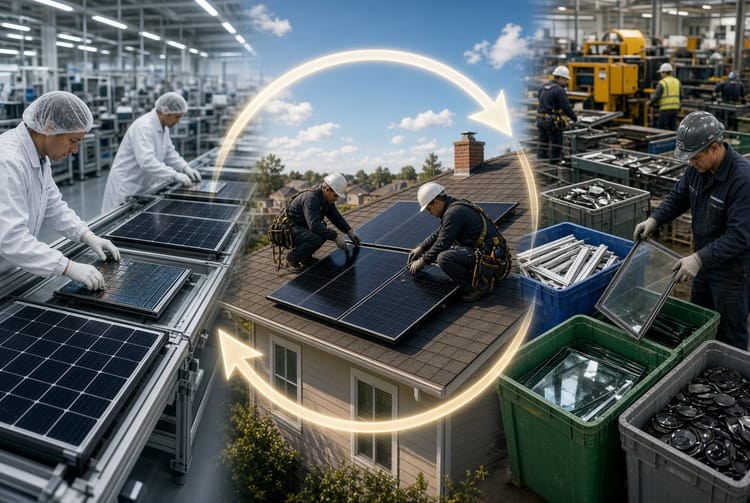
The Solar Panel Mounting: Roof-Penetrating vs. Ballasted Systems
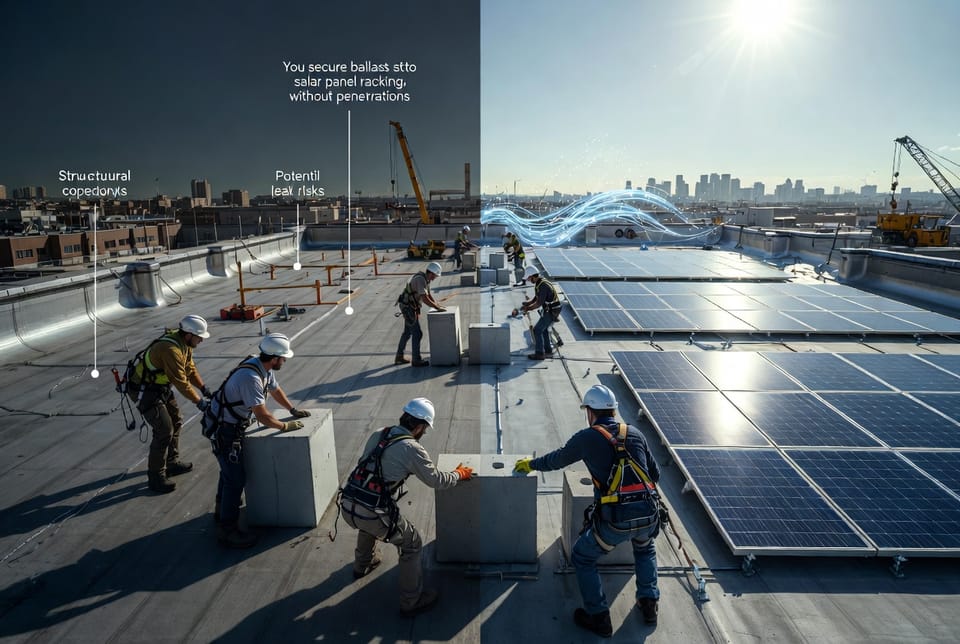
Choosing the right solar mounting system is not just about keeping panels flat. It is about the structural integrity of your building and the longevity of your roof warranty.
Many property owners assume all solar racks are the same. They are not. The difference between a roof-penetrating (attached) system and a ballasted (weight-based) system can mean the difference between a 25-year energy solution and a costly leak repair next spring.
Get the Right Solar Mounting for Your Roof – Call Now!
In this guide, we compare both methods head-to-head. You will learn exactly which system works for your roof type, your climate, and your budget.
Key Takeaway: No single method is best for every roof. The right choice depends on your roof slope, membrane material, wind zone, and structural load capacity.
What Is a Roof-Penetrating (Attached) System?
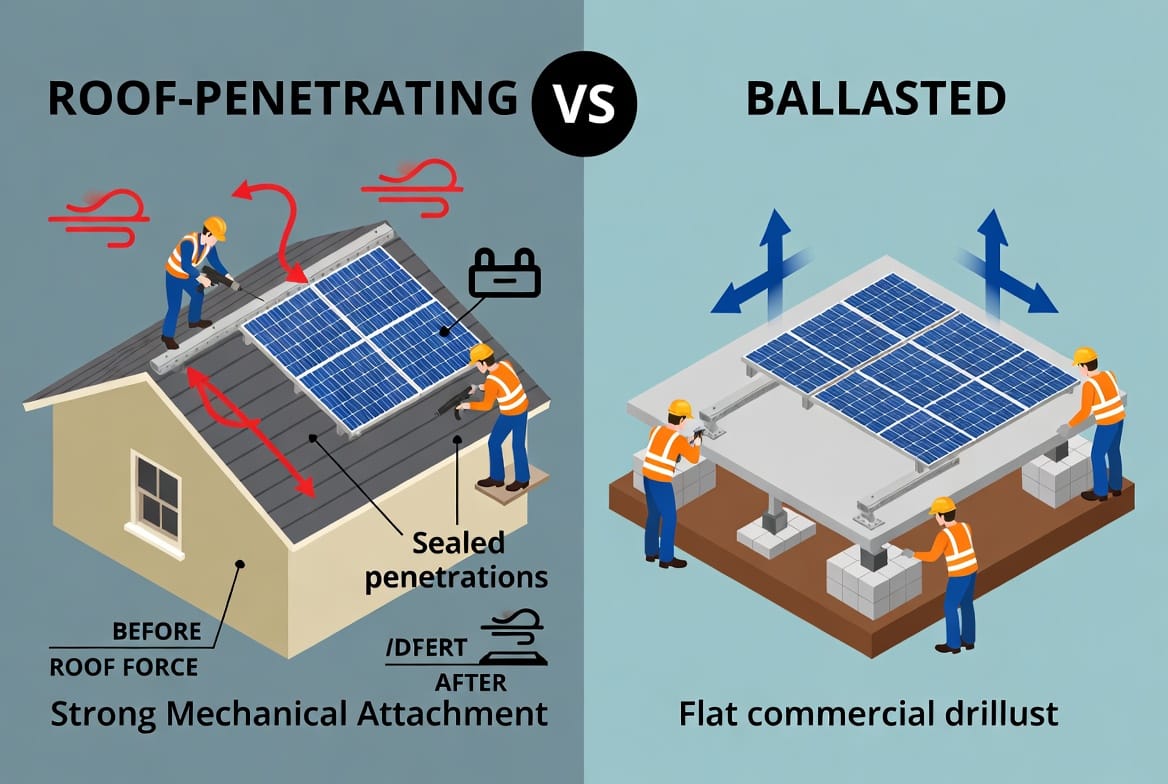
A roof-penetrating system—also called rafter-attached or mechanical attachment—involves drilling through the roofing material and into the structural deck or rafters. Stainless steel lag bolts or self-tapping screws secure the mounting rails directly to the building's framework.
These penetrations are then sealed with chemical flashings (EPDM or silicone boots) and sealants to prevent water intrusion.
Pros of Roof-Penetrating Systems
- Aerodynamic Strength: Because the array is bolted to the structure, it naturally resists uplift (wind trying to lift the panels off the roof). This is crucial in hurricane zones or high-wind regions.
- Lighter Total Load: While you are adding metal and fasteners, penetrating systems generally weigh less per square foot than ballasted systems because you do not need heavy concrete blocks.
- Steep Slope Compatible: This is the only safe method for pitched roofs (over 10-degrees). Ballasted systems require friction; on a steep slope, gravity works against you.
- Lower Material Cost for Large Arrays: The hardware cost per watt is often lower for penetrating systems on residential-scale projects.
Cons of Roof-Penetrating Systems
- Risk of Leaks: Even with perfect flashing, every penetration is a potential failure point. Over 20+ years, sealants degrade.
- Voided Roof Warranties: Many single-ply membrane manufacturers (TPO, PVC, EPDM) automatically void the warranty if you penetrate the field of the membrane.
- Labor Intensive: Locating rafters, drilling, sealing, and torquing bolts takes longer than simply placing blocks.
- Structural Dependency: You cannot attach to a rotted rafter or a weak metal deck. A structural engineer may be required.
⚠️ Critical Risk: Do not use penetrating mounts on standing seam metal roofs. You clamp to the seams instead. Drilling into standing seam is a permanent warranty killer.
What Is a Ballasted (Non-Penetrating) System?
A ballasted system uses the mass of concrete blocks, steel trays, or composite paver stones to hold the solar array in place. No holes are drilled into the roof membrane.
The racking lays directly on the roof surface. The combined weight of the racking plus the ballast blocks counteracts wind uplift and sliding forces. Friction between the ballast and the roof membrane does all the work.
Pros of Ballasted Systems
- Zero Roof Penetrations: Your roof membrane remains 100% intact. No sealants. No flashings. No leak paths.
- Warranty Preservation: Most TPO, PVC, and modified bitumen roofs retain their full warranty with a properly engineered ballasted system.
- Faster Installation: Installers roll out the membrane protection, place the trays, drop concrete blocks, and set the panels. No drilling, no measuring for rafters.
- Easy Reconfiguration or Removal: Want to add panels or replace the roof? Simply lift the blocks and move the array. No patching hundreds of holes.
- Ideal for Low-Slope Roofs: Any roof with a pitch less than 10-degrees (roughly 2:12 slope) is a candidate for ballasting.
Cons of Ballasted Systems
- Significantly Heavier: A typical ballasted system adds 15 to 25 lbs per square foot of dead load. A penetrating system might add only 3-5 lbs per square foot.
- Not for Steep Slopes: Once your roof pitch exceeds 10 degrees, friction fails. You would need massive, unsafe weights to hold the array down.
- Higher Initial Material Cost: Concrete blocks are cheap, but transporting them to a roof (crane or conveyor) adds logistics cost.
- Limited to Structurally Strong Roofs: Your building must support the extra weight. An old roof with a lightweight concrete deck may collapse under ballast.
- Wind Limitations: In extreme wind zones (over 130 mph), pure ballasting may require so much weight that the roof cannot handle it. Hybrid systems (minimal penetrations + lighter ballast) are sometimes used.
Industry Data: A properly engineered ballasted system on a flat roof can withstand Category 3 hurricane winds without sliding, provided the roof membrane has a friction coefficient of 0.5 or higher.
Direct Comparison: Which Roof Type Gets Which Method?
Not every roof is a candidate for both. Let’s break it down by real-world roofing materials.
Roof Type Cheat Sheet
| Roof Type | Slope | Recommended Mount | Reason |
|---|---|---|---|
| Asphalt Shingle | Pitched | Penetrating | Ballast would slide; penetrations are standard and can be flashed. |
| Standing Seam Metal | Pitched | Clamp (Non-penetrating) | Special case: Clamps attach to seams. No drilling, no ballast. |
| Clay/Concrete Tile | Pitched | Penetrating (with tile hooks) | Ballast impossible. Tile hooks replace a tile and bolt to rafters. |
| TPO/PVC (Flat) | < 10° | Ballasted (preferred) | Preserves membrane warranty. No penetrations to leak. |
| Built-Up Roof (BUR) | < 10° | Ballasted or Penetrating | BUR is tough; either works, but ballasting is safer for aging roofs. |
| EPDM (Rubber) | < 10° | Ballasted ONLY | EPDM is soft and thin. Penetrations will tear over time. |
| Wood Shake | Pitched | Penetrating | No ballast option. Must hit rafters. |
Critical Risks You Must Evaluate
1. Wind Uplift vs. Roof Load
A penetrating system fights wind by pulling down into the structure. A ballasted system fights wind by adding weight to the roof.
The risk? Engineers often underestimate dynamic load. Wind does not push straight down. It creates a vacuum effect on the leading edge of the array. If your ballasted system is too light, the entire row of panels becomes a sail and flips over the parapet.
Conversely, if you over-ballast to be safe, you may exceed the roof's live load capacity—causing a structural collapse.
Solution: Always require a stamped engineering analysis for ballasted systems over 15 lbs/sq ft.
2. Membrane Compatibility
- TPO & PVC: Excellent for ballast. High friction coefficient. Do not penetrate these if you want to keep the 20-year warranty.
- EPDM: Poor friction when wet. Ballasted EPDM requires slipl sheets or a textured membrane to prevent sliding.
- Modified Bitumen (Torch Down): Accepts ballast well but can soften on hot days, causing the blocks to settle or indent.
3. Seismic Zones
In earthquake-prone regions (California, Alaska, Japan), a penetrating system is often safer. Ballasted systems can walk or shift during lateral ground movement. A bolted system stays put.
The Hidden Cost: Re-roofing
Here is a question most solar sales reps avoid: What happens when your roof needs replacement in 15 years?
- With a Penetrating System: You must pay for a "lift & reinstall" – typically $0.30 to $0.60 per watt to remove the array, replace the roofing, and then reinstall the racks and panels. Plus, you have to re-seal all old penetrations.
- With a Ballasted System: A crane lifts the blocks and trays, the roofing crew works on an open deck, and the solar array goes right back down. No re-penetration. No new leak risks.
For flat roofs, ballasted systems offer superior lifecycle value despite the higher upfront weight.
When Should You Reject Ballasted?
Despite its benefits, you should never use a pure ballasted system in these scenarios:
- Pitch over 10 degrees – The math stops working.
- Roof with exposed insulation – The weight will crush the cover board.
- Structurally deficient deck – Old wood, lightweight concrete, or corroded metal.
- Extreme high-wind zone (>140 mph gust) – Unless you use a ballasted + penetrating hybrid (a few bolts plus lighter blocks).
- Rooftop with uneven surface – Ballast requires uniform contact.
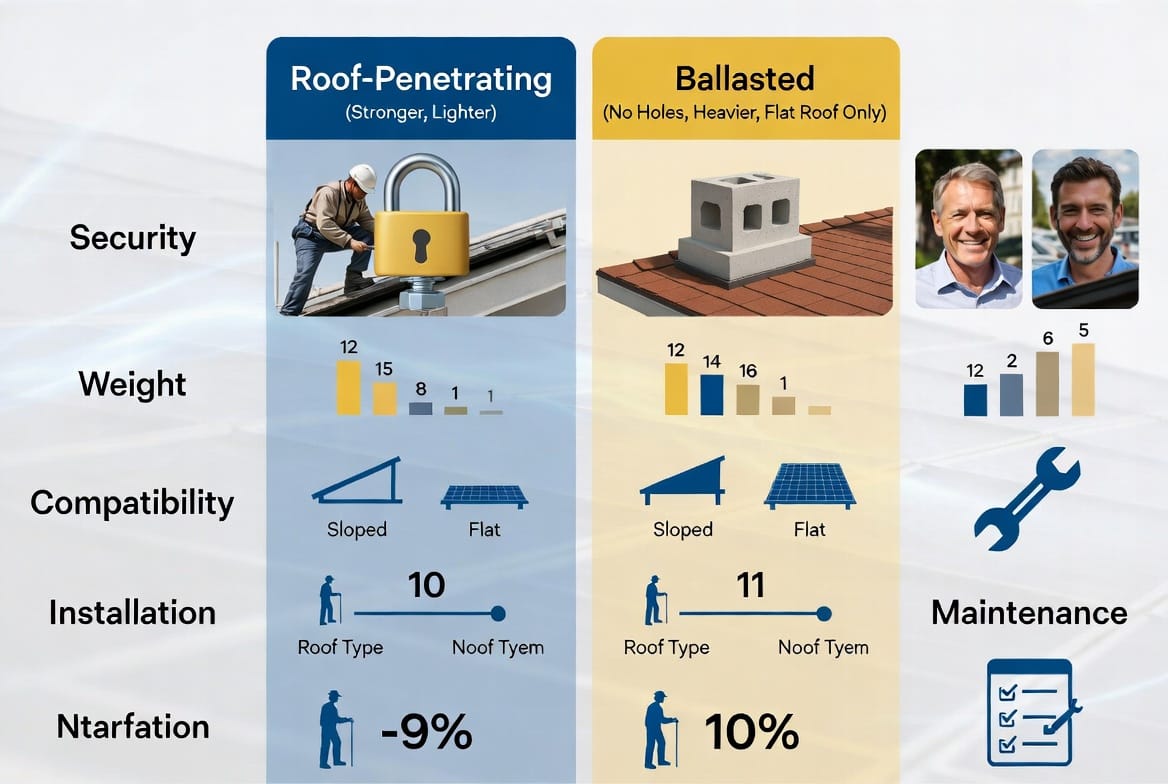
Final Verdict: Which One Do You Choose?
Choose Roof-Penetrating (Attached) If:
- Your roof is pitched (asphalt, tile, metal).
- Your building has a strong structural frame (wood or steel rafters).
- You live in a high-wind or seismic zone.
- The roof is new, and you do not mind flashings.
Choose Ballasted (Non-Penetrating) If:
- Your roof is flat or low-slope (< 10°).
- You have a single-ply membrane (TPO, PVC, EPDM).
- You want to preserve your roof warranty.
- Your building can support the extra weight (structural engineering report required).
- You plan to replace the roof within 10 years and want easy removal.
Pro Installer Note: We see far too many flat roofs with penetrating mounts that start leaking in year 7. Unless your flat roof is concrete deck with a torch-down membrane that can be patched forever, always push for ballasted.
The Bottom Line
There is no "best" system. There is only the correct system for your specific roof.
A mistake here is expensive. A leaking roof ruins inventory, damages interiors, and creates mold. A collapsed roof from over-ballasting is a catastrophe. Do not guess.
Get a professional onsite assessment. We measure your roof slope, inspect the deck, calculate wind loads, and present you with a mounting plan that protects your building for the full 25-year life of your solar panels.
Call to Action (CTA)
Stop guessing. Start protecting your investment.
Choosing the wrong mounting system can void your warranty or worse—damage your structure. We design roof-penetrating and ballasted systems tailored to your exact roof type, slope, and wind zone.
Expert Solar Mounting Advice for Your Roof – Call Today!