The Security System Night Mode: Protecting You While You Sleep
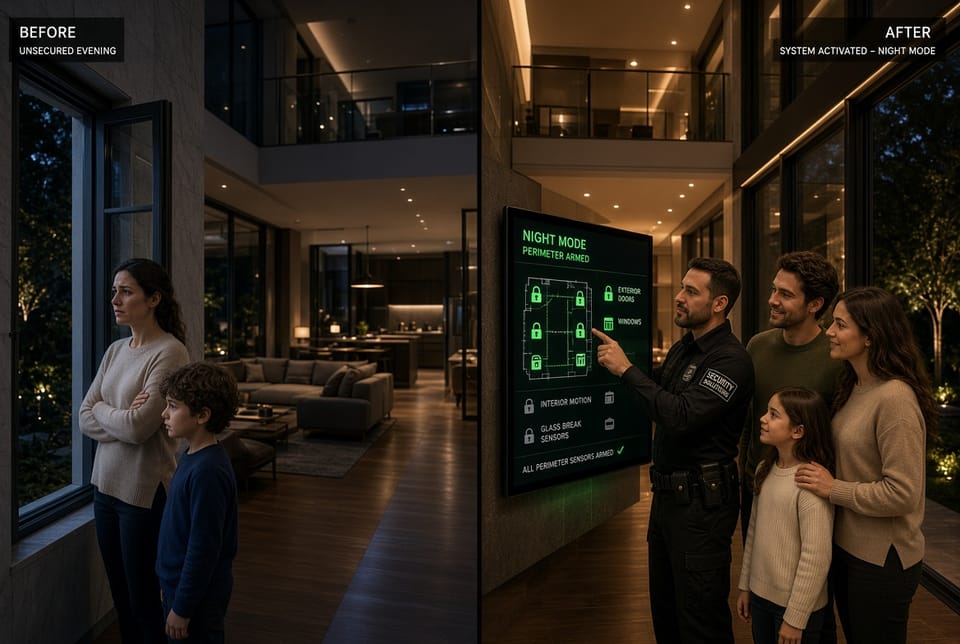
When daylight fades and the household settles into its evening routine, the home enters its most vulnerable hours. Occupants are tired, lights are low, and attention naturally turns inward. This is precisely the window when a properly configured Night Mode becomes one of the most valuable features of a modern security system. Night Mode is not a generic “stay-at-home” setting. It is a deliberate, purpose-built arming profile designed to keep the outer shell of the residence under constant watch while granting everyone inside complete freedom of movement.
Arm Perimeter Sensors the Right Way – Call Now
What Night Mode Actually Does
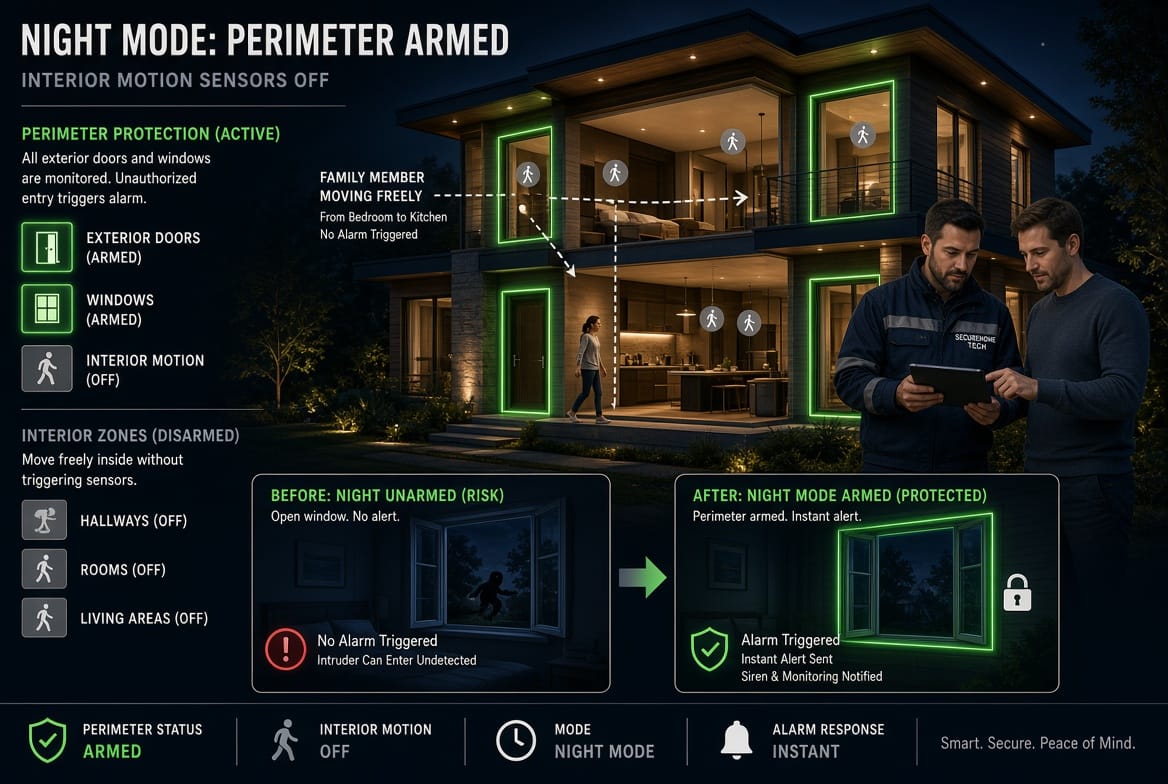
Night Mode, sometimes labeled Night Stay, Instant Night, or Perimeter Night depending on the control panel, activates every perimeter sensor while leaving interior motion detectors disarmed. Door contacts, window sensors, glass-break detectors, and any outdoor beam or shock sensors remain live. The moment an exterior door or window is forced or opened unexpectedly, the system responds. Inside the house, however, family members can walk to the kitchen, use the bathroom, check on children, or let a pet out without triggering an alarm.
This selective protection solves a common nighttime conflict: the need for security versus the need for normal living. Full Away mode would treat every hallway crossing as a potential intrusion. Night Mode removes that inconvenience without sacrificing the most likely points of unauthorized entry.
The distinction matters. Most residential burglaries that occur after dark begin at a door or window, not by someone already inside the living space. By keeping the perimeter armed, Night Mode places a reliable barrier exactly where it is needed most.
Why Nighttime Protection Requires a Dedicated Mode
Nighttime presents unique risks. Reduced visibility outside, lower street traffic, and the natural drop in household alertness create conditions that opportunistic intruders understand well. An unlocked sliding door, a window left slightly open for air, or a garage side-entry that was forgotten can become an invitation. At the same time, families still need to function. Children wake up. Someone gets a glass of water. A pet needs to go out.
Without Night Mode, homeowners face two unappealing choices: leave the system disarmed and accept the risk, or arm the entire system and accept constant false alarms or restricted movement. Both options undermine the purpose of owning a security system. Night Mode eliminates the dilemma.
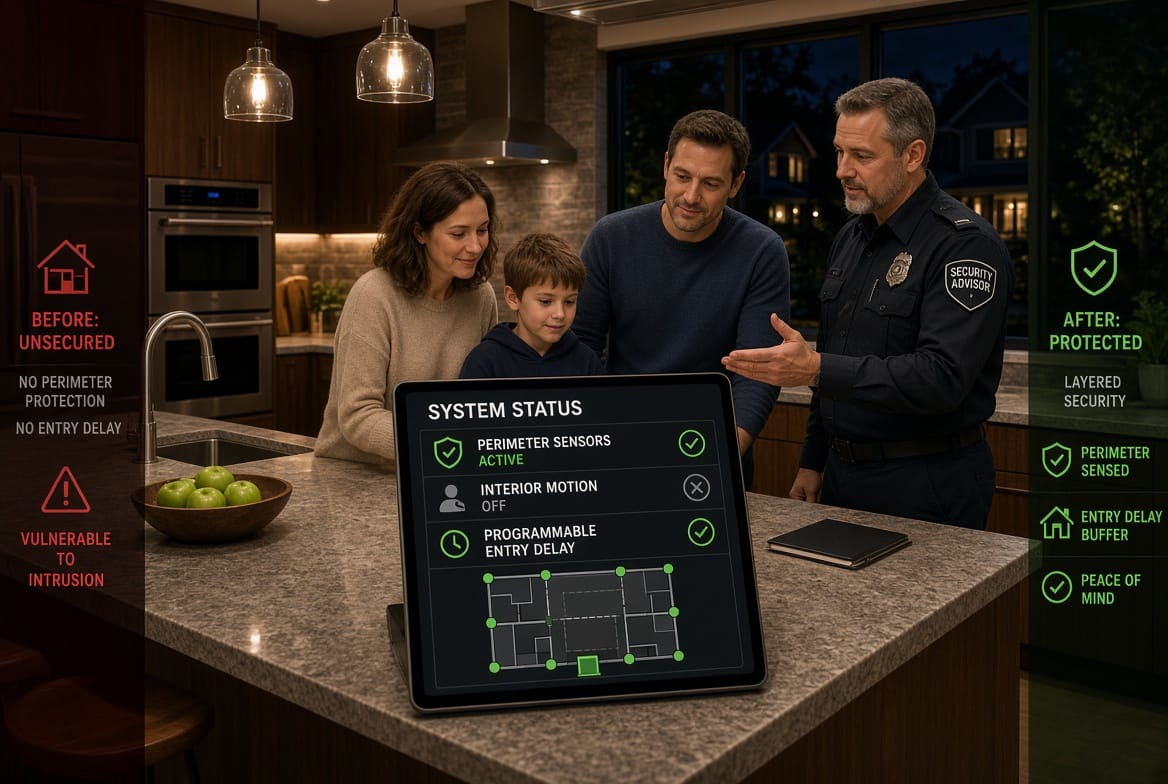
The mode also supports entry-delay logic on designated doors. A homeowner returning late or stepping outside briefly can still enter through the programmed delay door without immediately sounding the siren, provided the code is entered within the allotted seconds. All other perimeter points typically go instant. This balance of convenience and immediacy is what makes the setting practical for real households rather than theoretical ones.
How Night Mode Sensor Logic Works
The control panel maintains two distinct zone groups. Perimeter zones stay in the armed state. Interior zones are shunted or bypassed for the duration of the night arming period. When a perimeter zone is violated, the system follows its programmed response: local siren, notification to the monitoring center, and, if configured, camera or lighting activation.
Interior motion sensors remain silent even if a person or pet crosses their field of view. This is not a reduction in overall protection; it is a smart allocation of protection. The system concentrates its attention on the building envelope—the part most likely to be tested after dark.
Many panels also allow limited customization. A user can choose to leave one interior motion active in a basement or garage while keeping living-area motions off. Some systems support “Night Instant” so that once the exit delay expires, every remaining perimeter point becomes instant-alarm. Understanding these options lets a household match the mode to its exact layout and habits.
Step-by-Step Setup for Night Mode
Correct setup is straightforward once the logic is understood. The process should be performed when everyone who will be home is already inside and all exterior doors and windows are closed and locked.
- Walk the perimeter and confirm every door and window is shut. An open zone will prevent the system from arming or will force a bypass that leaves a gap.
- At the keypad or touchscreen, press the Night or Stay Night button. On app-controlled systems, open the arming menu and select the Night profile.
- Watch the panel display. It should confirm “Night Mode Armed” or equivalent language and show perimeter zones as active.
- If the system offers Instant versus Delayed Night, choose the option that matches household routine. Families who occasionally step onto a porch may prefer a short delay on one door; others prefer instant response on every perimeter point.
- Enter the user code if prompted and wait for the exit-delay countdown to finish if one is programmed. The system is now protecting the home.
- Test the configuration the first few nights by walking interior hallways and confirming no alarm occurs, then briefly opening a non-delay window (with the system in test mode) to verify the perimeter response.
App-based systems add convenience. A user can arm Night Mode from bed after realizing a door was left unlocked, or receive a notification if a perimeter zone is left open at bedtime. Voice-assistant integration on some platforms allows a simple spoken command once the profile has been saved.
After initial setup, most households find they can arm Night Mode in under ten seconds as part of the regular bedtime routine. Consistency is more important than complexity. The same sequence every night builds the habit that actually delivers protection.
Practical Benefits Beyond Basic Arming
Night Mode delivers several layered advantages that become apparent only after regular use.
First, it dramatically reduces false alarms. Interior motion sensors are the most common source of nighttime nuisance trips—pets, children, or an adult getting up. By leaving those sensors off, the system remains credible. Monitoring stations and neighbors take a genuine perimeter alarm more seriously when the system is not known for frequent false triggers.
Second, it supports healthy household rhythms. No one has to remember to disarm the system just to walk downstairs. Sleep is less interrupted. Guests staying overnight can be given a simple explanation rather than a list of restricted rooms.
Third, it pairs naturally with other protective layers. When a perimeter sensor activates, many systems can instantly turn on selected interior or exterior lights, start video recording on associated cameras, and send a push notification. The combination of an armed perimeter and automated response creates a layered deterrent that is far stronger than any single device.
Fourth, it provides peace of mind during travel or late work nights. A spouse arriving home after the rest of the family is asleep can enter through the delay door, disarm, and re-arm Night Mode without waking anyone or leaving the house unprotected.
These benefits compound. A system that is actually used every night because it does not inconvenience the occupants is infinitely more effective than a more comprehensive system that is frequently left off.
Common Adjustments and Best Practices
Not every home is identical. A few thoughtful adjustments keep Night Mode aligned with real life.
Homes with pets that roam at night rely especially heavily on the interior-off setting. Pet-immune motion sensors can be left active in some rooms if desired, but most families simply leave all interior motions off and depend on the perimeter.
Multi-story homes sometimes benefit from keeping a single basement or attic motion active while disarming main-floor and bedroom-level motions. The panel’s zone list makes this easy to configure once and then recall as part of the Night profile.
Entry-delay timing should be long enough for a tired person to reach the keypad but short enough that an actual intruder cannot exploit it. Fifteen to thirty seconds on one designated door is typical. All other doors and every window should be instant.
Monthly testing remains essential. Arm Night Mode, confirm interior movement does not trip the system, then (in test mode) open a window to verify the siren and notification path. A system that is never tested is only assumed to be working.
Finally, everyone who lives in the house should know the Night Mode procedure and the difference between a delay door and an instant door. A thirty-second conversation prevents accidental alarms and ensures the setting is used correctly.
Integrating Night Mode into a Complete Nighttime Routine
Night Mode works best when it is one element of a broader evening habit rather than an isolated button press. Lock exterior doors and windows first. Arm the system. Then complete the rest of the routine—lights, thermostats, devices. The security step becomes automatic rather than an afterthought.
Outdoor lighting on a dusk-to-dawn or motion schedule complements the armed perimeter. An approaching person is both illuminated and recorded if cameras are present. The combination of visible lighting and an armed Night Mode is a strong deterrent.
For households that travel or keep irregular hours, geofencing or scheduled arming can automatically suggest or apply Night Mode at a set time. The panel or app simply reminds the user; the final confirmation remains in human hands.
When the system is professionally monitored, a Night Mode alarm receives the same priority as any other alarm. The monitoring center follows the call list and, if necessary, dispatches authorities. The difference is that the alarm is far more likely to be genuine because interior motions are not creating noise.
Sleep Safely with Night Mode
A well-configured Night Mode gives a household something rare: genuine protection that does not demand constant compromise. The outer walls of the home stay under watch. The people inside remain free to live normally. The system stays armed because it is convenient to keep it armed.
That combination—perimeter security plus interior freedom—is exactly what nighttime requires. It addresses the real risks of after-dark hours without introducing new frustrations. Once the setting is understood and practiced, it becomes as routine as locking the front door.
For questions about Night Mode options on a specific panel, custom zone programming, or how the setting interacts with cameras and automation. A brief conversation can confirm the profile matches the home’s layout and the family’s habits so everyone can sleep knowing the perimeter is protected.
Move Freely Indoors, Stay Protected at Night – Call Now