The Security System Cellular vs. Internet: Which Monitoring Path Is Better
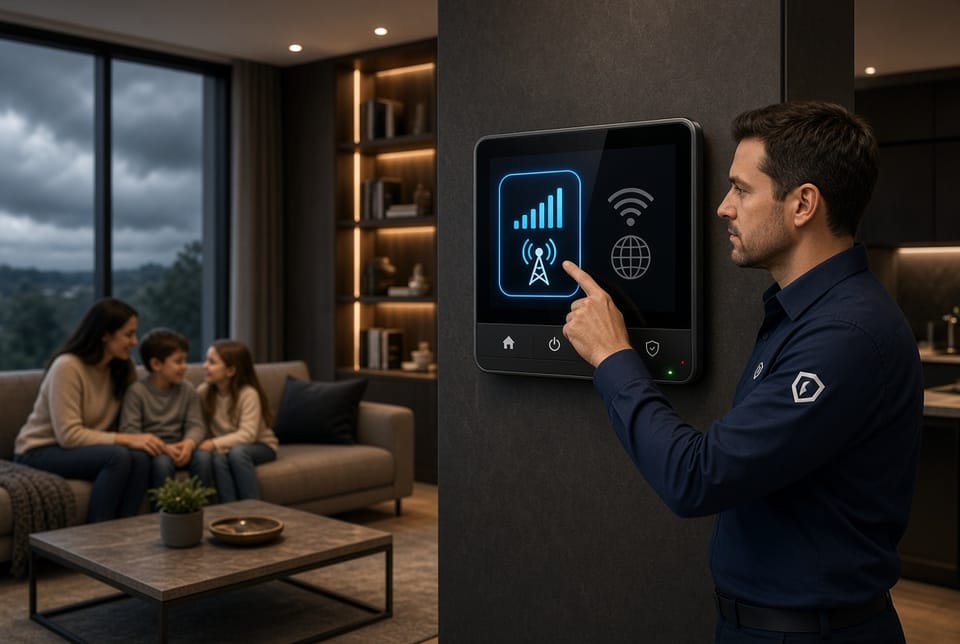
Choosing the right monitoring path for a home security system is one of the most important decisions a homeowner can make. The communication method that connects your alarm panel to the monitoring center determines whether help arrives when you need it most. Two primary options exist today: cellular monitoring and internet monitoring. Each uses a different route to send signals. Understanding their strengths and weaknesses helps you select the path that delivers consistent, trustworthy protection.
Speak with a Pro About Cellular vs. Internet Monitoring
A professional security system does far more than sound a siren. It must transmit an alert reliably so trained operators can verify the event and dispatch emergency services. Power failures, weather events, and internet disruptions happen regularly. The monitoring path you choose either withstands those events or leaves a gap in coverage. This article compares both methods in detail so you can make an informed, confident decision.
How Security System Monitoring Works
Every professionally monitored alarm system needs a communication channel between the control panel and the central station. When a sensor trips—door contact, motion detector, smoke alarm, or glass-break sensor—the panel packages the information and sends it along the chosen path. Speed, reliability, and independence from household utilities matter.
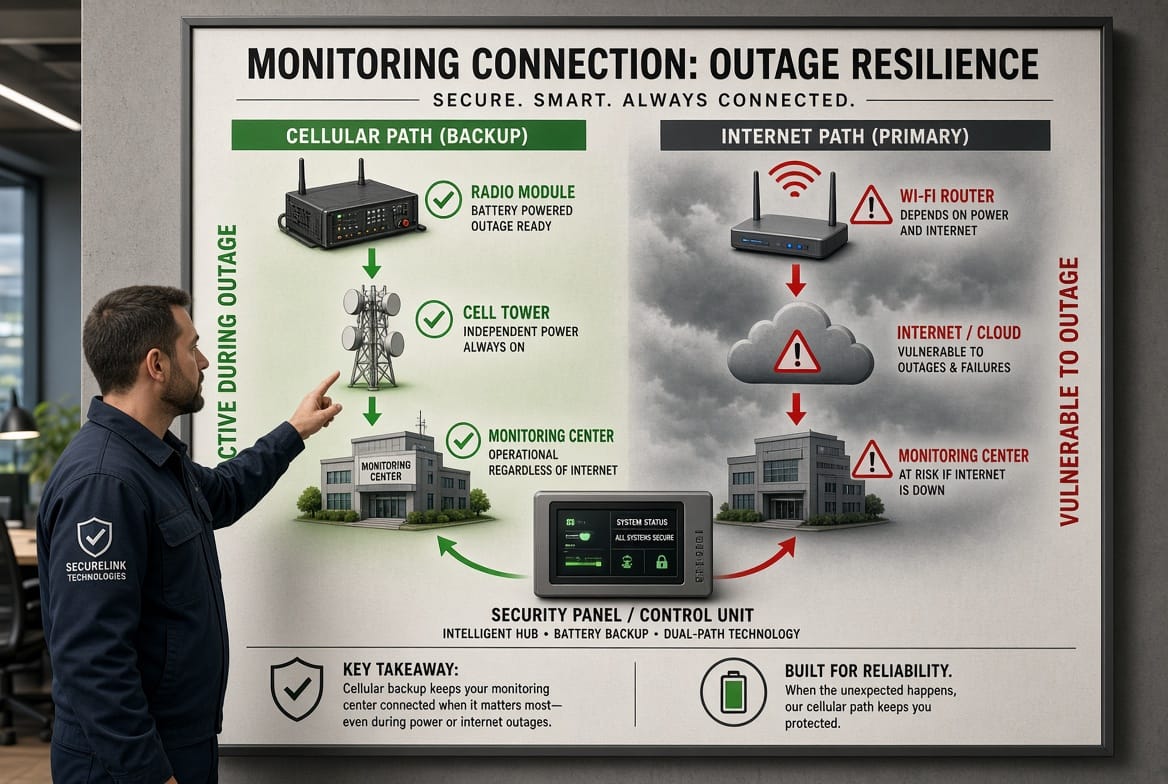
Cellular monitoring uses a dedicated wireless network similar to a mobile phone. The panel contains a radio module that communicates over cellular towers. Internet monitoring (also called IP or broadband monitoring) sends data through your home Wi-Fi router and internet service provider. Some systems offer dual-path or hybrid setups that combine both. The core question remains which single path, or combination, gives the strongest everyday performance.
Reliability is not theoretical. Homes experience outages. Storms knock out power and cable lines. Internet providers schedule maintenance. A monitoring path that depends on those services can fail at the exact moment protection is needed most.
Cellular Monitoring Explained
Cellular monitoring operates on a dedicated cellular network. The security panel includes a built-in or add-on cellular communicator that connects to towers independently of your home internet or landline. Signals travel over the same infrastructure used by mobile phones, but they use a specialized channel reserved for alarm traffic.
Because the path does not rely on your Wi-Fi router or broadband modem, it continues working during many common disruptions. If the power goes out, a backup battery in the panel and the cellular module keep the system alive. If the internet service drops, the cellular radio still reaches the monitoring center. This independence is the defining advantage.
Modern cellular communicators use 4G LTE or 5G technology with automatic fallback. They include encryption and authentication so signals cannot be easily intercepted or spoofed. Coverage exists in the vast majority of populated areas, and providers maintain overlapping tower networks for redundancy.
Advantages of Cellular Monitoring
- Works during internet and many power outages because it uses its own network and panel battery backup.
- Dedicated communication channel reduces the chance of congestion from household devices.
- No dependence on your internet service provider’s uptime or speed.
- Strong encryption and professional-grade authentication.
- Suitable for homes in areas with inconsistent broadband.
- Often includes automatic supervision so the monitoring center knows immediately if the communicator loses contact.
Considerations for Cellular Monitoring
- Monthly monitoring fees may be slightly higher because of the cellular data service.
- Very remote locations with weak cellular coverage may need a signal booster.
- The communicator module adds a modest hardware cost if not already included in the panel.
These considerations are manageable for most households. The extra reliability frequently outweighs the incremental cost when the goal is uninterrupted protection.
Internet Monitoring Explained
Internet monitoring sends alarm signals through your existing broadband connection. The control panel connects to your Wi-Fi network or a wired Ethernet port and uses your internet service to reach the central station. This method is often marketed as convenient because many homes already have high-speed internet.
The path is straightforward when everything functions normally. Data packets travel from the panel to the router, then through the internet service provider’s network to the monitoring center. Setup can be simple if the system is designed for IP communication.
The vulnerability appears when the household internet fails. A router reboot, a service outage, a cut cable, or a power loss that affects the modem can interrupt the monitoring path. Some systems include limited backup, but the primary route remains tied to the same connection used for streaming and browsing.
Advantages of Internet Monitoring
- Often lower monthly cost because it uses an existing broadband service.
- Fast data transmission when the connection is stable.
- Easy integration with smart-home devices that already live on the same network.
- No additional cellular hardware required in some basic systems.
Risks of Internet Monitoring
- Vulnerable to outages caused by internet service provider problems, weather damage to cables, or simple router failures.
- Power loss can take down both the modem and router unless separate battery backups are installed.
- Household network congestion or Wi-Fi interference can delay or drop signals.
- Cybersecurity considerations increase because the path shares the same network as other devices.
- Dependence on a third-party internet provider whose reliability you cannot control.
These risks are not rare. Internet interruptions occur more frequently than many homeowners realize. When the monitoring path goes silent, the security system cannot summon help.
Direct Comparison: Reliability, Cost, and Real-World Performance
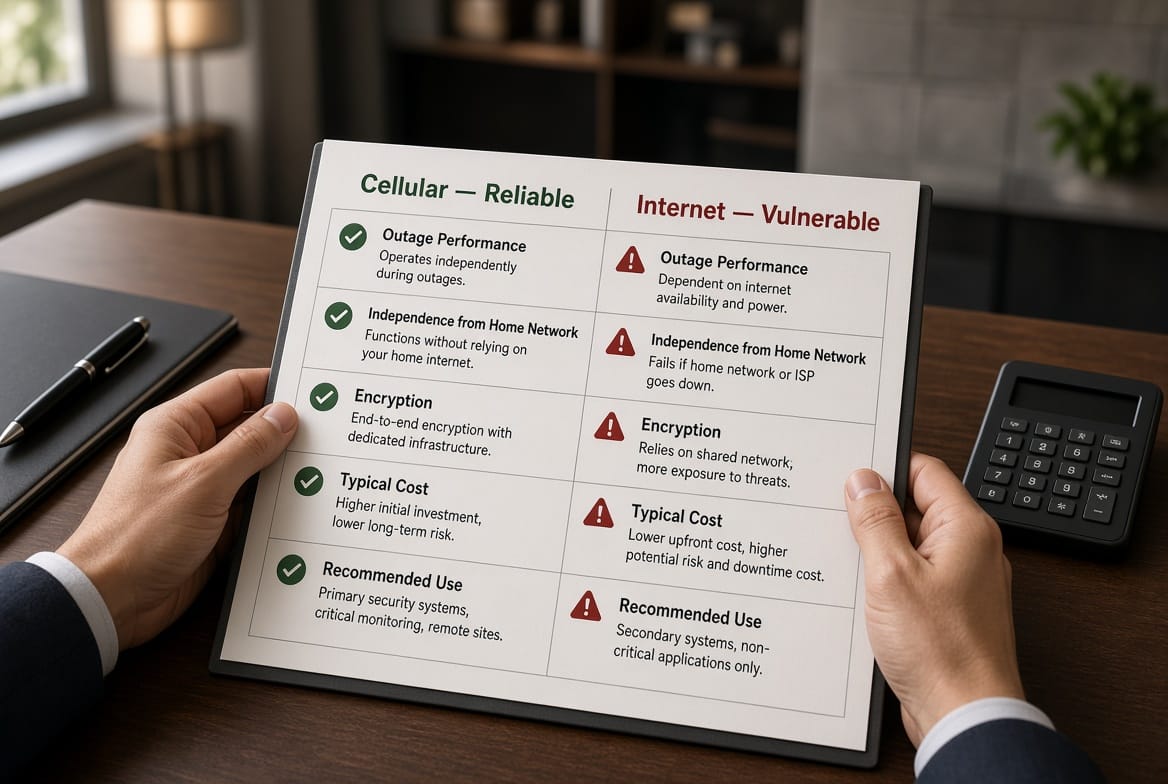
Reliability is the most important factor for a security system. Cellular monitoring earns higher marks because it does not share the same failure points as household internet. Independent testing and industry experience show that cellular communicators maintain contact with monitoring centers during events that disable broadband connections.
Cost differences exist but should be evaluated over the life of the system. Internet monitoring may appear cheaper on a monthly statement. Cellular service adds a modest fee. When an outage occurs and the internet path is silent, the actual cost of the cheaper option becomes the loss of protection. Many homeowners conclude that the small premium for cellular service is insurance against that gap.
Installation and maintenance also differ. Cellular modules are typically plug-and-play inside compatible panels and require little ongoing attention. Internet monitoring needs a stable Wi-Fi network, correct router settings, and sometimes port forwarding or VPN considerations. Changes to the home network can accidentally interrupt the alarm path.
Rural and suburban homes with uneven broadband benefit especially from cellular. Urban homes with fiber internet still experience occasional provider outages or local power events. In both settings, cellular provides a consistent layer of independence.
Some advanced systems offer dual-path monitoring. The panel tries the internet first and automatically switches to cellular if the broadband connection drops. This hybrid approach combines speed with backup reliability. Even in dual-path setups, the cellular component remains the more dependable foundation.
Additional Factors That Influence the Decision
Coverage maps matter. Cellular providers publish availability data, and professional installers can test signal strength at the panel location. A weak signal can usually be corrected with an external antenna. Internet monitoring assumes your current broadband plan remains active and unchanged.
Battery backup is another practical consideration. Quality security panels include batteries that keep the system running for hours during a power failure. Cellular communicators draw from that same battery. Internet monitoring additionally requires the modem and router to stay powered, which often needs a separate uninterruptible power supply.
Encryption and signal supervision are standard on professional cellular communicators. The monitoring center receives regular check-in signals. If those signals stop, operators know immediately that the communicator is offline. Internet paths can be supervised as well, but they still inherit the underlying network’s vulnerabilities.
Smart-home integration is possible with both methods. Cameras, locks, and thermostats can still function on Wi-Fi while the alarm signals travel separately over cellular. Separating the life-safety path from the convenience network is a sound design principle.
Common Misconceptions
One frequent assumption is that “the internet is always on.” Service records show otherwise. Another misconception is that cellular monitoring is outdated. Current LTE and 5G communicators are fast, secure, and widely supported. A third belief is that internet monitoring is “good enough” because outages are short. Even a brief interruption at the wrong moment can matter.
Homeowners sometimes think they can add a cellular backup later. Retrofitting is possible, yet installing the more reliable path from the beginning avoids extra service calls and ensures continuous coverage from day one.
Making the Choice with Confidence
The evidence favors cellular monitoring when the priority is reliability. It operates on a dedicated network, continues functioning during many internet and power events, and provides professional-grade supervision. Internet monitoring can serve as a secondary or complementary path, but relying on it as the sole communication method introduces avoidable risk.
A well-designed system matches the monitoring path to the homeowner’s need for peace of mind. Professional assessment of signal strength, existing internet quality, and household layout produces the best recommendation. The goal is not the cheapest monthly fee; the goal is a communication channel that works when it is needed.
Conclusion: Choose the Most Reliable Monitoring Path
A home security system is only as effective as its ability to reach help. Cellular monitoring delivers a dedicated, outage-resistant communication path that internet monitoring cannot match on its own. Combining both in a dual-path configuration offers extra assurance, yet the cellular component remains the foundation of dependable service.
Protecting your family and property deserves a monitoring method built for real-world conditions rather than ideal ones. Review your current setup, test signal quality, and select the path that stays connected when other household services fail.
To discuss cellular, internet, or dual-path options tailored to your home. A security professional can explain coverage in your area, review equipment compatibility, and help you implement the most reliable monitoring path available.
Protect Your Home When the Internet Fails – Call Today