The Security Camera Field of View: Wide Angle vs. Telephoto
Choosing the right security camera lens is one of the most important decisions you will make when protecting your home. The field of view determines how much of your property the camera actually sees and how clearly it records people, vehicles, and activity. A poorly matched lens creates blind spots, wasted coverage, or images that look sharp from a distance but fail to identify anyone when it matters most.
Get Clear Coverage and Detail – Call for Camera Options
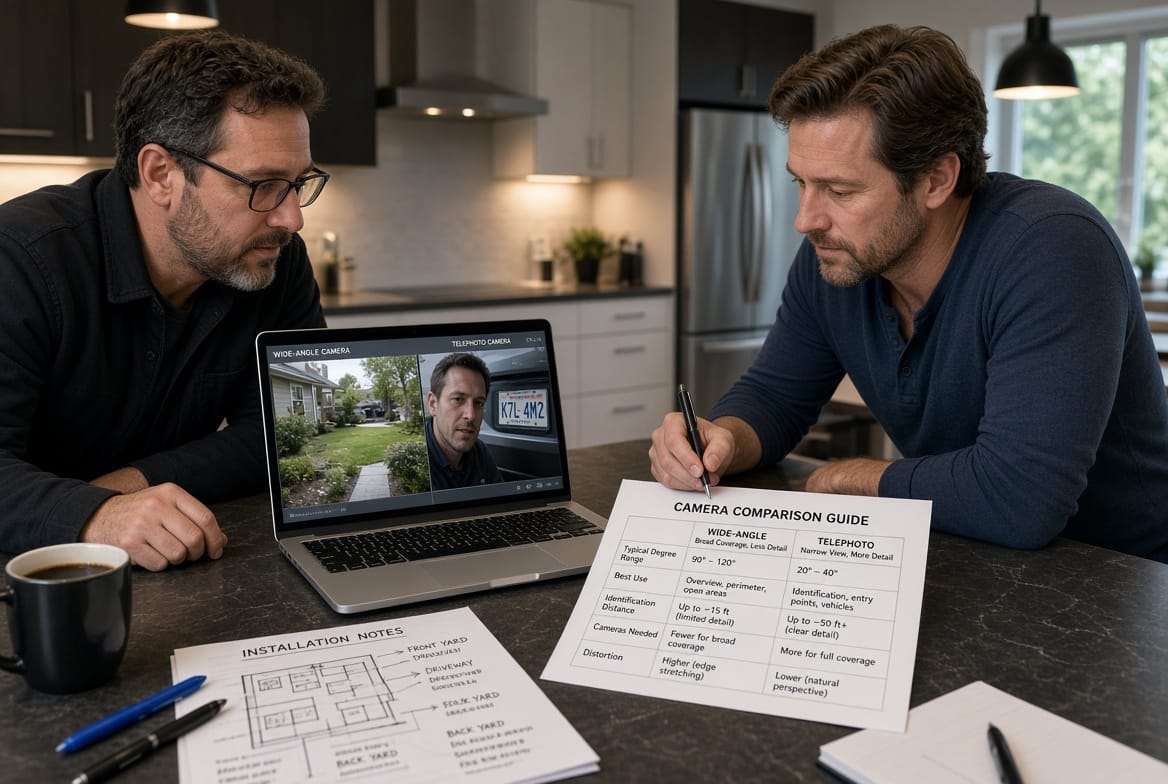
This guide explains lens choices in plain, practical language. You will learn the difference between wide-angle cameras that deliver broad coverage with less detail and telephoto cameras that deliver a narrow view with more detail. You will also learn how to match each type to specific locations and purposes so your system works the way you expect.
What Field of View Really Means
Field of view (FOV) is the angular width of the scene a camera captures, usually measured in degrees horizontally. A camera with a 120-degree FOV sees a wide slice of the world. A camera with a 30-degree FOV sees a much narrower slice but renders objects larger and with greater pixel density.
Two physical factors control FOV:
- Focal length of the lens. Shorter focal lengths produce wider views. Longer focal lengths produce narrower, more magnified views.
- Sensor size. Larger sensors can gather more of the image circle, but the lens still sets the angle.
In home security the practical result is simple: wider lenses help you detect activity across large areas; narrower lenses help you identify faces, license plates, and fine actions at a distance. Most modern systems use a mix of both.
Wide-Angle Lenses: Broad Coverage, Less Detail
Wide-angle lenses typically range from about 90 degrees to 180 degrees or more. They are the workhorses of perimeter and overview cameras.
Advantages
- One camera can watch an entire driveway, backyard, or long hallway.
- Fewer cameras are needed to eliminate large blind spots.
- Motion events are easier to spot because more of the scene is visible at once.
- Installation is often simpler because exact aiming is less critical.
Limitations
- Objects appear smaller. A person standing 40 feet away may occupy only a few dozen pixels.
- Facial features and license plates become difficult or impossible to read at moderate distances.
- Distortion increases toward the edges (the familiar “fisheye” look on very wide lenses).
- Digital zoom after the fact cannot recover detail that was never captured.
Best locations and purposes
- Front-yard overviews that need to see the street, walkway, and porch at the same time.
- Large backyards or side yards where you mainly want to know that someone is present.
- Indoor rooms or open-plan living areas.
- Entry-level deterrence cameras whose primary job is to record that an event occurred.
When you need only to know “something happened in this zone,” a well-placed wide-angle camera is efficient and cost-effective.
Telephoto Lenses: Narrow View, More Detail
Telephoto (or narrow-angle) lenses usually fall in the 20- to 60-degree range. They behave like a mild zoom lens.
Advantages
- Higher pixel density on the target. Faces and plates remain readable at greater distances.
- Reduced distortion in the center of the frame.
- Better performance in low light on the subject of interest because light is concentrated.
- Ideal for “identification zones” such as a gate, a specific parking spot, or a package drop area.
Limitations
- The camera sees only a small slice of the property. Activity just outside that slice is invisible.
- Precise aiming and mounting height become critical.
- More cameras (or a motorized PTZ) are required to cover the same total area.
- Wind, vibration, or slight mounting movement can push the target out of frame.
Best locations and purposes
- Driveway gates or street-facing positions where you must read license plates.
- Front doors or package areas where you need clear facial images.
- Long, narrow corridors or fence lines.
- High-value assets (boats, workshops, detached garages) that sit far from the house.
A telephoto camera answers the question “who or what exactly was that?” rather than “did something happen?”
How to Choose Based on Location and Purpose
The right lens is never “the widest” or “the most zoomed.” It is the lens that matches the job of that exact camera.
Front door and porch
Most homes benefit from a moderately wide lens (90–110 degrees) that sees the door, the package area, and a few feet of walkway. If porch depth is short, a slightly narrower lens can still capture faces clearly without wasting pixels on the sky.
Driveway and street
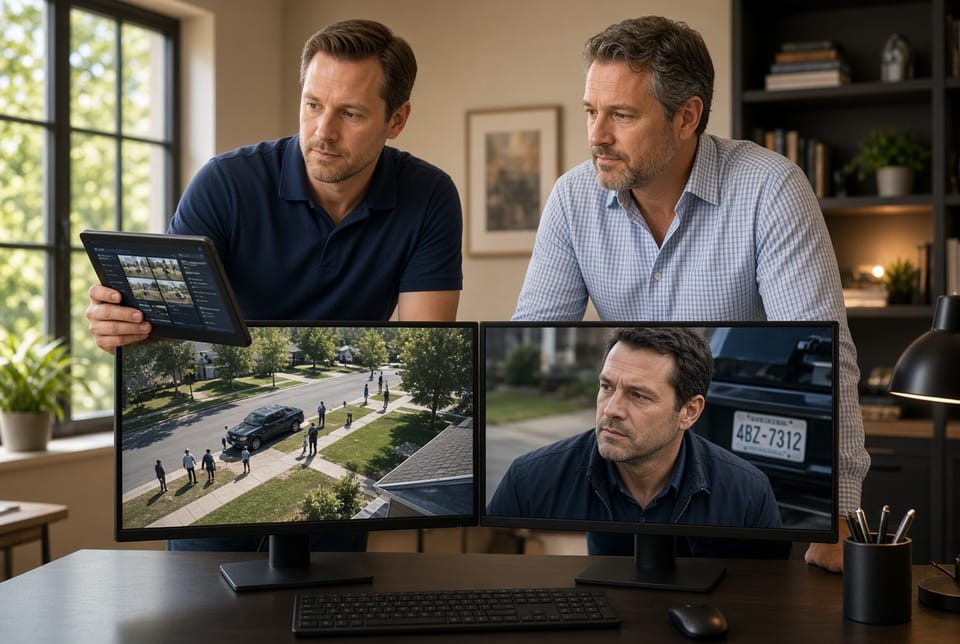
A wide-angle camera mounted high can watch the entire driveway and sidewalk. Add a dedicated telephoto camera aimed at the street or gate if you need plate reads. Many professionals use one wide camera for context and one narrow camera for identification.
Backyard and side yards
Large, open yards usually start with wide-angle cameras at the corners. If you have a specific sitting area, pool gate, or shed you care about, add a telephoto camera pointed at that spot.
Long property lines or rural driveways
Distance works against wide lenses. A person 80 feet away on a 120-degree camera may be unrecognizable. Here a telephoto or varifocal lens that can be adjusted on-site is often the better first choice.
Indoor spaces
Living rooms and kitchens favor wide-angle coverage. Hallways, stairwells, and rooms with a single point of interest (safe, jewelry box, child’s door) can use narrower views.
Lighting and mounting height also matter
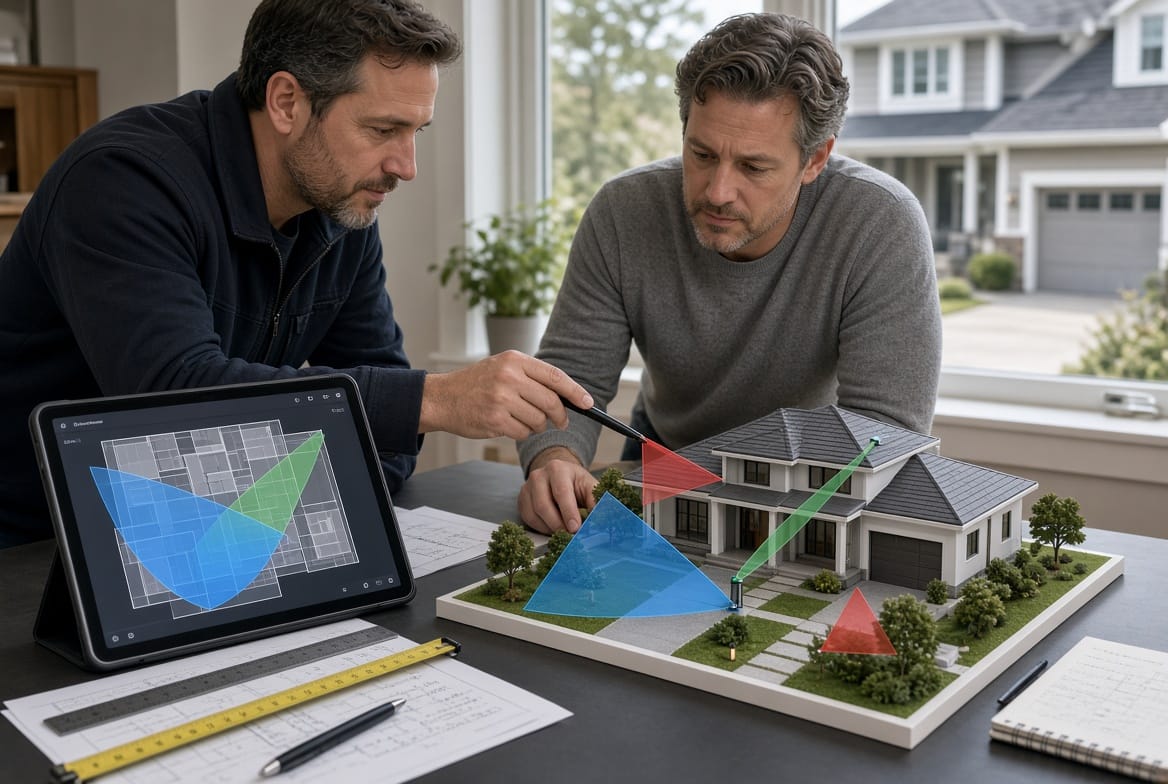
A wide lens mounted too high loses facial detail because heads become small. A telephoto lens mounted too low may miss the approach path. Professionals calculate both angle and height together.
Combining Lenses for Complete, Layered Coverage
The strongest systems do not pick one lens type for the whole house. They layer them:
- Overview cameras (wide-angle) detect motion and provide context.
- Identification cameras (telephoto) capture usable faces and plates.
- A few varifocal cameras let a technician fine-tune the exact angle after seeing the real scene.
This approach reduces blind spots while keeping storage and bandwidth reasonable. It also gives you both the “what happened” video and the “who was it” video from the same incident.
Common Mistakes That Weaken Security
- Using only ultra-wide cameras and later discovering no face is identifiable.
- Aiming a telephoto camera at a large empty lawn instead of a choke point.
- Ignoring mounting height; even the best lens fails if the camera looks down from 20 feet onto the tops of heads.
- Forgetting that digital zoom after recording cannot add pixels that were never captured.
- Buying cameras by megapixel count alone without considering the lens that focuses those pixels.
Each of these errors is easy to avoid once you treat field of view as a design decision rather than an afterthought.
Why Professional Assessment Makes the Difference
Online spec sheets list degrees, but they cannot see your unique driveway slope, tree line, or neighbor’s wall. A trained technician walks the property, notes distances, lighting changes throughout the day, and the exact questions you want answered (“Can I read the plate of any car that stops at the gate?”). That walk-through turns generic lens advice into a precise camera plan.
The result is fewer cameras doing more useful work, clearer evidence if you ever need it, and greater peace of mind.
Practical Next Steps for Your Home
Walk your property with these questions in mind:
- Where do I need to know that someone is present?
- Where do I need to recognize who that someone is?
- How far is the farthest point I care about in each zone?
- Are there natural choke points (gates, walkways, doors) that a narrower lens can watch efficiently?
Write the answers down. They become the specification for every camera you add or replace.
Modern cameras also offer varifocal and motorized-zoom options that let a technician adjust FOV on the truck or after installation. These flexible lenses are especially valuable when the exact distance is hard to judge from a product page.
Conclusion: Choose the Right Camera Lens
The difference between a security system that merely records motion and one that actually protects your family often comes down to lens choice. Wide-angle cameras give you broad coverage so nothing large happens unseen. Telephoto cameras give you the detail needed to identify people and vehicles. Used together, and aimed according to the real layout of your home, they close gaps and turn footage into useful evidence.
You do not have to guess. A short conversation with a trained advisor can map the right mix of lenses to your doors, driveways, and yards.
A specialist will help you select lenses that match your property and your peace-of-mind goals so every camera does the job it was installed to do.
Get Identifiable Footage, Not Just Motion—Call Now