The RV Insurance: Coverage for Motorhomes and Travel Trailers
Owning a motorhome or travel trailer is more than buying a vehicle. It is buying mobility, a second home, and often a long-term investment. Standard auto insurance was never designed for that reality. RV insurance is a specialized policy built for coaches and trailers that travel, park, store belongings, and sometimes serve as a primary residence. Understanding what it covers—and how it differs from an ordinary car policy—protects both your wallet and your lifestyle.
Protect Your RV Today – Call Now!
This guide explains liability, collision, comprehensive, and personal belongings coverage in plain language. It also shows why agents who only quote auto rates often leave RV owners underinsured.
Why RV Insurance Is a Specialized Policy
A passenger car is used for short trips and parked at home. An RV can be a rolling residence, a vacation asset, and a high-value unit that sits unused for months. Insurers treat that risk differently.
Specialized RV insurance typically accounts for:
- Higher replacement values and custom interiors
- Living quarters, appliances, and slide-outs
- Seasonal or full-time occupancy
- Towing, leveling, and campground liability
- Contents that travel with you
A generic auto policy may pay for a fender-bender but leave gaps when a hailstorm shreds an awning, a leak ruins cabinetry, or a guest is injured at a campsite. That is why dedicated RV coverage exists.
Key point: Treat the policy as protection for a home on wheels, not merely another vehicle.
What RV Insurance Covers
Most policies combine several core parts. Limits, deductibles, and endorsements vary by insurer and by whether the unit is a motorhome (self-propelled) or a travel trailer (towed).
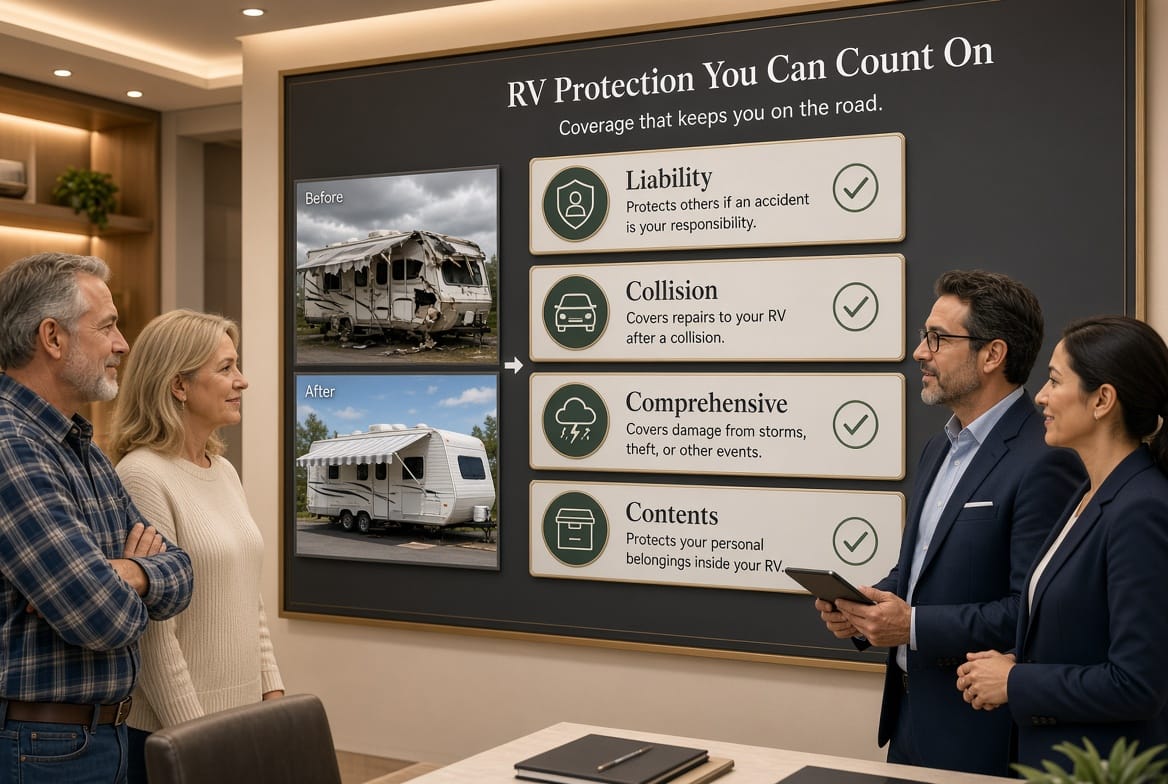
Liability Coverage
Liability pays when you are legally responsible for injury or property damage to others.
For RVs this often includes:
- Bodily injury to other drivers, passengers, or campground guests
- Property damage to another vehicle, a campsite fixture, or a building
- Legal defense costs if a claim becomes a lawsuit
Because an RV is larger and heavier, accident severity can be higher. Many owners choose higher liability limits than they carry on a daily driver. Some policies also add vacation liability or campsite liability so coverage follows you when the unit is parked and occupied.
Risk to watch: Minimum state auto limits are frequently too low for an RV claim.
Collision Coverage
Collision pays to repair or replace your RV after it hits another vehicle or object—or after it overturns—regardless of fault in many policy structures (subject to deductible).
Typical collision events include:
- Backing into a post at a fuel island
- Sideswiping a guardrail
- Jackknife or sway incidents with a trailer
- Low-clearance strikes on bridges or trees
Motorhomes and large trailers have unique repair paths: chassis, house structure, slides, and fiberglass or aluminum skins. Collision coverage should reflect actual cash value or, when available, agreed value or replacement cost options so you are not forced into a total loss at a depreciated figure that cannot replace the unit.
Comprehensive Coverage
Comprehensive (sometimes called “other than collision”) addresses non-crash losses.
Common comprehensive claims for RVs:
- Hail, wind, tornado, and falling objects
- Flood, fire, and explosion
- Theft of the unit or parts
- Vandalism and animal damage
- Glass and windshield breakage
- Some weather-related interior water intrusion, depending on wording
Because RVs spend time outdoors at campsites and storage lots, comprehensive is often the coverage owners use most. Confirm whether awnings, satellite dishes, solar panels, and aftermarket accessories are scheduled or included.
Personal Belongings and Contents
Unlike a typical auto policy, RV insurance can cover personal belongings inside the coach or trailer: clothing, electronics, kitchenware, sporting gear, and sometimes jewelry or collectibles up to sub-limits.
This is closer to a homeowners or renters contents endorsement than to auto “personal effects.” Full-timers and snowbirds should review:
- Whether contents are covered only while in the RV or also in storage
- Sublimits for high-value items
- Whether a separate renters or homeowners policy is still needed for items left at a stick-and-brick house
Important distinction: Auto insurance rarely treats the cabin as a furnished living space. RV contents coverage does.

How RV Insurance Differs from Auto Insurance
The difference is not marketing language. It is structure, use, and valuation.
Usage and rating
Auto policies assume daily commuting. RV policies often rate by usage type: pleasure, limited travel days, or full-timer. Mileage, storage location, and whether the unit is your primary residence all affect premium and eligibility.
Valuation
Cars are almost always actual cash value. RVs may offer stated amount, agreed value, or replacement cost options because depreciation on a coach can be steep while replacement of a comparable floorplan is expensive.
Living space
Auto policies do not insure kitchens, bathrooms, residential plumbing, or furniture as habitational property. RV policies can.
Towing and trailers
A travel trailer needs its own policy or a properly endorsed trailer policy. The tow vehicle’s auto policy does not automatically cover the trailer’s structure, contents, or liability while parked. Motorhomes combine chassis and house; coverage must address both.
Lay-up and storage
Many RV policies allow reduced coverage or lay-up periods when the unit is stored. Auto policies generally do not have a seasonal “parked residence” mode.
Additional living expense and vacation interruption
If a covered loss makes the RV unusable during a trip, some RV policies help with lodging or trip interruption. That benefit is foreign to standard auto contracts.
Medical payments and guests
Campground guests and traveling companions create exposure that looks more like premises liability than auto passenger coverage.
In short: auto insurance protects a machine used for transportation. RV insurance protects a machine that is also shelter, inventory, and lifestyle.
Motorhomes Versus Travel Trailers
Coverage logic is similar, but the paperwork differs.
Motorhomes (Class A, B, C)
Insured as self-propelled vehicles. The policy usually includes liability for operation on public roads plus physical damage to the coach. Drivers must be listed. Some carriers require special licenses or experience for large diesel pushers.
Travel trailers, fifth-wheels, and toy haulers
Often written as trailer policies. Liability while being towed may sit with the tow vehicle, but physical damage, contents, and parked liability belong on the trailer policy. Confirm who is responsible if the trailer separates or if it is parked for months.
Owners who tow should review both policies together so there is no gap at the hitch.
Extra Protections Worth Asking About
A strong specialized policy can add:
- Emergency expense / total loss replacement assistance
- Roadside assistance sized for a heavy coach (not a passenger-car tow)
- Vacation liability at campgrounds
- Full-timer endorsements when the RV is the primary home
- Disappearing deductibles for claim-free years
- Coverage for aftermarket upgrades (solar, lithium, custom cabinetry)
- Mexico or Canada travel extensions when needed
None of these are automatic. Ask in writing what is included and what is optional.
Common Gaps That Cost Owners Money
- Assuming the auto policy “covers the trailer”
- Carrying only liability and skipping comprehensive in hail country
- Underinsuring contents after years of outfitting the coach
- Failing to update value after major upgrades
- Letting a policy lapse during storage
- Using the wrong occupancy classification (pleasure vs. full-time)
A short annual review with an RV-focused agent closes most of these holes.
Choosing Limits and Deductibles
Match liability limits to your assets and travel pattern. Choose physical-damage deductibles you can actually pay after a storm or collision. If the unit is financed, the lender will require collision and comprehensive; confirm the lender is listed correctly as loss payee.
Photograph the interior and exterior, keep upgrade receipts, and store a digital inventory. Claims settle faster when documentation exists before the loss.
Working With the Right Advisor
Not every auto desk understands slide-out seals, generator hours, or campground ordinances. Look for professionals who regularly write motorhome and travel trailer policies. Ask how they handle:
- Agreed value versus actual cash value
- Full-timer status
- Towing combinations
- Storage and lay-up credits
Clear answers are a better signal than the lowest quote.
Final Advice: Protect Your RV Investment
A motorhome or travel trailer concentrates years of savings into one movable asset. Specialized RV insurance exists so a single storm, collision, or liability event does not erase that investment. Review liability limits, confirm collision and comprehensive valuation methods, and make sure personal belongings are not an afterthought.
Do not assume an auto policy is “close enough.” The structures are different by design.
Protect your RV investment.
Speak with an advisor who can compare options for your specific coach or trailer, usage, and travel plans. The right specialized policy is not an extra cost—it is how you keep the open road from becoming an open risk.
Call Now for Full RV Contents & Collision Protection