The Roof Shingle Wind Rating: ASTM D3161 vs. D7158 Standards
When it comes to safeguarding your home, few elements are as critical as your roof. In regions prone to high winds, hurricanes, or severe storms, the roof shingle wind rating can make the difference between a minor repair and a complete replacement. At our roofing services, we prioritize educating homeowners on these vital standards to ensure long-lasting, resilient protection.
Get Wind-Rated Shingles Installed Today – Call Now!
This comprehensive guide explores ASTM D3161 and ASTM D7158 — the two primary standards for evaluating asphalt shingle wind resistance. We'll break down what they mean, how they differ, their real-world implications, and how to select the right shingles for your specific wind zone. Whether you're in a standard suburban area or a coastal high-wind region, understanding these ratings empowers you to make informed decisions that enhance safety and durability.
Why Wind Ratings Matter for Your Roof
High winds exert tremendous uplift forces on shingles, potentially causing tabs to lift, tear, or detach entirely. Modern self-sealing asphalt shingles are engineered with adhesive strips and reinforced materials to combat this, but not all perform equally. Properly rated shingles provide peace of mind, reduce insurance claims, and maintain your home's structural integrity. By choosing shingles tested to rigorous ASTM standards, you're investing in proven performance rather than hoping for the best during the next storm.
Understanding Shingle Wind Resistance Basics
Wind resistance refers to a shingle's ability to withstand uplift forces without failing. Factors influencing this include the sealant strip's strength, shingle design rigidity, fastener quality, and proper installation.
- Uplift forces increase dramatically with wind speed — roughly with the square of the velocity.
- Self-sealing strips activate with heat and time, bonding layers together.
- Ratings simulate extreme conditions but emphasize that installation quality is equally important.
Homeowners in wind-prone areas benefit most from higher-rated products, which often include enhanced adhesives and thicker materials for superior hold-down.
ASTM D3161: The Fan-Induced Method
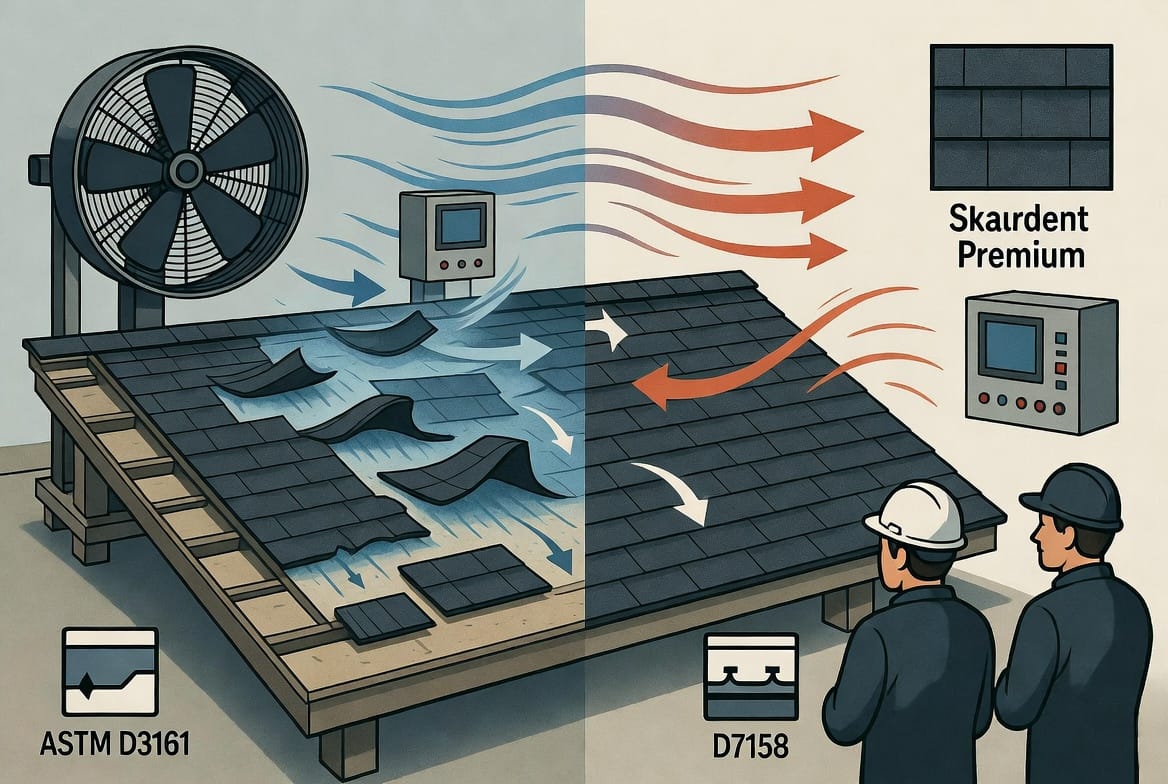
ASTM D3161 is the longstanding standard using a fan-induced method to test wind resistance of steep-slope roofing products like asphalt shingles. It involves constructing a test deck, conditioning shingles to activate seals, and subjecting them to sustained high-speed airflow for two hours.
Key classifications under D3161:
- Class A: Passes at 60 mph — suitable for low-wind areas.
- Class D: Passes at 90 mph — good for moderate wind zones.
- Class F: Passes at 110 mph — the highest for this standard, ideal for stronger gusts.
This method provides a direct, observable simulation of wind blowing across the roof. It tests the entire assembly's performance, including how well shingles resist lifting under constant pressure. Many manufacturers still reference it, especially for products outside the full scope of newer methods.
Advantages: Realistic visual demonstration and long-duration testing that stresses sealant bonds over time. It remains relevant for code compliance in various jurisdictions.
ASTM D7158: The Uplift Force/Uplift Resistance Method
ASTM D7158 represents a more advanced, calculation-based approach focused on sealed asphalt shingles. It measures uplift pressure coefficients via wind tunnel-like testing and compares them against the shingle's mechanical uplift resistance (sealant bond strength).
Classifications under D7158:
- Class D: Effective up to approximately 90-115 mph (depending on specific code correlations).
- Class G: Up to around 120-150 mph.
- Class H: The highest, handling up to 150-190+ mph ultimate design winds — perfect for hurricane-prone or high-wind zones.
This standard better accounts for real aerodynamic forces on the roof surface. It uses engineering principles from ASCE 7 to link lab data to design wind speeds, offering a more precise match for building codes.
Why D7158 is often preferred today: It provides detailed data for higher wind speeds and aligns closely with modern building code requirements in coastal and storm-heavy regions.
Key Differences Between ASTM D3161 and D7158
While both standards evaluate wind resistance, their methodologies and applications differ significantly:
- Testing Approach: D3161 relies on physical fan blowing for two hours (direct simulation). D7158 combines pressure measurements and uplift calculations (more analytical).
- Wind Speed Focus: D3161 tops out effectively at 110 mph (Class F). D7158 extends to higher classes (G and H) for extreme conditions.
- Scope: D3161 suits a broader range of steep-slope products. D7158 is specific to sealed asphalt shingles.
- Code Relevance: Many recent International Building Codes (IBC) and Residential Codes (IRC) prioritize or require D7158 labeling, with D3161 as an alternative for certain products.
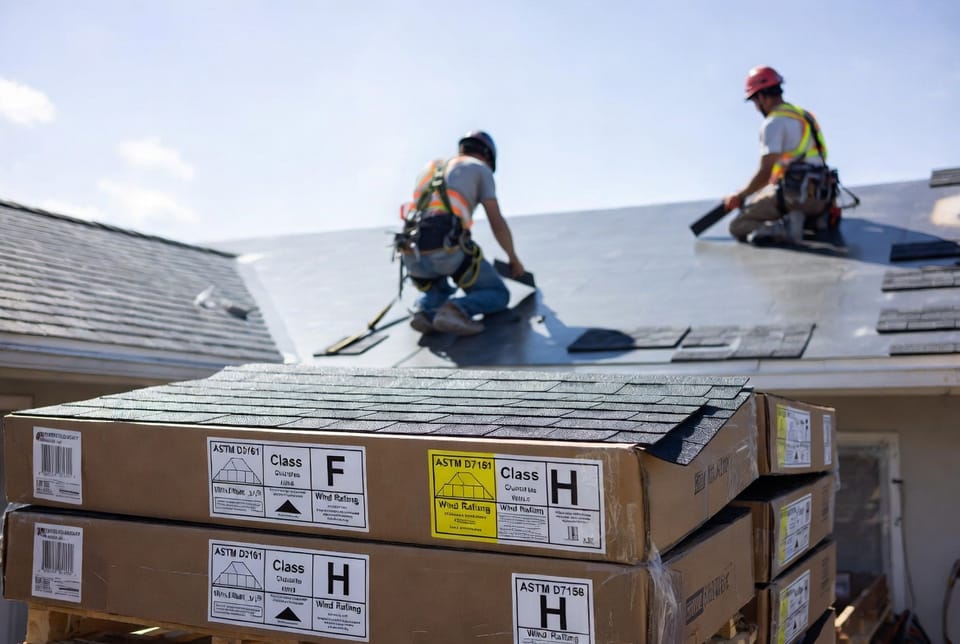
In practice, a shingle with D7158 Class H often also carries a strong D3161 Class F rating, giving dual assurance. However, always check packaging labels for the exact classifications.
What These Ratings Mean for Actual Performance
Ratings are valuable benchmarks but not absolute guarantees. They indicate performance under controlled lab conditions. Real-world success depends on:
- Proper installation: Correct overlap, fastening patterns (often 6-8 nails per shingle in high-wind areas), and sealant activation.
- Roof design: Slope, overhangs, and underlayment quality.
- Environmental factors: Sustained vs. gusty winds, debris impact, and aging over years.
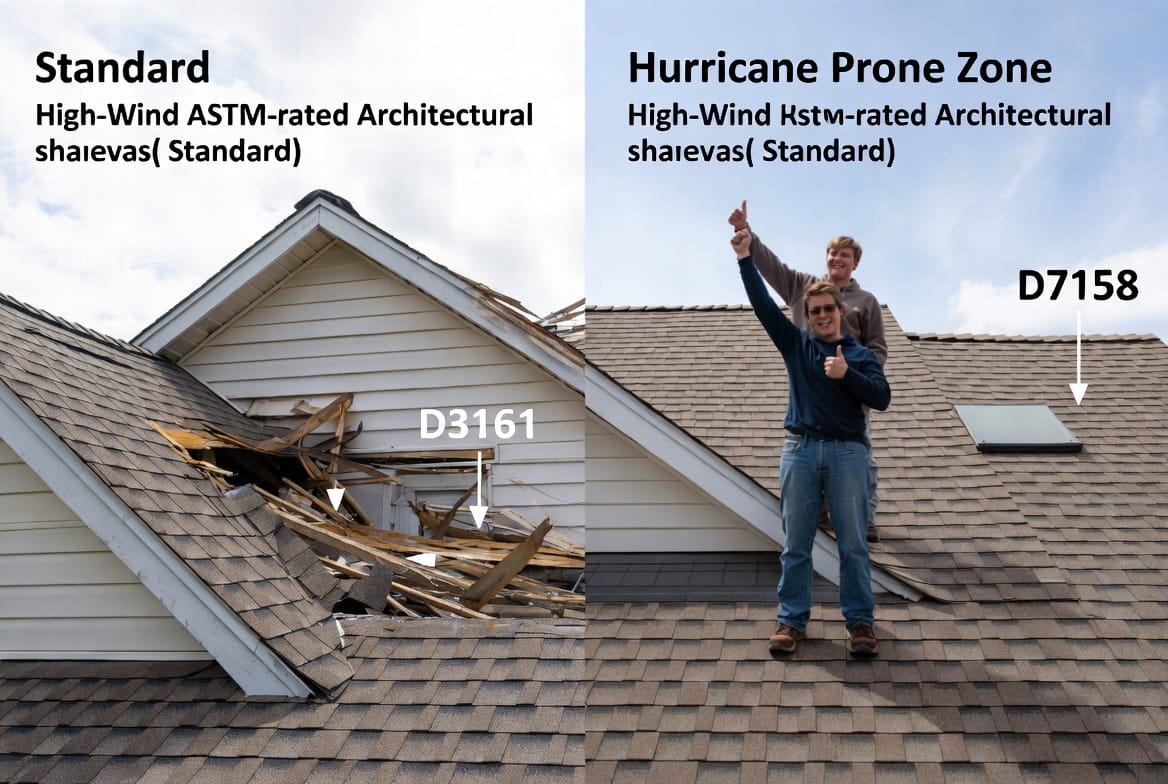
Class D3161 (60-110 mph) works well for inland standard areas with occasional storms. Class D7158 (110-150+ mph) provides superior uplift resistance crucial in hurricane zones, where 3-second gusts define design speeds.
Studies and post-storm analyses show that higher-rated shingles, when correctly installed, significantly reduce shingle loss and water intrusion. However, no roof is invincible — combining rated shingles with enhanced underlayment and edge sealing maximizes resilience.
How to Choose Shingles for High-Wind Areas
Selecting the right roof shingle wind rating involves assessing your location:
- Determine your wind zone: Check local building codes, ASCE 7 maps, or consult professionals for basic wind speed (3-second gust).
- Match or exceed requirements: For 110+ mph zones, prioritize D7158 Class G or H alongside D3161 Class F.
- Consider additional features: Impact-resistant, algae-resistant, and architectural shingles often pair with high wind ratings.
- Verify labeling: Look for clear ASTM compliance on packaging.
- Factor in warranty: Many premium shingles offer enhanced wind coverage (up to 130-150 mph) when installed properly.
In hurricane-prone regions like coastal Florida or the Gulf Coast, opting for the highest ratings is not just recommended — it's often code-mandated for new construction or replacements.
Installation Best Practices for Maximum Wind Resistance
Even the best-rated shingles require expert installation:
- Use manufacturer-specified nail patterns and lengths.
- Ensure full sealant strip contact and proper temperature for activation.
- Install high-performance underlayment and ice/water shields in vulnerable areas.
- Seal edges, ridges, and valleys meticulously.
Our team follows these protocols rigorously, ensuring your roof meets or exceeds code while delivering superior performance.
Benefits of High-Wind Rated Shingles
- Enhanced safety and durability for your family and property.
- Potential insurance discounts in high-risk areas.
- Longer roof lifespan with fewer repairs.
- Increased home value through premium materials.
- Peace of mind during storm season.
Investing in ASTM-compliant shingles is a smart, proactive choice that pays dividends over time.
Common Myths and Misconceptions
- Myth: All shingles are equally wind-resistant. Reality: Ratings vary widely — always verify specifics.
- Myth: Higher rating means indestructible. Reality: Proper installation and maintenance are essential.
- Myth: D3161 is outdated. Reality: It complements D7158 and remains widely accepted.
Rely on trusted roofing professionals to navigate these details.
Choose Shingles Matched to Your Wind Zone Today
Protecting your home starts with the right roof. Whether you need standard D3161-rated shingles or top-tier D7158 Class H for extreme conditions, our experts are here to guide you every step of the way. Don't wait for the next storm — secure your roof with confidence now.
Protect Your Roof from High Winds – Free Consultation Today!