The Rental Car Reimbursement: Coverage Limits and Usage

When an unexpected collision leaves your vehicle in the shop, the last thing you need is to be left without reliable transportation. Rental car reimbursement is a common yet often overlooked add-on that many drivers attach to their auto insurance policies precisely for this reason. This coverage steps in to pay the daily cost of a rental vehicle while your own car undergoes repairs after a covered accident. Understanding its coverage limits, how the benefit works, and the exact steps to activate it can mean the difference between days of inconvenience and seamless continuity in your routine.
Get Rental Car Reimbursement Coverage – Call Now!
In the following sections we explore every practical aspect of this protection—what it covers, the typical dollar and time boundaries, the claims process, real-world usage scenarios, and smart strategies to make the most of the benefit. The goal is simple: equip you with clear, actionable knowledge so you never feel stranded when your primary vehicle is temporarily out of service.
What Exactly Is Rental Car Reimbursement?
Rental car reimbursement (sometimes called rental reimbursement coverage or transportation expense coverage) is an optional endorsement added to a standard auto insurance policy. It is not part of liability, collision, or comprehensive coverage by default; it must be selected and paid for as an extra line item. Once in place, the endorsement reimburses you for the reasonable daily cost of renting a substitute vehicle while your insured car is being repaired following a covered loss.
The protection is triggered only when the damage results from a peril already covered under your policy—most commonly a collision or comprehensive claim such as vandalism, hail, or fire. If your vehicle is simply in the shop for routine maintenance or an uncovered mechanical failure, the benefit does not apply. This focused design keeps premiums affordable while delivering targeted help exactly when an accident disrupts daily life.
Because the coverage is secondary to any payment made by an at-fault driver’s insurer, many policyholders discover its value only after an incident. Having it already in force removes the stress of scrambling for temporary transportation and protects household budgets from unexpected out-of-pocket rental charges.
How the Coverage Works in Everyday Practice
After a covered accident, your insurer authorizes repairs and simultaneously activates the rental car reimbursement benefit. You select a rental vehicle from an approved provider, pay the rental company as usual, and then submit the itemized receipts to your insurance carrier. The insurer reimburses you up to the daily and total limits stated in your policy.
Most policies reimburse the base daily rental rate plus basic taxes and fees. Optional extras such as GPS units, child safety seats, additional drivers, or prepaid fuel are typically excluded unless specifically noted. The rental period usually begins the day your vehicle is declared undrivable or is dropped at the repair facility and ends when the repairs are completed and the car is ready for pickup—or when the maximum number of days is reached, whichever comes first.
Coordination with the repair shop is essential. Many insurers maintain preferred repair networks that can provide real-time status updates, allowing the claims adjuster to extend the rental authorization if delays occur. Clear communication among you, the body shop, and the claims representative keeps the process smooth and prevents gaps in coverage.
Typical Coverage Limits and Duration
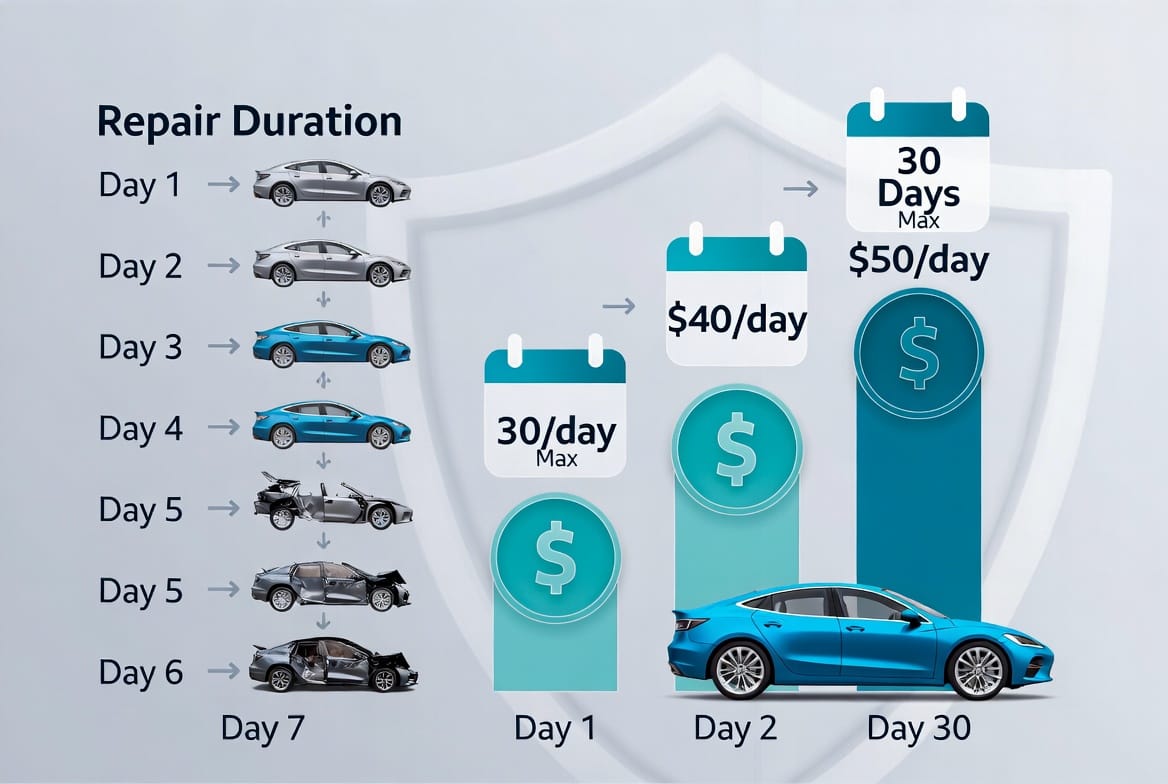
Coverage limits for rental car reimbursement are expressed in two dimensions: a maximum daily dollar amount and a maximum number of days. Industry standards commonly fall in the following ranges:
- Daily limit: $30 to $50 per day
- Duration limit: up to 30 days
Some policies offer higher tiers—$60 or even $75 per day—for drivers who prefer full-size or premium vehicles, while more economical packages stay closer to $30. The total benefit is simply the daily limit multiplied by the number of eligible days, subject to the overall maximum.
These figures are not arbitrary. A $30 daily limit typically covers an economy or compact car in most markets. A $50 daily limit expands the selection to mid-size sedans or small SUVs, which many families find more practical. The 30-day ceiling accommodates the average repair timeline for moderate collision damage; severe structural work may occasionally exceed this window, at which point the insured becomes responsible for any additional rental days.
Policy language is precise. The daily limit applies only to the rental period that coincides with authorized repair time. If the shop finishes early, reimbursement stops. If parts delays push the schedule beyond 30 days, the benefit ends unless the insurer grants a written extension—an uncommon but possible courtesy in documented hardship cases.
How to Activate and Use the Benefit After an Accident
The process is straightforward once you know the sequence. Follow these steps carefully to ensure full reimbursement:
- Report the accident to your insurer immediately—ideally within 24 hours—and confirm that rental car reimbursement is part of your policy.
- Ask the claims adjuster for a rental authorization number and a list of preferred rental partners.
- Choose a vehicle whose daily rate falls within your policy limit; exceeding the limit means you pay the difference.
- Inspect the rental thoroughly before driving away and document any existing damage with photos.
- Keep every receipt, contract, and fuel invoice.
- Once your own vehicle is repaired and returned, submit the complete documentation package to the claims department.
- Reimbursement is typically issued by check or direct deposit within 7–14 business days after approval.
Timing matters. Most insurers require the rental to begin only after the vehicle has been declared a total loss or has entered the repair facility. Starting a rental too early can result in partial denial. Likewise, continuing the rental after the shop has released the repaired car usually voids further payment.
If another driver’s insurance is primarily responsible, your own rental car reimbursement can still serve as a bridge. You may collect from the at-fault carrier later and simply repay your insurer, or your carrier may subrogate the claim on your behalf. Either path keeps you mobile from day one.
Real-World Scenarios That Illustrate the Value
Consider a midweek commute collision that leaves a sedan with front-end damage. The body shop estimates 12 working days for parts and labor. With a $40 daily limit and 30-day maximum, the driver rents a comparable mid-size vehicle for $38 per day. Total reimbursement reaches $456, covering the entire period without personal expense.
In another case, a hailstorm creates dozens of dents across the roof and hood. Comprehensive coverage pays for the body work, and the rental car reimbursement provides a compact SUV for 18 days at $45 per day. The family continues school runs and grocery trips without interruption.
A third example involves a multi-vehicle pile-up on a freeway. The insured vehicle requires specialized frame straightening that stretches to 28 days. Because the policy carries a $50 daily limit and full 30-day duration, the driver selects a full-size sedan and incurs zero out-of-pocket rental cost. Had the coverage been absent, the cumulative rental bill would have exceeded $1,400.
These situations highlight a consistent pattern: the add-on transforms a potentially expensive disruption into a managed, temporary inconvenience.
Factors That Influence Your Specific Limits
Several variables determine the exact coverage limits available to you:
- Geographic location—urban markets with higher rental rates often justify selecting the $50 tier.
- Household vehicle needs—families with multiple drivers or children may prefer higher daily limits to accommodate larger rental classes.
- Existing policy discounts—bundling with home or other lines can reduce the cost of the endorsement.
- Deductible interaction—rental reimbursement is usually independent of your collision deductible; you still pay the deductible on the repair claim, but the rental benefit pays separately.
Reviewing these factors during policy renewal or after a life change (new job, new driver in the household, relocation) ensures the limits remain aligned with actual needs.
Common Misunderstandings to Avoid
Many drivers assume rental car reimbursement automatically includes luxury vehicles or unlimited mileage. In reality, most contracts restrict class of vehicle and may impose mileage caps. Others believe the benefit continues indefinitely until repairs finish; the 30-day ceiling is firm unless an extension is formally granted.
Another frequent misconception is that the coverage replaces lost wages or public-transit costs. It does not. Its sole purpose is reimbursement of rental-vehicle expense. For broader transportation needs, some insurers offer optional “loss of use” or “transportation expense” packages with different structures.
Clarifying these points at the time of purchase prevents disappointment later.
Practical Tips for Maximizing the Benefit
- Photograph your damaged vehicle from multiple angles before it enters the shop; this documentation supports both the repair claim and the rental authorization.
- Request a written repair timeline from the body shop and share it promptly with your adjuster.
- Choose rental companies that participate in your insurer’s direct-billing program when available; this eliminates the need to pay out of pocket and wait for reimbursement.
- Monitor fuel levels carefully—returning the car with less fuel than received can trigger extra charges that fall outside coverage.
- Keep a digital folder of all rental paperwork; electronic submission speeds the reimbursement cycle.
- If repairs threaten to exceed 30 days, contact the claims representative at least five days before the limit expires to discuss possible extensions.
These small habits turn a potentially stressful process into a predictable routine.
The Cost of Adding the Coverage Versus the Cost of Going Without
Premiums for rental car reimbursement are modest relative to the protection provided. Annual costs typically range from a few dollars per month for the basic $30/30 package to a modest increase for the $50/30 tier. Compare that figure with a two-week rental bill at current market rates and the value becomes obvious.
Without the endorsement, an unexpected accident forces an immediate choice: absorb hundreds of dollars in rental fees, rely on rideshares that accumulate quickly, or rearrange work and family schedules around a single remaining vehicle. The financial and logistical burden can outweigh years of the small premium difference.
When Higher Limits Make Sense
Drivers who regularly transport clients, haul equipment, or simply prefer the comfort of a larger vehicle often upgrade to higher daily limits. Likewise, households in regions where average repair times run longer—due to parts availability or shop backlogs—benefit from the full 30-day duration rather than shorter options some carriers still offer.
Evaluating your typical weekly mileage, passenger needs, and local repair-shop performance helps determine the appropriate tier. A brief conversation with an experienced advisor can match the limits precisely to your lifestyle.

Coordinating With Other Coverages
Rental car reimbursement works alongside—not instead of—collision and comprehensive coverage. The primary claim pays for vehicle repairs (minus deductible), while the rental endorsement pays for temporary transportation. If the at-fault party’s insurer accepts liability, subrogation may recover both the repair costs and the rental outlay, restoring your policy limits for future use.
Gap insurance, if carried on a financed vehicle, addresses any shortfall between the actual cash value and the loan balance in a total-loss situation; it does not affect rental benefits. Understanding these relationships prevents overlapping payments or unexpected gaps.
Preparing Before an Accident Ever Occurs
The most effective use of rental car reimbursement begins long before any incident. During your next policy review:
- Confirm the exact daily and duration limits printed on your declarations page.
- Ask whether preferred rental partners offer direct billing.
- Note the claims phone number and keep it accessible in your vehicle and phone contacts.
- Consider whether a higher daily limit better matches your household’s transportation needs.
A few minutes of proactive attention ensures that, when an accident does occur, the benefit activates without delay or confusion.
Final Thoughts on Staying Mobile
Life rarely pauses for vehicle repairs. Work commitments, family obligations, and personal errands continue regardless of the status of your primary car. Rental car reimbursement exists to keep that momentum intact. By understanding the typical coverage limits of $30–$50 per day and up to 30 days, knowing precisely how to file after an accident, and selecting limits that fit your real-world needs, you transform a potential crisis into a manageable interval.
Do not wait until you are stranded on the roadside or sitting in a repair-shop waiting room to discover whether this protection is in place. A short conversation today can lock in the coverage that preserves your independence tomorrow.
Stay Mobile After an Accident – Call for Coverage Details!