The Refrigerator Ice Dispenser: Why It Won't Dispense Ice
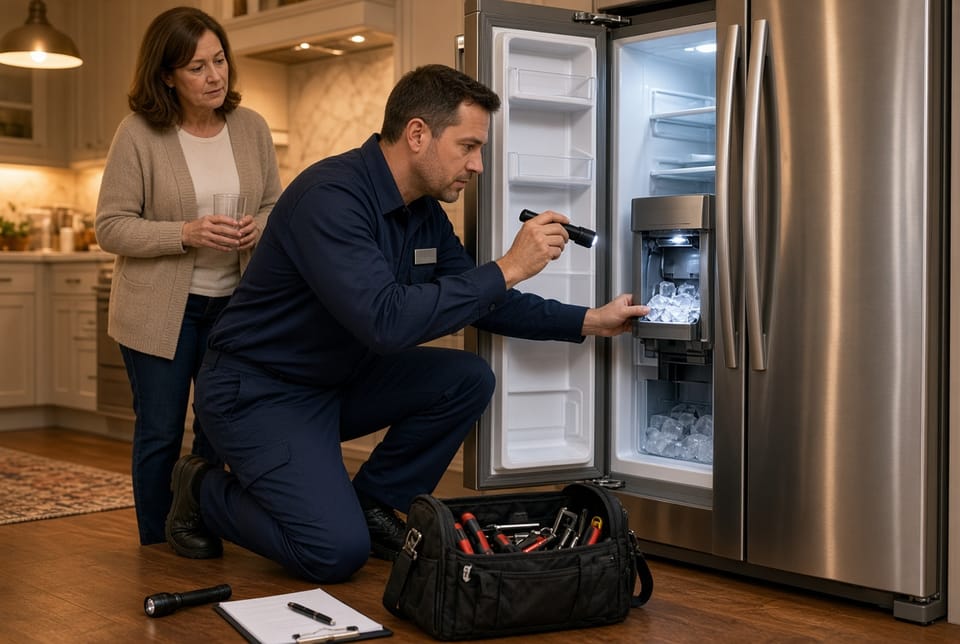
A refrigerator ice dispenser that suddenly stops working is one of the most common household frustrations. You press the lever or button, hear a faint click or nothing at all, and receive no ice. This problem appears in both side-by-side and French-door models and can develop gradually or overnight. The good news is that most ice dispenser failures stem from a handful of well-understood mechanical and environmental issues. Understanding those issues lets you perform safe basic checks before deciding whether professional service is required.
Ice Not Dispensing? Get Fast Repair – Call Now!
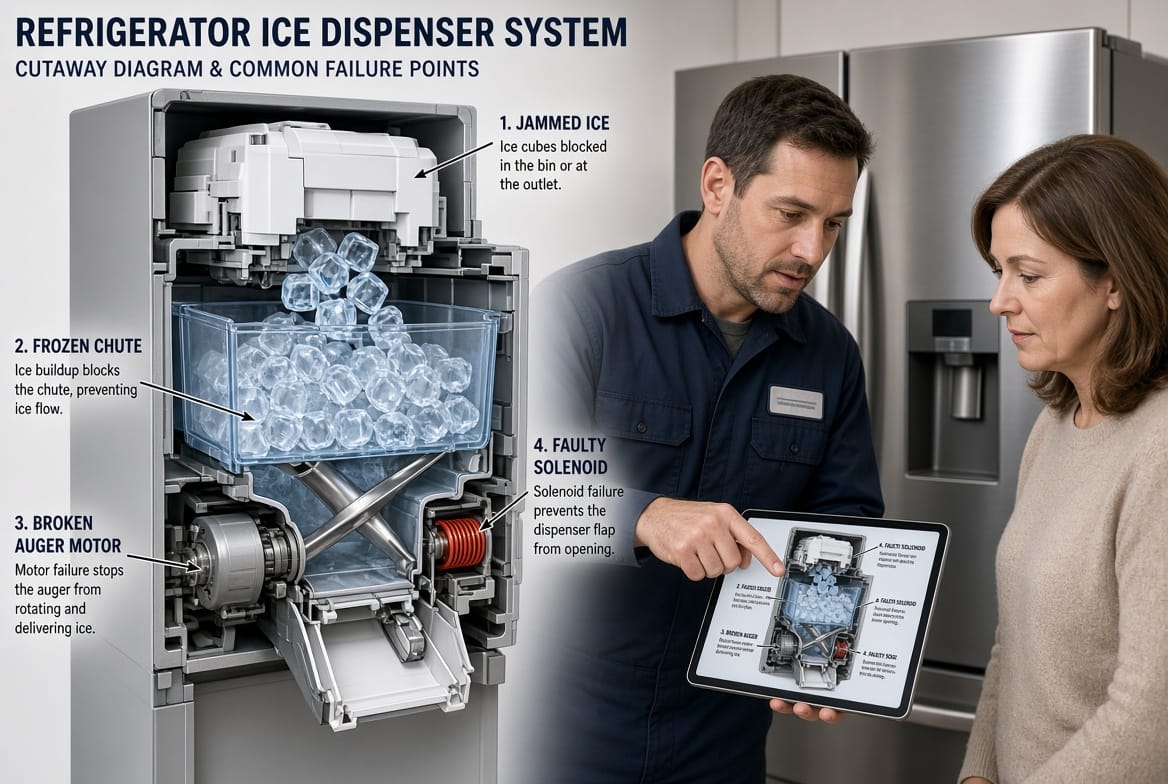
This guide explains the four most frequent causes — jammed ice, a frozen chute, a broken auger motor, and a faulty solenoid — and walks through practical troubleshooting steps. The tone throughout is straightforward and reassuring: these problems are routine for appliance technicians and are often resolved without replacing the entire refrigerator.
How a Refrigerator Ice Dispenser Is Supposed to Work
Ice is produced in the ice maker, drops into a storage bin, and is moved forward by an auger (a screw-like shaft). When you activate the dispenser, a solenoid or motor-driven flap opens the chute and the auger turns, pushing cubes or crushed ice through the opening. Any interruption along this short path — blockage, ice, motor failure, or electrical fault — stops the flow.
Knowing the path helps you isolate the problem quickly and avoid unnecessary parts replacement.
Common Cause 1: Jammed Ice
Jammed ice is the single most frequent reason an ice dispenser stops working. Cubes can fuse together into a solid mass, especially if the freezer temperature fluctuates, the door is left open, or the bin is overfilled. The auger then cannot turn, or it turns against a wall of ice and the dispenser simply refuses to deliver anything.
Signs include:
- The dispenser motor hums but no ice appears
- You hear grinding or clicking
- The ice bin feels unusually heavy or will not slide out easily
Troubleshooting Jammed Ice
- Unplug the refrigerator or switch off the ice maker at the control panel for safety.
- Remove the ice storage bin according to your model’s instructions (usually a simple lift-and-pull motion).
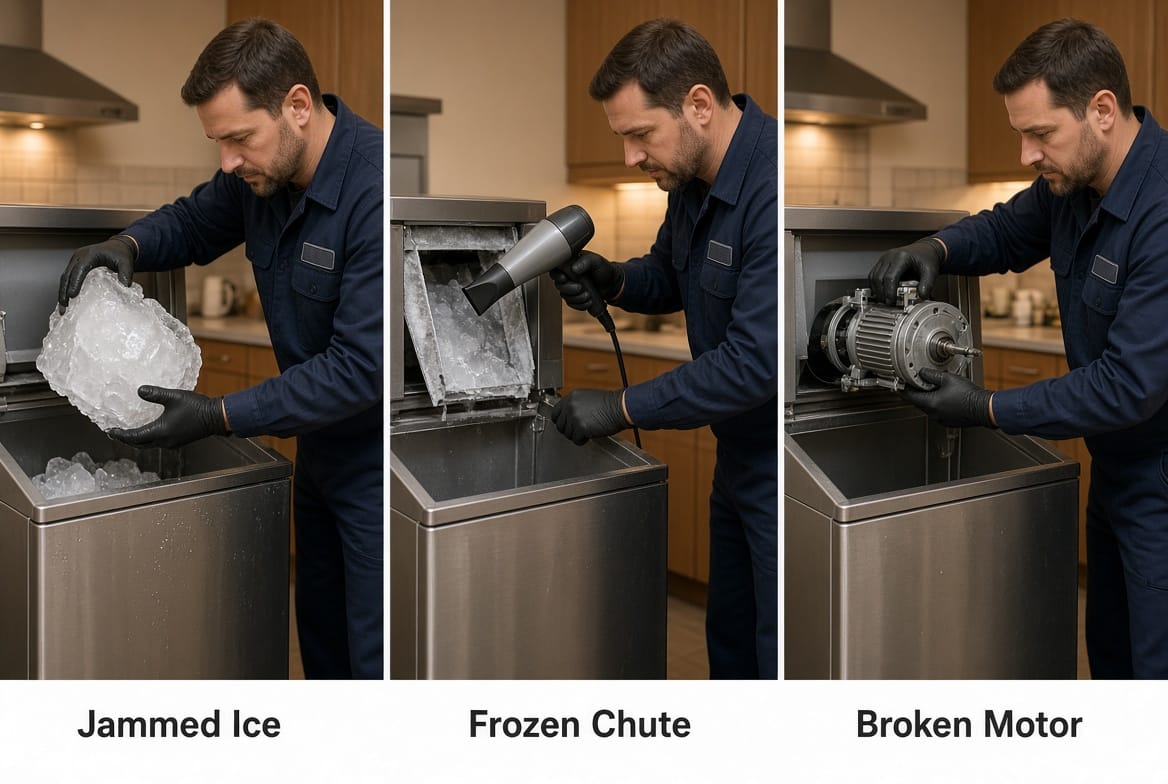
- Inspect the bin. Break apart any large clumps with a plastic scoop or wooden spoon — never use metal tools that can damage the plastic.
- Check the area around the auger for stray cubes that have wedged themselves in place.
- Reinstall the bin securely and restore power.
If the ice immediately jams again, the freezer temperature may be too high (ideal range is typically 0°F to 5°F / –18°C to –15°C) or the ice maker itself may be producing misshapen cubes. Address temperature first; persistent jamming after that usually points to a worn auger or failing motor.
Common Cause 2: Frozen Ice Chute
A frozen chute occurs when moisture from the ice or from humid kitchen air condenses and freezes inside the narrow delivery tube. The ice cannot physically pass, even if the auger is turning perfectly. This problem is more common in high-humidity climates or when the dispenser flap does not seal tightly.
Typical symptoms:
- Ice maker continues to produce ice, but nothing comes out of the dispenser
- Visible frost or ice buildup around the dispenser opening
- Occasional small pieces of ice that then stop completely
Troubleshooting a Frozen Chute
- Unplug the unit.
- Use a hair dryer on a low, warm setting held several inches away to gently melt the blockage. Never use a heat gun or boiling water.
- Alternatively, place a bowl of hot (not boiling) water near the chute for 10–15 minutes to raise the local temperature.
- Once the ice has melted, dry the area thoroughly with a clean cloth.
- Test the dispenser.
If the chute freezes repeatedly, the dispenser flap gasket may be torn or the flap solenoid may not be closing fully, allowing moist air to enter. That condition requires professional inspection.
Common Cause 3: Broken Auger Motor
The auger motor is the workhorse that rotates the screw inside the ice bin. When the motor fails, you may hear nothing, a single click, or a strained humming sound with no movement. Motors typically last many years but can burn out from repeated strain caused by jammed ice or from simple age.
Indicators of a failed auger motor:
- No sound or only a brief click when the dispenser is activated
- Ice bin is full and free of jams, yet nothing dispenses
- The auger shaft itself does not turn when you try to rotate it by hand (after unplugging)
Troubleshooting the Auger Motor
After confirming the bin is clear and the chute is open:
- Listen carefully while a helper presses the dispenser lever.
- If there is no motor noise, the motor or its wiring is the likely culprit.
- Visual inspection of the motor (accessible after removing the ice bin and sometimes a rear panel) may reveal burned wiring or a seized shaft.
Auger motors are model-specific. Replacement is a straightforward job for a trained technician but requires correct part matching and safe electrical disconnection. Attempting this without experience can damage the ice maker assembly or create a shock hazard.
Common Cause 4: Faulty Solenoid
The solenoid (or dispenser actuator) is an electromagnetic device that opens the flap covering the ice chute. When it fails, the flap stays closed and ice has nowhere to go. Some models use a small motor instead of a solenoid, but the symptom is identical.
Symptoms:
- You hear the auger turning but the flap never opens
- The dispenser light or display may still function
- Intermittent operation that worsens over days or weeks
Troubleshooting the Solenoid
- Confirm power is reaching the dispenser (check the control lock feature — many refrigerators have a lock that disables the dispenser).
- Listen for the distinct “click” of the solenoid when the lever is pressed.
- Absence of that click, combined with a moving auger, strongly suggests solenoid or flap-mechanism failure.
Solenoids are inexpensive parts, but accessing them often requires partial disassembly of the freezer door or dispenser housing. This is best left to a professional to avoid damaging the door insulation or water lines.
Step-by-Step Troubleshooting Sequence
Follow this order to save time:
- Safety first: Unplug the refrigerator or turn off the ice-maker switch.
- Remove and inspect the ice bin for jammed ice.
- Examine and, if needed, thaw the frozen chute.
- Listen for the auger motor.
- Check for the solenoid click and flap movement.
- Verify freezer temperature and ice-maker production.
- Restore power and test.
If the dispenser still fails after these checks, the problem is almost certainly a component that requires replacement.
When Basic Checks Are Not Enough
Some issues look simple but have hidden causes: a failing control board, a broken dispenser switch, a restricted water line affecting ice quality, or a worn coupling between the motor and auger. These situations benefit from professional diagnostic equipment and genuine replacement parts. Continuing to force a jammed mechanism can break the plastic housing or strip gears, turning a modest repair into a larger expense.
Prevention Habits That Reduce Future Failures
- Keep freezer temperature stable.
- Avoid overfilling the ice bin.
- Clean the dispenser area monthly.
- Replace the water filter on schedule so ice cubes form properly and do not clump.
- Use the dispenser regularly; long periods of inactivity allow moisture to freeze in the chute.
These small habits dramatically lower the chance of sudden dispenser failure.
Final Advice
Most ice-dispenser problems begin with one of four causes: jammed ice, a frozen chute, a broken auger motor, or a faulty solenoid. Start with the simple, safe checks described above. If the dispenser still will not deliver ice after you have cleared obvious blockages and verified basic operation, it is time for expert service.
Troubleshoot your ice dispenser using the steps in this guide. When the issue requires parts or specialized diagnosis. A trained technician can restore reliable ice delivery quickly and prevent further damage to your refrigerator.
Expert Ice Dispenser Repair – Call Today