The Reclaimed Heart Pine: Character and Sustainability
There is a quiet authority in flooring that has already lived a full life. Reclaimed heart pine is not simply another wood option; it is old-growth longleaf pine, densified by centuries of slow growth, saturated with deep color, and marked by the very history that once shaped American buildings. When these boards are carefully recovered from dismantled warehouses, mills, and homes, they arrive with an honesty that new lumber cannot manufacture. Homeowners seeking both beauty and responsibility increasingly turn to this material because it solves two persistent challenges at once: the visual emptiness of mass-produced floors and the environmental cost of harvesting fresh timber.
Bring History Home with Heart Pine – Call Now!
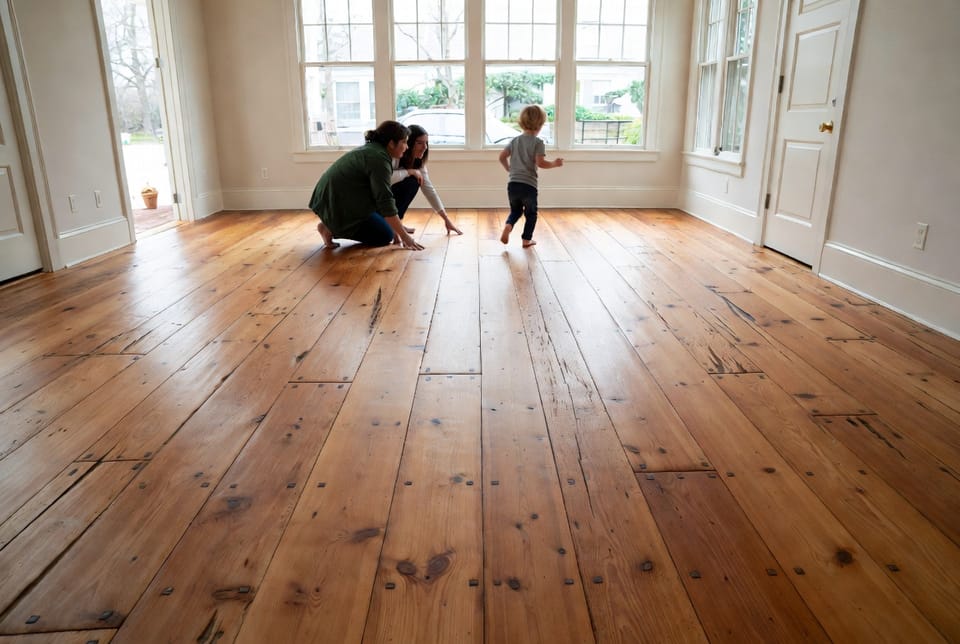
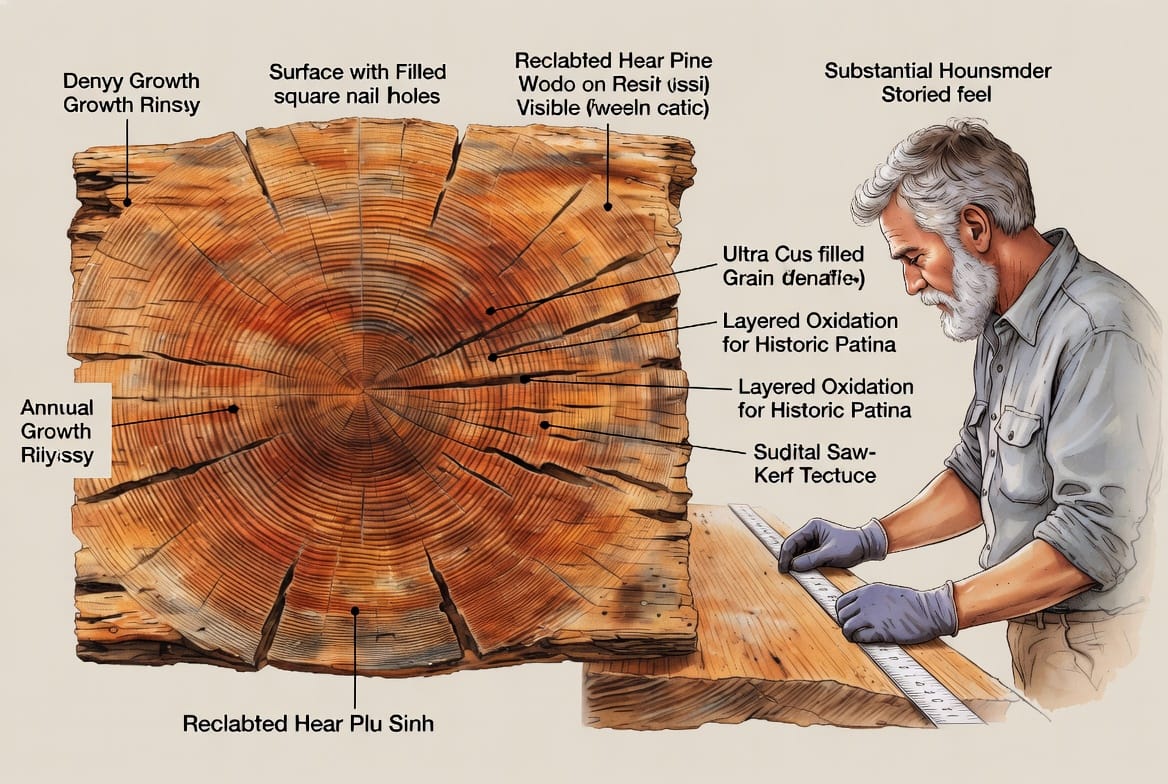
Heart pine earns its name from the dense, resin-rich core of the longleaf pine tree. These trees once dominated the southeastern landscape, growing for two hundred years or more before reaching harvest size. The resulting wood is tight-grained, heavy, and naturally resistant to wear. Its Janka hardness rating of 870 places it firmly in the durable category—firm enough for high-traffic family rooms, yet still workable for skilled installers. The color ranges from warm honey through rich amber to deep reddish-brown, deepening further with age and light exposure. What truly sets reclaimed heart pine apart, however, is the evidence of its previous life: nail holes, bolt shadows, saw marks, and the soft, uneven patina that only decades of use can create.
A Material Forged by Time and Purpose
Longleaf pine forests were the backbone of early American construction. The dense heartwood was prized for beams, flooring, and structural members precisely because it resisted decay and held fasteners securely. When those structures eventually came down, the wood did not lose value—it gained character. Reclaiming it means sorting, cleaning, denailing, and milling each board with respect for the marks it already carries. The result is flooring that tells a continuous story rather than starting a new one from blank stock.
This process is inherently sustainable. Every square foot of reclaimed heart pine is a square foot that does not require a living tree to be cut. The environmental benefit is straightforward and measurable: reduced demand on remaining old-growth stands, lower embodied energy compared with newly milled lumber, and the prevention of valuable material from entering landfills. Homeowners who choose it are not merely decorating; they are participating in a circular approach to building materials that prioritizes reuse over extraction.
The physical properties reinforce the ethical ones. Because the wood grew slowly under natural forest conditions, the growth rings are packed tightly. That density translates into dimensional stability and a surface that accepts finishes evenly while still revealing the underlying grain. The rich color is not stained on; it is intrinsic, developed through the tree’s own resin content and decades of oxidation. Light will continue to warm the tone over time, creating a living surface that improves rather than fades.
The Language of Character Marks
Modern manufacturing strives for uniformity. Reclaimed heart pine deliberately rejects that goal. Nail holes—often square from hand-forged nails—become decorative punctuation. Small checks and surface checks are left intact or gently stabilized so they read as texture rather than defect. The patina itself is a layered record of previous floors, previous footsteps, previous sunlight. These features are not flaws to be sanded away; they are the reason the material commands attention.
In practice, this character solves a design problem many homeowners face. New hardwood floors can look polished yet anonymous. Reclaimed heart pine arrives already differentiated board by board. Wide planks emphasize the scale of the original trees; mixed widths can be arranged for visual rhythm. The variation in color and marking means no two rooms will ever feel identical, even when the same species is used throughout a house.
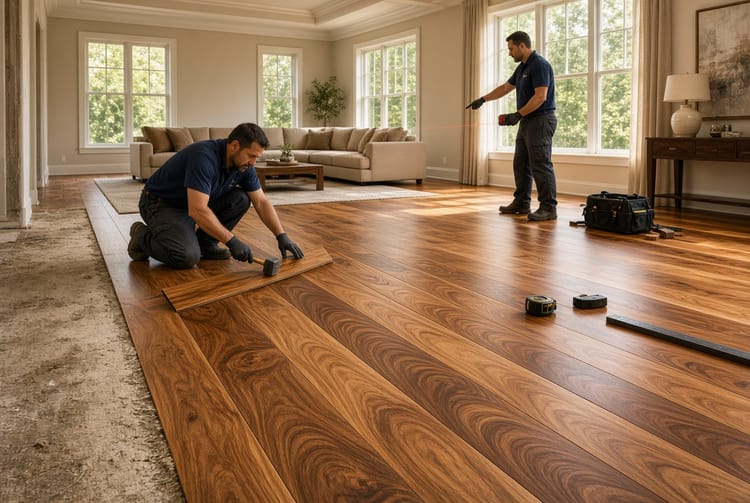
Installers who understand the material treat each board as an individual. They orient the grain for continuous flow, balance the distribution of nail holes, and allow the natural camber of older timber to settle under proper acclimation. The finished floor feels solid underfoot—another consequence of the high density—and develops a soft sheen with use rather than a factory gloss that eventually dulls.
Sustainability Beyond the Label
Repurposing wood is one of the most direct forms of material conservation available to the building industry. Reclaimed heart pine exemplifies the principle. Structures that have reached the end of their useful life still contain high-quality timber that can serve another century underfoot. The recovery process itself is labor-intensive rather than energy-intensive: selective dismantling, careful sorting by grade and dimension, removal of fasteners, and controlled kiln drying or air drying to stabilize moisture content. The outcome is a product with a dramatically lower carbon footprint than equivalent new flooring.
Homeowners often ask whether reclaimed material can meet modern performance standards. The answer is affirmative when the supplier follows disciplined protocols. Boards are graded for structural integrity, residual moisture is brought into equilibrium with the installation environment, and finishes are chosen to enhance rather than obscure the existing character. The Janka hardness of 870 provides a reliable benchmark for expected wear resistance in residential settings. In high-traffic zones the same density that once supported heavy machinery now supports daily family life without rapid indentation.
Choosing reclaimed heart pine also reduces pressure on remaining longleaf ecosystems. While restoration efforts continue, the fastest way to protect standing trees is to keep existing wood in productive use. Each reclaimed floor therefore functions as both a design statement and a conservation action.
Comparing the Options That Matter
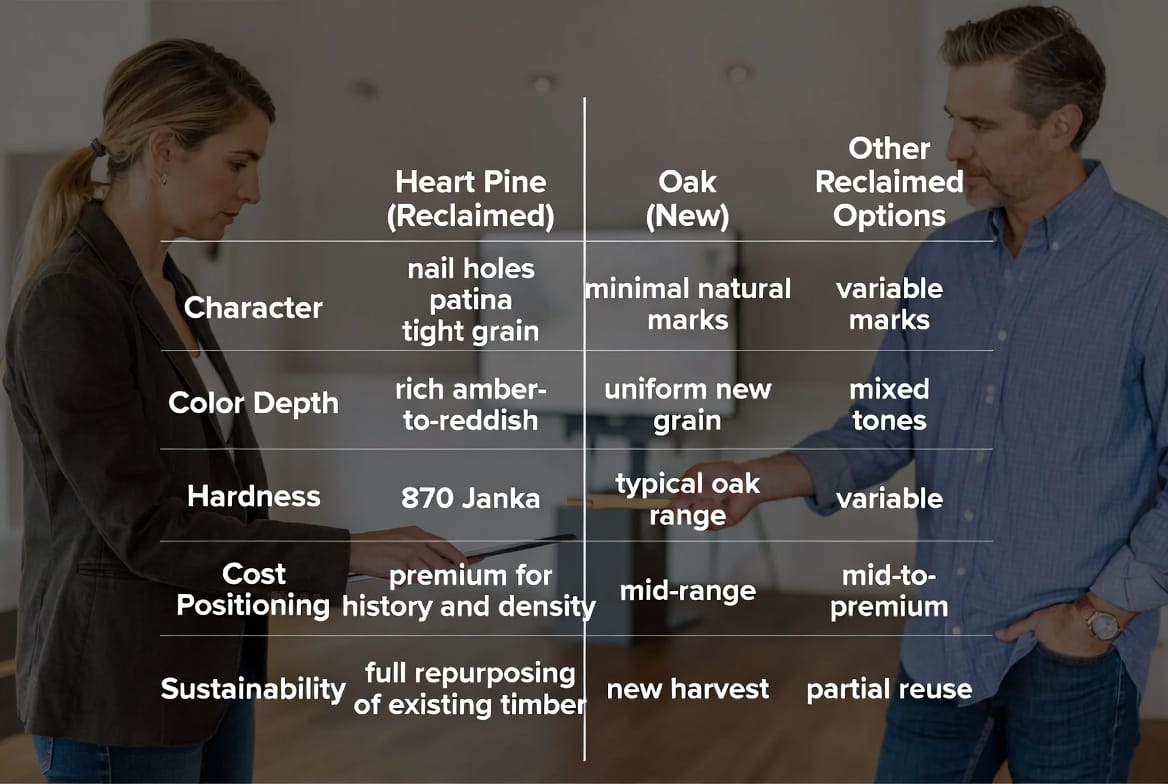
When evaluating flooring, character and cost must be weighed together with longevity and environmental impact. Reclaimed heart pine occupies a distinctive position. Its visual depth and historic markings cannot be duplicated by new oak or newly milled pine. The density offers practical durability, while the act of reclaiming delivers genuine sustainability credentials that go beyond marketing language.
New oak, for example, provides consistency and a familiar hardness range, yet it lacks the accumulated patina and the story of prior service. Fresh longleaf pine, when available, may share some of the color but rarely matches the tightness of grain found in true old-growth material. Other reclaimed species offer their own aesthetics, yet few combine the specific warm palette, the hardness rating, and the cultural resonance of heart pine recovered from American industrial and residential buildings.
Living With the Material
Once installed, reclaimed heart pine rewards attentive but not excessive care. Regular sweeping or soft vacuuming removes grit that could abrade the surface. Occasional damp mopping with a pH-neutral cleaner preserves the finish without raising the grain. Area rugs in high-wear zones and felt pads under furniture legs extend the intervals between refinishing. Because the wood is already dense and stable, seasonal movement is typically modest when humidity is kept within normal indoor ranges.
Over years the floor develops a further layer of lived-in beauty. Foot traffic polishes high spots; sunlight continues to warm the tone; the nail holes and checks remain as quiet reminders of the material’s previous life. Families often report that the floor becomes a conversation piece—guests notice the marks, ask about the origin, and leave with a new appreciation for materials that carry history rather than erase it.
The same qualities that make the wood attractive in living rooms serve equally well in kitchens, hallways, and even certain commercial spaces where authentic character is desired. The hardness rating supports these uses, while the visual variation prevents the surface from reading as institutional or cold.
Design Flexibility Without Compromise
Interior designers value reclaimed heart pine for its ability to bridge styles. In a traditional setting the warm tones and historic marks reinforce period authenticity. In contemporary spaces the same boards provide organic texture against clean lines and minimal furnishings. Mixed-width installations create visual interest without relying on complex patterns. Oil finishes emphasize the natural color and grain; more protective film finishes can be applied when higher abrasion resistance is required, still allowing the underlying character to remain visible.
Because each project draws from limited inventories of recovered material, the flooring is inherently limited-edition. That scarcity is not artificial; it reflects the finite supply of structures available for careful deconstruction. Homeowners who select it are therefore choosing something that cannot be endlessly replicated, adding a layer of exclusivity grounded in reality rather than marketing.
The Practical Path to Installation
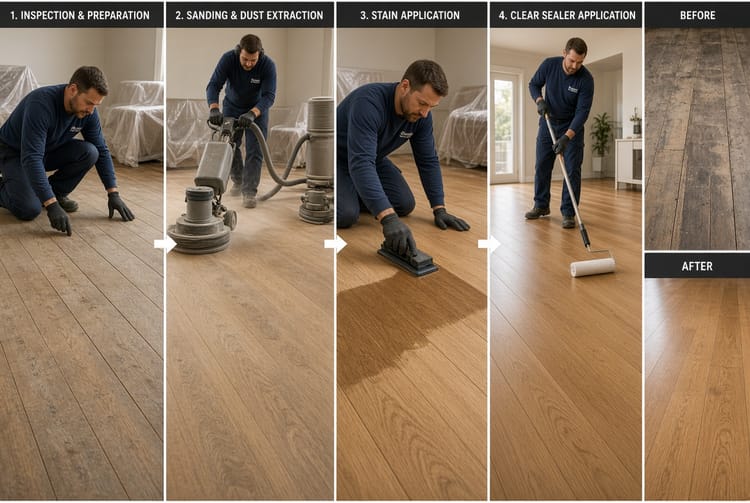
Successful projects begin with realistic expectations and experienced partners. Moisture testing of both the subfloor and the reclaimed boards is essential. Proper acclimation time allows the wood to reach equilibrium with the home’s environment. Professional installation ensures that the unique characteristics of each board are distributed thoughtfully rather than clustered. Expansion gaps are observed according to the specific properties of the denser old-growth material.
When these steps are followed, the finished floor performs reliably for decades. The same density that once supported heavy industrial loads now supports the lighter but constant traffic of residential life. Refinishing, when eventually needed, can often restore the surface while leaving the deeper character marks intact, extending the service life still further.
Why the Choice Matters Now
In an era of rapid construction and standardized materials, reclaimed heart pine offers a deliberate alternative. It answers the desire for uniqueness without resorting to artificial distressing. It satisfies environmental concerns through genuine reuse rather than incremental improvements in harvesting practice. It delivers measurable performance through a Janka hardness of 870 and the inherent stability of slow-grown timber. Most importantly, it brings tangible history into daily surroundings—nail holes that once held beams, patina formed by decades of light and use, color developed by the tree itself.
Homeowners who walk across these boards are walking across recovered American architecture. The material does not pretend to be new; it proudly remains what it has always been, simply relocated and given a second century of purpose. That continuity is both aesthetically powerful and ethically sound.
The decision to install reclaimed heart pine is therefore more than a flooring selection. It is an affirmation that beauty and responsibility can occupy the same surface, that character is not manufactured but earned, and that the most sustainable board is often the one already in existence.
Call Today for Reclaimed Heart Pine Options