The Post-Flood Mold Prevention: Keeping Humidity Below 50%
After floodwaters recede, the most dangerous phase of water damage often remains invisible. Standing water can be pumped out and wet materials can be extracted, yet elevated indoor humidity quietly creates the perfect environment for mold growth. The single most critical prevention step homeowners and property managers can take is to keep relative humidity below 50 %. This target is not arbitrary. It is the scientifically recognized threshold that starves mold of the moisture it needs to germinate, colonize, and spread.
Stop Post-Flood Mold – Call Now to Keep Humidity Below 50%
Acting within the first 24–48 hours after a flood dramatically reduces the chance that airborne mold spores—already present in virtually every building—will find conditions suitable for rapid development. When humidity stays at or under 50 %, those spores remain dormant. When humidity climbs above 60 %, growth can begin in as little as 24–48 hours on damp drywall, wood, insulation, and carpeting. The difference between a successful recovery and a costly, health-compromising mold infestation frequently comes down to disciplined humidity control.
This article explains exactly why the 50 % threshold works, how to monitor conditions accurately with hygrometers, and how to dehumidify a flooded property effectively. The guidance is practical, reassuring, and designed for immediate use.
Why Humidity Below 50 % Stops Mold in Its Tracks
Mold requires three elements: organic food sources (almost every building material), suitable temperature (most indoor environments already provide this), and sufficient moisture. Of these three, moisture is the only factor that can be controlled quickly after a flood.
Relative humidity (RH) measures the amount of water vapor in the air compared with the maximum the air can hold at that temperature. At 70–90 % RH, many common indoor molds—Aspergillus, Penicillium, Stachybotrys—absorb moisture directly from the air and from still-damp surfaces. Their metabolic processes accelerate, colonies become visible, and spores are released in large numbers.
When RH is held below 50 %, two protective mechanisms occur simultaneously:
- Surface moisture evaporates faster than it can be replenished, leaving materials too dry for spore germination.
- The air itself no longer supplies enough water vapor for mold to draw upon.
Laboratory and field observations consistently show that mold growth is strongly inhibited below 55 % RH and is effectively prevented for most species at or under 50 %. This is why professional restoration standards treat 50 % as the operational goal rather than a loose recommendation.
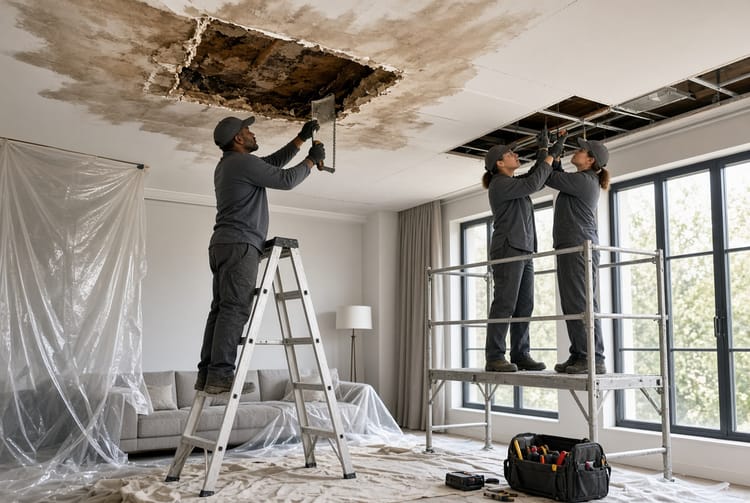
Failing to reach this target after a flood carries serious consequences. Hidden mold behind walls or under flooring can trigger respiratory irritation, allergic reactions, and, in sensitive individuals, more significant health effects. Structurally, prolonged high humidity warps wood, rusts fasteners, and degrades insulation. The financial cost of later mold remediation almost always exceeds the cost of proper drying and dehumidification performed immediately.
The good news is that the 50 % target is achievable with the right tools and a systematic approach.
How to Monitor Humidity Accurately with Hygrometers
You cannot manage what you do not measure. Guessing by how the air “feels” is unreliable after a flood because residual moisture in walls and floors continues to off-gas for days. Precise monitoring requires hygrometers.
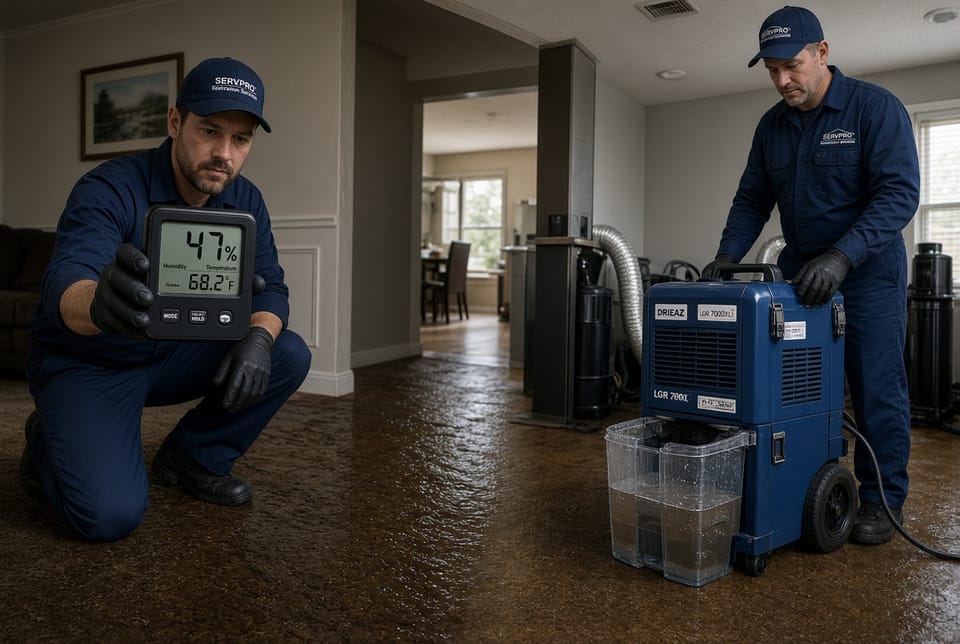
A quality digital hygrometer displays both temperature and relative humidity and typically costs far less than a single day of delayed drying. Place multiple units rather than relying on one reading:
- Position one unit in each major affected room.
- Place additional units in basements, crawl spaces, and any area that received water.
- Keep units away from direct airflow of dehumidifiers or HVAC vents so they record ambient conditions rather than localized dry air.
- Check readings at least twice daily during the first week and once daily thereafter until levels stabilize.
Look for models with data-logging capability or smartphone connectivity if the property is large. Analog hygrometers can serve as inexpensive backups, but digital units offer faster response and greater accuracy.
Interpret the numbers in context. A reading of 62 % in a recently flooded bedroom signals immediate action. A reading of 48 % in the same room after 36 hours of dehumidification indicates the process is working. Track trends, not isolated snapshots. If humidity rises overnight, hidden moisture pockets may still be present and additional drying equipment or professional inspection is warranted.
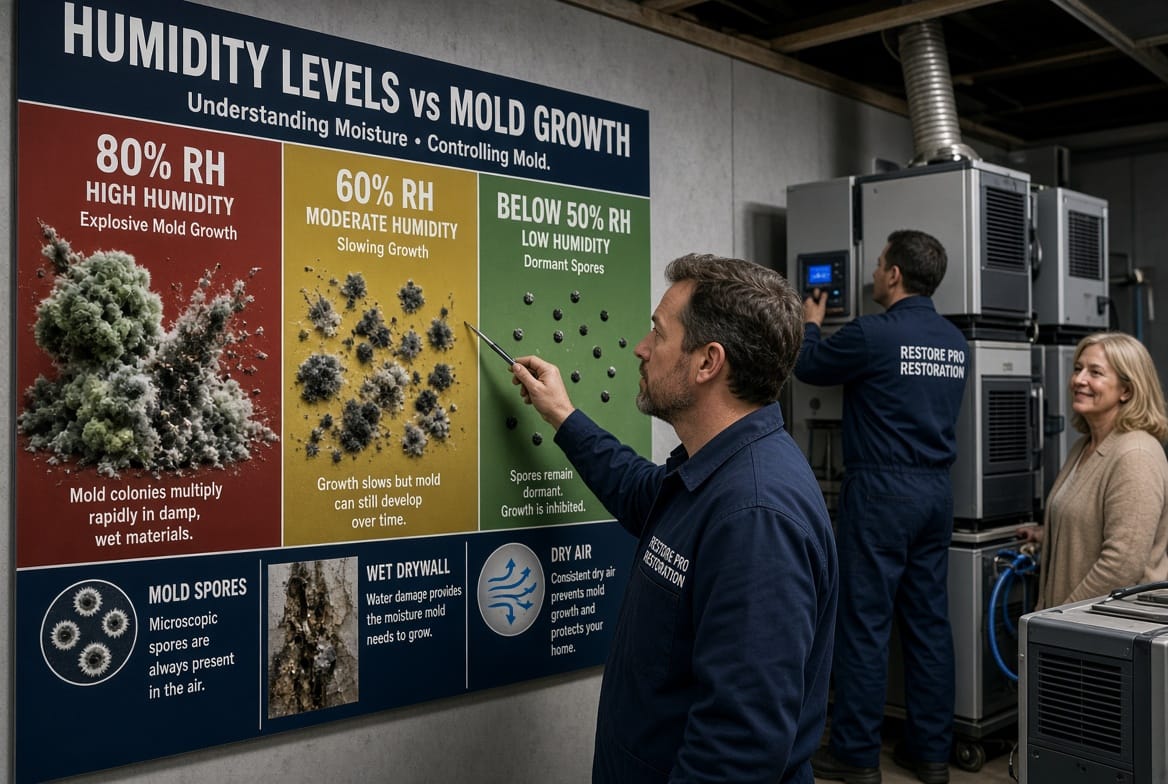
Consistent monitoring removes uncertainty and allows you to adjust equipment before conditions deteriorate.
How to Dehumidify Effectively After a Flood
Monitoring tells you the problem; dehumidification solves it. Effective dehumidification after flooding is more intensive than ordinary household use because the building materials themselves are saturated.
Choose the Right Equipment
Residential portable units rated at 30–50 pints per day are usually insufficient for a flooded space. Commercial-grade refrigerant or desiccant dehumidifiers that remove 70–150+ pints per day are the standard in professional restoration. Desiccant models perform especially well in cooler environments such as basements.
Match capacity to the size and wetness of the space. A general rule is to oversize rather than undersize; running equipment continuously is safer than cycling it on and off.
Placement and Airflow Strategy
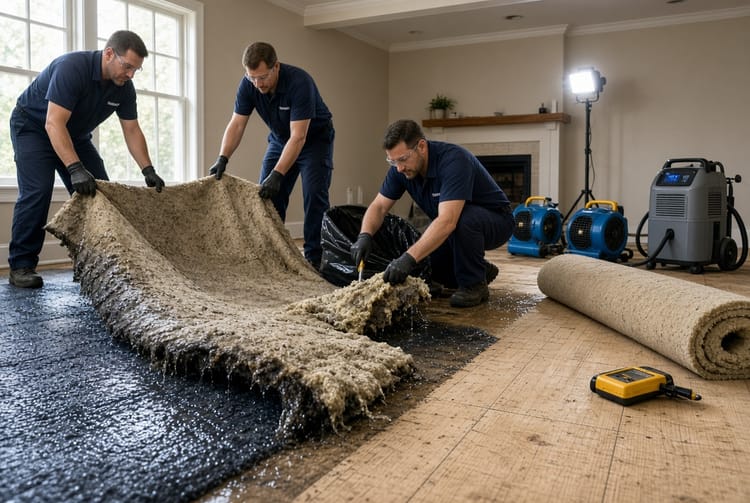
Position dehumidifiers in the center of affected rooms or in the path of prevailing air movement. Combine them with high-velocity air movers aimed at wet surfaces. The combination of lowered humidity and increased evaporation accelerates drying of carpets, padding, drywall, and framing.
Close windows and exterior doors during active dehumidification so outdoor moisture cannot enter. If outdoor humidity is lower than indoor humidity and weather permits, limited ventilation can help, but this decision should be based on hygrometer readings, not assumption.
Empty collection reservoirs frequently or, better, connect units to a continuous drain. A full tank that shuts the machine off overnight can allow humidity to rebound.
Timeline and Persistence
Most flooded structures require 3–7 days of continuous operation, sometimes longer if water reached wall cavities or subfloors. Do not discontinue equipment the moment the air feels dry. Confirm with hygrometers that readings remain stably below 50 % for at least 24–48 hours after equipment is turned off. Only then is it reasonably safe to assume hidden moisture has been addressed.
Professional restoration teams use moisture meters on materials in addition to air hygrometers. This dual approach verifies that both the air and the building components have reached safe dryness levels.
Common Pitfalls and How to Avoid Them
Even well-intentioned efforts can fall short. Avoid these frequent mistakes:
- Relying on a single hygrometer placed near a dehumidifier.
- Turning equipment off at night to save electricity.
- Assuming that because visible water is gone the job is finished.
- Using household fans alone without dehumidifiers; fans circulate moist air rather than remove moisture.
- Waiting more than 48 hours to begin aggressive drying.
Each of these errors allows humidity to linger in the danger zone long enough for mold to establish itself.
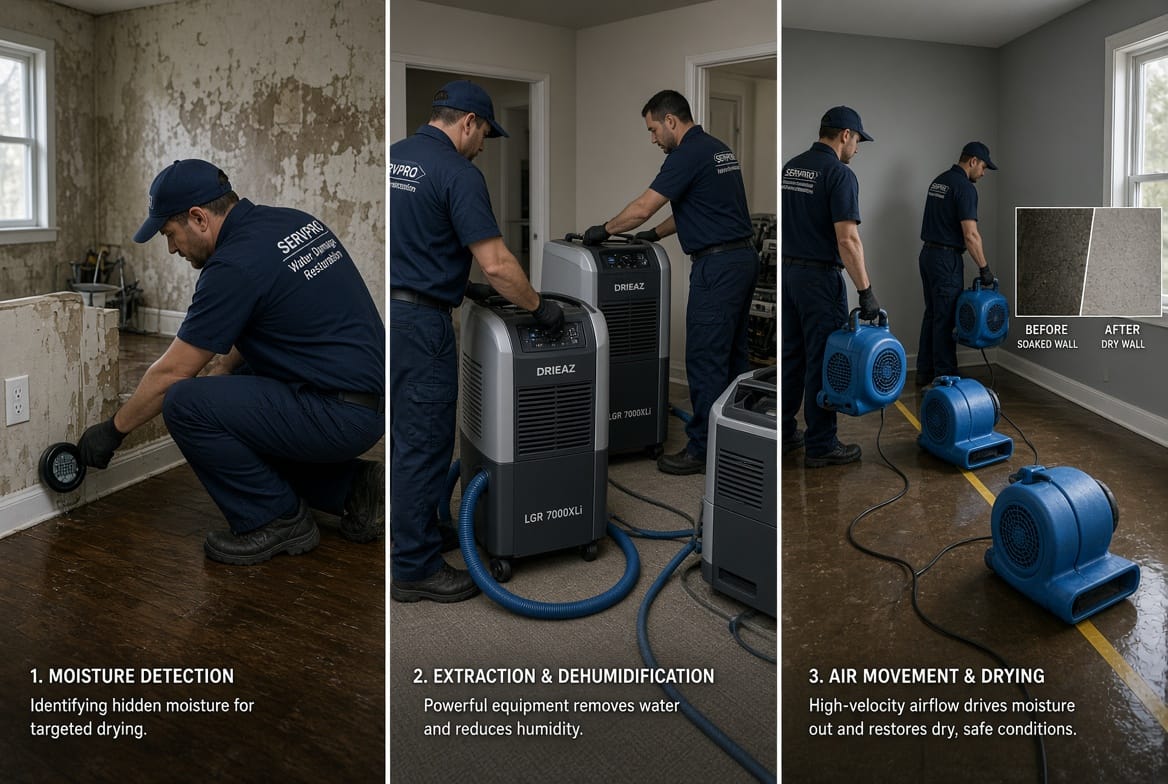
Long-Term Protection After the Immediate Crisis
Once humidity is stably below 50 % and materials test dry, maintain the gain. Run HVAC systems if they were not damaged, use bathroom and kitchen exhaust fans, and consider a whole-house dehumidifier in humid climates. Inspect for any lingering musty odors, which can indicate hidden moisture that still needs attention.
Regular hygrometer checks during the first month after a flood provide peace of mind. If readings creep upward, reintroduce portable dehumidifiers promptly.
Take Control Before Mold Takes Hold
Keeping indoor humidity below 50 % is the most reliable, evidence-based method of preventing post-flood mold. It is also one of the few steps that property owners can begin immediately while arranging professional help. Accurate monitoring with hygrometers and properly sized, continuously operating dehumidifiers form the core of an effective strategy.
When flooding has been extensive, hidden cavities are involved, or you simply want certainty that the job is done correctly, professional water-damage restoration is the surest path. Trained technicians bring commercial equipment, moisture-mapping tools, and the experience to dry a structure thoroughly without causing secondary damage.
Control humidity to prevent mold. Do not wait for visible growth or musty odors. Early, decisive action protects both the building and the health of everyone who lives or works inside it.
Control Humidity Before Mold Starts – Call Now!