The Landscape Lighting Timer: Mechanical vs. Digital vs. Smart
A well-designed landscape lighting system transforms a property after dark. Paths become safer, architectural features gain depth, and gardens stay usable long after sunset. The component that actually decides when those lights turn on and off is the landscape lighting timer. Choosing the wrong timer wastes energy, leaves lights running at the wrong hours, or forces constant manual adjustments. Choosing the right one delivers consistent, efficient, and nearly hands-free control.
Call Today for Expert Timer Setup and Night-Ready Lighting
This guide compares the three main categories homeowners and property managers encounter: mechanical timers, digital timers, and smart timers. Each type is explained in plain language, with clear pros and cons, so you can match the device to your lighting goals, budget, and willingness to manage schedules.
Why the Timer Matters More Than Most People Realize
Landscape lights typically run on low-voltage or line-voltage circuits that stay energized 24 hours a day. Without a timer they either stay on continuously (expensive and wasteful) or require someone to flip a switch every evening and morning. A quality timer:
- Turns lights on at dusk and off at a set time or at dawn
- Prevents lights from operating during daylight hours
- Protects lamps and fixtures from unnecessary runtime
- Creates a lived-in appearance even when the house is empty
The technology inside the timer determines how precisely those events happen and how much effort you spend maintaining the schedule.
Mechanical Landscape Lighting Timers: Simple, Cheap, Manual Dial
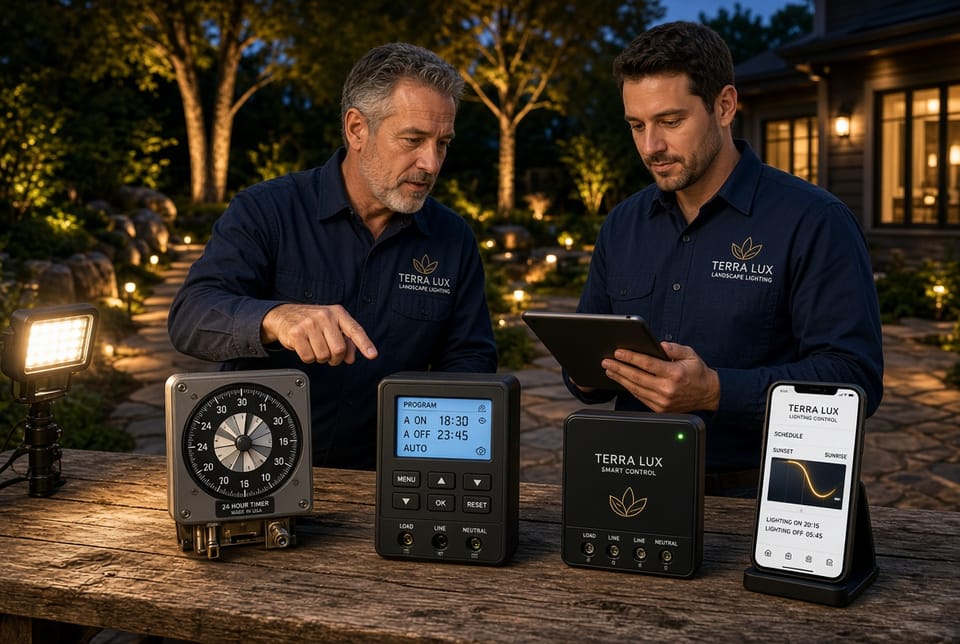
A mechanical timer uses a motor-driven clock face and a set of physical pins or a rotating dial. You push pins in or out (or slide segments) to mark on and off periods. The motor advances the dial once every 24 hours. When a pin reaches the switch mechanism, the circuit closes or opens.
These units are the oldest and least expensive option still widely available for outdoor lighting.
How they typically work
- 24-hour analog dial marked in 15- or 30-minute increments
- Pins or sliders that you physically set
- Optional photocell override on some models
- Manual on/off lever that bypasses the schedule
Pros of mechanical timers
- Lowest purchase price — often a fraction of digital or smart models
- Extremely simple to understand; no menus or apps
- No batteries required in many designs (the motor runs on line voltage)
- Reliable in basic applications when set correctly
- Easy to replace if damaged
Cons of mechanical timers
- Limited precision — schedules change only in large time blocks
- No automatic adjustment for seasonal sunrise and sunset shifts
- You must physically reset the pins twice a year for daylight saving time
- Pins can break or slip, causing lights to stay on or off unexpectedly
- No remote access or notification if the schedule fails
- Less protection against power outages; the clock may drift
Mechanical timers suit small, static lighting layouts where the owner does not mind walking outside twice a year to adjust the dial. They remain popular for budget-conscious installations and rental properties where simplicity is valued over convenience.
Digital Landscape Lighting Timers: Programmable and Feature-Rich
A digital timer replaces the analog dial with an electronic clock and a small LCD or LED display. Buttons let you program multiple on/off events, set different weekday and weekend schedules, and often include a built-in photocell or astronomical clock.
These units sit in the middle of the market: more capable than mechanical models yet less connected than full smart systems.
Typical features
- Multiple daily or weekly programs
- Random or “vacation” mode that varies on/off times slightly
- Battery backup that keeps time during outages
- Photocell or dusk-to-dawn sensing on many landscape-specific models
- Countdown or interval functions for fountain or accent circuits
Pros of digital timers
- Greater scheduling flexibility than a mechanical dial
- Clear display shows current time and next event
- Battery backup prevents schedule loss after brief power interruptions
- Many models automatically adjust for daylight saving time
- Still relatively affordable compared with smart systems
- No smartphone or Wi-Fi required
Cons of digital timers
- Programming can feel tedious if the interface uses small buttons and cryptic icons
- Display may be hard to read in bright sunlight or at night without a flashlight
- Limited or no remote adjustment; changes require standing at the timer
- Photocell sensors can be fooled by nearby porch lights or snow cover
- Fewer integration options with whole-home automation
Digital timers work well for homeowners who want reliable, set-it-and-forget-it operation without learning an app. They are a practical upgrade from mechanical units when the lighting design includes several zones or when seasonal schedule changes become annoying.
Smart Landscape Lighting Timers: App-Controlled Intelligence
A smart timer connects to Wi-Fi or a dedicated hub and is managed from a smartphone, tablet, or voice assistant. The most capable models use astronomical clocks that calculate exact sunrise and sunset for your latitude and longitude, then automatically shift the schedule throughout the year. Many also accept geofencing, weather data, and third-party automation.
Core capabilities
- App-based scheduling with unlimited events
- Automatic sunrise/sunset and twilight offsets
- Remote on/off and real-time status from anywhere
- Integration with Alexa, Google Assistant, or Apple Home
- Energy-use reporting on some models
- Firmware updates that add features after purchase
Pros of smart timers
- True set-and-forget seasonal adjustment — no twice-yearly pin changes
- Control and monitoring from any location
- Easy last-minute changes (dinner party running late, unexpected guests)
- Potential energy savings through precise dusk-to-dawn operation
- Notifications if a circuit fails or Wi-Fi drops
- Scalable for multi-zone landscape systems
Cons of smart timers
- Highest upfront cost
- Requires stable Wi-Fi and occasional app or firmware updates
- Dependent on internet connectivity for remote features (local schedules usually still run)
- Slightly more complex initial setup
- Privacy and security considerations common to any connected device
- May need a compatible hub depending on brand
Smart timers deliver the highest convenience and the closest match to how people actually use outdoor lighting. They shine on properties with extensive lighting, frequent entertaining, or owners who travel.
Side-by-Side Comparison: Which Timer Fits Your Lights?
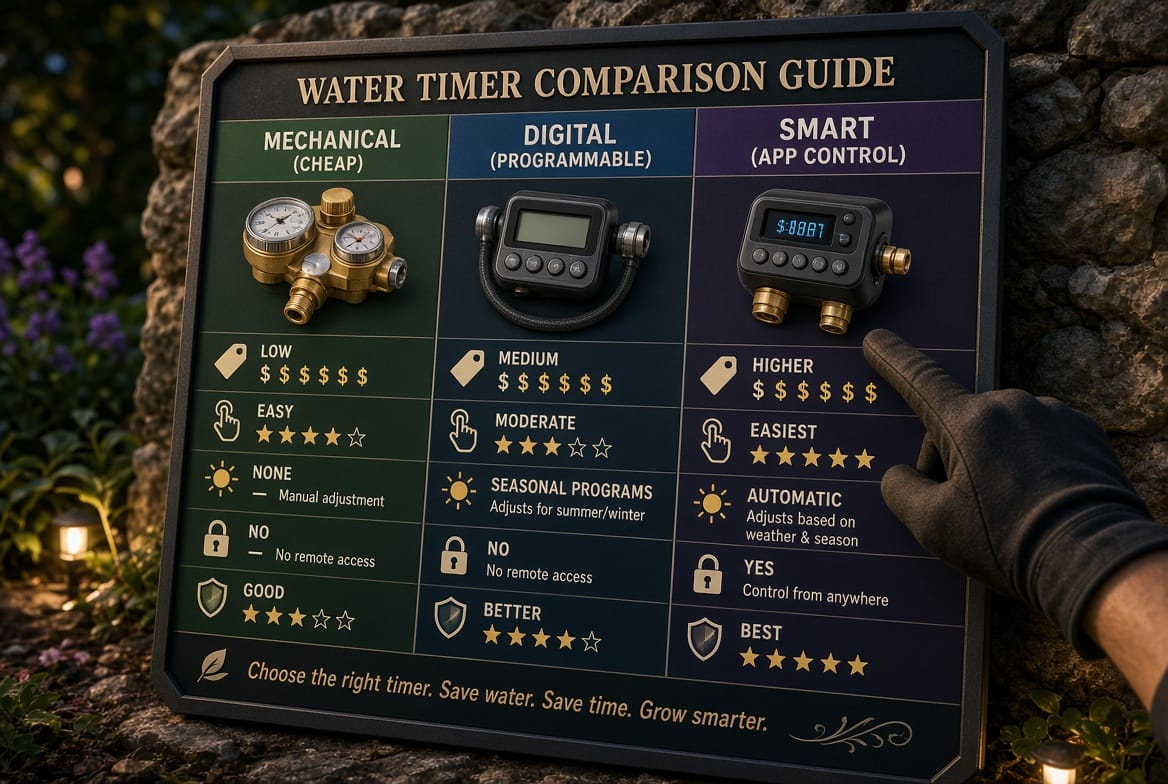
The best choice depends on how often you want to touch the system, how large the lighting design is, and whether remote access matters.
- Mechanical — Best for simple path or accent lighting on a tight budget. Expect manual seasonal adjustments.
- Digital — Best for most residential landscapes that need reliable daily and weekly programs without an app.
- Smart — Best for larger properties, frequent schedule changes, or owners who value remote control and automatic dusk-to-dawn tracking.
Practical Factors Beyond the Timer Itself
Even the best timer fails if the rest of the system is neglected.
Voltage and load matching
Confirm the timer is rated for the total wattage of your fixtures and for the voltage (120 V line-voltage or 12/24 V low-voltage) used by the transformer.
Weather protection
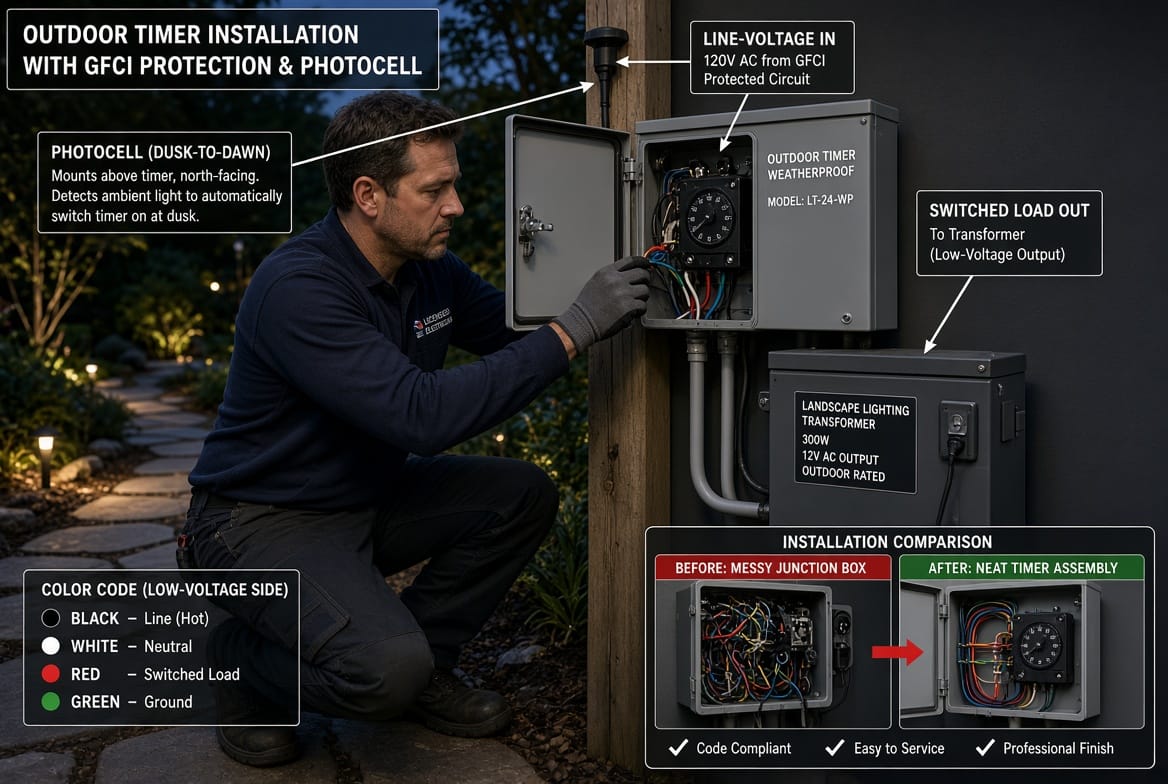
Outdoor timers must be listed for wet locations or installed inside a weatherproof enclosure. Moisture is the leading cause of premature failure.
Photocell placement
If the timer includes or works with a photocell, mount the sensor where it sees true sky, not under an eave or near a competing light source.
Professional installation
Incorrect wiring can leave lights on continuously, trip breakers, or create a shock hazard. A licensed electrician or landscape lighting specialist ensures the timer, transformer, and fixtures operate as a coordinated system.
Warning: Choose the Right Timer for Your Lights
Selecting a timer that cannot keep pace with your lighting design leads to wasted electricity, shortened lamp life, and frustrated evenings spent resetting pins or hunting for a flashlight. An undersized mechanical timer on a large multi-zone system becomes a weekly chore. An overly complex smart timer on a simple three-fixture path can feel like unnecessary expense. Match capability to actual need.
If you are unsure which category fits your property, or if existing wiring and transformers need evaluation, professional help prevents costly mistakes.
A qualified technician can assess your current lights, recommend the appropriate timer type, and complete a code-compliant installation so your outdoor lighting performs reliably night after night.
Call Today to Upgrade Your Outdoor Lighting Controls