The Inpatient vs. Outpatient Treatment: Which Is Right for You

Deciding between inpatient treatment and outpatient treatment is one of the most important choices a person can make when seeking help for substance use or co-occurring mental health challenges. Both levels of care are evidence-based. Both have helped thousands of people rebuild their lives. The right fit depends on clinical need, home environment, medical stability, and personal responsibilities—not on which option sounds more convenient or more intense.
Compare Inpatient vs. Outpatient – Call Today
This guide explains what each setting actually looks like day to day, the genuine advantages and limitations of each, and the practical questions that help you and a clinician decide together. The goal is not to push one model. The goal is to match the level of care to the person so recovery has the strongest possible foundation.
Understanding Levels of Care
Addiction treatment is organized on a continuum. Inpatient (also called residential) care sits at the more intensive end: the person lives at the facility and receives around-the-clock structure and support. Outpatient care sits on the less restrictive end: the person lives at home and travels to scheduled sessions.
Neither is “better” in the abstract. A person with severe withdrawal risk, an unsafe living situation, or repeated unsuccessful attempts at lower-intensity care often needs the containment of inpatient treatment. A person with a stable home, reliable transportation, and a milder or already-stabilized condition may thrive in outpatient care and keep work or family routines intact.
A thorough confidential assessment is the only reliable way to determine which starting point is appropriate. Self-diagnosis based on cost or schedule alone frequently leads to under-treatment or unnecessary disruption.
What Inpatient Treatment Really Involves
Inpatient treatment means the individual resides at a licensed facility for a defined period—commonly 30, 60, or 90 days, sometimes longer when clinically indicated. The environment is designed to remove the person from daily triggers, substances, and chaotic home dynamics while providing 24/7 medical and clinical supervision.
A typical day is highly structured. Mornings often begin with vital-sign checks or medication management, followed by breakfast, a community meeting, and several hours of group therapy. Afternoons may include individual counseling, psychoeducation on relapse prevention, family sessions (in person or virtual), and skills practice such as cognitive behavioral therapy or mindfulness. Evenings usually include a 12-step or alternative support meeting, recreation or fitness, and quiet time. Sleep occurs on-site in a monitored setting.
Medical staff are present for withdrawal management when needed. Nursing and physicians can address emerging physical or psychiatric symptoms immediately rather than waiting for the next appointment. The community itself becomes part of treatment: peers who are also working on recovery offer accountability that is difficult to replicate at home.
Inpatient care is frequently recommended when:
- There is a history of medically complicated withdrawal.
- The home environment contains active substance use or high conflict.
- Previous outpatient attempts have not produced lasting stability.
- Co-occurring depression, anxiety, trauma, or other psychiatric conditions require close monitoring.
- The person cannot reliably stay substance-free for even a few days without external structure.
The setting is not a hospital lock-down for most programs; it is a therapeutic community with clear expectations, privileges earned through participation, and a planned step-down to lower levels of care.
Advantages of Inpatient Treatment
- Complete removal from triggers and easy access to substances during the most vulnerable early weeks.
- 24/7 clinical and medical oversight, which reduces the risk of undetected medical or psychiatric crisis.
- Immersive schedule that leaves little unstructured time in which old habits can reassert themselves.
- Built-in peer community that normalizes the hard work of early recovery.
- Faster stabilization for many people because every hour is oriented toward treatment rather than divided among work, family logistics, and therapy.
- Dedicated time for family programming without the competing demands of daily life.
Limitations of Inpatient Treatment
- Requires leaving home, work, and family for weeks or months; this can create financial and relational strain.
- Higher cost than outpatient care; insurance coverage varies and deductibles can be significant.
- Some people experience the environment as too restrictive once acute risk has passed.
- Transition back to ordinary life still requires a solid aftercare plan; the structure does not automatically transfer home.
- Not necessary, and sometimes not advisable, for individuals who already have strong external supports and milder symptoms.
What Outpatient Treatment Really Involves
Outpatient treatment allows the person to live at home and continue many ordinary responsibilities while attending scheduled clinical sessions. Intensity varies:
- Standard outpatient: one or two sessions per week.
- Intensive outpatient program (IOP): typically 9–15 hours per week, often three or four evenings or days.
- Partial hospitalization program (PHP): 20 or more hours per week, resembling a full treatment day but with return home each night.
Sessions include the same core elements found in residential care—individual therapy, group process, education, family work, and relapse-prevention planning—compressed into fewer hours. Many programs also offer evening or weekend tracks so employed people can participate.
Because the person remains in their real-world environment, outpatient care tests coping skills immediately. Success depends heavily on a relatively stable living situation, reliable transportation, and at least one supportive person who understands the treatment schedule.
Outpatient care is often appropriate when:
- Medical detoxification, if needed, has already been completed.
- The home is free of active substance use and reasonably supportive.
- The individual has demonstrated the ability to attend appointments consistently.
- Work, school, or caregiving duties cannot be paused for an extended residential stay.
- The person is stepping down from inpatient treatment and needs continued structure without 24-hour containment.
Advantages of Outpatient Treatment
- Flexibility to maintain employment, schooling, and family roles.
- Lower overall cost and often better insurance coverage for the hours actually used.
- Immediate practice of new skills in the same environment where they must eventually be used.
- Greater privacy for some people who do not want colleagues or neighbors to know they are away at a facility.
- Easier involvement of family members who can attend sessions without traveling to a distant campus.
Limitations of Outpatient Treatment
- Daily exposure to the same triggers, people, and routines that previously supported use.
- Less immediate help if cravings, mood changes, or medical issues arise between sessions.
- Requires high personal motivation and organizational ability; missed sessions quickly erode progress.
- Not sufficient when withdrawal is still active or when the home itself is unsafe.
- Some individuals underestimate the time commitment of IOP or PHP and become overwhelmed.
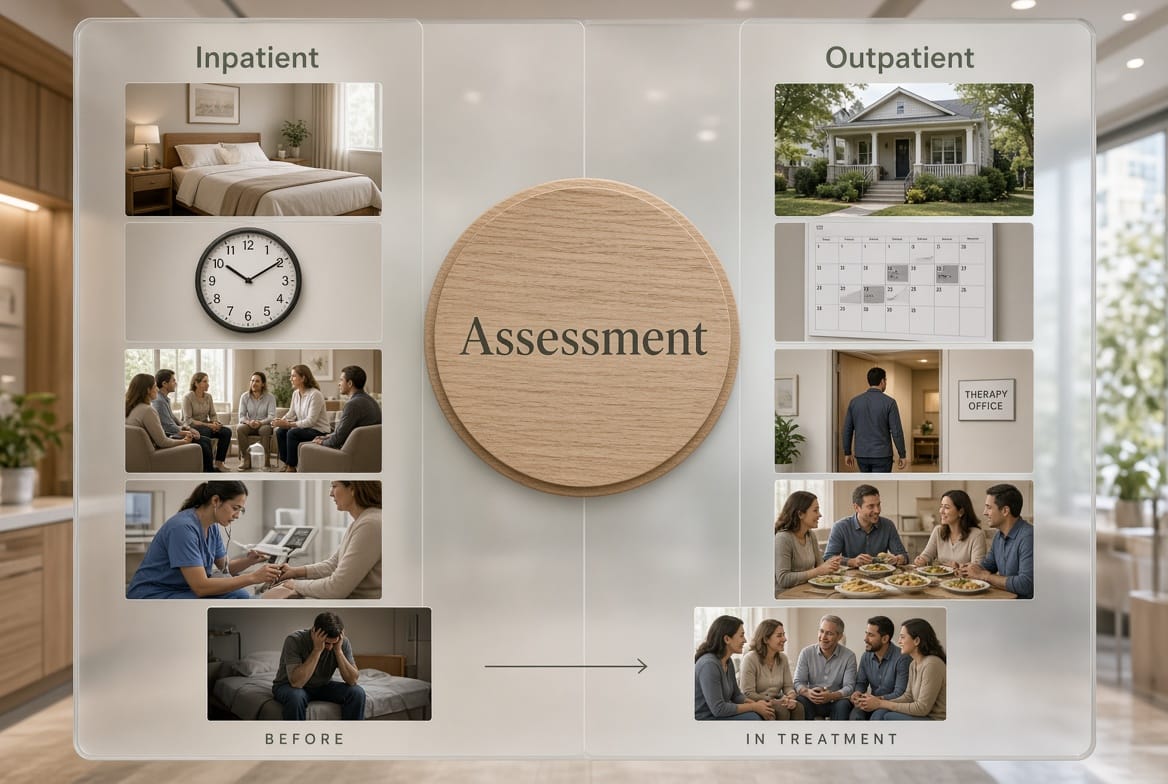
Side-by-Side Reality Check
The most useful comparison is not “which is stronger” but “which problems each setting is designed to solve.”
Inpatient solves the problem of an unsafe or unsupportive environment and the problem of needing constant monitoring during acute stabilization. It creates a temporary bubble in which new habits can take root without constant interruption.
Outpatient solves the problem of needing treatment that can coexist with real life. It solves the problem of cost and disruption for people whose clinical picture does not require 24-hour containment.
A person can move between levels. Many successful recoveries begin with a short inpatient stay for detoxification and initial stabilization, then continue in IOP or standard outpatient care. This stepped approach uses the intensity of residential treatment only as long as it is necessary.
Insurance companies and clinical guidelines generally expect the least restrictive setting that can still keep the person safe and progressing. Starting at a higher level than needed can create avoidable hardship; starting at a lower level than needed can lead to early dropout or medical risk.
How to Decide Which Level Fits
Several practical factors should be reviewed with a qualified clinician rather than decided in isolation.
Severity and recency of use. Daily use of alcohol or benzodiazepines, recent overdoses, or intravenous drug use often point toward inpatient or at least a medically supervised start.
Home environment. If substances are present in the house, if a partner or roommate is still using, or if the living situation is chaotic, outpatient attendance becomes much harder.
Medical and psychiatric complexity. Uncontrolled diabetes, history of seizures, suicidal thinking, or untreated trauma frequently require the closer observation available in residential care.
Support system. A person with reliable family members who will drive them to IOP and keep the home substance-free has a better chance in outpatient care than someone who is isolated.
Previous treatment history. Multiple unsuccessful outpatient episodes usually indicate that a higher level of structure is needed, at least temporarily.
Work and financial realities. Some employers will hold a job for a documented residential stay; others will not. These realities matter and should be discussed openly during assessment.
Motivation versus capability. High motivation is necessary for outpatient success, but motivation alone cannot compensate for an unsafe environment or untreated withdrawal.
A good assessment interview covers all of these areas, reviews medical history, and often includes input from a family member when the person consents. The recommendation that follows should be explained in plain language so the individual understands why one level is being suggested over the other.

Taking the Next Step with Confidence
There is no moral hierarchy between inpatient and outpatient treatment. There is only the question of fit. Choosing a level of care that is too low often results in early return to use and a sense of personal failure that is actually a mismatch of setting. Choosing a level that is higher than needed can create unnecessary disruption and cost. Both outcomes are avoidable when the decision is based on a professional assessment rather than guesswork or stigma.
If you or someone you love is unsure which path makes sense, the most useful action is a confidential conversation with an admissions clinician. That conversation can clarify medical needs, insurance realities, and the concrete differences in daily life between the two options. From there, a personalized recommendation can be made and a start date arranged.
Choose the right level of care. Recovery is difficult enough without fighting an environment that works against you. A short, private assessment can identify whether 24/7 structured support or a flexible outpatient schedule gives you the best chance of lasting change.
Trained staff can answer questions about both inpatient and outpatient options, verify insurance, and help you take the first clear step.
Speak With Admissions – Confidential Assessment