The HVAC Variable Frequency Drive: How VFDs Save Energy on Motors
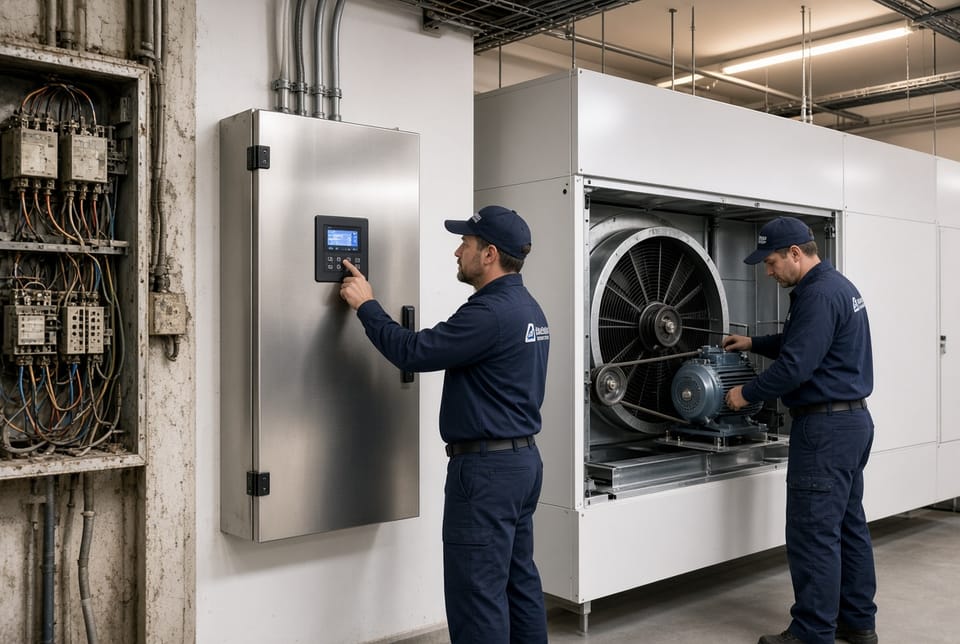
Modern commercial and institutional buildings no longer accept the old habit of running every fan and pump at full speed all day. The HVAC variable frequency drive has become the practical, proven solution that matches motor output to actual demand. By varying frequency and voltage supplied to an AC motor, a VFD lets the motor slow down when the building needs less airflow or less water flow. The result is dramatic energy savings, quieter operation, and longer equipment life.
Call Now for HVAC VFD Energy Savings
This article explains exactly what a VFD does, why the physics of fans and pumps reward even modest speed reductions, how to recognize early signs of VFD failure, and where these drives deliver the greatest value. The tone throughout is practical and reassuring: when specified, installed, and maintained correctly, variable frequency drives are among the most reliable energy-conservation investments an HVAC system can receive.
What a Variable Frequency Drive Actually Does
A variable frequency drive is an electronic power converter placed between the incoming electrical supply and an AC induction motor. Its core job is simple to state and sophisticated in execution: it varies motor speed based on demand.
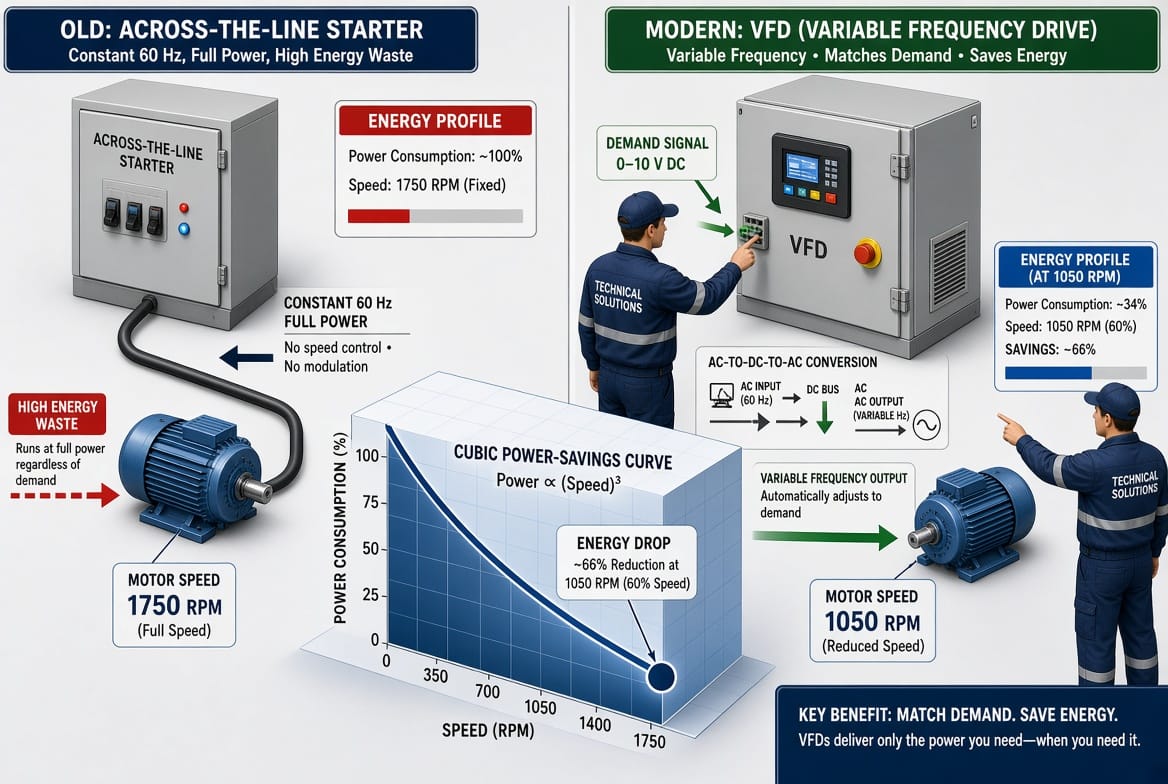
Traditional starters apply full line frequency (60 Hz in North America) the instant the motor is called. The motor therefore always runs at its design speed—typically 1,750 or 3,450 rpm—regardless of whether the space needs 100 percent or 40 percent of design airflow. A VFD changes that relationship. It first converts incoming AC to DC, then reconstructs a new AC waveform whose frequency and voltage can be adjusted in real time. Because motor synchronous speed is directly proportional to frequency, dropping the output from 60 Hz to 40 Hz drops shaft speed by one-third.
The drive receives a control signal from a building-automation system, a pressure transducer, a temperature sensor, or a simple potentiometer. That signal tells the VFD how fast the motor should turn at that moment. The drive then produces the corresponding frequency and voltage while protecting the motor from over-current, under-voltage, and overheating. In short, the VFD turns a constant-speed workhorse into a responsive, demand-driven machine.
Modern units add layers of intelligence: automatic energy-optimization algorithms, harmonic-mitigation filters, and communication protocols that let facility teams monitor kilowatt-hours, fault history, and runtime from a central dashboard. These features keep the technology both powerful and approachable.
How VFDs Save Energy on Motors
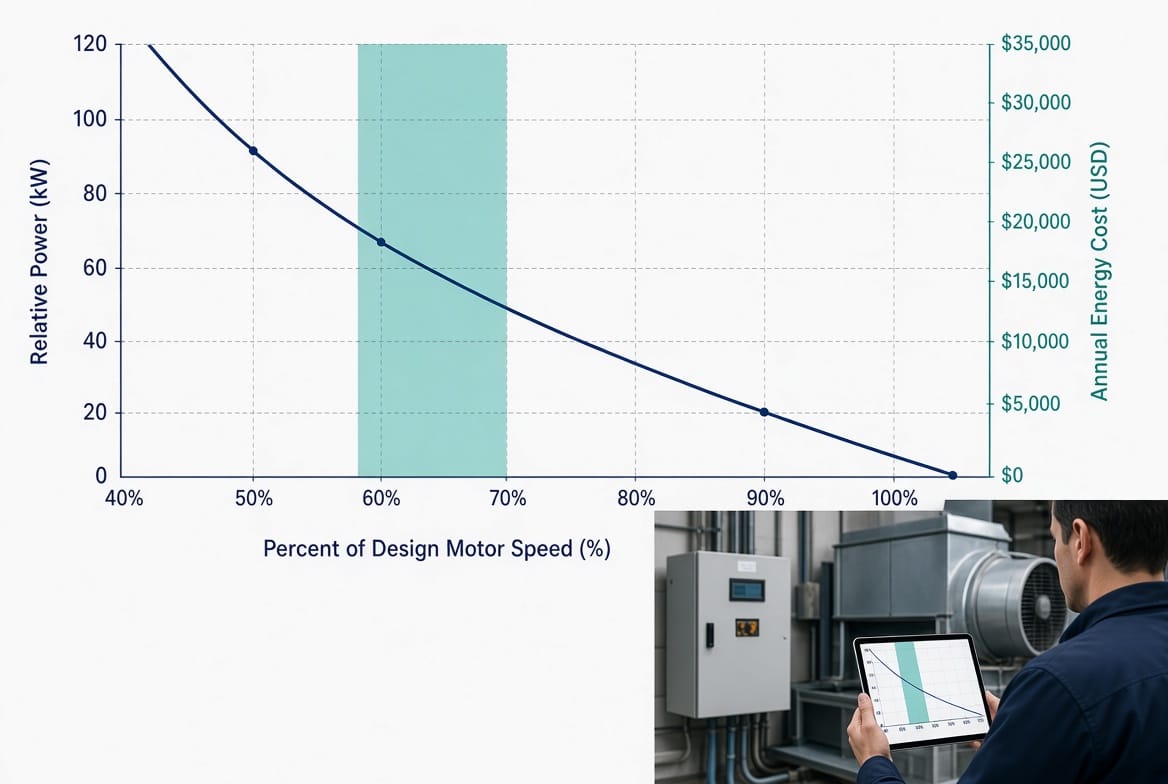
The energy benefit is not linear; it is cubic. Fan and pump affinity laws state that power consumption varies with the cube of shaft speed. Reduce speed by 20 percent and theoretical power drops to roughly half. Reduce speed by 50 percent and power falls to about one-eighth. Because most HVAC systems spend the majority of operating hours at part load, the cumulative energy savings become substantial.
Consider a typical air-handling unit sized for peak summer design. On a mild spring afternoon the space may need only 60 percent of design airflow. Without a VFD the fan still consumes nearly full power. With a VFD the motor slows, static pressure drops, and electrical demand plummets. The same principle applies to chilled-water pumps, condenser-water pumps, and cooling-tower fans. Even modest average-speed reductions of 15–25 percent routinely produce 30–50 percent motor-energy savings.
Additional savings appear indirectly. Lower motor speed reduces heat rejected into mechanical rooms, so less cooling is required for the space itself. Bearings and belts last longer because they experience less mechanical stress. Inverter-duty motors paired with properly tuned VFDs also avoid the inrush current spikes that stress transformers and generators during start-up.
The net effect is a system that consumes electricity only when—and only to the degree that—the building actually needs it. That alignment of supply and demand is the essence of modern, efficient HVAC operation.
Signs of VFD Failure and What They Mean
Even well-built drives eventually require attention. Recognizing early warning signs prevents unexpected downtime and protects the connected motor. Common indicators include:
- Error codes displayed on the keypad or transmitted to the building-automation system (over-current, over-voltage, ground fault, over-temperature).
- Erratic operation such as unexplained speed hunting, sudden stops, or failure to reach commanded frequency.
- Unusual motor noise or vibration that appears only after the drive was installed or after a parameter change.
- Repeated tripping during acceleration or deceleration, often caused by incorrect ramp-time settings or an undersized drive.
- Visible overheating of the drive enclosure, discoloration of capacitors, or a burning odor near the heat sink.
- Communication loss with the BAS or unexpected parameter resets after a power event.
Most of these symptoms point to solvable issues: dirty cooling fans, loose power connections, incorrect motor-data parameters, or harmonic distortion on the supply side. A qualified technician can usually restore reliable operation by cleaning filters, verifying grounding, updating firmware, and re-tuning acceleration ramps. Ignoring the signs, however, risks motor-winding damage or complete drive failure. Regular inspection and a documented fault-log review keep risk low and confidence high.
Practical HVAC Applications Where VFDs Excel
Variable frequency drives are no longer limited to large central plants. They appear throughout contemporary HVAC systems:
- Supply and return fans on air-handling units and dedicated outdoor-air systems.
- Secondary chilled-water and hot-water pumps serving variable-flow distribution loops.
- Cooling-tower fans that modulate to maintain condenser-water temperature set-point.
- Exhaust fans in laboratories and kitchens that track occupancy or contaminant levels.
- Compressors on certain screw or centrifugal chillers that use VFDs for capacity control.
- Energy-recovery wheels and heat-pipe systems whose rotation speed is adjusted for optimal effectiveness.
In each case the drive converts a once-constant load into a variable one. The building-automation system simply writes a speed or pressure set-point; the VFD does the rest. Retrofit projects often yield the fastest payback because the existing motor and mechanical equipment remain in place while only the electrical starter is replaced.
Newer “smart” VFDs add predictive-maintenance features that track bearing frequencies, capacitor health, and thermal history. These capabilities further reduce unplanned outages and give facility managers data they can act on before a problem becomes urgent.
Specification, Installation, and Long-Term Reliability
Choosing the right drive involves more than matching horsepower. Confirm the motor is inverter-duty rated, specify an appropriate enclosure rating for the mechanical-room environment, and include harmonic-mitigation measures when the electrical service is sensitive. Proper grounding and shielded motor cable prevent electrical noise that can interfere with sensors and controls.
Commissioning is equally important. Enter the exact motor nameplate data, set acceleration and deceleration times that avoid mechanical shock, and enable the drive’s built-in energy-optimization mode. After start-up, trend kilowatt and speed data for several weeks to verify that the system is operating in the expected part-load range.
Routine maintenance is straightforward: keep cooling passages clean, inspect connections annually, and replace cooling fans on the manufacturer’s recommended interval. With these simple steps, modern VFDs routinely deliver 10–15 years of reliable service.
The technology continues to advance. Wide-bandgap semiconductors reduce heat and size, while onboard analytics flag developing issues before they cause downtime. For building owners the message remains consistent: a properly applied HVAC variable frequency drive is one of the most cost-effective, low-risk ways to cut motor energy use without sacrificing comfort or capacity.
Save energy with variable frequency drives.
Call Today for Variable Frequency Drive Solutions