The HVAC Thermostat Calibration: Ensuring Accurate Temperature Control
A properly functioning thermostat is the quiet commander of every heating and cooling system. When it reads the room correctly, your HVAC equipment delivers consistent comfort, efficient operation, and predictable energy use. When it drifts even a few degrees, the entire system begins to work against itself. Thermostat calibration is a simple but important adjustment that restores that accuracy. This article explains why thermostats lose precision over time, the everyday signs that readings have become unreliable, and the professional process technicians use to bring them back into alignment.
Stop Short Cycling – Call for Expert Calibration
Why Accurate Temperature Control Matters
Your thermostat does more than display a number. It is the sensor and decision-maker that tells the furnace or air conditioner when to start and stop. A two-degree error can trigger unnecessary runtime, create hot and cold spots, and leave occupants complaining that the house never feels “right.” Over months and years those small errors compound into higher utility bills, extra wear on compressors and heat exchangers, and reduced indoor comfort.
Calibration is the process of comparing the thermostat’s displayed temperature against a known-accurate reference and then adjusting the unit so the two match. It is not a complicated repair, yet it is one of the most cost-effective services an HVAC professional can perform. Homeowners who schedule regular calibration enjoy steadier temperatures, fewer service calls for “the system just isn’t cooling,” and longer equipment life.
How Thermostats Sense Temperature
Most modern thermostats use a thermistor or a digital temperature sensor. Older electromechanical models rely on a bimetallic strip or mercury switch. In every case the sensor reacts to the air immediately surrounding the device. The thermostat then compares that reading to the setpoint you selected and sends a signal to the HVAC equipment.
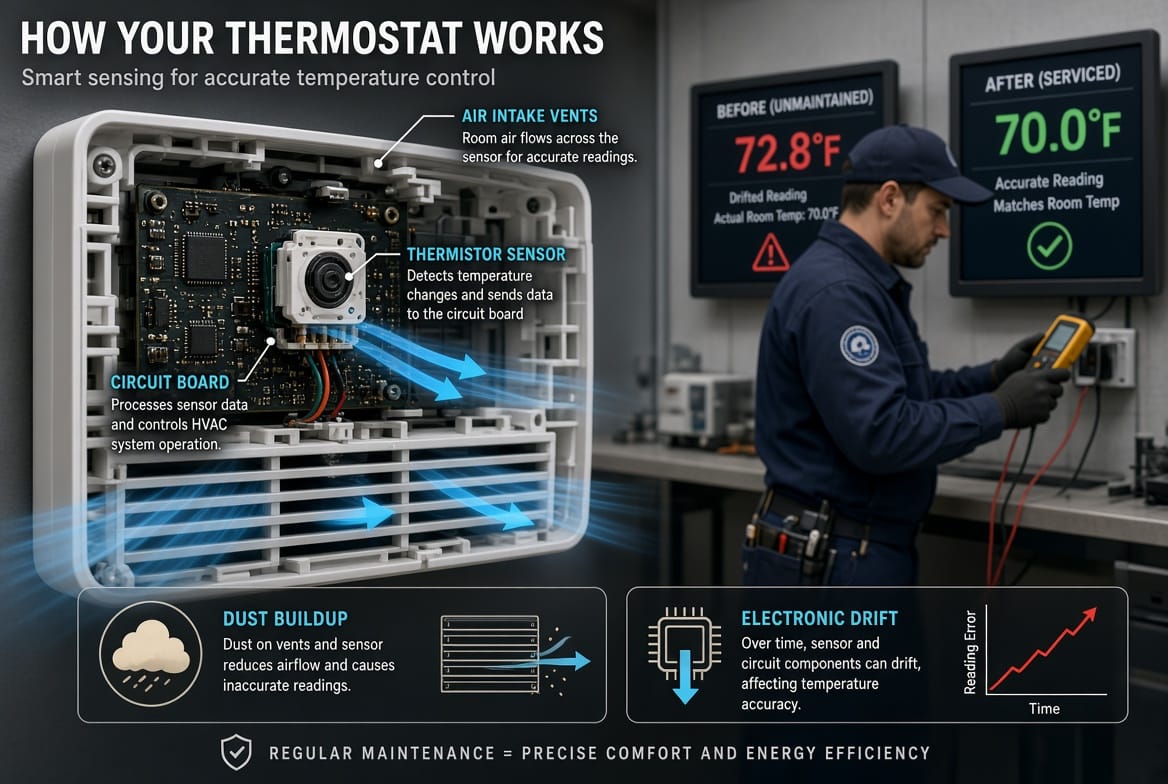
Because the sensor sits on a wall, it is influenced by several local factors: sunlight through a nearby window, heat rising from a lamp or television, drafts from a poorly sealed door, or even the warmth of the wall itself. Over time the sensor’s response curve can also change. Dust accumulation, slight electronic drift in the circuit board, and mechanical wear in older units all contribute to thermostat drift.
Why Thermostats Drift Over Time
Drift is gradual and therefore easy to miss. A thermostat that was perfectly accurate when installed may read one degree high after two years and two degrees high after five. Common causes include:
- Accumulation of dust and debris on the sensor or inside the housing
- Repeated thermal cycling that slightly alters electronic components
- Voltage fluctuations or poor wiring connections
- Physical settling of the wall or mounting plate
- Exposure to direct sunlight or heat sources that were not present at installation
None of these issues usually require replacement of the thermostat. In the majority of cases a trained technician can restore accuracy with a straightforward calibration procedure.
Signs of Inaccurate Temperature Readings
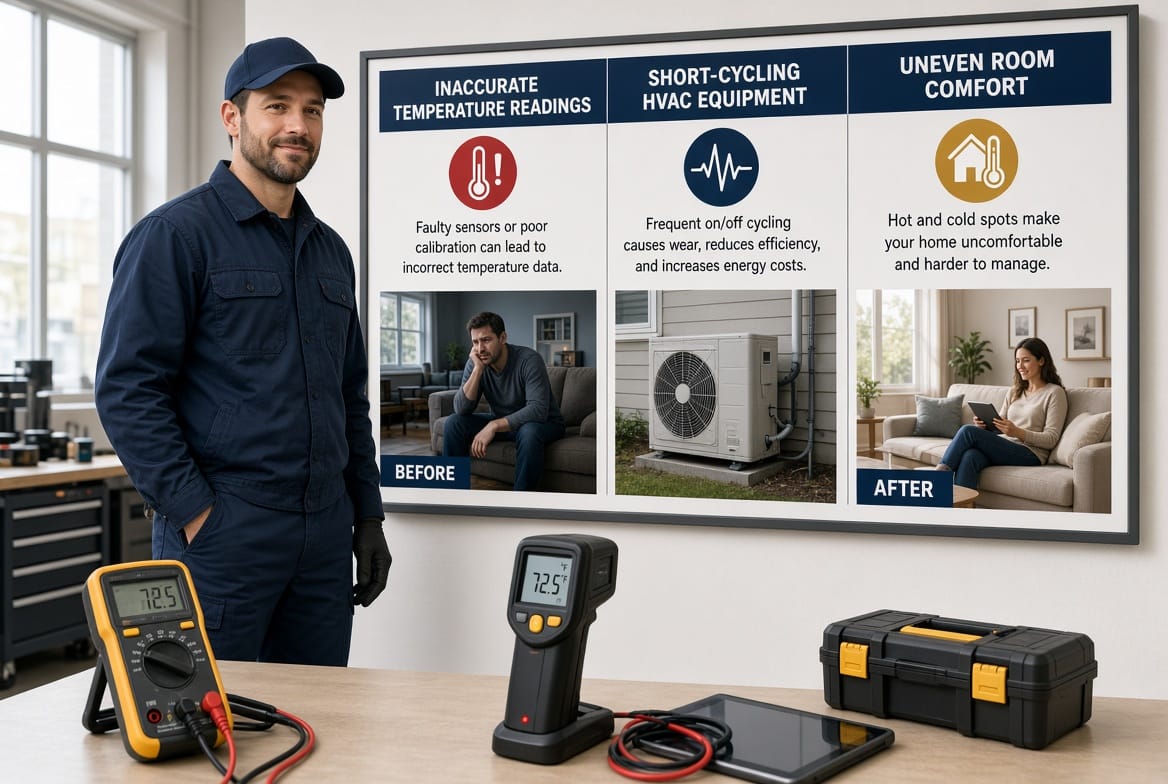
Occupants often notice the effects of drift before they realize the thermostat itself is the culprit. The most frequent indicators fall into three categories: comfort complaints, short cycling, and uneven temperatures throughout the home.
Comfort Complaints
Family members or office staff begin saying the rooms feel warmer or cooler than the displayed temperature. Someone turns the setpoint down, yet the space still feels stuffy. Another person raises it and still feels a chill. These contradictory reports are classic signs that the thermostat is no longer reporting the true room temperature.
Short Cycling
When the thermostat believes the room has already reached the desired temperature, it shuts the system off prematurely. A few minutes later the actual temperature has not changed enough, so the thermostat calls for heat or cooling again. The result is frequent on-off cycles known as short cycling. Short cycling wastes energy, increases wear on motors and compressors, and can leave humidity levels poorly controlled.
Uneven Comfort
Some rooms feel comfortable while others remain too warm or too cool. Although ductwork or insulation problems can cause this, an inaccurate thermostat often exaggerates the imbalance. The system may over-cool one zone while under-heating another simply because the central sensor is reporting the wrong number.
How Technicians Calibrate Thermostats
Professional calibration follows a methodical sequence that removes guesswork and produces a documented result.
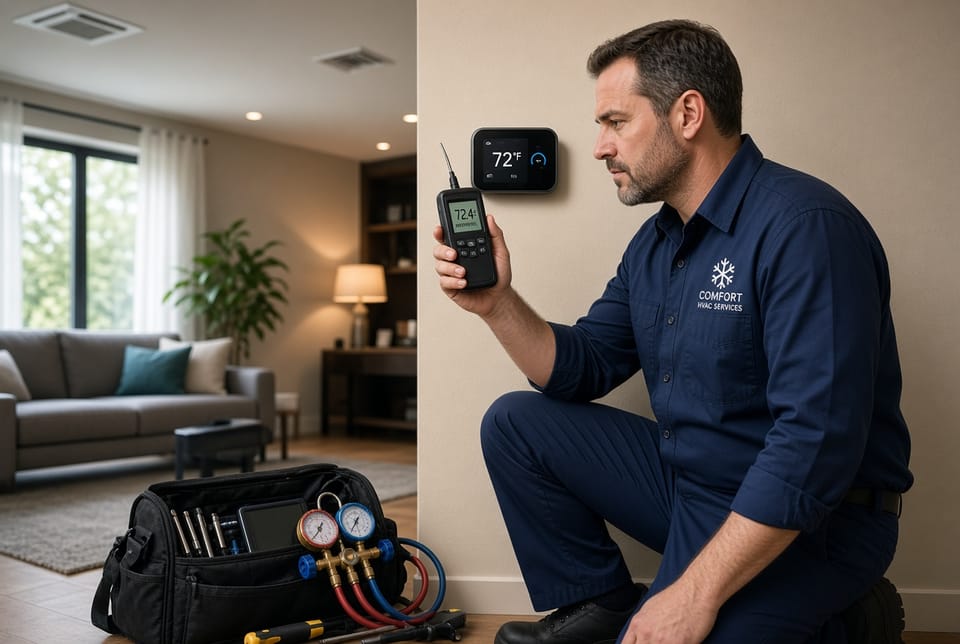
First the technician places a calibrated reference thermometer—usually a high-accuracy digital probe certified to a known standard—next to the thermostat. Both devices are allowed to stabilize for several minutes so they measure the same air. The difference between the two readings is recorded.
Next the technician accesses the thermostat’s calibration menu or offset setting. Most digital and smart thermostats allow an adjustment of plus or minus several degrees in tenth-of-a-degree increments. The technician enters the exact offset needed to make the displayed temperature match the reference thermometer.
For older analog thermostats the process may involve a small mechanical adjustment of the anticipator or a slight repositioning of the bimetallic element. In every case the technician re-checks the reading after the adjustment and may wait through a heating or cooling cycle to confirm the system now responds correctly.
Additional steps often include:
- Cleaning dust from the sensor and housing
- Verifying that the thermostat is level (critical for mercury and some analog models)
- Checking wiring tightness and voltage
- Reviewing recent runtime data on smart thermostats to confirm the system is no longer short-cycling
The entire visit typically lasts less than an hour, yet the improvement in comfort is immediate and lasting.
Benefits of Regular Thermostat Calibration
Once the thermostat again reports true room temperature, several advantages appear quickly:
- The HVAC system runs only as long as needed, reducing energy consumption
- Short cycling stops, lowering mechanical stress
- Indoor humidity stays closer to the desired range
- Occupants stop constantly adjusting the setpoint
- Equipment lasts longer because it is not forced into extra cycles
Many manufacturers recommend checking calibration every two to three years, or whenever comfort complaints arise. Homes with large temperature swings, high dust levels, or recently remodeled interiors often benefit from more frequent checks.
When to Schedule Professional Calibration
You do not need to wait for a complete system failure. Consider calling a technician if you notice any of the following:
- The displayed temperature and how the room actually feels no longer match
- The system turns on and off more frequently than it used to
- Certain rooms are consistently too warm or too cool
- Energy bills have risen without a change in usage habits
- It has been several years since the thermostat was last checked
A qualified HVAC professional brings both the calibrated instruments and the experience to interpret the results correctly. Attempting to “guess” an offset without a reference thermometer can make the problem worse.
Maintaining Accuracy Between Professional Visits
Homeowners can support calibration results with a few simple habits. Keep the area around the thermostat free of lamps, televisions, and direct sunlight. Change HVAC filters on schedule so dust does not migrate toward the sensor. Avoid placing furniture that blocks air circulation near the thermostat. These small steps help the sensor continue to sample representative room air.
Smart thermostats that learn occupancy patterns still rely on an accurate temperature sensor. Calibration remains essential even with the most advanced models.
Accurate thermostats mean better comfort.
Call Today to End Comfort Complaints for Good