The HVAC Static Pressure Test: Diagnosing Airflow Restrictions
Airflow is the lifeblood of every heating and cooling system. When that airflow meets resistance, comfort drops, energy bills climb, and equipment wears out faster. The HVAC static pressure test is the definitive diagnostic service that reveals exactly where and why air is struggling to move through your ductwork. Unlike simple visual inspections or basic thermostat checks, this test quantifies the invisible force known as static pressure and turns vague symptoms into clear, actionable findings.
Schedule Your Static Pressure Test Today – Call Now!
In the pages that follow, you will learn what static pressure really means, how trained technicians measure it with a manometer, what normal versus elevated readings look like, and the most common causes of high static pressure. You will also discover the everyday signs that point to airflow restrictions and why addressing them promptly protects both your comfort and your wallet. This is practical, authoritative guidance designed to help homeowners and property managers make informed decisions.
What Static Pressure Actually Means
Static pressure is the resistance air encounters as it travels through the duct system. Think of it as the “push-back” the blower motor must overcome to deliver conditioned air to every room. In a properly designed system, this resistance stays within a narrow, healthy range. When resistance rises, the blower works harder, air delivery becomes uneven, and efficiency declines.
Key terms to remember:
- Total external static pressure (TESP) – the combined resistance on both the supply and return sides of the system.
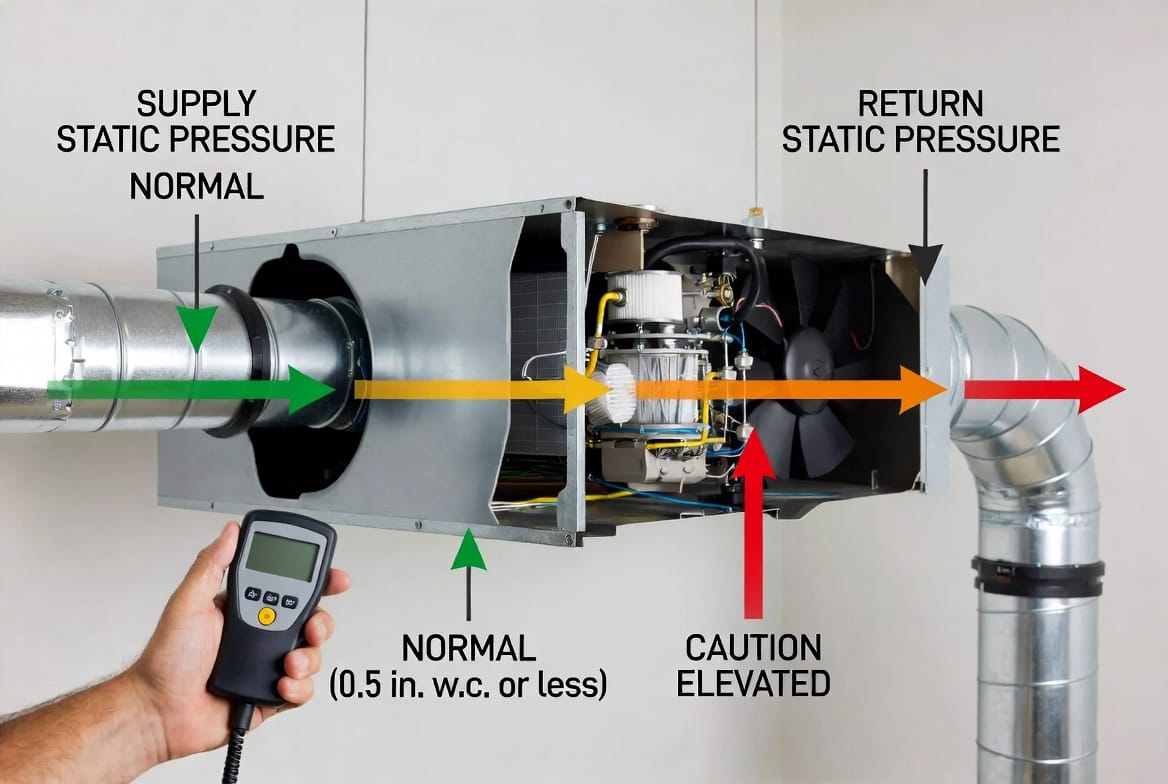
- Supply static pressure – resistance downstream of the blower, typically caused by restrictive supply ducts, closed dampers, or undersized registers.
- Return static pressure – resistance upstream of the blower, often the result of undersized return ducts, dirty filters, or blocked return grilles.
Understanding these distinctions allows a technician to pinpoint the exact location of the problem rather than guessing. High static pressure is not a minor inconvenience; it is a measurable stress that shortens equipment life and drives up operating costs.
How the Static Pressure Test Is Performed
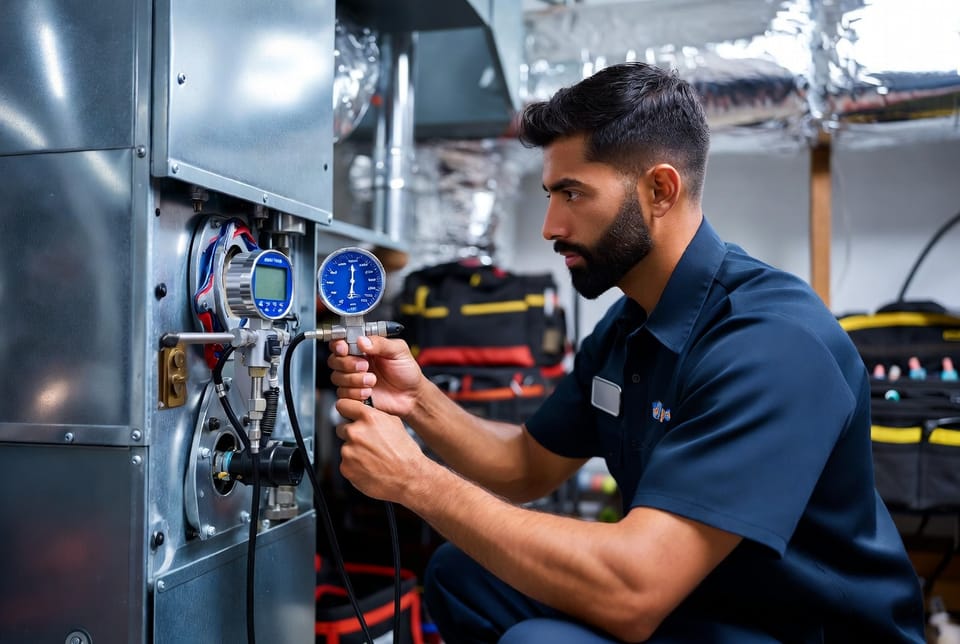
The primary instrument used is a manometer—a sensitive pressure gauge capable of reading very small differences in air pressure, usually in inches of water column (in. w.c.). Modern digital manometers provide instant, highly accurate readings and often include data-logging features that help technicians track trends over time.
A typical professional procedure follows these steps:
- The technician first inspects the filter, ensuring it is clean and correctly sized.
- Access ports are carefully drilled or existing test ports are used at critical points: the supply plenum, return plenum, and sometimes intermediate duct locations.
- Manometer probes are inserted, and readings are recorded under normal operating conditions with all doors and windows closed.
- The system is tested at both heating and cooling speeds if the unit has multi-speed or variable-speed capabilities.
- Results are compared against manufacturer specifications and industry guidelines.
This process is non-destructive when performed correctly and yields data that visual inspection alone can never provide. The technician then interprets the numbers in the context of the home’s layout, equipment age, and observed symptoms.
Normal Readings Versus High Readings
Industry standards and equipment manufacturers generally accept a total external static pressure of 0.5 inches of water column or less for most residential systems, although some high-efficiency units are designed for slightly higher values. Anything consistently above 0.8–1.0 in. w.c. is considered elevated and warrants investigation.
What high static pressure typically indicates:
- Undersized ducts – the most common long-term design flaw. Ducts that were never properly sized for the equipment create permanent resistance.
- Closed or partially closed dampers – whether intentional (for zoning) or accidental, restricted dampers choke airflow.
- Dirty or restrictive filters – a clogged filter is the quickest way to spike return static pressure.
- Blocked or undersized return pathways – furniture, closed doors, or inadequate return grille area all contribute.
- Collapsed or kinked flexible ducts – common in attics and crawl spaces where installation quality varies.
- Excessive duct length or sharp turns – friction losses accumulate over long runs and tight elbows.
When readings exceed design limits, the blower motor draws more current, heat exchangers or coils can freeze or overheat, and the entire system cycles inefficiently. Left unaddressed, high static pressure becomes a leading cause of premature compressor or heat exchanger failure.
Everyday Signs That Point to Airflow Restrictions
Homeowners often notice symptoms long before they understand the underlying cause. Recognizing these warning signs early makes the static pressure test especially valuable.
Common indicators include:
- Noisy system operation – whistling, roaring, or excessive blower noise frequently signals restricted airflow.
- Uneven temperatures – some rooms stay too hot or too cold while others feel comfortable.
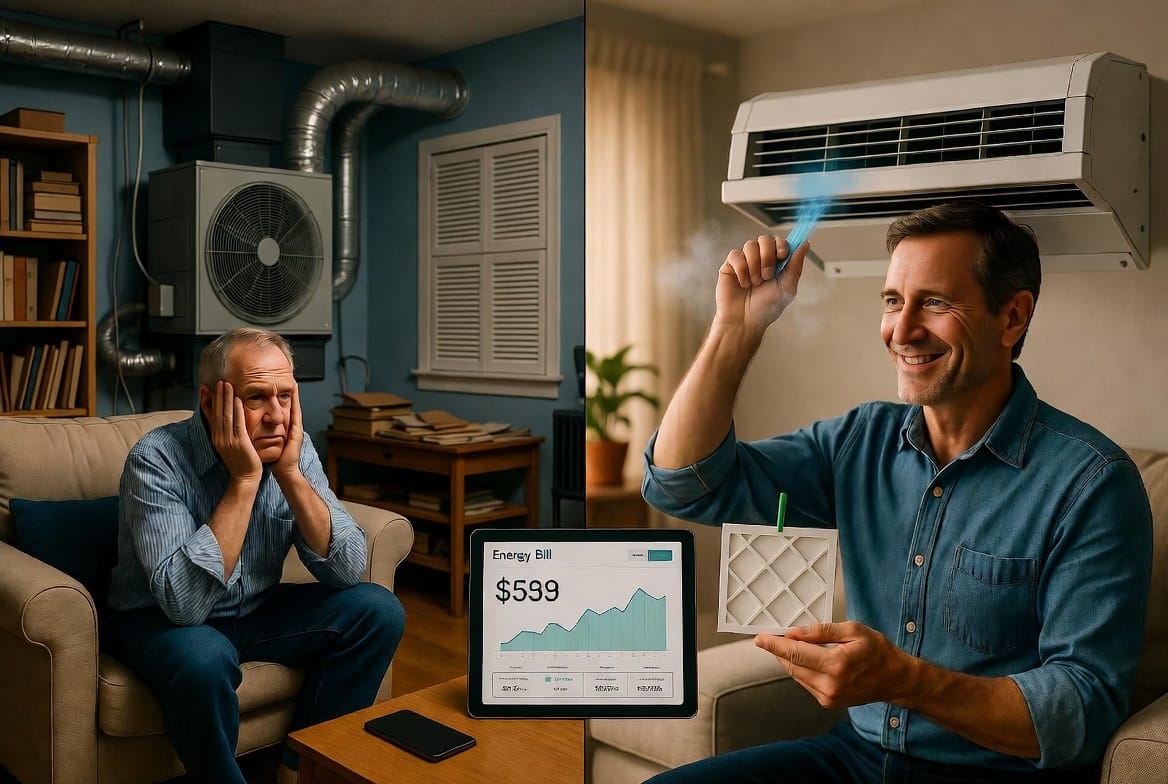
- Higher-than-expected energy bills – the system runs longer and harder to achieve the same temperature.
- Short cycling – the equipment turns on and off more frequently than normal.
- Dust accumulation – reduced airflow can lead to uneven filtration and more dust settling in living spaces.
- Ice formation on cooling coils – restricted airflow across the evaporator coil is a classic cause of freezing.
These symptoms rarely resolve on their own. A professional static pressure test isolates the true source so corrections can be precise rather than experimental.
Why Addressing High Static Pressure Matters
Airflow restrictions do more than reduce comfort. They force the blower motor to operate outside its designed efficiency range, increasing electricity consumption. In cooling mode, restricted airflow across the evaporator coil can cause the coil to freeze, leading to water damage and further efficiency loss. In heating mode, restricted airflow across a heat exchanger can elevate surface temperatures and shorten equipment life.
Correcting the underlying causes—whether through duct modifications, proper damper balancing, filter upgrades, or return-air improvements—restores designed airflow, lowers energy use, and extends the service life of expensive components. The static pressure test is the diagnostic foundation that makes these corrections accurate and cost-effective.
What to Expect During a Professional Static Pressure Test
A thorough diagnostic appointment typically lasts 45–90 minutes depending on system complexity. The technician will:
- Review any previous service history and current symptoms.
- Perform a visual inspection of accessible ductwork and equipment.
- Conduct the manometer measurements at multiple points.
- Document readings and explain them in plain language.
- Provide prioritized recommendations ranging from simple filter changes to more involved duct corrections.
You receive clear data rather than vague advice. This transparency builds confidence and allows informed decisions about next steps.
Protecting Comfort and Efficiency for the Long Term
Once restrictions are identified and corrected, ongoing maintenance becomes simpler and more effective. Regular filter changes, periodic damper checks, and annual system evaluations keep static pressure within healthy limits. Homeowners who invest in proper diagnostics rarely face the repeated comfort complaints and unexpected repair bills that plague systems with unresolved airflow issues.
The static pressure test is not an exotic or optional procedure. It is a fundamental diagnostic service that separates guesswork from precision. When airflow is free to move as designed, the entire HVAC system operates quieter, more efficiently, and more reliably.
Airflow restrictions waste energy.
Fix High Static Pressure & Save Energy – Call Now!