The HVAC Reheat Mode: Dehumidification Without Overcooling
Maintaining ideal indoor comfort is never just about temperature. In many buildings the real challenge is humidity. Excess moisture leaves spaces feeling clammy, promotes mold growth, and makes occupants uncomfortable even when the thermostat reads a perfect number. Traditional cooling systems often respond by running the air conditioner longer, which can drop the temperature too far and create an overcooled environment. The solution that solves this dilemma is the HVAC reheat mode—a sophisticated comfort feature that removes humidity without overcooling the space.
Get Expert HVAC Reheat System Design Today
This article explores exactly what the reheat mode does, how it works at a technical level, and the environments where it delivers the greatest value. By the end you will understand why thoughtful system design that incorporates reheat is one of the most effective ways to achieve stable, healthy indoor air quality.
Understanding the Core Problem: Humidity Versus Temperature
Most conventional air-conditioning systems cool air by passing it across a cold evaporator coil. As the air temperature drops, moisture condenses on the coil and drains away. This process dehumidifies the air, but only while the system is actively cooling. Once the thermostat is satisfied, the compressor stops. If humidity remains high, the space can feel sticky again within minutes.
In humid climates or tightly controlled environments, the result is a frustrating cycle: the system cools too much to remove enough moisture, then shuts off, allowing humidity to rebound. Occupants complain of being cold and damp at the same time. Energy is wasted, and comfort remains elusive.
The reheat mode breaks this cycle. After the air has been cooled enough to condense moisture, a controlled amount of heat is added back so the supply air leaves the unit at a comfortable temperature while still carrying far less humidity. The result is dehumidification without overcooling.
What the Reheat Mode Actually Does
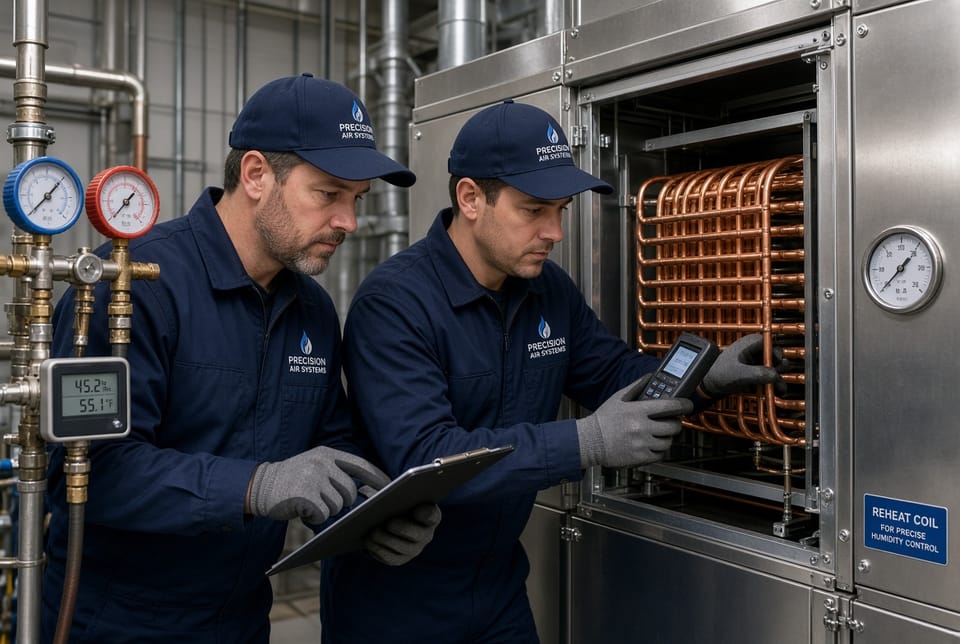
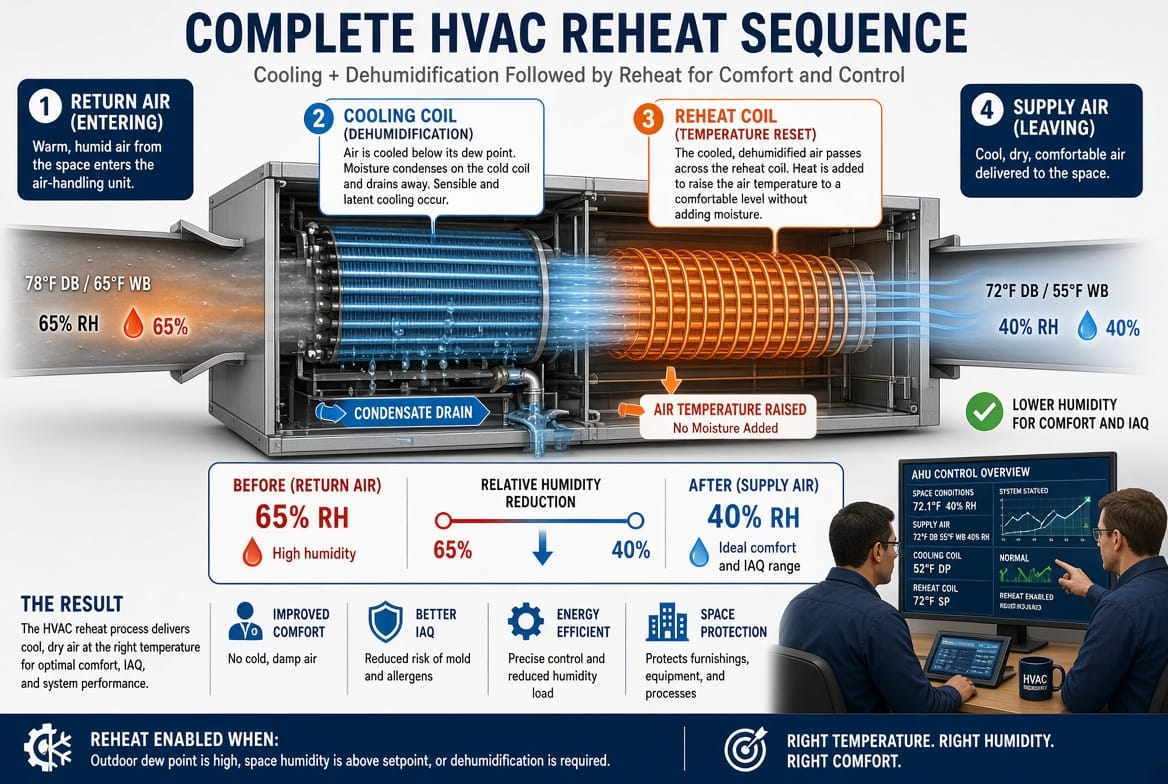
At its simplest, the reheat mode removes latent heat (moisture) while carefully managing sensible heat (temperature). The system first cools the air below the desired room temperature so that maximum condensation occurs. Then a reheat coil raises the air temperature just enough to match the space setpoint. The delivered air is dry yet neither too cold nor too warm.
This dual action keeps relative humidity in the ideal 40–60 percent range without forcing the room temperature below the comfort zone. The feature is especially valuable because it operates independently of the main cooling demand. When humidity rises but temperature is already satisfied, the system can still engage the cooling coil and reheat coil together, maintaining precise control.
Key benefits include:
- Stable indoor humidity levels even during mild outdoor temperatures
- Elimination of the cold, clammy feeling common in overcooled spaces
- Reduced risk of mold and mildew growth on surfaces and furnishings
- Improved perceived comfort for occupants who are sensitive to moisture
- Lower overall energy use in many applications because the system no longer needs to overcool for extended periods
How the Reheat Process Works Step by Step
Modern HVAC systems implement reheat in several reliable ways. The most common configuration uses a cooling coil followed immediately by a reheat coil inside the same air-handling unit or duct section.
- Return air enters the unit and passes across the cooling coil.
- The cooling coil lowers the air temperature to a predetermined dew-point condition—typically 50–55 °F—so that a large amount of moisture condenses.
- Condensate drains away, leaving the air significantly drier.
- The now-cool, dry air moves across the reheat coil.
- The reheat coil adds just enough heat (via hot water, electric resistance, or recovered heat) to bring the air temperature up to the desired supply-air setpoint, usually 55–65 °F depending on the application.
- The tempered, dehumidified air is delivered into the occupied space.
Because the cooling and reheating processes occur in sequence, the system can modulate each coil independently. Advanced controls monitor both temperature and humidity sensors, adjusting valve positions or electric elements in real time. The result is continuous, precise humidity control without the temperature swings that plague simpler systems.
Some designs recover heat from the condenser or from exhaust air, making the reheat stage nearly free in terms of energy. Others use dedicated outdoor-air systems with reheat to precondition ventilation air before it mixes with return air. In every case the principle remains the same: cool to dehumidify, then reheat to comfort.
When Reheat Mode Delivers the Greatest Value
Not every building needs reheat, but many benefit dramatically. The feature shines in three primary situations.
Humid Climates
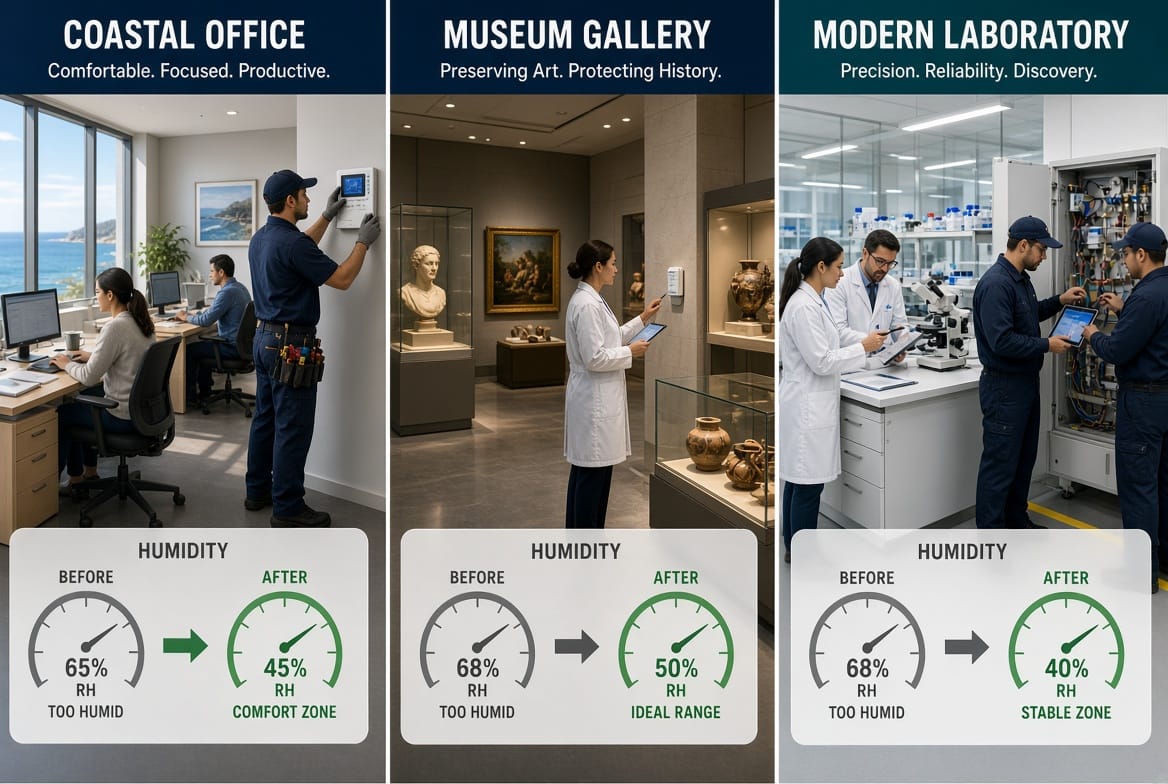
Coastal regions, the Southeast United States, and tropical environments experience long periods of high outdoor dew points. Even when outdoor temperatures are moderate, the moisture load entering a building through ventilation or infiltration can overwhelm a standard cooling system. Reheat allows the HVAC equipment to continue removing moisture without driving indoor temperatures into the low 60s °F. Homes, offices, and retail spaces stay comfortable instead of feeling like refrigerated caves.
Museums, Archives, and Cultural Institutions
Artifacts, paintings, books, and historical documents are extremely sensitive to both temperature and humidity swings. Relative humidity outside the narrow 45–55 percent band can cause irreversible damage. Overcooling to control moisture is unacceptable because it stresses materials and creates condensation risks on cold surfaces. Reheat systems maintain exact setpoints year-round, protecting irreplaceable collections while keeping galleries pleasant for visitors and staff.
Sensitive Environments and Critical Spaces
Hospitals, laboratories, data centers, clean rooms, and pharmaceutical manufacturing facilities demand tight environmental control. Excess humidity can compromise sterile conditions, encourage microbial growth, or affect electronic equipment. Overcooling wastes energy and can create drafts that disturb sensitive processes. Reheat provides the dual control these spaces require—removing moisture aggressively while holding temperature within fractions of a degree.
Additional applications include:
- High-end residential homes where owners refuse to sacrifice comfort
- Hotels and resorts seeking five-star guest experiences
- Schools and universities that must protect both students and building materials
- Grocery stores and refrigerated display areas that battle infiltration of moist outdoor air
In each case the reheat mode transforms a potential comfort or preservation problem into a reliably managed condition.
Design Considerations for Effective Reheat Systems
Successful implementation begins with accurate load calculations. Engineers must determine both the sensible and latent loads for the space, then size the cooling coil to handle peak moisture removal and the reheat coil to restore the required temperature. Oversizing either coil leads to inefficiency; undersizing leaves humidity uncontrolled.
Control strategies are equally important. Modern building-automation systems use dedicated humidity sensors and proportional-integral-derivative logic to stage cooling and reheat seamlessly. Some systems incorporate economizer modes or energy-recovery wheels so that reheat energy is minimized. Electric reheat is simple and precise but can increase operating cost; hydronic reheat using boiler water or condenser heat recovery is often more efficient in larger facilities.
Maintenance remains straightforward. Regular filter changes, coil cleaning, and condensate-drain inspection keep the system performing at peak efficiency. Because the reheat coil operates at higher temperatures than the cooling coil, it is less prone to biological growth, further supporting indoor air quality.
Energy Implications and Efficiency Opportunities
Critics sometimes worry that reheating air after cooling it wastes energy. In reality, well-designed reheat systems frequently reduce total energy use. Without reheat, a conventional system must overcool for extended periods and then rely on the building’s internal heat gains or auxiliary heaters to restore temperature—often less efficiently. Reheat allows the system to meet the latent load precisely and then stop, rather than cycling continuously.
Heat-recovery reheat configurations capture otherwise-wasted condenser heat and redirect it to the reheat coil. In many commercial buildings this approach can cut reheat energy by 50 percent or more. Variable-speed compressors and fans further improve part-load performance, ensuring that the system uses only the energy required at any given moment.
When life-cycle cost is considered—factoring in reduced mold remediation, lower complaint calls, and extended equipment life—the investment in reheat typically pays for itself within a few years.
Comfort and Health Benefits That Matter to Occupants
Beyond pure temperature and humidity numbers, the reheat mode delivers tangible human benefits. Occupants no longer experience the sudden chill that arrives when a system overcools to chase humidity. Allergies and respiratory irritation decrease because mold spores and dust mites find less favorable conditions. Productivity rises in offices where people no longer feel sluggish from excess moisture. Guests in hotels sleep better and leave higher satisfaction scores.
Facility managers appreciate fewer service calls and a more predictable indoor environment. Building owners protect their investment by avoiding moisture-related damage to drywall, ceiling tiles, and furnishings.
Integrating Reheat into New and Existing Systems
For new construction the decision is straightforward: specify an air-handling unit or rooftop package that includes both cooling and reheat coils, then program the controls for humidity priority. In retrofit situations, existing ductwork and air handlers can often accept a secondary reheat coil with modest modifications. Electric duct heaters or hydronic coils can be added downstream of the cooling coil, and modern controllers can be layered onto older thermostats.
Professional design and commissioning remain essential. Improperly sequenced controls can cause simultaneous heating and cooling that wastes energy, or they can leave humidity uncontrolled. A qualified HVAC design team evaluates the specific building, climate data, and occupancy patterns to create a solution that performs reliably for decades.
Looking Ahead: Smarter Reheat for Tomorrow’s Buildings
As building codes tighten and occupant expectations rise, reheat technology continues to evolve. Integration with Internet-of-Things sensors, machine-learning algorithms, and predictive weather data allows systems to anticipate humidity spikes and pre-condition spaces before problems develop. Variable-refrigerant-flow systems with dedicated dehumidification modes and advanced heat-recovery units further expand the options available to designers.
Yet the fundamental principle remains unchanged: cool the air enough to remove moisture, then carefully reheat it to the exact temperature occupants need. That simple sequence continues to deliver unmatched comfort and protection.
Final Thoughts and Next Steps
Humidity control is no longer a secondary concern. In today’s buildings it is a primary determinant of comfort, health, and asset preservation. The HVAC reheat mode provides a proven, elegant solution—dehumidification without overcooling. Whether you manage a coastal residence, a cultural institution, a healthcare facility, or any space where moisture and temperature must both stay within tight limits, reheat technology offers reliable performance that conventional cooling alone cannot match.
Control humidity without overcooling.
Design Your Reheat System for Lasting Comfort