The HVAC Low Ambient Kit: Operating AC in Cold Weather
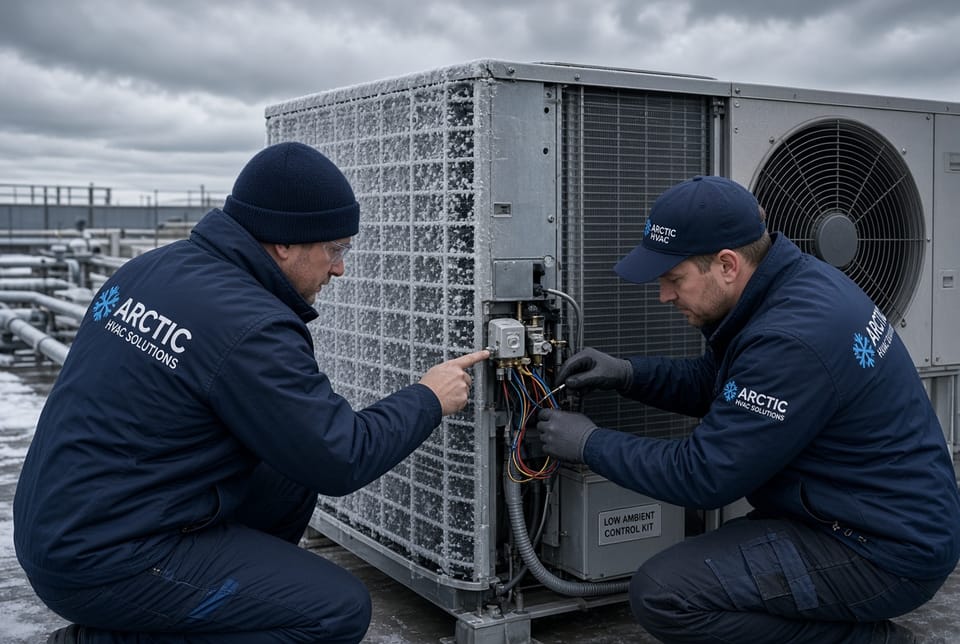
Many building owners and facility managers assume air conditioning systems are strictly warm-weather equipment. That assumption can create serious problems when spaces require cooling year-round. Server rooms, commercial kitchens, data centers, medical facilities, and certain manufacturing areas generate heat continuously, regardless of outdoor temperatures. When outdoor air drops below the design limits of a standard air-conditioning system, the equipment can stop functioning properly or shut down entirely. The solution is a specialized accessory known as the low ambient kit.
Get Your Low Ambient Kit Installed Today – Call Now!
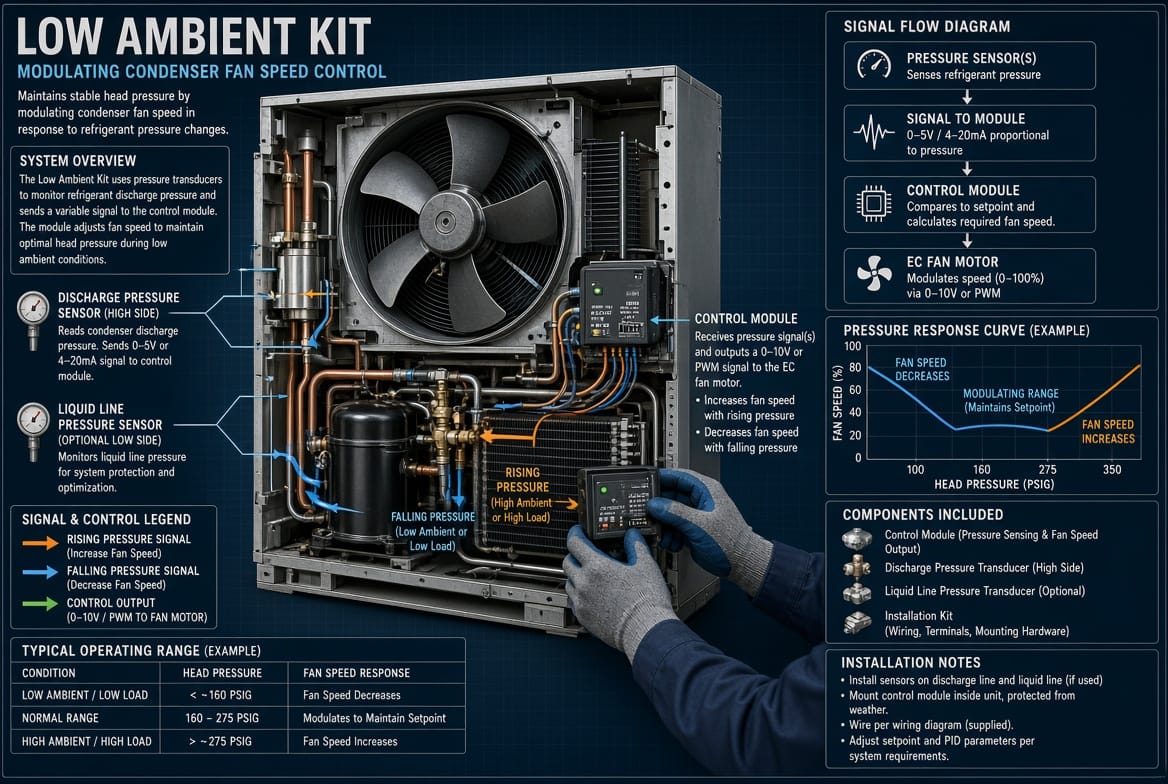
A low ambient kit is an engineered control package that allows an air-conditioning system to operate safely and efficiently when outdoor temperatures fall well below the normal operating range. By precisely managing condenser fan speed, the kit maintains the correct refrigerant pressures inside the system. This simple yet critical adjustment keeps the cooling process stable even when the outdoor air is cold.
Understanding How a Standard Air Conditioner Behaves in Cold Weather
A conventional air conditioner is designed for warm outdoor conditions. The outdoor condenser rejects heat by moving air across refrigerant-filled coils. When outdoor temperatures drop, the refrigerant pressure inside the condenser can fall too low. Low pressure disrupts the refrigeration cycle, reduces cooling capacity, and can cause the compressor to short-cycle or shut down on safety controls.
Without intervention, the system may ice up, lose oil return, or experience liquid refrigerant flood-back. These conditions place mechanical stress on components and can lead to premature failure. In spaces that cannot tolerate temperature spikes—such as server rooms housing critical IT equipment—the consequences of an unexpected shutdown are far more serious than temporary discomfort.
What a Low Ambient Kit Actually Does
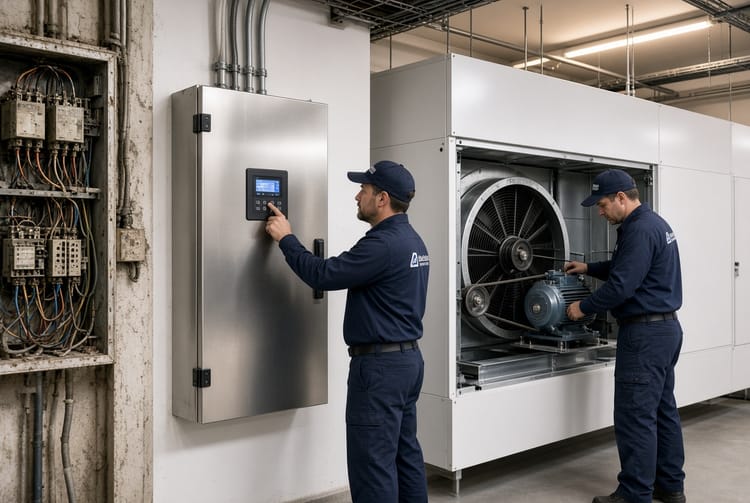
The low ambient kit solves the pressure problem by controlling the speed of the condenser fan. Most kits use a pressure sensor or temperature sensor that continuously monitors conditions in the refrigerant circuit. When outdoor temperatures drop and head pressure begins to fall, the control module slows the fan. Reduced airflow keeps more heat in the condenser, raising the refrigerant pressure back into the safe operating range.
Some advanced kits modulate fan speed gradually rather than simply turning the fan on and off. This continuous adjustment provides smoother operation, quieter performance, and better energy efficiency. Other designs use variable-frequency drives or solid-state controllers that respond instantly to pressure changes. Regardless of the exact technology, the core function remains the same: maintain stable condenser pressure so the air conditioner can continue delivering cooling.
The result is reliable operation in temperatures that would otherwise force a standard system offline. Many low ambient kits enable cooling down to 0 °F, –20 °F, or even lower, depending on the specific model and system design.
When a Low Ambient Kit Becomes Essential
Not every air-conditioning system needs a low ambient kit. Homes that only require cooling during summer months rarely benefit. The accessory becomes critical in applications where cooling demand continues through fall, winter, and early spring.
Key situations include:
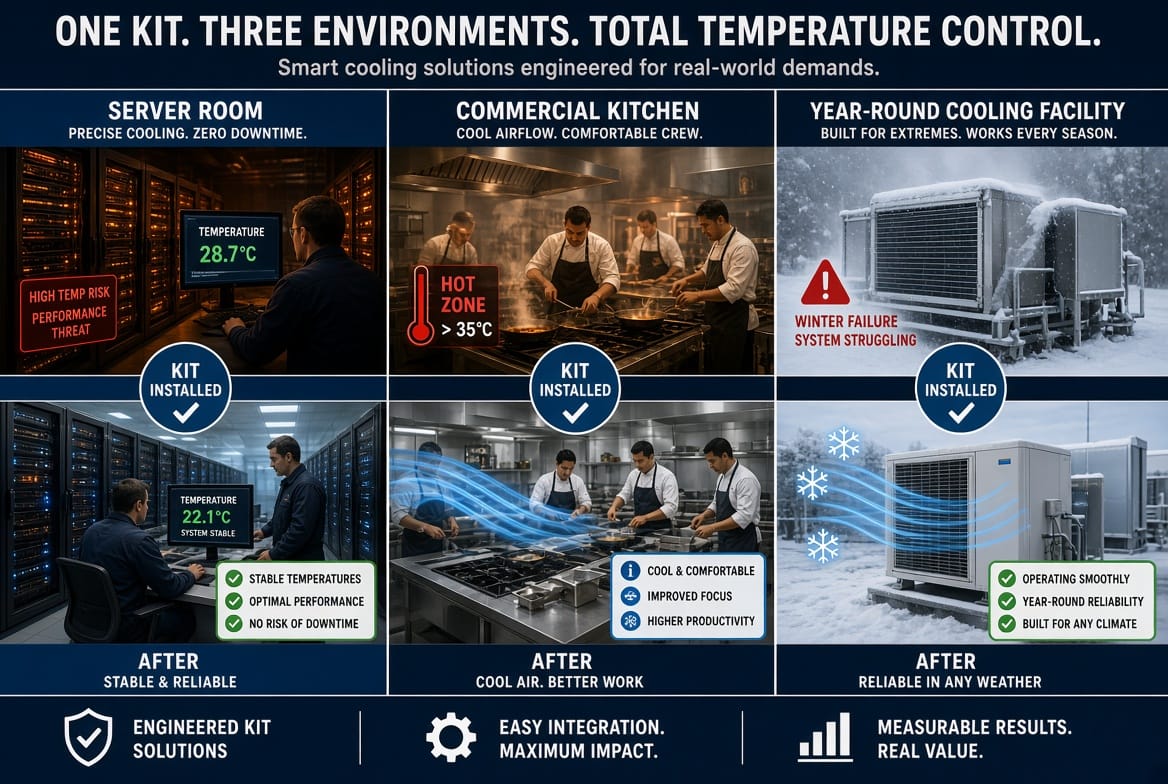
- Server rooms and data centers – IT equipment produces constant heat. Even a short temperature rise can damage hardware or trigger automatic shutdowns.
- Commercial kitchens – Cooking equipment, refrigeration units, and high occupancy generate heat year-round. Comfort and food-safety standards demand consistent cooling.
- Medical and laboratory facilities – Precise temperature control protects sensitive equipment, samples, and patient areas.
- Manufacturing and process spaces – Certain production lines or clean rooms require stable conditions regardless of outdoor weather.
- Retail and office buildings with high internal loads – Dense occupancy, lighting, and electronics can create cooling needs even on mild or cold days.
- Any facility with year-round cooling requirements – When the building design or occupancy pattern demands continuous temperature control.
In these environments, the cost of an unexpected cooling failure far exceeds the investment in a properly installed low ambient kit. The accessory transforms a seasonal cooling system into a reliable year-round solution.
Installation Considerations for Reliable Performance
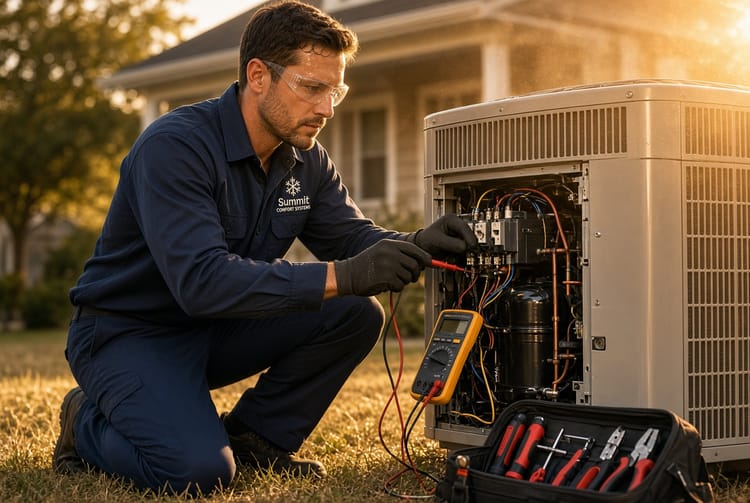
Proper installation is as important as the kit itself. A low ambient kit must be matched to the specific condenser model, refrigerant type, and system capacity. Mismatched components can create control conflicts or fail to maintain correct pressures.
Professional installation typically involves several key steps:
- Selecting a kit rated for the lowest expected outdoor temperature and the system’s refrigerant charge.
- Mounting the pressure or temperature sensor in the correct location on the refrigerant circuit.
- Wiring the control module according to manufacturer diagrams and local electrical codes.
- Integrating the kit with existing safety controls so it does not interfere with high-pressure or low-pressure cut-outs.
- Testing the system across a range of outdoor temperatures to verify stable operation.
- Adjusting setpoints if the kit allows field calibration.
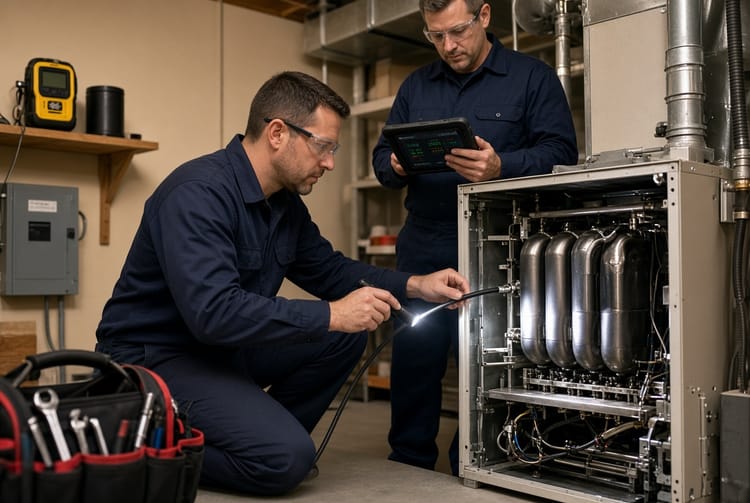
Technicians also evaluate whether additional accessories—such as crankcase heaters, accumulator tanks, or head-pressure control valves—are needed for complete cold-weather protection. In some cases, the low ambient kit works in combination with these components to deliver full system reliability.
Because the outdoor unit operates in potentially harsh conditions, weatherproof enclosures, secure mounting, and proper strain relief on wiring are essential. A poorly installed kit can introduce new failure points rather than solve existing ones.
Benefits Beyond Simple Operation
A correctly specified and installed low ambient kit delivers more than the ability to run the air conditioner in cold weather. Facility managers often notice several secondary advantages:
- Reduced risk of compressor damage from low-pressure operation or liquid flood-back.
- More consistent indoor temperatures, which protects equipment and improves occupant comfort.
- Lower likelihood of emergency service calls during unexpected cold snaps.
- Extended equipment life through smoother, controlled operation.
- Flexibility to schedule maintenance or renovations without worrying about seasonal cooling limitations.
In commercial settings, these benefits translate directly into lower total cost of ownership and higher operational confidence.
Common Myths About Cold-Weather Cooling
Several misconceptions still circulate about running air conditioning in cooler months. One frequent belief is that simply turning the outdoor fan off will solve pressure problems. In reality, complete fan shutdown can cause rapid pressure swings and uneven coil temperatures. Modern modulating kits provide far more precise control.
Another myth is that all systems can be “winterized” with the same aftermarket part. Compatibility matters. Using an incompatible kit can void warranties or create unsafe operating conditions. Working with experienced HVAC professionals ensures the correct accessory is selected and installed.
Some building owners assume that free cooling or economizer modes eliminate the need for mechanical cooling in cold weather. While economizers are valuable, they cannot always meet the full cooling load of high-heat-density spaces. A low ambient kit keeps the mechanical system available as a reliable backup or primary source when outdoor air alone is insufficient.
Choosing the Right Partner for Installation
Selecting a low ambient kit is only half the process. The quality of installation and ongoing support determines long-term success. Look for HVAC contractors who demonstrate experience with commercial refrigeration and control systems, not just residential comfort cooling. They should be able to explain sensor placement, control logic, and testing procedures in clear terms.
Ask about warranty coverage on both the kit and the labor. Request documentation of the final setpoints and operating parameters so future technicians understand how the system was configured. A professional installation includes training for on-site staff on basic monitoring and what conditions should trigger a service call.
Maintaining Peak Performance After Installation
Once the low ambient kit is in place, routine maintenance becomes straightforward. Technicians should verify sensor readings, inspect wiring connections, and confirm fan-speed response during seasonal checkups. Keeping the outdoor coil clean remains important, because restricted airflow can affect pressure control even with the kit operating correctly.
Most modern kits require little ongoing adjustment. Their solid-state electronics are designed for long service life in outdoor environments. Still, annual professional inspection ensures the entire cooling system—including the low ambient controls—continues to perform as intended.
The Bottom Line on Year-Round Cooling Reliability
Spaces that generate heat every day of the year cannot rely on seasonal equipment. A low ambient kit bridges the gap between standard air-conditioning design and real-world operational needs. By controlling condenser fan speed in response to refrigerant pressure, the kit keeps the system running safely when outdoor temperatures drop. The result is stable indoor conditions, protected equipment, and greater peace of mind for facility managers.
Whether the application is a critical server room, a high-heat commercial kitchen, or any environment that demands cooling regardless of the season, the low ambient kit provides a proven, targeted solution. Proper selection and professional installation turn a potential vulnerability into a dependable asset.
Run your AC in any weather with a low ambient kit.
Call for Fast, Expert HVAC Low Ambient Kit Installation