The HVAC Condenser Fan Speed: Why Proper RPM Matters for Efficiency
In every air conditioning or heat pump system, the outdoor condenser unit performs a critical role that many homeowners overlook until performance declines. At the heart of that unit sits the condenser fan, a component whose rotational speed—measured in revolutions per minute, or RPM—directly governs how effectively the system rejects heat. When the fan operates at the correct RPM, the entire refrigeration cycle runs smoothly, energy consumption stays low, and indoor comfort remains consistent. When the speed drifts too high or too low, efficiency drops, pressures rise, and the system works harder than necessary. Understanding why proper condenser fan RPM matters is essential for protecting both comfort and operating costs.
Call Now for Expert Condenser Fan RPM Diagnosis & Repair
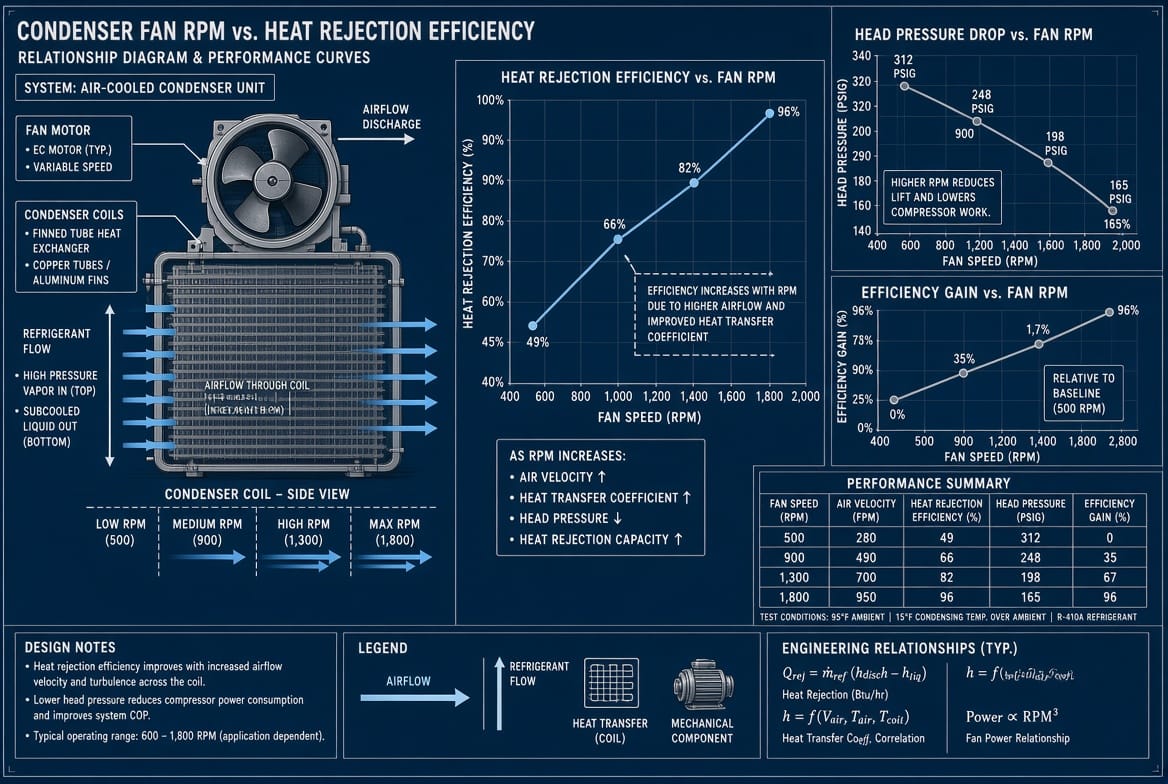
How Condenser Fan Speed Influences Heat Rejection
The condenser’s primary job is to release the heat absorbed from inside the home into the outdoor air. Refrigerant arrives at the condenser as a high-pressure, high-temperature vapor. As outdoor air moves across the condenser coil, that heat transfers to the air, allowing the refrigerant to condense into a liquid. The condenser fan is responsible for moving the required volume of air across those coils.
Fan speed determines the airflow rate. Higher RPM produces greater airflow, which increases the rate of heat transfer. Lower RPM reduces airflow and therefore slows heat rejection. Manufacturers design each system for a specific airflow volume that matches the coil surface area, refrigerant charge, and outdoor design conditions. Operating outside that narrow RPM window disrupts the carefully balanced heat-exchange process.
When airflow is insufficient, the refrigerant cannot fully condense. Residual heat remains in the system, elevating head pressure—the pressure on the high side of the refrigeration circuit. Elevated head pressure forces the compressor to work against greater resistance, drawing more electricity and generating additional heat. Conversely, excessive fan speed can over-cool the refrigerant, potentially causing liquid flood-back or reducing the temperature differential needed for efficient heat transfer. In both cases, the system’s Coefficient of Performance (COP) declines, and energy bills rise.
Proper RPM also influences the temperature of the liquid refrigerant leaving the condenser. Correct speed keeps the liquid subcooled within the manufacturer’s recommended range, ensuring the expansion device receives refrigerant at the ideal condition for efficient indoor cooling. Any deviation from the designed RPM therefore cascades through the entire cycle, affecting capacity, efficiency, and long-term reliability.
Signs That Condenser Fan Speed Is Incorrect
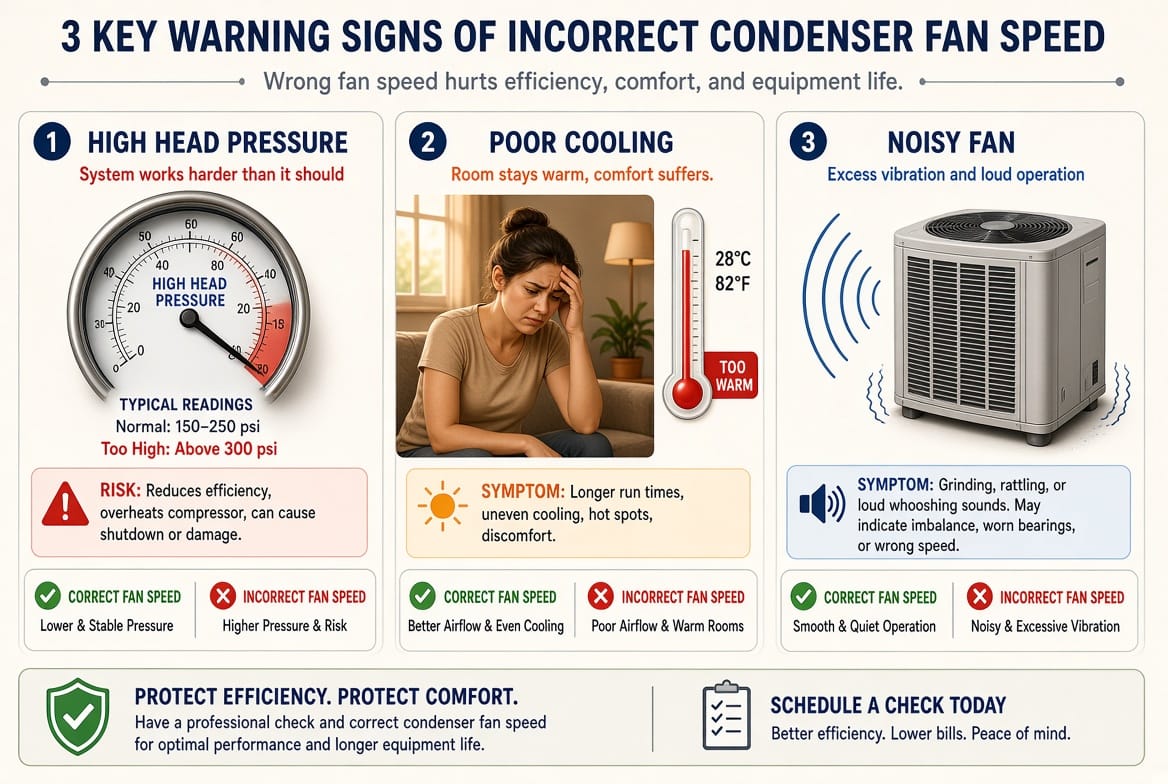
Homeowners and technicians can often detect incorrect fan speed through observable symptoms before catastrophic failure occurs. The most common indicators include:
- High head pressure readings on service gauges, frequently accompanied by the high-pressure switch tripping and shutting the system down.
- Poor cooling performance indoors, even though the indoor blower appears to operate normally. Rooms take longer to reach the set temperature, or the system runs continuously without satisfying the thermostat.
- Noisy fan operation—unusual humming, rattling, or high-pitched whining that changes with outdoor temperature.
- Excessive compressor amperage draw that exceeds nameplate ratings.
- Ice or frost forming on the liquid line near the outdoor unit in cooling mode, signaling incomplete condensation.
- Noticeably higher electricity bills during peak cooling months without a corresponding increase in outdoor temperatures.
These symptoms rarely appear in isolation. High head pressure and poor cooling almost always travel together when fan speed is too low. A noisy fan may indicate bearing wear or blade imbalance that has already reduced effective RPM. Early recognition of these warning signs allows professionals to intervene before the compressor suffers irreversible damage.
Why Fan Motors Lose Correct Speed Over Time
Several factors can cause a condenser fan motor to operate outside its designed RPM range. Capacitor degradation is one of the most frequent culprits. The run capacitor supplies the phase shift needed for the motor to reach and maintain full speed. As the capacitor weakens, the motor may start but never attain the correct RPM, or it may slow under load.
Bearing wear is another common issue. Contaminants, moisture, and years of continuous outdoor exposure gradually increase friction. Higher friction demands more torque, reducing rotational speed even when voltage and capacitance remain adequate. In extreme cases, the motor may seize entirely.
Voltage fluctuations and wiring problems also play a role. Undersized conductors, loose connections, or utility voltage that falls outside the motor’s tolerance range can prevent the fan from reaching design RPM. Finally, physical obstruction—bent fan blades, debris lodged in the shroud, or a misaligned motor mount—can create aerodynamic drag that effectively lowers air-moving capacity even if the shaft still turns at the correct speed.
How Professionals Measure and Correct Fan Speed
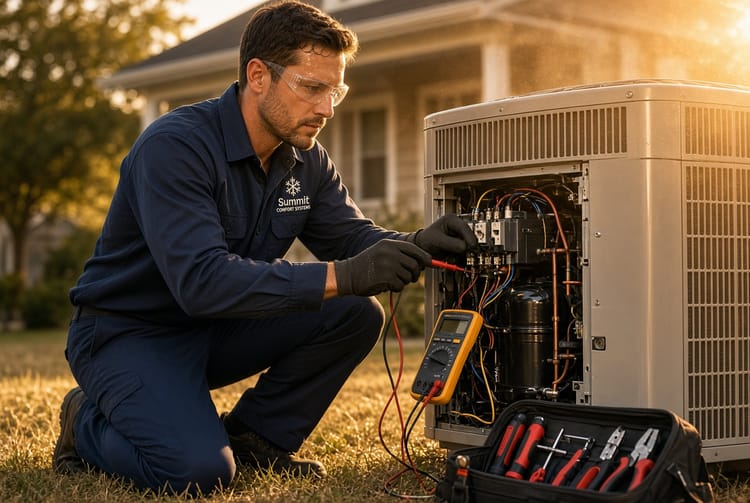
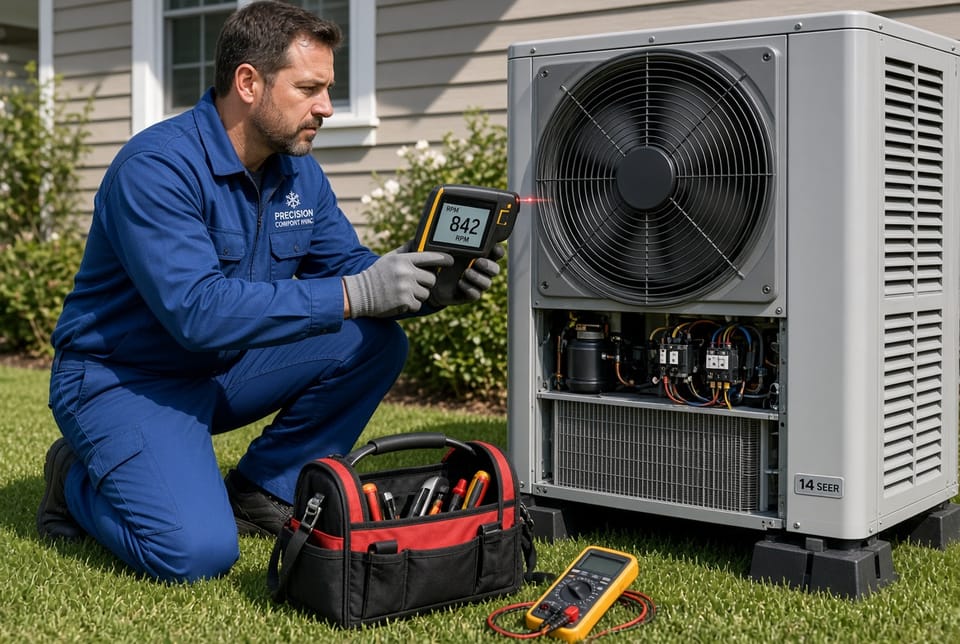
Accurate diagnosis begins with measurement. Technicians use a non-contact digital tachometer or a stroboscopic tachometer to read actual RPM while the system runs under normal load. The measured value is then compared against the manufacturer’s specification, typically printed on the motor nameplate or listed in the service literature. Most residential condenser fans operate between 800 and 1,100 RPM, though exact targets vary by model and blade design.
If the measured RPM falls outside the acceptable range, the technician systematically checks supporting components. Capacitor microfarad values are tested under load. Voltage at the motor terminals is verified. Amperage draw is compared to nameplate data. Bearings are inspected for play or roughness. Only after these supporting elements are confirmed healthy does the technician conclude that the motor itself requires replacement.
When replacement is necessary, professionals select a motor that matches the original in horsepower, voltage, rotation direction, shaft diameter, and mounting configuration. Many modern replacement motors are multi-speed or permanent-split-capacitor designs that allow fine-tuning. After installation, the new motor is carefully aligned, the fan blade is balanced, and RPM is re-checked to confirm it meets design specifications. In some cases, technicians may also adjust the fan blade pitch or install a different blade profile to restore the exact airflow volume required by the coil.
Variable-speed and electronically commutated motors (ECMs) introduce additional possibilities. These advanced motors can be programmed or controlled by the system board to modulate RPM according to outdoor temperature, refrigerant pressure, or demand. When commissioning or servicing an ECM condenser fan, technicians use manufacturer-specific diagnostic tools to verify that the motor is receiving the correct control signal and achieving the commanded speed. Proper setup of these motors can yield even greater seasonal efficiency gains than fixed-speed designs.
The Direct Link Between Correct RPM and System Efficiency
Every increase in head pressure caused by inadequate airflow raises compressor power consumption. Industry data consistently show that a 10 percent reduction in condenser airflow can increase energy use by 5 to 8 percent under design conditions, with larger penalties during extreme outdoor temperatures. Conversely, restoring the fan to its designed RPM immediately lowers head pressure, reduces compressor runtime, and improves the system’s ability to maintain indoor setpoints with less energy.
Correct fan speed also protects the compressor’s lubrication and mechanical integrity. High head pressure elevates discharge temperatures, accelerating oil breakdown and stressing valves and bearings. By keeping heat rejection on target, proper RPM extends compressor life and reduces the likelihood of costly mid-season failures.
From an indoor comfort perspective, adequate condenser airflow ensures the system can deliver its full rated capacity. When the outdoor unit rejects heat efficiently, the indoor coil can absorb heat at the design rate, maintaining lower supply-air temperatures and better humidity control. Homeowners notice the difference as more consistent temperatures and shorter, quieter cooling cycles.
Preventive Practices That Preserve Fan Speed Accuracy
While some degradation is inevitable with age, several maintenance practices help keep condenser fan RPM within specification for as long as possible. Annual professional inspections should include capacitor testing, bearing lubrication (where applicable), and visual examination of the fan blade and shroud. Keeping the outdoor coil clean is equally important; dirt and debris increase static pressure, forcing the fan motor to work harder and potentially slowing under load.
Homeowners can assist by maintaining clear space around the condenser—typically two feet on all sides—and by gently rinsing the coil with a garden hose each spring. Avoiding the use of high-pressure washers prevents fin damage that would otherwise restrict airflow and place additional load on the fan motor.
When Replacement Is the Most Efficient Path
Not every slow fan can be restored by capacitor or bearing service. Motors that have suffered internal winding damage, severe corrosion, or prolonged operation at reduced speed often cannot be economically repaired. In these situations, replacement with a high-efficiency motor—preferably an ECM if the system supports it—delivers both immediate performance recovery and long-term energy savings.
Technicians also evaluate the entire outdoor unit during motor replacement. An aging coil with significant fin damage may warrant concurrent coil cleaning or replacement so that the new motor can deliver its full designed airflow. Matching the new motor and blade combination to the original airflow specification is critical; simply installing a faster motor without verifying cubic-feet-per-minute delivery can create new problems such as excessive noise or over-cooling of the refrigerant.
The Broader Performance Factor of Fan Speed
Among the many variables that influence HVAC efficiency—refrigerant charge, indoor airflow, duct design, and thermostat calibration—condenser fan RPM stands out as a pure performance factor that is both measurable and correctable. It requires no invasive refrigerant work and can often be diagnosed and resolved in a single service visit. Because the fan operates whenever the compressor runs, even modest improvements in speed accuracy compound across thousands of annual operating hours.
System owners who prioritize correct RPM gain more than lower energy bills. They gain quieter operation, more predictable comfort, and greater confidence that the most expensive component—the compressor—is not being forced to operate under abnormal stress. In commercial applications the same principle scales dramatically; a single rooftop unit with an under-performing condenser fan can waste thousands of kilowatt-hours over a cooling season.
Conclusion: Protecting Efficiency Through Proper Fan Speed
The relationship between condenser fan RPM and system efficiency is direct and unforgiving. Correct speed enables complete heat rejection, stable head pressure, and optimal compressor operation. Incorrect speed produces the opposite results—higher energy use, reduced capacity, and accelerated wear. Recognizing the signs of high head pressure, poor cooling, and noisy fan operation allows timely professional intervention. Through precise measurement, component testing, and, when necessary, motor replacement, technicians restore the airflow the system was designed to deliver.
Call Today to Prevent Costly Breakdowns with a Fan Motor Tune-Up