The HVAC Air Filter Rating: MERV vs. MPR vs. FPR Explained
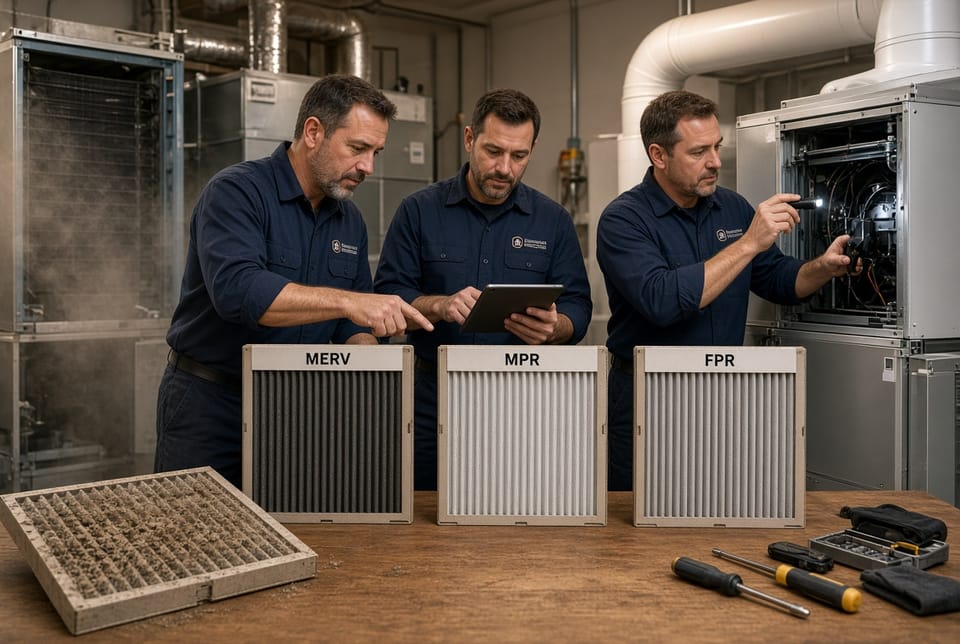
Choosing an air filter used to feel simple. Today the same aisle can display three different numbers on nearly identical boxes. One package lists a MERV rating. Another highlights a large MPR number. A third uses an FPR score and color band. Homeowners reasonably wonder which number actually matters and whether a higher figure always means cleaner air.
Choose the Safest HVAC Filter for Your Home – Call Today
The short answer is that MERV is the independent industry standard. MPR and FPR are useful retailer or brand scales, but they are not interchangeable. Understanding what each rating measures—and the limits of your HVAC equipment—lets you select a filter that improves indoor air quality without restricting airflow or shortening equipment life.
This guide explains the three systems in plain language, shows how they roughly convert, and walks through a practical decision process for most homes.
Why Three Rating Systems Exist
MERV (Minimum Efficiency Reporting Value) was created by ASHRAE, the professional society that sets HVAC engineering standards. It uses a published laboratory test that evaluates particle capture across defined size ranges. Almost every filter sold in the United States can carry a MERV rating, so it is the only number that works across brands and stores.
MPR (Microparticle Performance Rating) is a proprietary scale developed by 3M for its Filtrete line. It emphasizes capture of the smallest particles (roughly 0.3–1 micron).
FPR (Filter Performance Rating) is The Home Depot’s in-store system. It combines particle capture with other practical factors such as dust-holding capacity so shoppers can make a faster decision on the shelf.
Neither proprietary scale is inherently misleading. They simply answer slightly different questions and use different numbers. The reliable way to compare products is to convert everything back to MERV.
What MERV Actually Measures
A MERV rating reports how well a filter captures particles between 0.3 and 10 microns under standardized test conditions. The scale most commonly seen on residential filters runs from 1 to 16 (higher numbers exist for specialized applications).
Key particle groups include:
- Larger particles (3–10 microns): pollen, dust mites, carpet fibers, lint
- Mid-size particles (1–3 microns): many mold spores, pet dander, some smoke residue
- Smaller particles (0.3–1 micron): fine smoke, bacteria-sized droplets, many allergens
Higher MERV ratings capture a greater percentage of the smaller particles on each pass. That does not automatically make the highest number the best choice for every house. Denser media also increases airflow resistance. If the blower must work harder than the system was designed for, efficiency drops and components can wear faster.
Typical residential ranges:
- MERV 6–8: Everyday dust, lint, and larger allergens; low resistance
- MERV 11–13: Pets, moderate-to-strong allergy concerns, finer particles
- MERV 13+: High-efficiency residential or light commercial use when the equipment can support it
Hospital-grade filtration often starts around MERV 15–16 and higher, but those filters are rarely appropriate for a standard home furnace or air handler without professional verification.
What MPR Measures
MPR focuses on microparticles smaller than about 1 micron. The published scale commonly runs from 300 to 2800. Because the test emphasizes the smallest particles, a large MPR number can look more impressive than the equivalent MERV rating.
Approximate translations used by manufacturers and retailers (these are ranges, not exact equations):
- MPR 300 ≈ MERV 6
- MPR 600 ≈ MERV 8
- MPR 1000–1200 ≈ MERV 11
- MPR 1500–1900 ≈ MERV 12–13
- Higher MPR values approach MERV 13 and above
MPR is helpful when you already prefer Filtrete products. It is less useful when you are comparing a Filtrete filter to a different brand that only lists MERV.
What FPR Measures
FPR typically appears as a 4-to-10 (sometimes up to 12) score plus a color code. Home Depot designed it so a shopper can quickly distinguish “good / better / best” without reading a technical table.
The rating weights:
- Capture of larger particles
- Capture of smaller particles
- How much dust the filter can hold before pressure drop rises too far
Approximate conversions:
- FPR 4–5 ≈ MERV 6–8
- FPR 7 ≈ MERV 11
- FPR 10 ≈ MERV 13
Because FPR includes lifespan factors, two filters with the same FPR can still differ slightly in particle-size performance. Again, look for the printed MERV equivalent when you need a precise comparison.
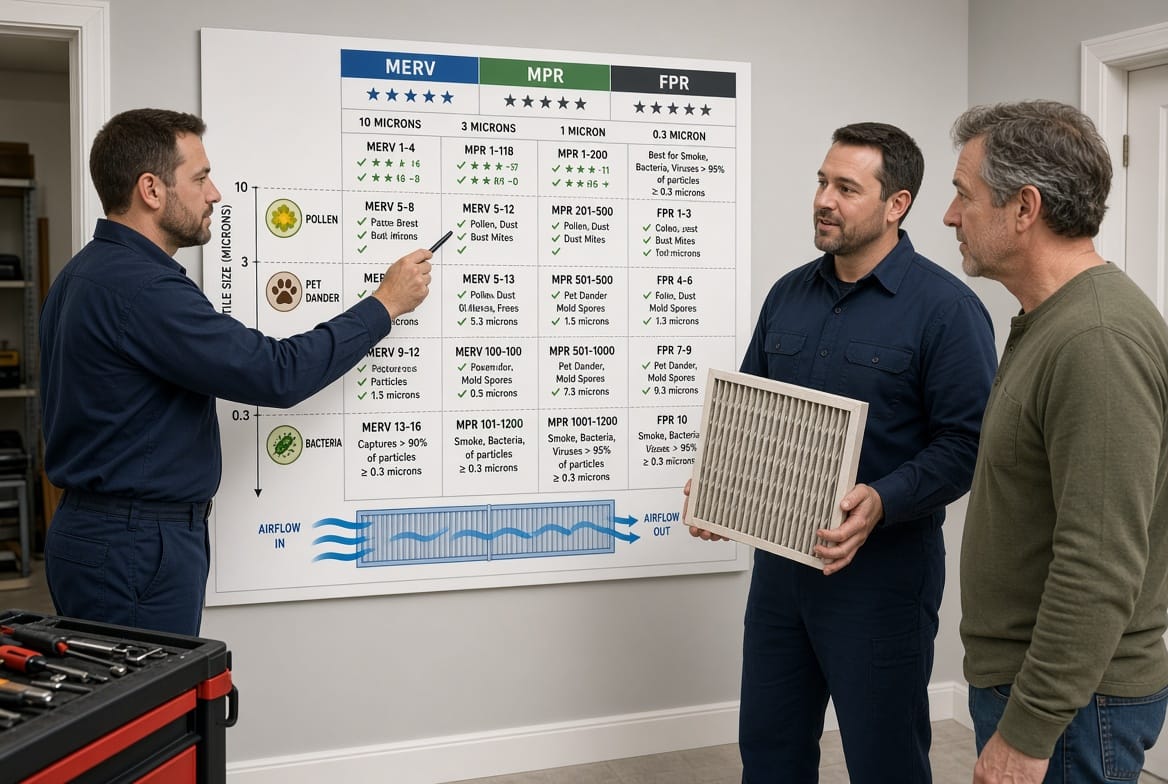
How the Three Ratings Compare in Practice
Treat conversion charts as shopping aids, not laboratory certificates. The most consistent pattern is:
| Need | Typical MERV | Rough MPR | Rough FPR |
|---|---|---|---|
| Basic dust and lint | 6–8 | 300–600 | 4–5 |
| Everyday home, light pets | 8 | 600 | 5 |
| Pets and mild allergies | 11 | 1000–1200 | 7 |
| Stronger allergy or smoke concerns | 13 | 1900 | 10 |
When boxes disagree, trust the MERV number printed in smaller type. That is the only rating produced under the same test method for every brand.
Choosing the Right Rating for Your System
The best filter is the highest efficiency your equipment can support without excessive pressure drop. Follow this sequence.
1. Check the manufacturer’s guidance
Look in the furnace or air-handler manual, on the existing filter frame, or on a sticker near the filter slot. Many residential systems are designed around MERV 8–13. Installing a much denser filter than specified can starve the coil of air.
2. Match the household, not the highest number
- No pets, no allergy issues, older equipment: MERV 8 (or MPR 600 / FPR 5) is often sufficient and safest.
- Pets or seasonal allergies: MERV 11 is the most common upgrade.
- Asthma, multiple pets, wildfire smoke, or someone with higher sensitivity: MERV 13 if the system can handle it.
3. Confirm physical fit and depth
A 1-inch filter and a 4-inch or 5-inch media filter with the same MERV rating behave differently. Deeper filters usually have more surface area, so they can achieve higher efficiency with less resistance. Never force a thicker filter into a slot that was not designed for it.
4. Watch static pressure and runtime
After an upgrade, listen for a louder blower, longer run times, or reduced airflow at registers. Those are signs the filter is too restrictive. A qualified technician can measure total external static pressure and confirm the selection.
5. Replace on schedule
A dirty high-efficiency filter can restrict airflow more than a clean lower-efficiency filter. Follow the printed interval (often 30–90 days for 1-inch filters) and shorten it in homes with pets, construction dust, or heavy occupancy.
Risks of Choosing the Wrong Rating
Too low: Larger particles reach the coil and blower, reducing efficiency and indoor air quality. Allergens remain in circulation.
Too high for the equipment: Restricted airflow can cause frozen evaporator coils, overheated heat exchangers, higher energy use, and premature component failure.
Mismatched depth or size: Air bypasses the filter around the edges, defeating the rating entirely.
These problems are avoidable. The goal is balanced filtration—cleaner air and a system that still breathes easily.
Practical Recommendations by Household Type
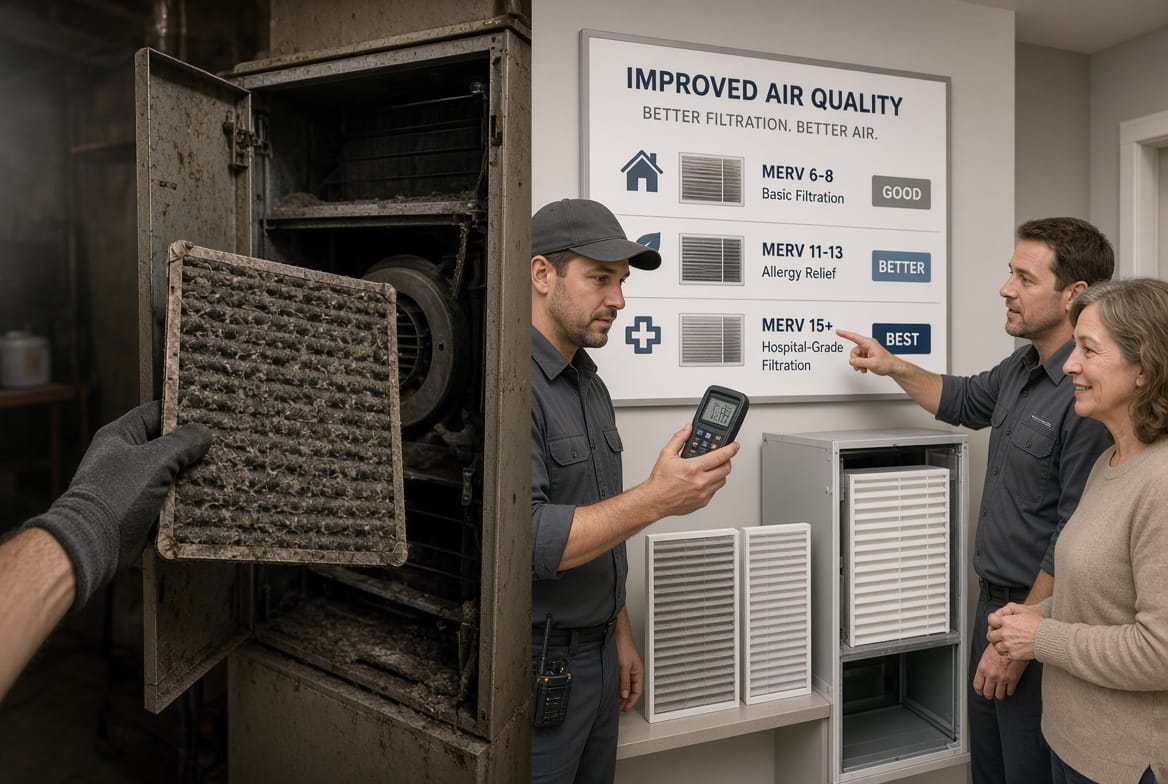
- Basic protection (most homes): MERV 6–8. Captures dust, lint, and larger pollen with minimal strain.
- Allergy and pet households: MERV 11–13. Adds meaningful capture of dander, finer dust, and many smoke particles.
- Highest residential or special-needs settings: MERV 15+ only after a professional confirms the blower, duct design, and filter cabinet can accept the extra resistance. These ratings are common in hospitals and clean-room environments, not typical living rooms.
Maintenance Habits That Protect Both Air and Equipment
- Mark the next change date on the filter frame or calendar the day you install it.
- Inspect monthly during heavy-use seasons.
- Keep returns unobstructed by furniture or rugs.
- Consider a professional filter consultation when you upgrade equipment or notice new allergy symptoms.
A correctly rated, regularly changed filter is one of the lowest-cost ways to protect both indoor air and the HVAC investment.
Putting It All Together
MERV remains the clearest, most comparable number. Use MPR when you shop Filtrete and FPR when you shop at Home Depot, then convert back to MERV before you buy. Select the rating that matches your household’s air-quality goals and your system’s airflow capacity. When in doubt, a modest, well-maintained MERV 8–11 filter outperforms an oversized, overdue MERV 13 that starves the equipment of air.
Call Today to Match MERV, MPR, or FPR to Your HVAC