The Home Office Surge Protection: Power Strips vs. Whole-House Protection
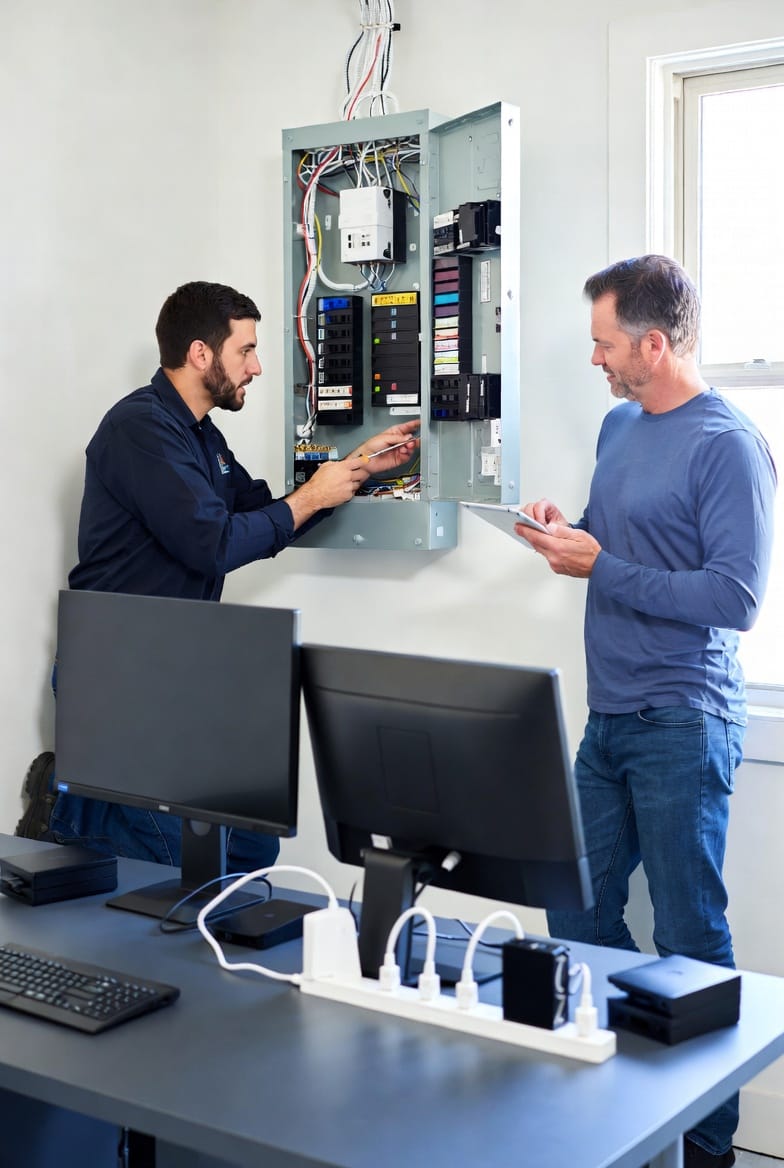
Home offices have become the quiet engine of modern work. Laptops, monitors, external hard drives, routers, docking stations, and printers now sit side by side for eight or more hours a day. That concentration of sensitive electronics creates a single point of vulnerability: the electrical system that powers them. A single lightning-induced surge, a utility switching event, or even the cycling of a large appliance elsewhere in the house can send a brief but powerful voltage spike through the wiring. Without proper surge protection, the result can be immediate equipment failure, corrupted files, or silent degradation that shortens the life of every device on the circuit.
Protect Your Home Office Today – Call Now!
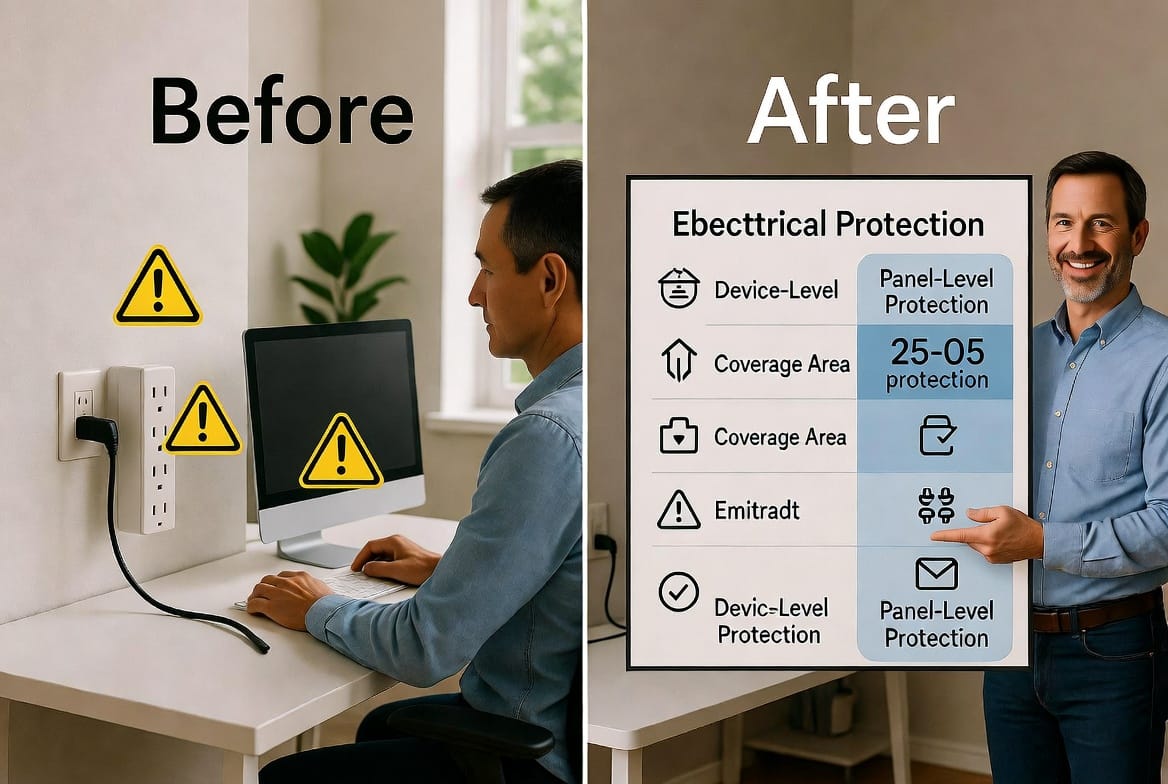
Two distinct layers of defense exist. Power strips that include surge-suppression circuitry protect individual devices at the outlet. Whole-house surge protectors install at the main electrical panel and intercept dangerous energy before it ever reaches those outlets. Each layer has clear strengths and clear limits. The most reliable strategy is not to choose one over the other but to deploy both. This article examines how each technology works, where it falls short, and why the combination delivers the highest level of protection for a professional home office.
Understanding the Nature of Power Surges
A power surge is a sudden increase in voltage above the normal 120-volt level that North American homes expect. These events last only microseconds, yet the energy they carry can overwhelm the delicate circuitry inside modern electronics. Sources include:
- Lightning strikes that induce voltage on utility lines
- Utility company capacitor switching or transformer problems
- Internal events such as air-conditioner compressors or well pumps starting and stopping
- Faulty wiring or loose neutral connections
Even a modest surge of a few hundred volts can damage power supplies, motherboards, and solid-state drives. Repeated smaller spikes accelerate wear. In a home office the cost is measured not only in replacement hardware but also in lost productivity and potential data recovery expenses. Protecting against these events is therefore a practical business decision as much as a technical one.
Power Strip Surge Protectors: Device-Level Defense
A surge-protected power strip is the most familiar form of protection. It sits between the wall outlet and the equipment, usually featuring multiple receptacles, an on/off switch, and status indicator lights. Inside, metal-oxide varistors (MOVs) or similar components clamp excess voltage and divert it to ground.
Strengths of device-level protection:
- Immediate, visible placement next to the equipment
- Affordable entry point for basic coverage
- Ability to protect a cluster of devices on a single strip
- Easy replacement when the protective elements wear out
Limitations that matter in a home office:
- Finite energy-handling capacity measured in joules; once the rating is exceeded the strip may no longer protect
- Protection stops at the devices plugged into that strip; other outlets and hard-wired appliances remain exposed
- Many consumer strips lack adequate let-through voltage ratings or proper grounding verification
- They do nothing for surges that enter through data or coaxial lines
Because a power strip only reacts after the surge has already traveled through the house wiring, residual energy can still reach the connected equipment. In practice this means a high-joule strip can save a computer during a moderate event yet still leave the hard drive or network switch vulnerable to the next stronger spike. Device-level protection is therefore best understood as the final, localized barrier rather than a complete solution.
Whole-House Surge Protection: Panel-Level Security
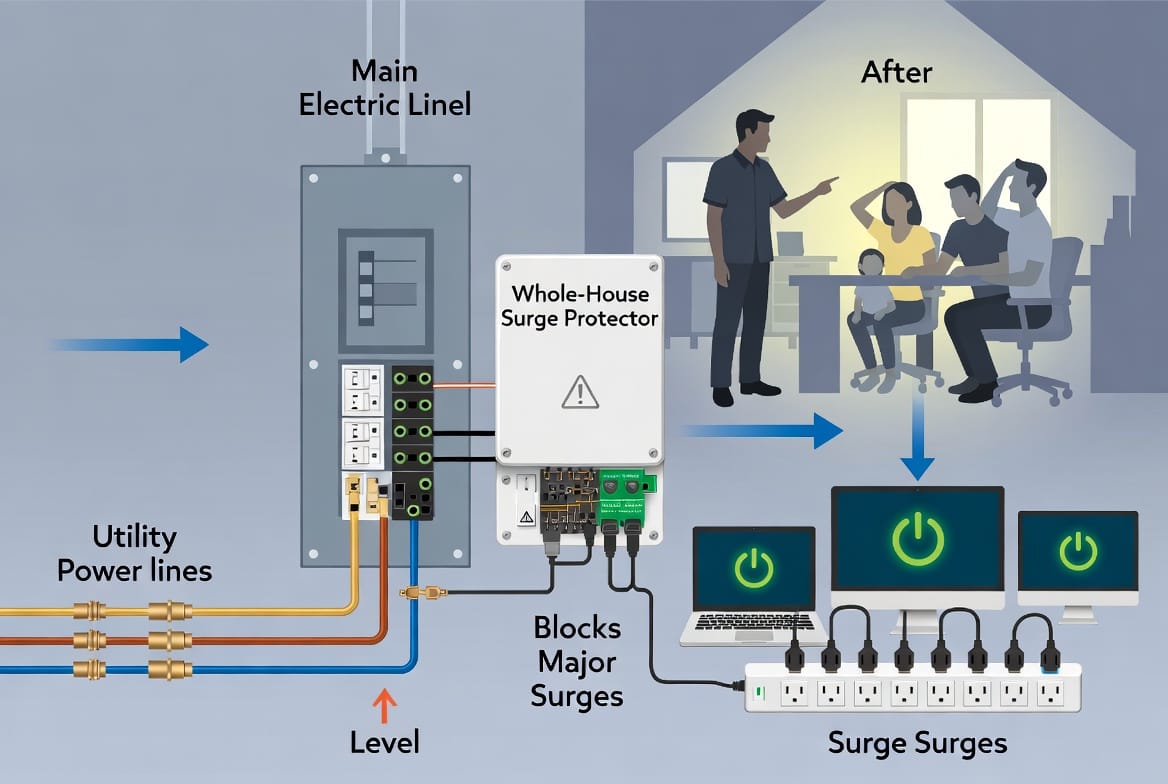
A whole-house surge protector mounts directly at the main service panel or, in some designs, at the meter base. It monitors the incoming power and diverts excess voltage to the grounding system before the energy can travel through branch circuits. These units are sized for the entire electrical service and typically handle far higher energy levels than any power strip.
Core advantages:
- Single-point protection for every outlet, light fixture, and hard-wired appliance in the home
- Higher joule ratings and lower let-through voltages than portable strips
- Continuous monitoring that does not rely on a user remembering to plug devices into a protected strip
- Longer service life when properly installed and coordinated with the home’s grounding system
Professional installation is required. An electrician verifies that the grounding electrode system is intact, selects the correct model for the service amperage, and ensures the unit is listed to the appropriate safety standards. Once in place, the whole-house protector becomes the first line of defense, absorbing the bulk of any external or internal surge.
Even the best panel-level device cannot reduce residual voltage to zero. A small amount of energy can still pass through and travel to individual outlets. That residual energy is precisely what a quality power strip is designed to handle. The two layers therefore complement each other rather than compete.
Why Both Layers Deliver Superior Protection
Think of surge protection the way building designers think of fire safety: multiple barriers improve the odds. The whole-house unit handles the large, infrequent events that originate outside or from major appliances. The power strip handles the smaller, residual, or localized events that still reach the work surface. Together they create redundancy.
Practical benefits of the combined approach include:
- Dramatically reduced risk of catastrophic equipment failure
- Extended lifespan of expensive electronics through consistent voltage clamping
- Peace of mind that every device, even those occasionally plugged into unprotected outlets, benefits from the primary layer
- Ability to replace only the worn power strip without opening the electrical panel
Insurance companies and equipment manufacturers increasingly recognize the value of layered protection. Many warranties for high-end computers and networking gear now encourage or require documented surge protection. A dual-layer system satisfies that expectation more completely than either product used alone.
Key Selection Criteria for Each Layer
When choosing a power strip for the home office, look beyond the number of outlets. Prioritize:
- A joule rating of at least 2,000–3,000 for serious workstations
- Low clamping voltage (ideally under 400 V)
- Clear failure indication so the strip can be replaced before protection is lost
- Adequate cord length and spacing to avoid overcrowding
- Independent testing marks from recognized laboratories
For the whole-house protector, the decision is more technical. An electrician will evaluate:
- Service entrance amperage and available space in the panel
- Quality of the existing grounding electrode system
- Presence of any secondary panels that may need additional protection
- Coordination with any solar, generator, or EV-charger systems already installed
The goal is a unit that responds faster and handles more energy than any single power strip while remaining coordinated with the rest of the electrical system.
Common Misconceptions That Leave Offices Exposed
Several widespread beliefs undermine effective protection. The first is the idea that a single high-end power strip is “good enough.” In reality, that strip only guards what is plugged into it. A second misconception is that whole-house protection makes power strips unnecessary. Residual energy still exists, and sensitive solid-state devices benefit from the extra clamping. A third is the belief that surge protectors last forever. Both MOVs in strips and the components inside panel units degrade with each event; periodic inspection and replacement are part of responsible maintenance.
Another frequent error is ignoring the grounding system. No surge protector can function correctly without a low-impedance path to earth. An electrician can test and improve grounding if needed, ensuring both layers perform as designed.
Practical Steps to Implement Dual-Layer Protection
Begin with an inventory of the home office. List every device that plugs into an outlet and note any that are hard-wired or connected via data lines. Next, schedule a consultation with a licensed electrician experienced in surge protection. The professional will assess the panel, grounding, and load centers, then recommend a whole-house unit sized for the property.
While that installation is planned, upgrade the power strips at the desk. Choose models with status lights and replace any that no longer indicate active protection. Organize cables so that critical equipment shares the highest-rated strips and secondary devices use secondary strips. Finally, establish a simple maintenance calendar: check indicator lights monthly and have the whole-house unit inspected every few years or after any significant electrical event.
These steps convert theoretical protection into daily operational security. The home office continues to function without interruption, and the investment in equipment is preserved.
Long-Term Value and Risk Reduction
The financial case for dual-layer protection is straightforward. A single failed laptop or external drive can cost more than a quality whole-house unit and several power strips combined. Beyond hardware, consider the value of uninterrupted work, the avoidance of data-recovery fees, and the reduced likelihood of insurance claims that raise future premiums. Over a five- to ten-year horizon the combined system typically pays for itself many times over through avoided losses and extended equipment life.
Equally important is the psychological benefit. Knowing that both layers stand between a sudden voltage spike and the tools of the trade allows deeper focus on actual work rather than background worry about power quality.
Final Recommendation and Call to Action
Power strips and whole-house surge protectors are not competing products; they are complementary layers of a complete defense strategy. Device-level strips deliver localized, last-line protection for the specific equipment on the desk. Panel-level whole-house systems intercept the majority of dangerous energy at the source and cover every circuit in the home. Used together they provide the highest practical level of security available for a modern home office.
Protect your electronics with surge protection. Do not wait for the next storm or utility event to reveal a vulnerability. A qualified electrician can evaluate your panel, recommend the correct unit, and coordinate installation so that both layers work in harmony. Secure the workplace that supports your livelihood—starting today.
Safeguard Your Electronics with Expert Surge Protection – Call Now