The Garage Door Opener Antenna: Extending Range for Reliable Operation
Struggling with your garage door opener that only works when you're standing right next to it? Range issues are one of the most common frustrations homeowners face with automatic garage doors. The good news is that a simple antenna extension often solves the problem quickly and affordably — without replacing the entire system.
Secure Your Garage Door Today – Call Now
At Local Hero Garage Door, we’ve helped thousands of homeowners restore full-range operation through proper antenna optimization. This comprehensive guide walks you through exactly how the garage door opener antenna functions, what causes reduced range, and the most effective DIY antenna extension methods you can try today.
Image Placement Note: Insert the Main Opening Image here (as described above).
Understanding How the Garage Door Opener Antenna Works
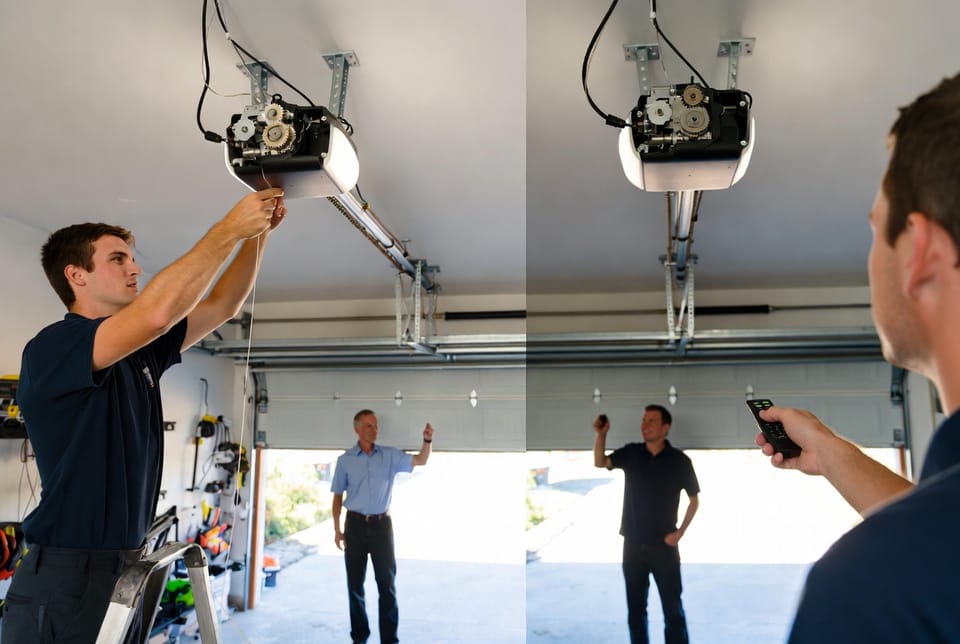
The garage door opener antenna serves as the critical link between your handheld remote (or wall console) and the motor unit mounted in your garage. It receives the radio frequency signal transmitted by the remote, allowing the opener to activate the door mechanism.
Most modern openers operate on frequencies such as 315 MHz or 390 MHz. The antenna is typically a thin, flexible wire extending from the back or bottom of the motor unit. When the remote sends a coded signal, the antenna captures it and passes the information to the opener’s receiver board.
Key point: The effectiveness of this reception depends heavily on the antenna’s length, orientation, and positioning. A properly extended antenna acts like a longer “ear” for the system, capturing weaker signals from greater distances.
Many homeowners never realize their antenna is coiled up or tucked away during installation, severely limiting performance from day one. Extending it properly can often double or triple the effective operating range.
Common Factors That Reduce Garage Door Opener Range
Several everyday elements can interfere with signal strength and create range problems. Understanding these helps you diagnose and fix issues more effectively:
- Distance: The farther you are from the opener, the weaker the signal becomes. Standard systems are designed for 100–150 feet in ideal conditions, but real-world performance often drops significantly.
- Interference from metal objects: Large metal surfaces (vehicles, tool chests, water heaters, or even the garage door tracks themselves) can block or reflect radio waves.
- Electromagnetic interference: Wi-Fi routers, LED light bulbs, cordless phones, and nearby power lines can create “noise” that drowns out the opener’s signal.
- Antenna condition and position: A coiled, bent, or upward-pointing antenna dramatically reduces reception quality.
- Low remote battery: A weak battery produces a lower-power signal that struggles to reach the receiver.
- Environmental factors: Thick walls, dense foliage outside the garage, or even heavy rain can contribute to signal loss.
Bold risk note: Ignoring persistent range issues can lead to safety concerns — such as being unable to open the door quickly during an emergency or relying on manual operation that strains the system over time.
Why a Simple Antenna Extension Often Solves Range Issues
The antenna wire on most garage door openers is intentionally made longer than what’s needed for basic installation. Manufacturers expect homeowners or technicians to extend it fully for optimal performance. When left coiled near the motor unit, it fails to capture signals effectively.
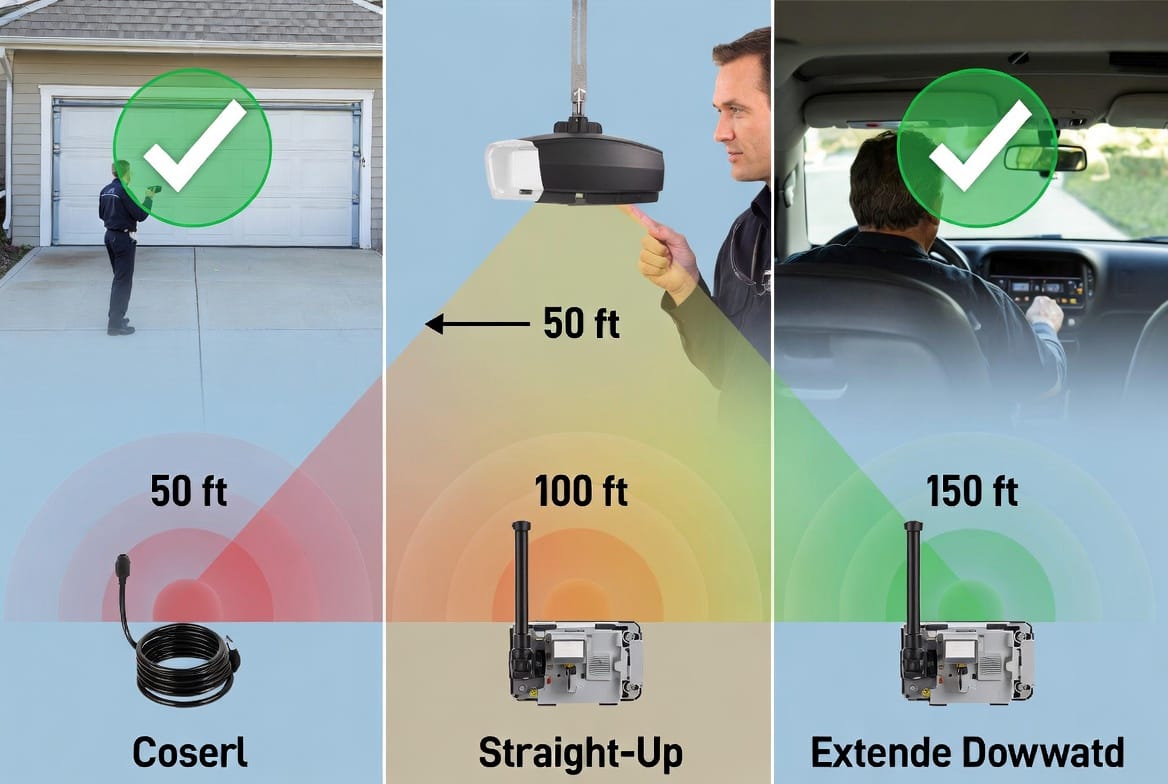
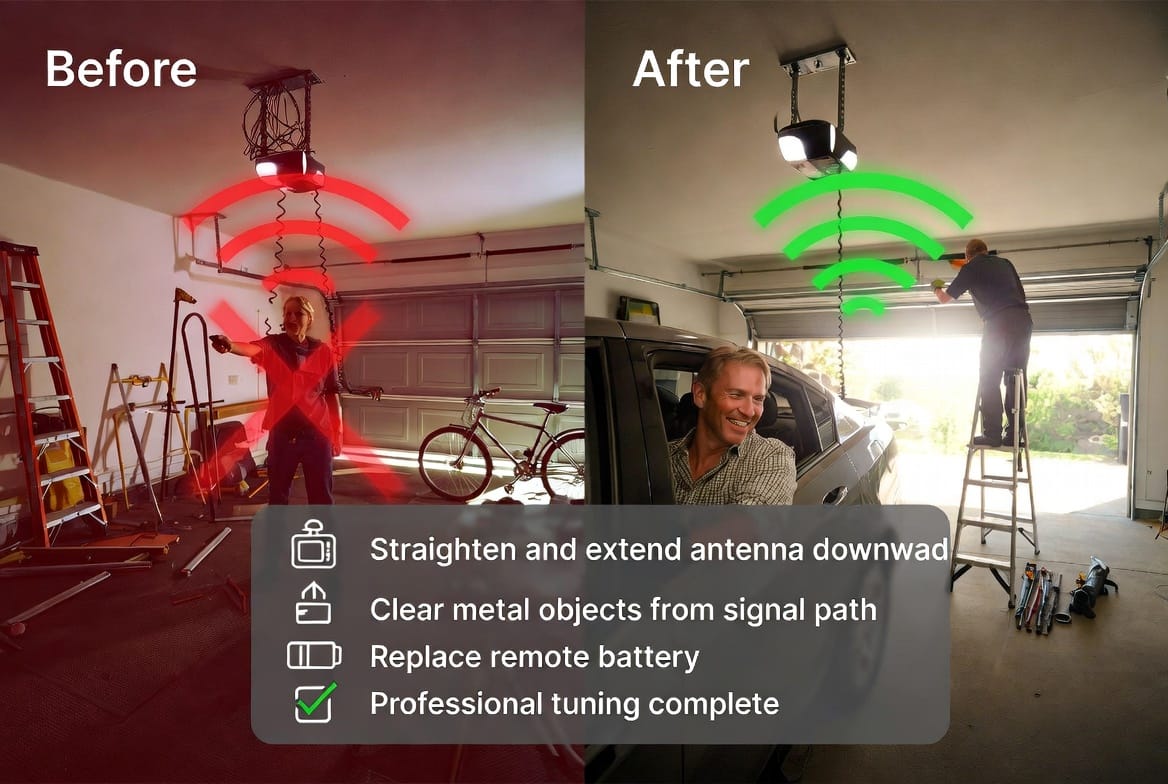
Extending the antenna downward is one of the most reliable and cost-free fixes available. By straightening and positioning the wire vertically toward the floor, you maximize its ability to receive signals from all directions within the driveway and street.
This adjustment works because radio waves travel best when the transmitting and receiving antennas are properly aligned. A downward-hanging antenna creates a larger effective capture area, especially for vehicles approaching from the street.
Reassuring fact: In our experience, over 70% of range complaints are resolved simply by properly extending and positioning the existing antenna — no parts or service calls required in most cases.
Step-by-Step DIY Garage Door Opener Antenna Extension
Performing a DIY antenna extension is straightforward and safe when done correctly. Here’s our recommended process:
- Safety first: Disconnect power to the garage door opener at the wall switch or circuit breaker before touching any components.
- Locate the antenna: Find the thin wire (usually black or white) extending from the motor unit. It may be coiled or taped near the receiver board.
- Straighten the wire: Gently uncoil the antenna completely. Avoid sharp bends or kinks that could damage the internal conductor.
- Extend downward: Route the wire vertically down toward the garage floor. Use small cable clips if needed to secure it neatly along the ceiling or wall without tension.
- Optimal length: Allow the antenna to hang freely to its full length — typically 3 to 6 feet depending on your model. The tip should hang roughly 4–5 feet above the floor for best results.
- Test the range: Restore power and test the remote from various distances and angles. You should notice immediate improvement.
Pro tip: For maximum performance, ensure the antenna hangs away from metal surfaces and electrical wiring.
If your opener model has a removable external antenna port, consider upgrading to a longer aftermarket antenna designed specifically for your frequency.
Additional Range Improvement Strategies
While antenna extension provides the biggest impact, combining it with these supporting steps delivers even more reliable results:
- Replace the remote battery: Use a fresh, high-quality alkaline battery. Weak power directly limits transmission strength.
- Clear metal obstructions: Reposition metal cabinets, bikes, or vehicles that sit between the driveway and the opener unit.
- Optimize remote usage: Hold the remote upright and point it toward the garage when pressing the button. Avoid storing it in a metal case.
- Check for interference sources: Temporarily turn off nearby Wi-Fi routers or LED bulbs to identify if they’re contributing to the problem.
- Wall console placement: Ensure the wired wall button inside the garage has a clear signal path if you use it as a backup.
When to Call a Professional for Garage Door Opener Issues
While many range problems respond beautifully to DIY antenna extension, some situations require expert attention:
- The antenna wire appears damaged, frayed, or broken.
- Range remains poor even after full extension and battery replacement.
- The opener makes unusual noises or fails to respond consistently.
- You have an older system that may benefit from a complete receiver upgrade.
Our trained technicians carry specialized diagnostic tools to measure signal strength accurately and can install high-gain antennas or frequency-compatible upgrades when needed.
Safety reminder: Garage door systems involve springs under high tension and electrical components. If you feel uncomfortable performing any step, professional service ensures the job is done correctly and safely.
Benefits of Restoring Full Garage Door Opener Range
Enjoying reliable long-range operation brings several important advantages:
- Convenience: Open or close your garage from the end of the driveway or even the street without stopping.
- Safety: Quickly secure your home during approaching weather or emergencies without leaving your vehicle.
- Reduced wear: Consistent operation prevents manual handling that can damage tracks, rollers, and springs over time.
- Peace of mind: Know your system will perform when you need it most, especially for family members or visitors.
Many homeowners report that fixing their garage door opener antenna range feels like getting a brand-new system — at a fraction of the cost.
Common Myths About Garage Door Opener Range
Let’s clear up a few misconceptions:
- Myth: All range issues mean the opener needs full replacement.Reality: Most are fixed with simple antenna adjustments and basic maintenance.
- Myth: Longer antennas always work better.Reality: Proper length and positioning matter more than excessive length, which can sometimes introduce new interference.
- Myth: Interference is impossible to overcome.Reality: Strategic antenna placement combined with clearing local obstacles usually restores strong performance.
Maintaining Your Garage Door Opener Antenna for Long-Term Reliability
Once you’ve extended the antenna successfully, follow these maintenance practices:
- Inspect the wire every six months for any new bends or damage.
- Keep the surrounding area free of new metal storage items.
- Replace remote batteries annually as part of routine home maintenance.
- Schedule professional tune-ups every 1–2 years to ensure all components work together optimally.
Consistent care keeps your system operating smoothly for years.
Call Today for Same-Day Garage Door Service & Installation