The Exotic Hardwood Flooring: Sustainability and Ethics
Exotic hardwood floors carry a rare kind of presence. Deep reds, golden browns, tight grain, and a hardness that shrugs off daily traffic make species such as ipe, teak, jatoba, cumaru, merbau, and certain mahoganies magnets for kitchens, great rooms, and high-end renovations. Beauty alone, however, is not a complete specification. Every plank began as a tree in a living forest. The ethical question is not whether exotic wood can be used. The question is whether that tree was removed in a way that keeps the forest standing, the workers safe, and the species viable for the next generation.
Get Sustainably Sourced Hardwood – Call Now
This guide focuses on environmental considerations: why sustainable sourcing matters, what FSC certification actually verifies, how uncertified harvest can damage tropical landscapes, and how homeowners can choose responsibly sourced options with confidence. The goal is practical. You can have a striking exotic floor without underwriting silent deforestation.
Why Exotic Hardwoods Demand Extra Scrutiny
Domestic oaks, maples, and hickories grow in well-documented temperate forests with relatively short supply chains. Many exotic species grow in biodiversity-rich tropical and subtropical forests. Those forests store large volumes of carbon, shelter rare wildlife, and support communities whose livelihoods depend on standing trees as much as on timber.
Several traits make exotic flooring species environmentally sensitive:
- Slow replacement. Some high-value trees take many decades to reach commercial size. A harvest cycle that looks profitable on paper can exceed the forest’s ability to recover.
- Sparse distribution. Certain species do not grow in dense stands. Removing one target tree can require access roads and collateral damage to neighboring vegetation.
- High market value. Premium decking and flooring prices create strong incentives for illegal logging, document fraud, and “laundering” of timber through mills far from the forest of origin.
- Long transport distances. Even legal exotic boards often travel across oceans. Carbon from shipping does not erase the need for good forest practice, but it is part of the full environmental picture.
None of these facts make exotic flooring inherently unethical. They do mean uncertified or poorly documented wood carries higher risk. Certification, traceability, and a supplier willing to answer hard questions turn that risk into a managed decision.
The Real Impact of Unchecked Harvesting
When exotic timber is taken without credible controls, the damage rarely stops at a single stump. Conventional or predatory logging in tropical regions has been associated with:
- Fragmented habitat as skid trails and feeder roads open previously intact forest.
- Loss of seed trees, which weakens natural regeneration of the very species buyers prize.
- Increased fire and conversion risk, because opened canopy and new access can precede ranching or agriculture.
- Carbon release from both the harvested tree and the degraded stand left behind.
- Social harm, including conflict over land rights and unsafe working conditions.
High-demand species illustrate the pattern. Ipe (several Handroanthus and related species) is prized for outdoor and indoor durability, yet populations recover slowly and have been pressured by luxury decking and flooring markets. Jatoba, often marketed as Brazilian cherry, became a high-volume export and has been tied to poorly controlled Amazon supply in some channels. Genuine mahogany species have faced commercial decline across parts of their range and sit under international trade rules for good reason. Merbau and related tropical hardwoods have appeared in investigations of illegal or high-risk supply chains.
The lesson is not “never use these woods.” The lesson is never buy them on appearance and price alone. A finished floor can hide a chaotic origin. Paperwork and third-party labels are how you see behind the stain.
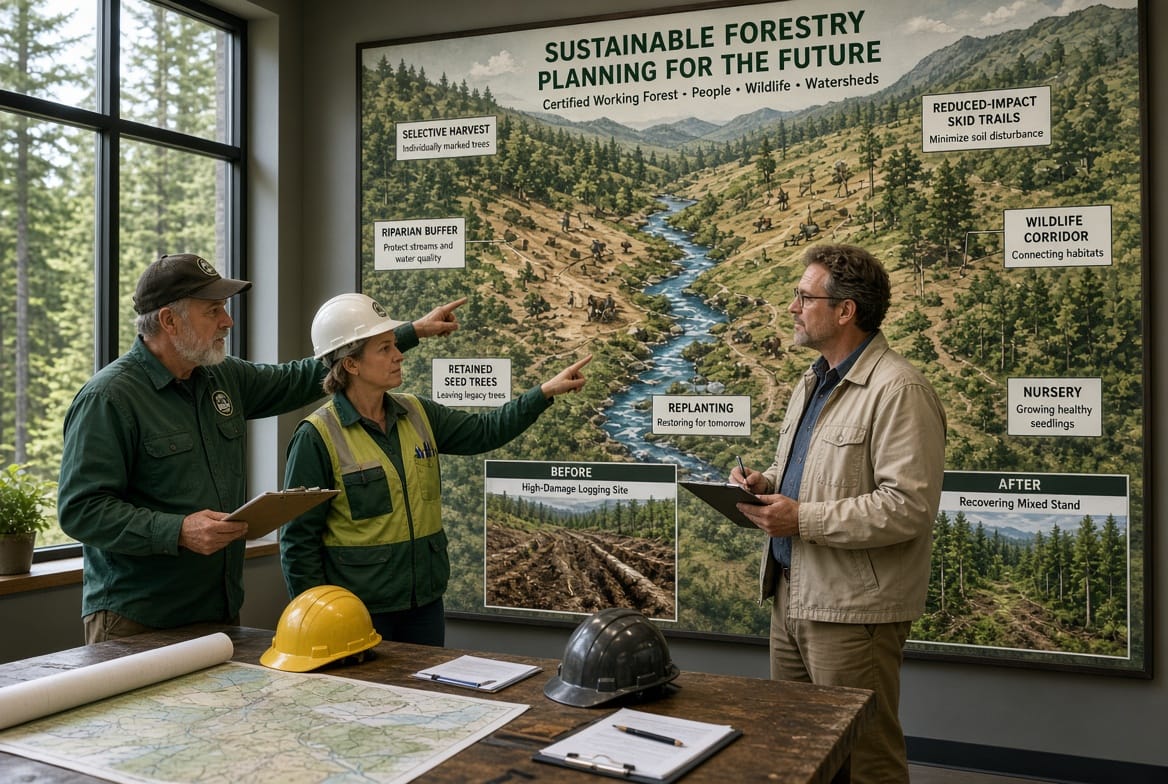
Responsible harvest looks different. Reduced-impact logging, selective cutting, protection of high conservation value areas, and verified regeneration keep a working forest as a forest. That is the environmental case for certified exotic flooring: the product remains a renewable material instead of a one-time extraction.
What Sustainable Sourcing Actually Means
Sustainable sourcing is more than a green sticker on a sample board. It is a system that can answer four questions:
- Where was this tree grown and harvested?
- How was the stand managed—selectively, legally, and with limits on damage?
- Who held rights to the land, and were workers and communities treated fairly?
- Can the claim be traced from forest management unit through mill, factory, importer, and retailer?
Those answers travel through a chain of custody. If any link is missing, a sustainability claim becomes marketing language. For exotic hardwood flooring, insist on documented chain of custody, not a verbal assurance that the wood is “eco-friendly” or “from managed forests.”
Legal compliance is the floor, not the ceiling. In the United States, the Lacey Act prohibits trade in illegally harvested plants and plant products. Legality matters. It does not automatically equal best-practice forestry. A shipment can be lawful on paper and still come from a forest managed with weak biodiversity rules. Certification systems exist to raise that bar.
FSC Certification: The Benchmark for Responsible Exotic Wood
The Forest Stewardship Council (FSC) is the certification most environmental professionals and many green-building programs treat as the gold standard for forest products. Founded to respond to global concern over deforestation, FSC uses a multi-stakeholder model: environmental, social, and economic interests help set the rules.
For a homeowner choosing exotic flooring, FSC matters because it typically requires:
- Protection of high conservation value forests and limits on converting natural forest.
- Restrictions that are generally stricter on clear-cutting, old-growth, and certain high-risk practices than many competing schemes.
- Attention to Indigenous Peoples’ rights, labor standards, and community relations—not only tree counts.
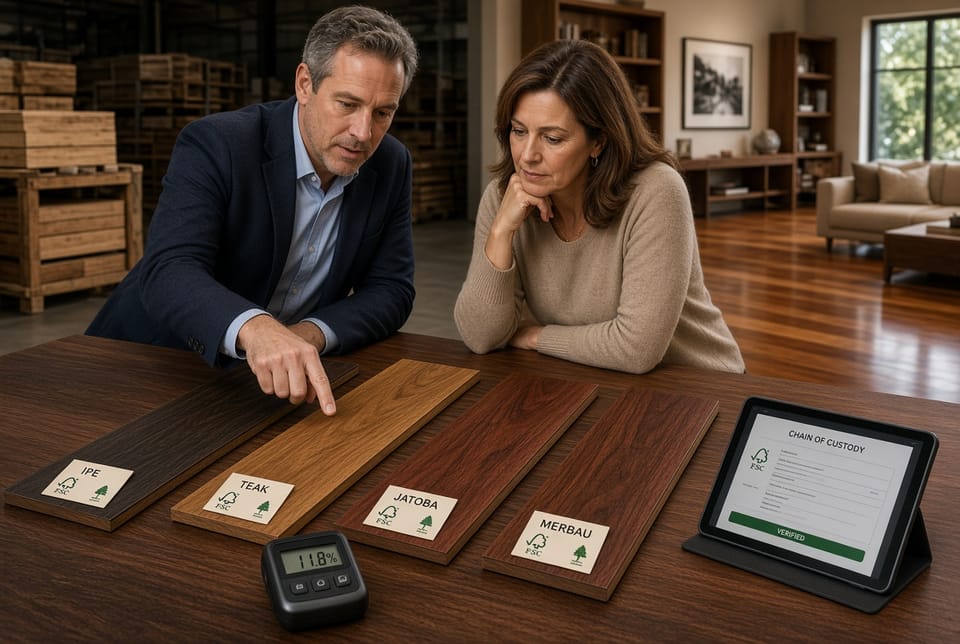
- Independent audits and a chain-of-custody system so a finished plank can carry a legitimate FSC claim.
- Labels that distinguish FSC 100% (all material from FSC-certified forests) from FSC Mix (certified material combined with controlled wood under defined rules) and recycled claims.
FSC 100% is the clearest story for an exotic species that faces harvest pressure. FSC Mix can still be a responsible choice when availability of 100% material is limited, provided the supplier can explain the controlled-wood component. Treat vague “FSC-inspired” or “meets FSC principles” language as a warning. Either the product is certified and numbered, or it is not.
Ask to see:
- The FSC license code associated with the manufacturer or the chain-of-custody holder.
- The species scientific name, not only a marketing name such as “Brazilian cherry” or “Pacific mahogany.”
- The country and, when possible, region of harvest.
- Whether the flooring is solid or engineered, and whether the visible wear layer itself is the certified exotic species.
Certification does not make a tropical tree grow faster. It does make the harvest accountable. That accountability is the difference between a luxury floor and an environmental liability.
PEFC and SFI: Additional Verified Pathways
FSC is not the only third-party system. Two other names appear often on flooring literature: PEFC and SFI.
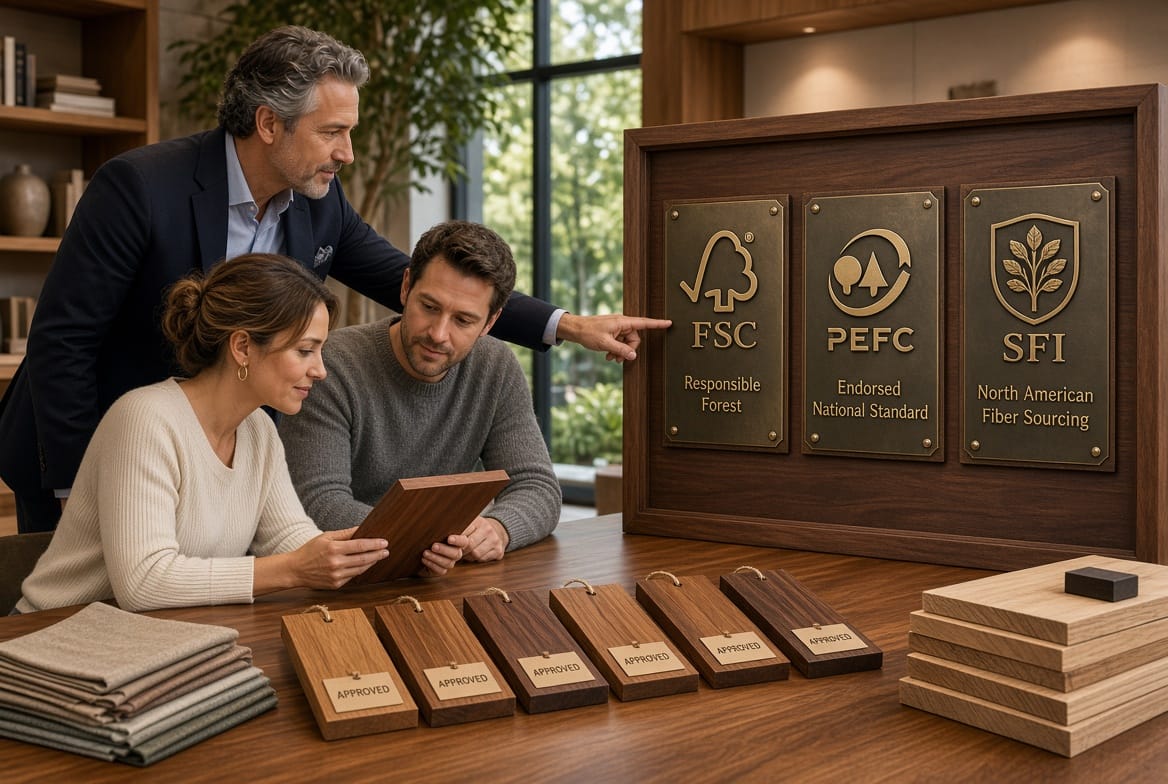
PEFC (Programme for the Endorsement of Forest Certification) is a global umbrella. It endorses national forest-certification schemes that meet its requirements. PEFC covers a very large area of certified forest worldwide and is widely used in Europe. Quality can vary with the underlying national standard, so the PEFC mark is strongest when paired with transparent chain of custody and a supplier who can name the forest source.
SFI (Sustainable Forestry Initiative) is a major North American program, also recognized within the PEFC family. SFI emphasizes fiber sourcing, water quality, biodiversity measures, and training. It is common on North American softwoods and some hardwood supply. Environmental groups often judge FSC as more stringent on issues such as indigenous rights, old-growth protections, and harvest limits. SFI remains a meaningful improvement over uncertified wood, especially when the alternative is an undocumented tropical shipment.
A practical way to rank claims for exotic flooring:
- Best first choice: FSC-certified material with a complete chain of custody, preferably FSC 100% for high-risk tropical species.
- Credible alternatives: PEFC-certified European or well-documented sources; SFI where the species and geography actually match SFI’s North American strength.
- Not enough on their own: “Sustainable,” “green,” “eco,” “plantation,” or “legal” without a certificate number and species-level traceability.
No label replaces judgment. A certified product from a species that is biologically difficult to regenerate still deserves extra questions. A certified product from a well-managed second-growth or plantation stand, paired with durable finishing and a long service life, can be an environmentally sound investment.
How Certification Protects More Than Trees
Ethics in exotic flooring is environmental and human. Independent standards typically address:
- Worker safety in remote logging and milling operations.
- Fair labor and the exclusion of forced or child labor from the chain.
- Community consultation where forests overlap customary lands.
- Chemical and pesticide limits in forest management and, separately, low-emission finishes in the finished floor.
A floor that lasts thirty years or more also has an environmental advantage over short-lived coverings that go to landfill. Durability is part of sustainability—if the original harvest was responsible. A long-lasting plank from a wrecked primary forest is still a costly ecological bargain. Pair longevity with certified origin.
Engineered exotic flooring can help when designed honestly. A thick certified wear layer over a stable core uses less of a scarce log than a solid 3/4-inch board, provided the core itself is legal and preferably certified. Avoid products that hide an unverified tropical face behind a generic “engineered hardwood” description.
How to Choose Responsibly Sourced Exotic Flooring
Use this sequence in the showroom or on a site visit. It keeps the conversation professional and specific.
Confirm the species, not the nickname
Marketing names change by retailer. Demand the botanical name. Hymenaea courbaril is jatoba. Handroanthus species are sold as ipe. Tectona grandis is teak. Ambiguous labels make certification claims harder to verify.
Require a recognizable certificate
Look for FSC, PEFC, or SFI on the carton, sample, or specification sheet. Photograph the mark and the certificate or license code. If the salesperson cannot produce documentation within a business day, treat the product as unverified.
Trace the chain of custody
Ask who milled the lumber, who manufactured the flooring, and who imported it. Responsible companies expect this question. Evasive answers are a risk signal.
Prefer documented harvest regions
“South America” is not a source. A named country and forest-management context is a source. High-risk regions require stronger paperwork, not weaker curiosity.
Examine the full product, not only the face
For engineered floors, ask about the core species, adhesives, and formaldehyde performance (look for compliance with current composite-wood emissions rules). A certified face on a high-emitting core is an incomplete environmental win.
Weigh use and lifespan
Match species hardness and moisture behavior to the room. A certified exotic floor that fails in a damp basement becomes waste. Correct acclimation, subfloor preparation, and finish choice protect both your investment and the carbon stored in the wood.
Consider alternatives when risk stays high
If a desired species cannot be found with credible certification, consider:
- Another exotic species that is available as FSC 100%.
- A domestic hardwood with a comparable visual stain and certified origin.
- Reclaimed exotic material with documented salvage history.
Choosing a different species is not a compromise in ethics. It is often the most sustainable decision available that week.
Questions Worth Asking Every Supplier
Keep the list short and written:
- Is this flooring FSC, PEFC, or SFI certified, and may I have the chain-of-custody number?
- Is the claim 100% certified or a mix/controlled-wood claim?
- What is the scientific name and country of harvest?
- Can you confirm Lacey Act due diligence for this lot?
- For engineered products, what is in the core, and what emissions standard does the adhesive meet?
- Do you offer a written specification I can keep with my project file?
A confident supplier answers without irritation. That calm is itself a quality marker.
A Reassuring Standard for a Beautiful Floor
Exotic hardwood does not have to be a guilty pleasure. Grown, harvested, milled, and sold under credible rules, it remains a renewable, long-lived material that stores carbon in your home for decades. The environmental harm associated with these species is concentrated in opaque supply chains, not in the idea of wood flooring itself.
FSC certification gives the strongest widely recognized assurance that a tropical or exotic board came from a forest managed to protect ecological and social values. PEFC and SFI provide additional verified routes, particularly when geography and species align with those systems. Your role is straightforward: name the species, demand the certificate, keep the paperwork, and install the floor so it lasts.
That is sustainable sourcing in practice. It is also good taste with a clean conscience.
Choose Sustainable Exotic Flooring
Ready to specify a floor that looks exceptional and stands up to ethical review? Choose sustainable exotic flooring. Ask about FSC, PEFC, and SFI certifications, species origin, and chain of custody before you commit to a single box of planks.
Call Today for Ethical Hardwood Flooring Guidance