The Dental Plaque Removal: Professional Cleaning vs. At-Home
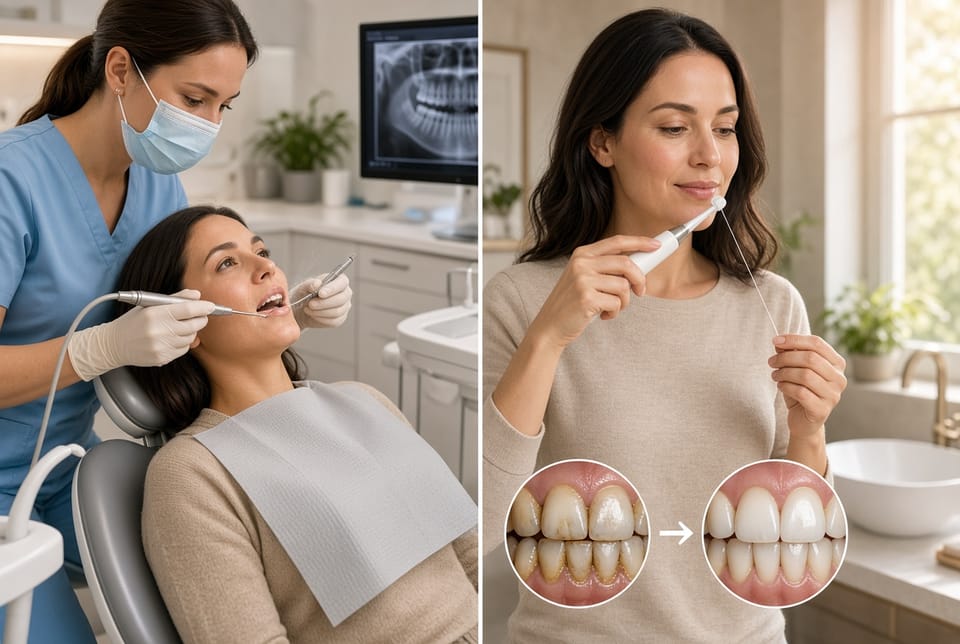
Dental plaque forms every day. It is a soft, sticky biofilm of bacteria that coats teeth within hours after eating or drinking. Left undisturbed, it hardens into calculus (tartar). The two deposits look similar to the untrained eye, yet they demand completely different removal methods. Daily at-home care — brushing and flossing — reliably removes fresh plaque. It cannot touch mineralized calculus. Professional cleaning — scaling and polishing — removes the hardened deposits that home tools cannot reach. Both are required. Neither replaces the other.
Schedule Your Professional Cleaning – Call Now
This article explains the biological difference, the exact techniques used in each setting, and why skipping either step quietly raises the risk of gingivitis, periodontitis, cavities, and chronic inflammation. The tone is straightforward and reassuring: consistent combined care keeps most people free of advanced disease.
What Plaque Really Is — and How Fast It Changes
Plaque begins as a nearly invisible film. Bacteria in the mouth feed on sugars and starches, produce acids, and organize into a structured community. Within 24–48 hours the film thickens. Minerals from saliva — calcium and phosphate — begin to crystallize inside the matrix. Once that mineralization occurs, the deposit is no longer plaque. It is calculus.
Calculus is porous, rough, and firmly attached to enamel and root surfaces. It cannot be brushed or flossed away. It also provides a perfect sheltered surface for new plaque to form even faster. The cycle accelerates: more plaque, more minerals, more calculus, more bacterial load near the gumline.
Key risk: Once calculus sits below the gumline, it constantly irritates the periodontal tissues. The body responds with inflammation. That inflammation, if persistent, destroys the attachment between gum and tooth.
Home care interrupts the cycle at the plaque stage. Professional care interrupts it at the calculus stage. Both interruptions are necessary.
At-Home Removal: Brushing and Flossing Done Correctly
Effective at-home plaque removal rests on two mechanical actions performed every day.
- Brushing disrupts the biofilm on the chewing surfaces, the outer faces, and most of the inner faces of the teeth. A soft-bristled brush (manual or electric) used at a 45-degree angle to the gumline, with short gentle strokes, lifts plaque before it mineralizes. Two minutes, twice daily, remains the evidence-based minimum.
- Flossing (or an equivalent interdental cleaner) reaches the contact points and the sulcus — the shallow groove between tooth and gum — that bristles miss. Plaque loves these sheltered spaces. Daily flossing or use of interdental brushes or water flossers keeps those areas from becoming calculus factories.
When performed well, these habits remove the great majority of newly formed plaque. They also massage the gums, stimulate circulation, and deliver fluoride if a fluoridated toothpaste is used. The result is a measurable drop in gingival bleeding and a slower rate of calculus formation.
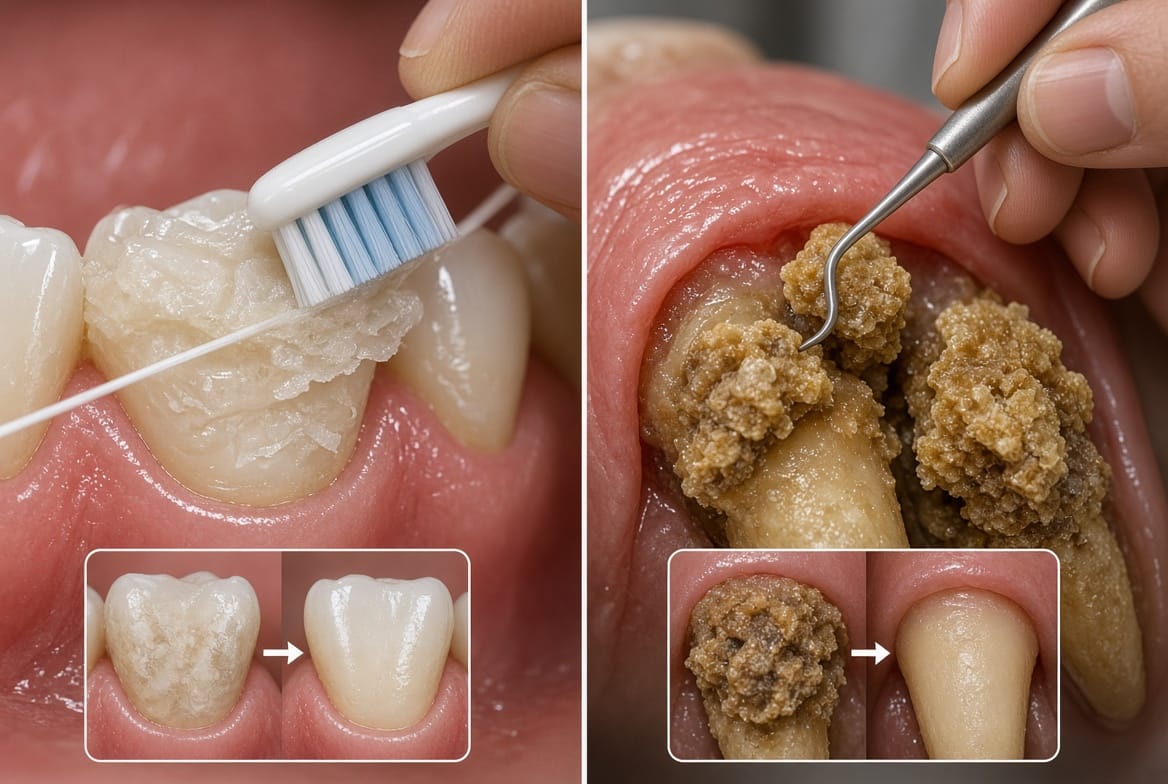
Limitation that cannot be ignored: Once plaque has mineralized, home tools slide over it. They polish the outer surface of the calculus but leave the bulk attached. Patients who brush and floss diligently yet still notice rough spots or persistent bleeding usually have subgingival or interproximal calculus that only a hygienist can remove.
Why At-Home Care Alone Is Never Enough
Even excellent home technique leaves small amounts of plaque in grooves, around restorations, and just under the gum margin. Over months those remnants mineralize. The resulting calculus acts as a reservoir. New plaque colonizes it rapidly. The bacterial load stays high even if the patient never skips a brushing session.
Clinical observation is consistent: people who rely solely on home care eventually develop detectable calculus, especially on the lower anterior teeth and the upper molars — the classic “calculus magnets.” Gingival inflammation follows. Pocket depths increase. The situation is still reversible if professional intervention occurs in time. If it does not, the inflammation becomes periodontitis.
Reassuring fact: The combination of daily plaque disruption plus periodic calculus removal keeps the majority of adults in a state of health. The two methods are complementary, not competing.
Professional Cleaning: Scaling and Polishing Explained
A professional dental cleaning has two core mechanical phases: scaling and polishing.
Scaling is the systematic removal of calculus from tooth surfaces above and below the gumline. Hygienists use:
- Ultrasonic scalers that vibrate at high frequency and flush debris with a water stream.
- Hand scalers and curettes that adapt precisely to root anatomy and reach into periodontal pockets.
The goal is complete deposit removal without gouging enamel or cementum. Once the calculus is gone, the root surface is smoother and less hospitable to new bacterial colonization.
Polishing follows. A rubber cup or air-polishing device with a fine abrasive paste removes residual plaque and surface stains. Polishing also leaves the enamel glassy, making it harder for plaque to adhere immediately afterward.
The appointment typically includes an examination of the gums, measurement of pocket depths, and often a fluoride treatment. The entire process is comfortable for most patients when performed by an experienced clinician. Sensitivity, if present, is managed with desensitizing agents or adjusted technique.
What professional cleaning cannot do: It cannot replace the next 24 hours of plaque formation. New biofilm begins forming the moment the patient leaves the chair. That is why the hygienist always reinforces home-care technique before the patient walks out.
The Synergy: Why Both Methods Must Work Together
Think of plaque control as a two-part system.
- Daily at-home care keeps the bacterial load low and prevents most plaque from ever becoming calculus.
- Periodic professional scaling removes the calculus that inevitably forms in hard-to-reach sites and resets the surface so home care can work more efficiently.
When both are present:
- Gingival inflammation stays low.
- Pocket depths remain stable or improve.
- The rate of new cavity formation drops.
- Breath stays fresher.
- The need for more invasive periodontal therapy is delayed or avoided.
When one is missing, the other is overburdened. Excellent home care plus neglected professional visits still allows slow calculus buildup. Frequent professional cleanings plus poor home care allow rapid re-accumulation of plaque and early return of inflammation.
Authoritative observation: The patients who maintain the healthiest gums over decades are those who treat the two methods as a single habit — daily disruption plus scheduled professional reset.
Practical Risks of Imbalance
Neglecting professional care while maintaining good home habits still carries measurable risk:
- Persistent low-grade gingivitis that the patient may not notice.
- Gradual increase in probing depths.
- Hidden calculus acting as a constant irritant.
- Higher likelihood of recession and root sensitivity over years.
Neglecting home care while attending regular cleanings produces a different pattern:
- Rapid plaque rebound between visits.
- Recurring inflammation that never fully resolves.
- Greater stain and calculus formation, making each cleaning more time-consuming.
- Elevated risk of cavities in pits, fissures, and interproximal areas.
Both patterns are preventable. The solution is not more of one method; it is consistent use of both.
How Often Each Should Occur
Home care is daily — morning and night at minimum, with interdental cleaning once per day.
Professional cleaning frequency is individualized. For most adults with healthy gums and modest calculus formation, twice yearly is sufficient. Patients with a history of periodontitis, heavy calculus formers, smokers, or those with certain medical conditions often benefit from three- or four-month intervals. The dentist or hygienist determines the interval after evaluating tissue response and deposit accumulation.
The schedule is not arbitrary. It is timed to the biology of plaque mineralization in that specific mouth.
Making the Combined Routine Sustainable
Small, realistic adjustments keep both parts of the system working:
- Use an electric toothbrush with a pressure sensor if manual technique is inconsistent.
- Choose an interdental tool that actually gets used — floss, soft picks, or a water flosser.
- Schedule the next professional cleaning before leaving the office.
- Note any bleeding, swelling, or new roughness and mention it at the next visit rather than waiting.
These steps are simple. They compound. Over years they produce a mouth that looks and feels healthy with far less drama than crisis-driven treatment.
The Clear Next Step
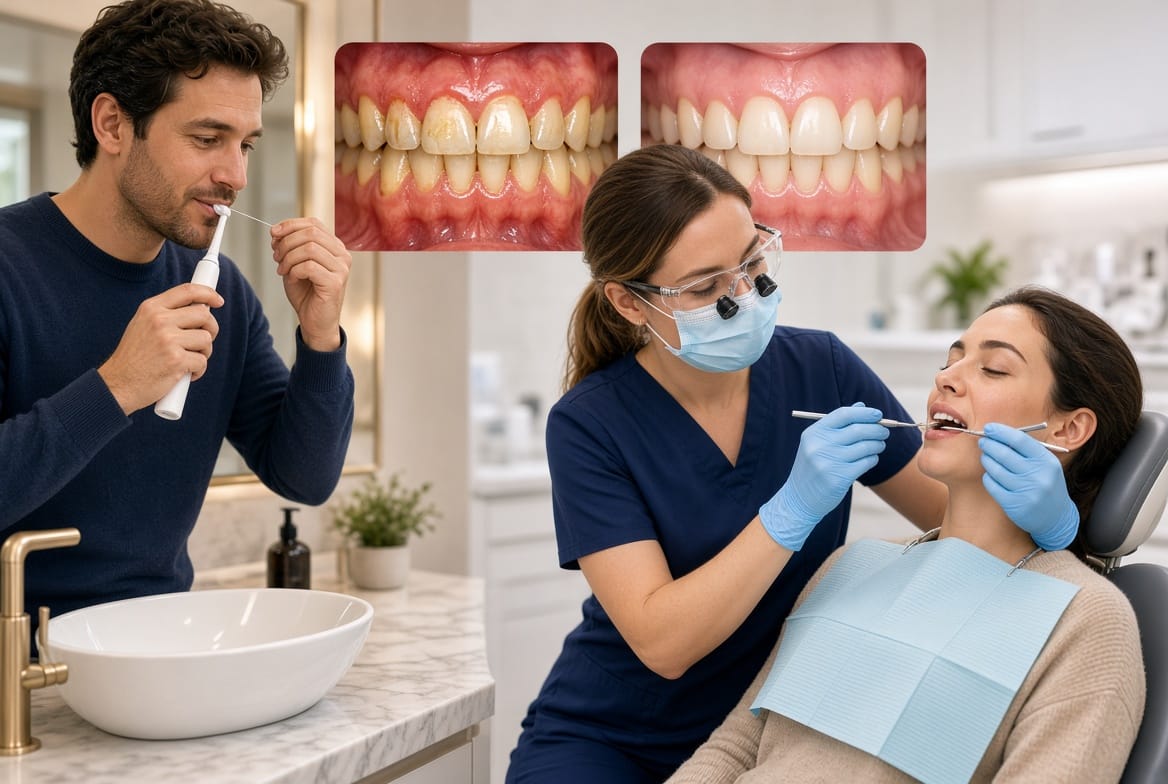
Dental plaque removal is not a choice between the bathroom and the dental chair. It is the disciplined use of both. Brushing and flossing keep the biofilm from hardening. Scaling and polishing remove what has already hardened and give the home routine a clean surface to protect.
The combination is proven, practical, and within reach for virtually every adult.
Remove plaque effectively. Daily home care plus timely professional intervention is the reliable path.
Don’t Let Plaque Harden – Schedule Cleaning Today