The Dental Bridge vs. Partial Denture: Which Is Right for You?
Missing teeth affect far more than appearance. They change how you chew, how you speak, how neighboring teeth drift, and how the jawbone maintains its shape. Two of the most frequently recommended tooth-replacement solutions are the dental bridge and the partial denture. Both restore function and confidence, yet they differ in permanence, cost, preparation of remaining teeth, daily care, and long-term feel.
Choose the Right Tooth Replacement – Call Now!
This guide compares the two options in clear, practical terms so you can discuss them confidently with your dentist. Neither choice is universally “better.” The right solution depends on the number and location of missing teeth, the health of adjacent teeth, budget, lifestyle, and personal preference for a fixed versus removable restoration.
Understanding Tooth Replacement After Tooth Loss
When a tooth is lost, the surrounding teeth can tilt or over-erupt. The opposing tooth may drift downward. Bone in the empty socket begins to resorb. Chewing efficiency drops, and the smile can look uneven. Replacing the missing tooth (or teeth) protects the remaining dentition and supports facial structure.
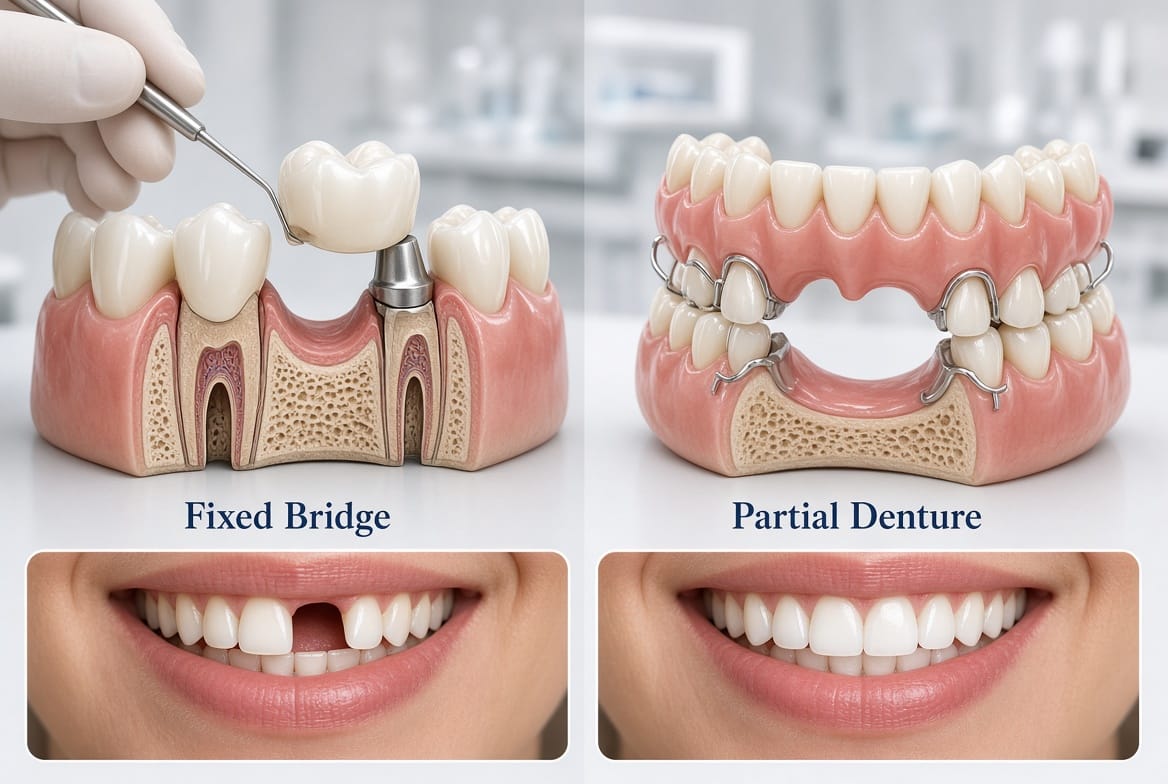
A dental bridge is a fixed prosthesis that uses the teeth on either side of the gap as anchors. A partial denture is a removable appliance that clasps onto remaining natural teeth and can be taken out each night. Both have decades of clinical use and high patient satisfaction when properly designed and maintained.
What Is a Dental Bridge?
A dental bridge literally “bridges” the space left by one or more missing teeth. The most common design is a traditional fixed bridge: the teeth immediately adjacent to the gap (called abutment teeth) are prepared by reducing their enamel so they can receive crowns. Those crowns are connected to a replacement tooth (the pontic) that sits in the space. The entire unit is cemented in place and cannot be removed by the patient.
Modern bridges are typically made of porcelain fused to metal, all-ceramic, or zirconia for strength and natural appearance. The result looks and feels much like natural teeth. Because the restoration is fixed, there is no movement during eating or speaking once the patient has adapted.
The procedure usually requires two or more appointments: preparation and impressions, followed by try-in and final cementation. Temporary crowns protect the prepared teeth in the interim.
Advantages of a Dental Bridge
- Fixed and stable — does not come out during meals or conversation.
- Excellent chewing efficiency and speech once healing is complete.
- Highly aesthetic when high-quality ceramics are used.
- Relatively short treatment timeline compared with implant-supported options.
- Helps keep neighboring teeth from shifting.
Considerations and Potential Drawbacks
- Requires preparation of healthy adjacent teeth, which is irreversible.
- Higher upfront cost than a typical partial denture.
- If an abutment tooth later develops decay or needs a root canal, the entire bridge may need replacement.
- Does not stimulate the jawbone beneath the pontic the way a dental implant does.
- Meticulous flossing under the pontic (with floss threaders or water flossers) is essential to prevent decay and gum inflammation.
A well-made bridge, cared for with excellent hygiene and regular dental visits, commonly lasts 10–15 years or longer.
What Is a Partial Denture?
A removable partial denture (often simply called a “partial”) replaces one or more missing teeth with artificial teeth set in a pink acrylic base that resembles gum tissue. A metal or flexible framework and clasps engage the remaining natural teeth for retention and stability. The patient removes the appliance for cleaning and usually sleeps without it.
Partials can be fabricated relatively quickly after impressions and bite records. They are often recommended when several teeth are missing in different areas of the same arch, when remaining teeth are not strong enough to support a bridge, or when budget is a primary concern.
Advantages of a Partial Denture
- Less expensive than a comparable multi-unit bridge.
- No aggressive preparation of adjacent teeth in most cases.
- Easy to add additional teeth later if more natural teeth are lost.
- Removable for thorough cleaning of both the appliance and the remaining teeth.
- Can serve as a temporary or transitional solution while planning future implant or bridge treatment.
Considerations and Potential Drawbacks
- Removable, so some patients notice movement or a period of adjustment with speech and eating.
- Clasps may be visible when smiling, depending on design and tooth position.
- The acrylic base can feel bulky at first.
- Requires daily removal and cleaning; leaving it in overnight is generally not advised.
- May contribute to slightly faster wear on clasped teeth if the fit is not maintained.
- Typical lifespan is often 5–8 years before relining or replacement becomes necessary as the mouth changes.
A well-fitted partial, combined with regular professional adjustments, can provide reliable function and an acceptable appearance for many years.
Direct Comparison: Bridge Versus Partial Denture
The choice often comes down to a handful of practical differences.
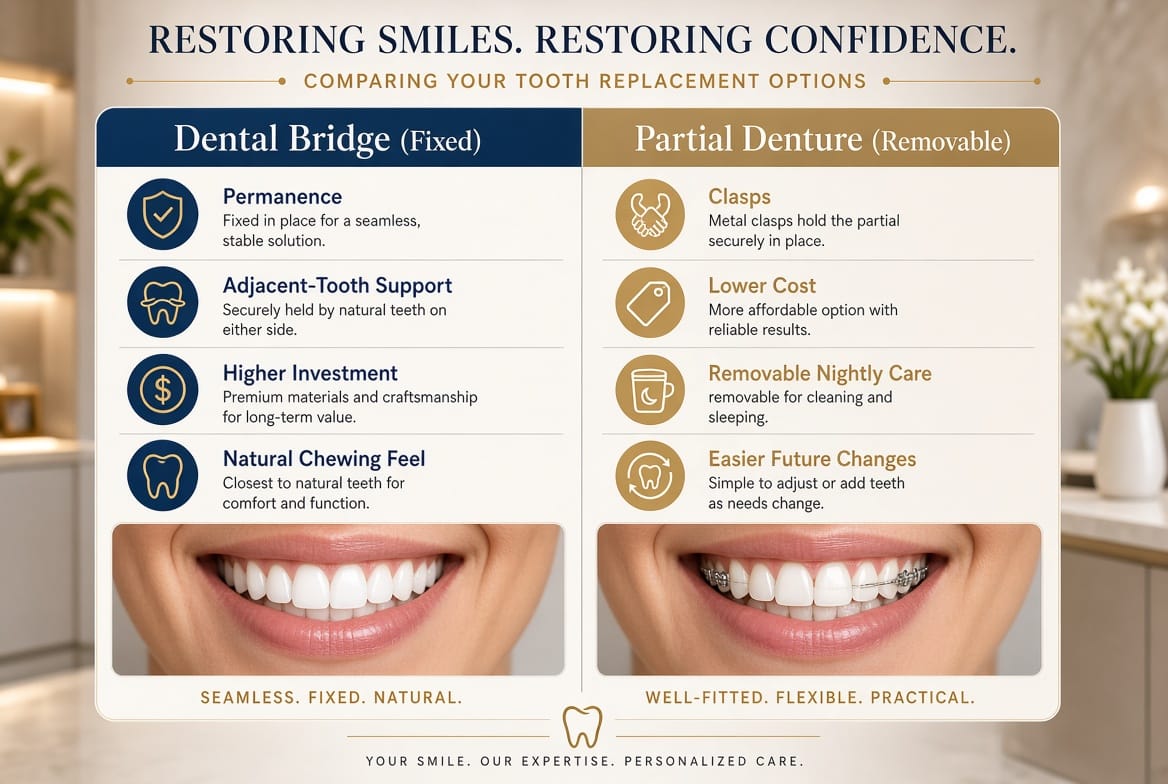
- Permanence: A bridge is fixed; a partial is removable.
- Tooth preparation: Bridges require reduction of abutment teeth. Partials generally do not.
- Cost: Bridges are typically more expensive per missing tooth. Partials are the more budget-friendly option.
- Aesthetics: High-quality bridges usually look more like natural teeth. Partials can look excellent but clasps or the acrylic flange may be noticeable in some smiles.
- Chewing and speech: Most patients report a more natural feel with a well-made bridge after the short adaptation period. Partials require a longer adjustment phase for some people.
- Maintenance: Bridges stay in the mouth and need special flossing techniques. Partials are taken out and cleaned separately.
- Future flexibility: Partials are easier to modify if additional teeth are lost. Bridges are more difficult to alter.
- Bone preservation: Neither option stops bone loss under the missing tooth as effectively as an implant, but a bridge maintains the position of neighboring teeth more rigidly.
Who Is a Good Candidate for Each Option?
A dental bridge is often preferred when:
- Only one or two adjacent teeth are missing.
- The neighboring teeth already need crowns or have large restorations.
- The patient wants a fixed, non-removable solution and is comfortable with preparing the abutment teeth.
- Oral hygiene is excellent and the patient is committed to professional cleanings.
A partial denture is frequently recommended when:
- Multiple teeth are missing in different quadrants.
- Remaining teeth have inadequate support for a bridge.
- Budget or treatment timeline is a significant factor.
- The patient prefers a less invasive, reversible approach or may need additional replacements later.
- Medical conditions or bone volume make implants or extensive bridgework less suitable at this time.
Your dentist will evaluate the health of remaining teeth and gums, take radiographs, and discuss how each option fits your daily life. In some cases a combination approach or a future upgrade to implants may be planned.
Cost, Longevity, and Daily Care
Upfront investment is usually higher for a bridge because of laboratory fees, the number of units, and the need for precise preparation. A partial denture generally costs less initially. Over a 10-year period the total cost can narrow if the partial requires relines or replacement while the bridge remains serviceable.
Longevity depends far more on home care and professional maintenance than on the material itself. Patients who brush twice daily, clean under pontics or around clasps, avoid chewing ice or hard objects, and attend regular check-ups enjoy the longest service from either restoration.
Daily routines differ. Bridge wearers treat the restoration like natural teeth with added attention to the area under the pontic. Partial wearers remove the appliance, brush it with a denture brush and non-abrasive cleanser, and soak it as directed. Remaining natural teeth still require thorough brushing and flossing.
Potential Risks and How They Are Managed
Both treatments are considered safe and predictable when performed by an experienced dentist. Possible concerns include:
- Decay or gum inflammation around abutment teeth or clasped teeth if hygiene lapses.
- Fracture of porcelain or acrylic with excessive force.
- Changes in fit as the mouth ages (more common with partials).
- Temporary sensitivity after bridge preparation.
These risks are minimized by accurate diagnosis, high-quality laboratory work, patient education, and routine follow-up visits. Your dentist will review specific precautions based on your oral health.
Making the Decision That Fits Your Life
Ask yourself (and your dentist) a few focused questions:
- Do I want something I never have to take out?
- Am I comfortable having neighboring teeth prepared?
- What is my realistic budget this year and over the next decade?
- How important is the most natural feel versus the most conservative approach?
- Might I lose additional teeth in the coming years?
There is no single correct answer. Many patients begin with a well-made partial denture and later transition to bridges or implants as circumstances allow. Others choose a bridge from the start because they value a fixed restoration and have suitable abutment teeth.
The most successful outcomes occur when the patient and dentist decide together after a thorough examination, discussion of goals, and review of photographs or models of similar cases.
Take the Next Step Toward a Complete Smile
Choosing between a dental bridge and a partial denture is an important decision that affects comfort, appearance, and oral health for years. Both options have helped millions of people eat, speak, and smile with confidence again. The best choice is the one that matches your clinical situation, lifestyle, and priorities.
Choose the right tooth replacement. Schedule a consultation to review your X-rays, discuss the advantages of each approach in your specific case, and see examples of completed work. A knowledgeable team is ready to help you restore function and leave the office with a clear, personalized plan.
Call Today to Compare Bridges vs. Partials with a Dentist