The Cork Flooring Installation: Floating vs. Glue-Down
Cork flooring offers a unique combination of natural warmth, comfort underfoot, and environmental appeal that few other materials match. Harvested from the bark of cork oak trees without harming the tree, it provides inherent sound absorption, thermal insulation, and a distinctive look that works in living rooms, bedrooms, offices, and even some commercial spaces. Yet the beauty and performance of cork depend heavily on how it is installed. Two primary methods dominate the market: floating installation and glue-down installation. Choosing incorrectly can lead to movement, gaps, moisture issues, or premature wear. This guide explains both approaches in detail so you can select the method that matches your space, traffic level, skill, and long-term goals.
Floating or Glue-Down? Get Expert Help
Understanding the difference starts with how each system interacts with the subfloor. Floating cork flooring sits on top of an underlayment and interlocks plank-to-plank without being bonded to the floor below. Glue-down cork flooring is permanently adhered directly to a prepared subfloor using specialized adhesive. Each method has distinct advantages, limitations, and preparation requirements. The right choice reduces callbacks, protects your investment, and delivers the quiet, resilient surface cork is known for.
Why Installation Method Matters for Cork
Cork is a natural material that expands and contracts with changes in humidity and temperature. It is also relatively soft compared with hardwood or tile, which makes proper support essential. An installation that allows too much movement can produce hollow sounds, edge wear, or visible gaps. An installation that is overly rigid on an imperfect subfloor can telegraph irregularities or fail at the adhesive line. Subfloor condition, expected foot traffic, moisture levels, and whether you prefer a DIY-friendly or permanent professional result all influence the decision.
Homeowners and facility managers who plan ahead avoid the most common problems: loose planks in high-traffic zones, adhesive failure from dusty or uneven concrete, and difficulty making future repairs. The sections that follow break down each method so you can weigh ease of installation, durability, repairability, and overall cost of ownership.
Floating Cork Flooring: How It Works
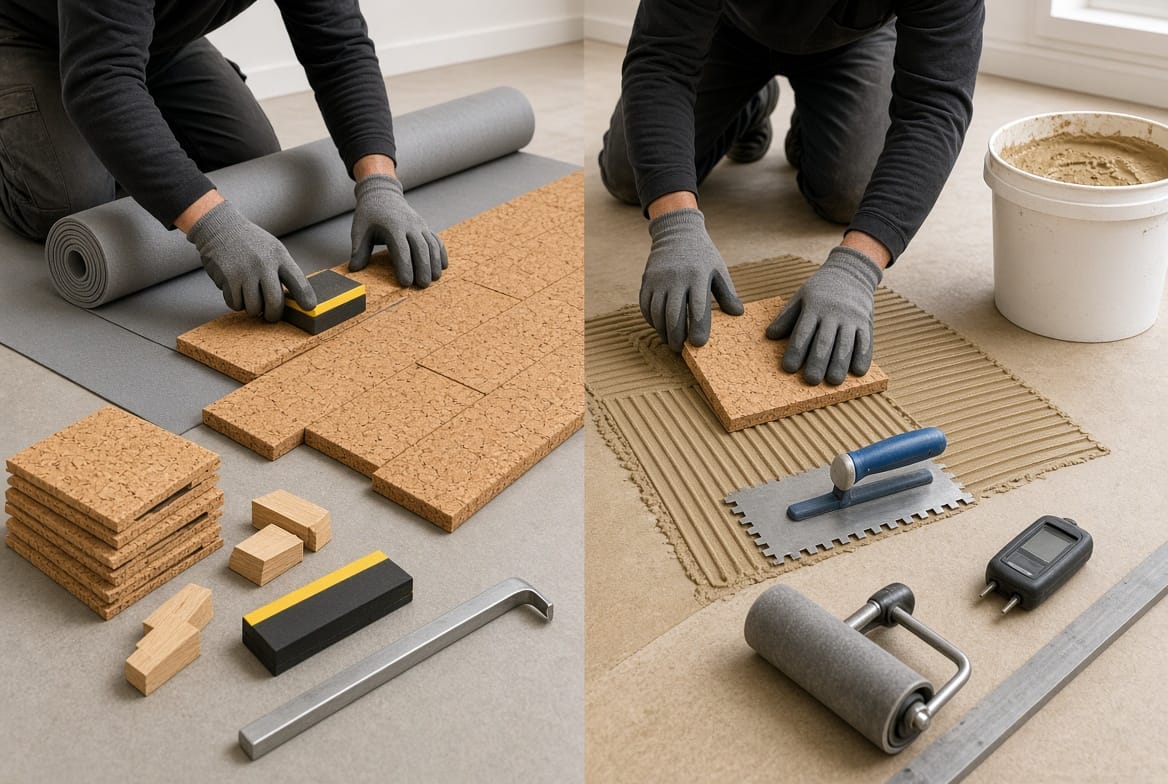
Floating installation treats the cork surface as a single interconnected layer that “floats” above the subfloor. Most modern floating cork products use a click-lock or similar interlocking profile along the edges. An underlayment—often a foam, cork, or combination pad with a moisture barrier—is first rolled out over a clean, dry, and reasonably level subfloor. Planks or tiles are then clicked together, starting from one wall and working across the room. Expansion gaps are left around the perimeter and at fixed objects so the entire floor can move slightly as a unit.
No adhesive bonds the cork to the subfloor. The weight of the assembled floor and friction from the underlayment keep it in place. This system is popular for residential renovations, upper-level rooms, and situations where the existing floor cannot be heavily modified.
Typical Floating Installation Steps
- Inspect and level the subfloor; fill low spots and sand high spots so variation stays within manufacturer tolerances (often 3/16 inch over 10 feet).
- Clean thoroughly and allow any moisture-related work to dry completely.
- Roll out underlayment, butting seams and taping if required; include a vapor barrier on concrete.
- Acclimate cork planks in the room according to product instructions, usually 48 hours or more.
- Begin laying from the longest straight wall, using spacers to maintain the expansion gap.
- Click or tap planks together, staggering end joints for strength and appearance.
- Cut the final row to fit, install transition moldings, and add baseboards or quarter-round to conceal gaps.
The process is straightforward for someone comfortable with basic carpentry tools: a tapping block, pull bar, spacers, utility knife or saw, and measuring tools. Many homeowners complete a modest room in a weekend.
Advantages of Floating Installation
- No adhesive mess and faster overall timeline.
- Easier DIY option for capable homeowners.
- The floor can be removed or replaced with less damage to the subfloor.
- Underlayment adds extra sound dampening and minor cushioning.
- Suitable over some existing floors when height and condition allow.
- Expansion and contraction occur as a whole assembly rather than stressing individual bonds.
Limitations and Risks of Floating Installation
- The floor can feel slightly less solid underfoot than a fully bonded surface.
- High-traffic areas or rolling loads may cause more micro-movement over time.
- Poor underlayment or inadequate expansion gaps can produce squeaks, gaps, or buckling.
- Not always recommended for very large open areas without additional intermediate expansion provisions.
- Moisture that reaches the underlayment can be harder to detect until problems appear.
Risk to watch: Installing floating cork over an uneven or damp subfloor almost always leads to visible issues later. The floating system cannot hide significant irregularities the way a thick glue-down bed sometimes can.
Glue-Down Cork Flooring: How It Works
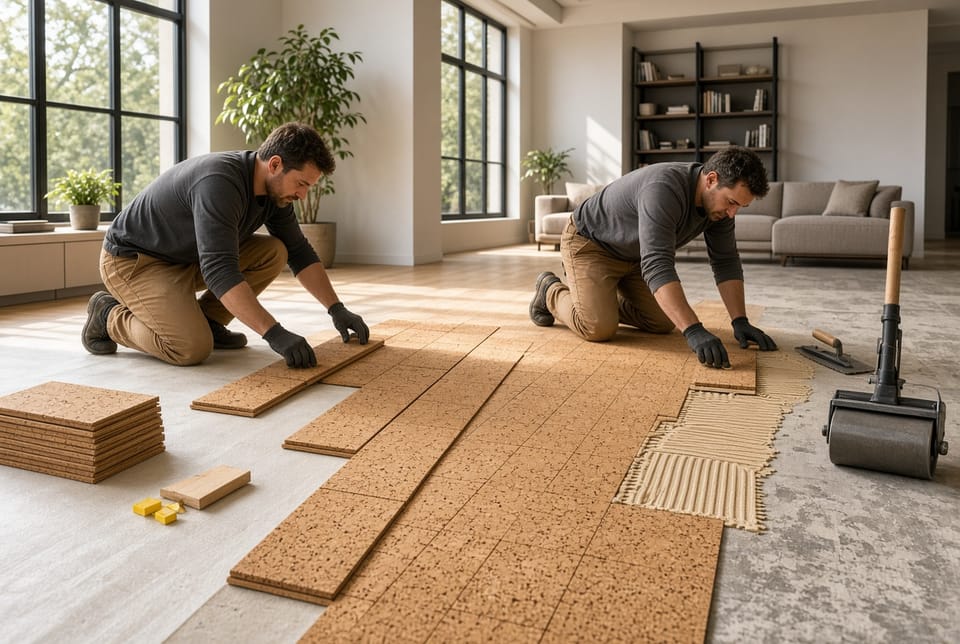
Glue-down installation permanently bonds cork tiles or planks to the subfloor with a manufacturer-approved adhesive, typically a polyurethane or acrylic product formulated for cork. The adhesive is spread with a notched trowel to a specified coverage rate. Cork pieces are laid into the wet adhesive, pressed firmly, and often rolled with a heavy roller to ensure full contact and eliminate air pockets. Once cured, the floor becomes a unified, stable surface.
This method is frequently specified for commercial spaces, high-traffic residential areas, radiant-heat floors (when compatible), and any location where a solid, quiet feel is preferred. Because the cork is locked to the substrate, individual movement is minimized.
Typical Glue-Down Installation Steps
- The subfloor must be exceptionally clean, dry, smooth, and structurally sound. Concrete often requires grinding or patching; wood subfloors may need additional fastening or overlay.
- Moisture testing is critical—concrete slabs frequently need a moisture barrier or mitigation system before adhesive is applied.
- Acclimate the cork material in the space.
- Snap layout lines so the first rows stay straight and the pattern is balanced.
- Spread adhesive in manageable sections so it does not skin over before cork is placed.
- Set each piece carefully, aligning edges and maintaining consistent joints.
- Roll the floor immediately and again after a short interval if the manufacturer requires it.
- Allow full cure time before heavy traffic or furniture placement; this can range from 24 to 72 hours or longer.
Professional installers usually handle glue-down work because timing, adhesive open time, and subfloor preparation leave little room for error.
Advantages of Glue-Down Installation
- Creates a permanent, stable floor with minimal hollow sound.
- Excellent performance in high-traffic and commercial settings.
- Better resistance to shifting or individual plank movement.
- Can follow minor contours of a well-prepared subfloor more closely.
- Often preferred when the finished height must stay low.
Limitations and Risks of Glue-Down Installation
- Requires a perfectly prepared subfloor; dust, grease, or moisture cause bond failure.
- More labor-intensive and usually higher labor cost.
- Difficult and messy to remove later; the subfloor may need extensive repair.
- Adhesive odors and longer wait times before use.
- Mistakes in trowel size or coverage can create weak spots or telegraphing.
Risk to watch: Applying glue-down cork over a contaminated or overly porous concrete slab is one of the leading causes of later delamination. Proper testing and surface preparation are non-negotiable.
Direct Comparison: Floating vs. Glue-Down
The two methods differ in almost every practical dimension. Use the following points to match the system to your project.
- Attachment: Floating relies on interlocks and underlayment; glue-down uses full-spread adhesive.
- Feel underfoot: Glue-down generally feels firmer and quieter; floating can have a slight give.
- DIY suitability: Floating is more accessible for experienced homeowners; glue-down favors trained installers.
- Traffic suitability: Glue-down handles heavy, constant traffic better; floating works well in moderate residential use.
- Repair and replacement: Individual floating planks can sometimes be lifted; glue-down repairs usually involve cutting out and patching bonded material.
- Subfloor demands: Both need a sound base, but glue-down is far less forgiving of residual dust, moisture, or unevenness.
- Moisture behavior: Floating with a proper vapor barrier can work over concrete; glue-down requires stricter moisture control because trapped vapor attacks the adhesive.
- Expansion management: Floating needs consistent perimeter gaps; glue-down still requires acclimation but the bond restricts large-scale movement.
- Cost profile: Material cost is similar; floating often saves on labor, while glue-down may add adhesive, extra prep, and professional fees.
- Longevity in demanding spaces: Glue-down typically delivers longer service in kitchens, entries, and commercial corridors when installed correctly.
Climate and indoor humidity also matter. Cork in a very dry or very humid region will move more. A floating floor accommodates that movement as a single sheet; a glue-down floor depends on the adhesive remaining flexible enough and the subfloor remaining stable.
Subfloor Preparation: The Foundation of Success
No installation method succeeds on a poor base. Concrete slabs should be tested for moisture vapor emission rate and relative humidity. Wood subfloors must be structurally sound, free of squeaks, and within flatness tolerances. Existing vinyl or other resilient floors may need removal or overlay depending on the cork product and method chosen.
For floating floors, a quality underlayment that includes a moisture barrier is often the last line of defense. For glue-down floors, mechanical abrasion or shot-blasting plus a primer or moisture-mitigation coating is common on concrete. Skipping these steps is the most frequent reason installations fail years later.
Tools, Materials, and Common Mistakes
Floating work typically requires underlayment, spacers, tapping block, pull bar, saw, and measuring tools. Glue-down work adds the correct trowel, adhesive, roller, and moisture-testing equipment.
Frequent errors include:
- Ignoring acclimation time.
- Using the wrong adhesive or trowel notch size.
- Leaving inadequate expansion space on floating floors.
- Walking on glue-down floors before full cure.
- Failing to stagger joints or maintain a consistent layout.
Each of these mistakes can turn an attractive cork surface into a noisy, gapping, or lifting floor. Following manufacturer instructions exactly is the simplest way to avoid them.
Cost, Timeline, and Maintenance Considerations
Floating installation usually costs less in labor and can be completed faster. Glue-down installation costs more upfront but can reduce long-term movement-related service calls in busy spaces. Maintenance after either method is similar: regular sweeping or vacuuming, damp (never wet) mopping with cork-safe cleaners, and prompt attention to spills. Area rugs in high-wear paths and felt pads under furniture protect the surface regardless of installation type.
Cork finishes vary—some are pre-finished, others receive a site-applied sealer or wear layer. The installation method does not change the need for appropriate finish protection, but a well-bonded glue-down floor is less likely to develop edge wear from micro-movement.

Choosing the Right Method for Your Project
Ask these practical questions:
- How much daily traffic will the floor receive?
- Is the subfloor concrete or wood, and what is its current condition?
- Do you want the option to remove or change the floor later?
- Is a professional installer available and within budget?
- Are there radiant heat, moisture, or height-restriction issues?
Moderate-traffic bedrooms and living areas often perform well with a quality floating system and proper underlayment. Kitchens, hallways, offices, and retail spaces frequently benefit from the stability of glue-down cork when the subfloor can be prepared to specification.
Both methods can produce a beautiful, comfortable, sustainable floor when executed correctly. The difference lies in matching the system to the realities of the space rather than choosing solely on initial convenience or cost.
Final Thoughts and Next Step
Cork flooring rewards careful planning. Floating installation offers speed, accessibility, and easier future changes. Glue-down installation offers permanence, a solid feel, and stronger performance under heavy use. Neither is universally superior; the better choice is the one that aligns with your subfloor, traffic, timeline, and long-term plans.
Prepare the substrate thoroughly, follow product guidelines, and use the right accessories. When those elements are in place, cork delivers the quiet, resilient surface that makes it a lasting favorite.
Choose the right cork installation method for your home or business. Speak with an experienced flooring specialist about floating and glue-down options tailored to your space.
Get the Best Cork Installation Method