The Concrete Truck Mixing: The 90-Minute Rule

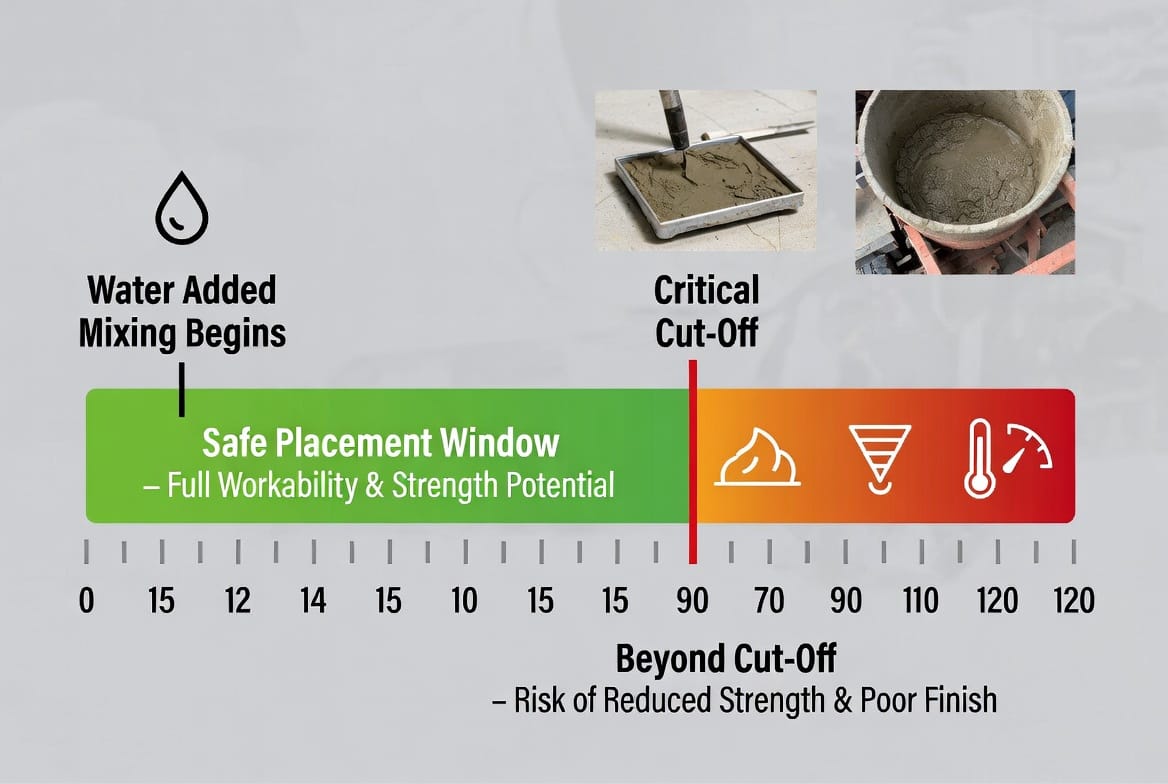
Every successful concrete pour begins long before the truck arrives. It begins the moment water meets cement inside the mixing drum. From that instant a silent countdown starts. Industry standards and decades of field experience agree on one non-negotiable window: concrete must be placed within 90 minutes of mixing—or, more precisely, within 90 minutes of the first addition of water. Miss that window and the material you paid for is no longer the same material that left the plant. This article explains exactly why the 90-minute rule exists, what happens when it is ignored, how to recognize the early warning signs of “old” concrete, and how professional crews protect every load so your project receives concrete at peak performance.
Get Concrete Placed Within the 90-Minute Rule – Call Now!
Why the Clock Starts the Instant Water Is Added
Cement is a hydraulic binder. The moment water contacts the cement particles a chemical reaction called hydration begins. Tiny crystals start to grow, interlocking and giving the paste its future strength. In the first 30–45 minutes the reaction is relatively gentle; the concrete remains highly plastic and easy to place, consolidate, and finish. After roughly 90 minutes the crystal network has advanced far enough that the paste begins to stiffen noticeably. Beyond that point the concrete enters the initial set phase. Workability drops sharply, internal temperatures rise, and the risk of cold joints, honeycombing, and reduced long-term strength climbs rapidly.
Ready-mix producers carefully calculate batch water, admixtures, and drum revolutions so that the concrete reaches the job site still well inside this safe window. Transit time, traffic, site access, and pour sequence are all planned around the same 90-minute limit. When that limit is respected, the concrete behaves exactly as the mix design intended. When it is ignored, even the best mix design cannot compensate.
The Science Behind the 90-Minute Cut-Off
Hydration is exothermic and irreversible. Once the cement grains begin dissolving and precipitating calcium-silicate-hydrate gel, the process cannot be paused or reversed simply by adding more water at the job site. Extra water increases the water-cement ratio, weakens the final matrix, raises permeability, and invites shrinkage cracking. Retarding admixtures can stretch the window modestly under controlled conditions, but they are never a license to ignore the clock. Most project specifications—ACI 301, ASTM C94, and virtually every state DOT standard—explicitly state that concrete shall be discharged within 90 minutes of the introduction of mixing water unless special approval is granted and documented.
Temperature accelerates the reaction. On a hot summer day the safe window can shrink to 60–75 minutes. Cold weather slows it, yet the 90-minute rule still applies because other risks (false set, inconsistent finishing) remain. The rule is therefore both a chemical necessity and a contractual requirement.
Recognizing Concrete That Has Exceeded the Window
Even experienced crews can be tempted to “make it work” when a truck is running late. The material itself, however, never lies. Watch for these clear signs that the concrete is past its prime:
- Stiff, unresponsive consistency – The load that left the plant at a 5-inch slump now measures 2 inches or less and refuses to flow under vibration.
- Difficulty placing and consolidating – Workers struggle to fill corners, around rebar, and into deep forms; the concrete tears rather than flows.
- Rapid surface set – A shiny paste that should remain workable for 30–45 minutes after placement begins to crust within minutes, leaving little time for proper finishing.
- Increased internal heat – The drum or the placed concrete feels warmer than normal for the ambient temperature, a symptom of accelerated hydration.
- Visible bleeding that stops too early – Normal bleed water rises and is reabsorbed; on old concrete the surface dries prematurely while the interior remains plastic, creating a weak top layer.
Any one of these symptoms is reason enough to reject the load. Continuing to place it risks permanent defects that no amount of later repair can fully erase.
How Professional Teams Protect the 90-Minute Rule
Experienced concrete contractors treat the clock as a critical path item equal in importance to formwork strength or reinforcement placement. Several disciplined practices keep every load safely inside the window:
Pre-pour coordination
The batch plant, dispatcher, and site supervisor communicate continuously. Truck departure times are staggered so that the first load arrives only after forms are ready and the crew is in position. GPS tracking on modern mixer trucks lets the plant and the job site watch remaining transit time in real time.
On-site readiness checklist
Before the first truck is released, the crew confirms that:
- Access routes are clear and graded.
- Forms are braced, oiled, and inspected.
- Reinforcement is tied, chairs are in place, and embeds are secured.
- Vibration equipment, finishing tools, and curing materials are staged.
- Weather contingency plans (shade, wind breaks, or heaters) are ready.
Continuous monitoring of elapsed time
Every delivery ticket lists the exact time water was added. The site superintendent notes the arrival time and calculates remaining placement time. If traffic or mechanical issues threaten the window, the load is either accelerated with high-range water reducers (only if previously approved) or rejected and returned.
Slump and temperature verification
A quick slump test and temperature reading on arrival confirm that the concrete still matches the approved mix design. Any significant deviation triggers an immediate conversation with the producer and, if necessary, rejection of the load.
Efficient placement sequence
Large pours are broken into manageable segments so that each truck can be emptied and the concrete consolidated before the next truck arrives. This prevents trucks from waiting on site with the drum turning and the concrete aging further.
These steps are not bureaucratic extras; they are the practical application of the 90-minute rule. When they are followed, the concrete that ends up in the forms is the same high-quality material that left the plant.
Consequences of Ignoring the Rule
Placing concrete past the 90-minute mark is never a minor inconvenience. The risks compound:
- Reduced compressive strength – Late hydration produces a coarser, more porous microstructure. Cylinders taken from such concrete frequently fall short of design strength.
- Cold joints and weak interfaces – Stiff concrete cannot properly bond to previously placed layers, creating planes of weakness.
- Honeycombing and voids – Poor flow around reinforcement leaves unfilled spaces that later become pathways for water and corrosion.
- Surface defects – Rapid set leads to plastic shrinkage cracks, dusting, and difficult finishing that permanently affect appearance and durability.
- Costly remediation – Removing and replacing rejected concrete, repairing cold joints, or strengthening under-strength members can exceed the original pour cost many times over.
Insurance carriers and structural engineers take a dim view of documented placement outside the specified time window. In the worst cases the entire structural element may be required to be demolished and rebuilt.
Special Conditions That Tighten or Stretch the Window
While 90 minutes is the standard, real-world conditions sometimes demand tighter control:
Hot weather
When ambient temperatures exceed 80 °F (27 °C) or concrete temperature climbs above 90 °F (32 °C), many specifications reduce the allowable time to 60–75 minutes. Ice, chilled water, or set-retarding admixtures become essential tools, but they never eliminate the need for rapid placement.
Mass concrete
Large foundation mats or thick walls generate significant internal heat. The 90-minute rule still applies to each truckload, yet additional measures—cooling pipes, sequential pours, or specially formulated low-heat mixes—are layered on top.
Long-distance hauls
Rural projects or congested urban routes can push transit times close to the limit. In these cases producers may use hydration-controlling admixtures that temporarily suspend the chemical reaction, effectively “pausing” the clock until the truck reaches the site. Even then, once the admixture is overcome the remaining placement time is carefully monitored.
Night and cold-weather pours
Lower temperatures slow hydration, giving a slightly longer practical window, yet the formal 90-minute limit remains. The greater risk in cold weather is incomplete finishing or frozen surfaces, not exceeding the clock.
In every special condition the professional approach is the same: plan, measure, and never guess.

Practical Tips for Project Owners and Site Supervisors
You do not need to be a concrete technologist to protect your investment. Simple habits make a measurable difference:
- Request the batch time on every delivery ticket and note it in the daily log.
- Walk the forms and reinforcement one final time before the first truck is released.
- Keep a calibrated thermometer and slump cone on site; five minutes of testing can save weeks of repair.
- Designate one person whose only job during the pour is watching the clock and coordinating truck sequence.
- Establish a clear rejection protocol in the pre-pour meeting so there is no hesitation if a load arrives late.
- Photograph ticket times, slump results, and placement progress; documentation protects everyone if questions arise later.
These practices cost almost nothing yet dramatically reduce the chance that a single late truck will compromise an entire structure.
The Role of Modern Technology
Today’s ready-mix industry has tools that make compliance easier than ever. On-board sensors continuously record drum revolutions, concrete temperature, and sometimes even real-time rheology. Cloud-based dispatch systems give both the plant and the job site a shared view of every truck’s location and remaining time. Some producers offer “just-in-time” delivery windows accurate to within a few minutes. When combined with disciplined site preparation, these technologies turn the 90-minute rule from a source of anxiety into a reliably managed process.
Yet technology never replaces judgment. Sensors can warn, but only people decide whether to accept or reject a load. The most advanced fleet in the world still requires a superintendent who understands that concrete past its window is no longer the concrete specified in the contract documents.
Conclusion: Timing Is Quality
The 90-minute rule is not an arbitrary number invented by bureaucrats. It is the practical expression of the chemistry of cement hydration. Respect it and the concrete you place will develop the strength, durability, and finish the design intends. Ignore it and you introduce risks that no amount of later effort can fully remove.
Every load of ready-mix concrete carries an invisible expiration clock that starts the second water meets cement. Professional teams treat that clock with the same seriousness they give to formwork strength or reinforcement cover. They plan, they measure, they communicate, and when necessary they reject. The result is concrete that performs for decades rather than concrete that becomes a liability within months.
If your next project demands concrete that meets every specification the first time, partner with a team that lives by the 90-minute rule. They will coordinate batch times, monitor every truck, verify workability on arrival, and place your concrete while it is still at peak performance. Timing matters. Quality depends on it. Let experienced hands protect both.
Call Today for On-Time Professional Concrete Pouring