The Concrete Countertops: Design, Fabrication, and Installation

Custom concrete countertops give homeowners a rare combination of strength, artistic control, and lasting uniqueness that factory-made surfaces cannot match. When you choose a custom concrete countertop, you are not selecting from a limited catalog; you are commissioning a surface built to your exact dimensions, color, thickness, and edge profile. The result is a durable, heat-resistant work surface that can be tailored to contemporary, industrial, or warm residential kitchens.
Design Your Custom Concrete Countertops – Call Now
This guide walks through what concrete countertops actually are, the full range of design options, how professional fabrication happens, and the practical installation considerations that protect both the product and your home. Every recommendation below is written to help you make confident decisions and avoid common pitfalls.
What Concrete Countertops Really Are
A concrete countertop is a high-performance, site-specific slab made from a carefully engineered mix of Portland cement, aggregates, pigments, fibers, and admixtures. Unlike pre-cast stone or laminate, each piece is custom-formed to the precise layout of your cabinets, walls, and appliances. The material itself is inherently durable: properly mixed and sealed concrete resists daily heat, scratches from normal use, and staining far better than many people expect.
The uniqueness comes from the process. Color can be integral (mixed throughout the batch) or applied as a topical stain. Texture can be glass-smooth, honed, or lightly textured. Thickness can range from a slender 1.5 inches to a substantial 3 inches or more. Edge profiles can be square, eased, bullnose, or waterfall. Because the slab is built for one kitchen only, seams are minimized and the finished look is truly one-of-a-kind.
Homeowners who want both beauty and performance often select concrete precisely because it can be customized at every step rather than adapted after the fact.
Design Options That Define the Finished Look
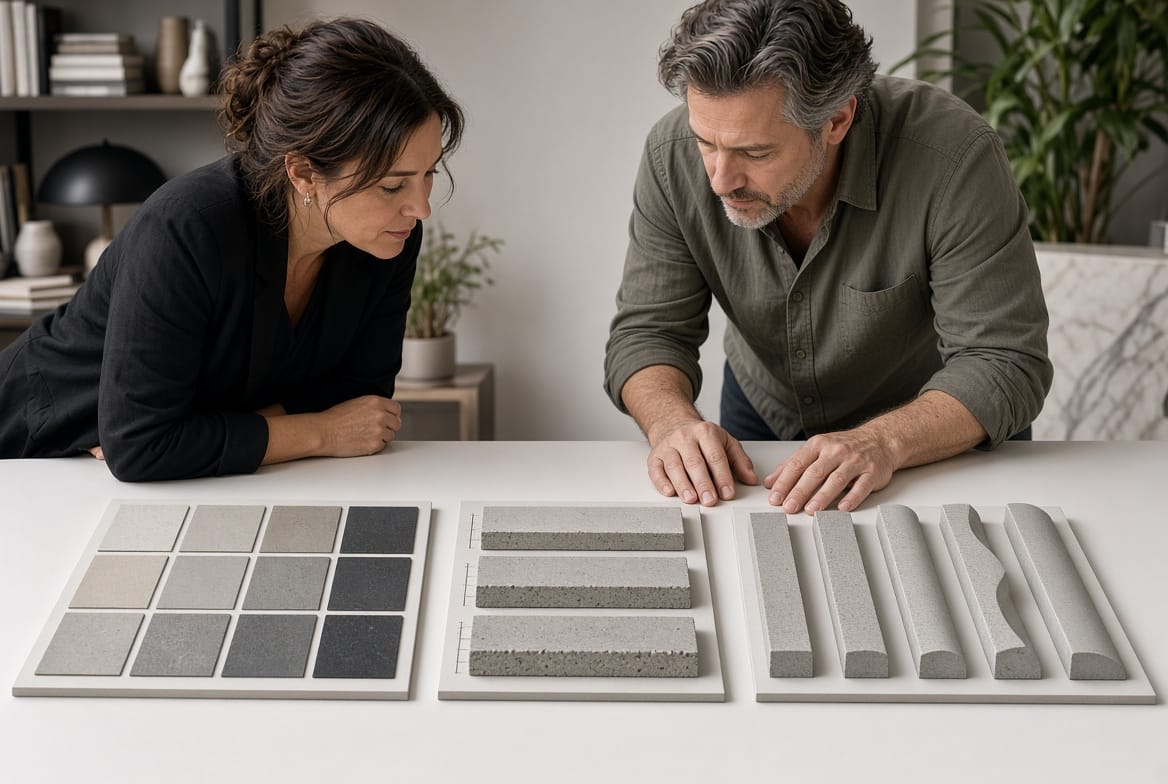
Successful concrete countertops begin with clear design choices. Three variables matter most: color, thickness, and edge profiles. Getting these right early prevents costly changes later.
Color Selection
- Integral pigments produce consistent, fade-resistant hues that run through the entire slab.
- Acid or water-based stains create depth and movement similar to natural stone.
- Custom blending lets you match existing cabinetry, flooring, or a specific sample you bring to the shop.
- Neutral grays, warm taupes, and deep charcoals remain the most requested because they pair easily with both wood and painted cabinets.
A professional fabricator will pour sample boards so you can see the exact color under your kitchen lighting before the full pour.
Thickness Decisions
- 1.5-inch slabs keep visual weight light and work well on standard base cabinets.
- 2-inch slabs add presence and extra strength for larger spans.
- 2.5- to 3-inch slabs create a bold, architectural statement and can incorporate built-in features such as drain boards or integrated sinks.
- Thicker edges also allow more dramatic profile shaping.
Thicker concrete increases weight, so cabinet reinforcement must be planned at the same time as the design.
Edge Profiles
- Square or slightly eased edges give a clean, modern line.
- Bullnose or half-bullnose softens the look and is kinder to forearms.
- Ogee or more ornate profiles add traditional character.
- Waterfall edges drop the same material down the side of an island for a continuous, high-end appearance.
These three decisions—color, thickness, and edge profiles—are locked in during the design phase and cannot be easily changed after the mold is built.
Fabrication: From Design Drawing to Finished Slab
Professional fabrication follows a controlled sequence that protects both quality and schedule.
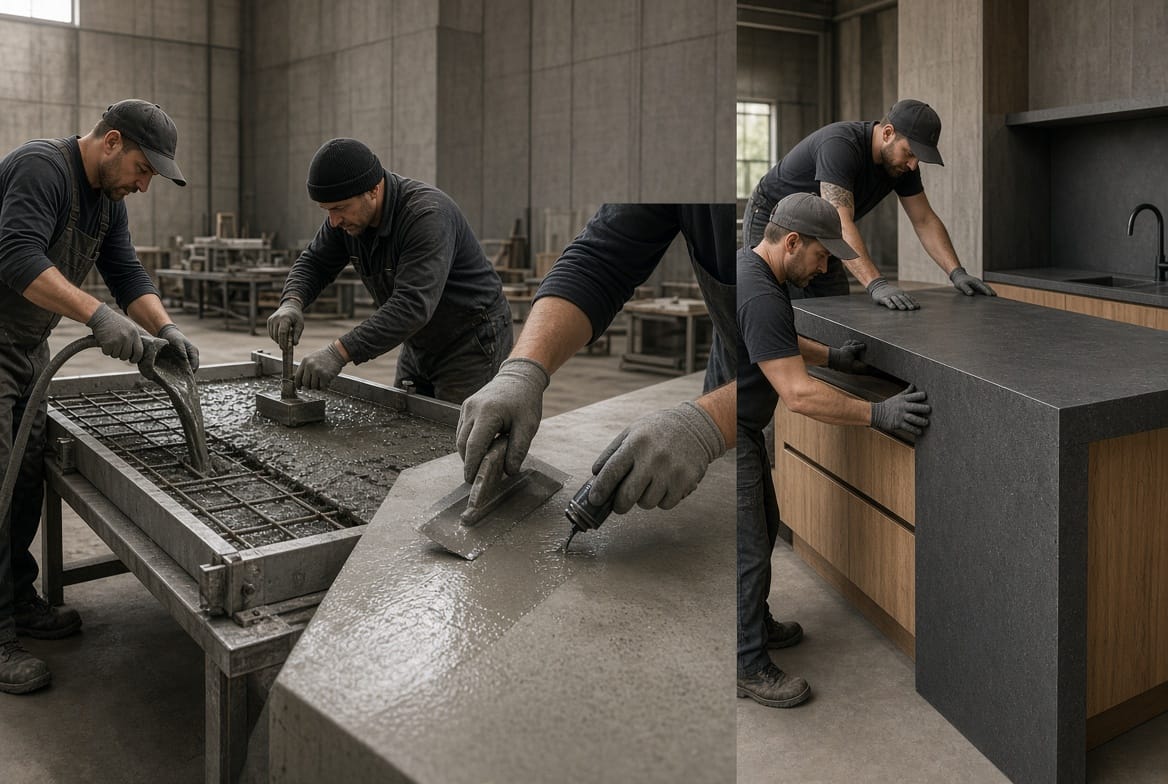
First the fabricator templates the exact cabinet layout, noting every cut-out, faucet hole, and appliance reveal. A mold is then built from melamine or similar material that will produce the chosen edge profile and thickness. Reinforcement—usually steel mesh or fiber—is placed inside the mold according to span calculations.
The concrete mix is batched with the selected color pigments and any performance admixtures that improve workability or reduce shrinkage. The mix is poured, vibrated to remove air pockets, and finished to the specified texture. After initial set, the slab is cured under controlled temperature and moisture so it reaches full strength before it ever leaves the shop.
Sealing is not an afterthought. A high-quality penetrating or topical sealer is applied in multiple coats so the surface resists everyday kitchen stains while remaining food-safe. Only after the sealer has cured is the slab ready for transport and installation.
Because every countertop is custom, lead times typically run several weeks. That time is used to refine details rather than rush production.
Installation Considerations That Protect Your Investment
Even the best-fabricated slab can underperform if installation is rushed or poorly planned. Several factors deserve attention.
Weight is the most important structural issue. Concrete is heavy; a 2-inch slab can exceed 20 pounds per square foot. Cabinets must be level, plumb, and reinforced with additional blocking or steel if necessary. A professional installer will inspect the existing cabinetry before the pour so surprises do not appear on installation day.
Seams should be kept to an absolute minimum. When a seam is unavoidable, it is located in the least visible spot and filled with a color-matched epoxy so it remains tight and discreet.
Support and leveling must be exact. Shims and adhesive are used to create a perfectly flat plane; any rocking or gap will telegraph through the finished surface.
Sealing and maintenance begin the day the countertop is set. The installer applies the final sealer coats on site if needed and leaves you with simple care instructions: wipe spills promptly, use cutting boards, and re-seal according to the product schedule (usually every one to three years depending on use).
Risk of cracking exists if the slab is undersized for its span or if the cabinets shift after installation. Proper reinforcement, correct thickness, and a stable base virtually eliminate this risk when the work is performed by experienced fabricators.
Temperature and humidity during installation also matter. Extreme conditions can affect adhesive cure times, so scheduling around weather or HVAC control is part of a professional plan.
When these installation considerations are handled correctly, a concrete countertop becomes a low-maintenance, high-performance surface that lasts for decades.
Why a Fully Custom Approach Makes the Difference
Factory-made surfaces force you to work within existing sizes and colors. A custom concrete countertop starts with your kitchen and builds outward. You control every visual and functional detail, from the exact shade that complements your backsplash to the precise thickness that feels substantial under your hands. Integrated features—drain grooves, knife blocks, or even heating elements—can be cast in rather than added later.
The same process that creates uniqueness also creates durability. Because the mix, reinforcement, and sealer are specified for your project, the finished countertop is engineered for real kitchen use rather than generic assumptions.
Homeowners who take the custom route consistently report higher satisfaction because the surface looks as though it was always meant to be there.
Ready to Create Custom Concrete Countertops
A well-designed, professionally fabricated, and carefully installed concrete countertop delivers custom beauty, durable performance, and a unique presence that no other material quite matches. From the first conversation about color, thickness, and edge profiles through final placement, every step can be tailored to your home.
Create custom concrete countertops that fit your kitchen exactly.
Call Now for Custom Color, Thickness & Edge Options