The Concrete Retaining Wall Block Patterns: Staggered vs. Stacked
Choosing the right concrete retaining wall block pattern is one of the most important decisions a property owner or builder can make. The pattern you select does far more than shape the look of the finished wall. It directly influences structural integrity, long-term durability, drainage performance, and overall safety. Two of the most common approaches are the stacked pattern and the staggered pattern. Understanding the clear differences between them helps ensure your retaining wall stands strong for decades while enhancing the beauty of your landscape.
Choose the Right Concrete Block Pattern – Call Now!
In this comprehensive guide we examine both patterns in detail. We explore how each is constructed, the structural advantages and limitations of each, the aesthetic impact each creates, and practical factors that should guide your final choice. By the end you will feel confident selecting the pattern that best matches your site conditions, design goals, and performance expectations.
What Exactly Is a Stacked Pattern?
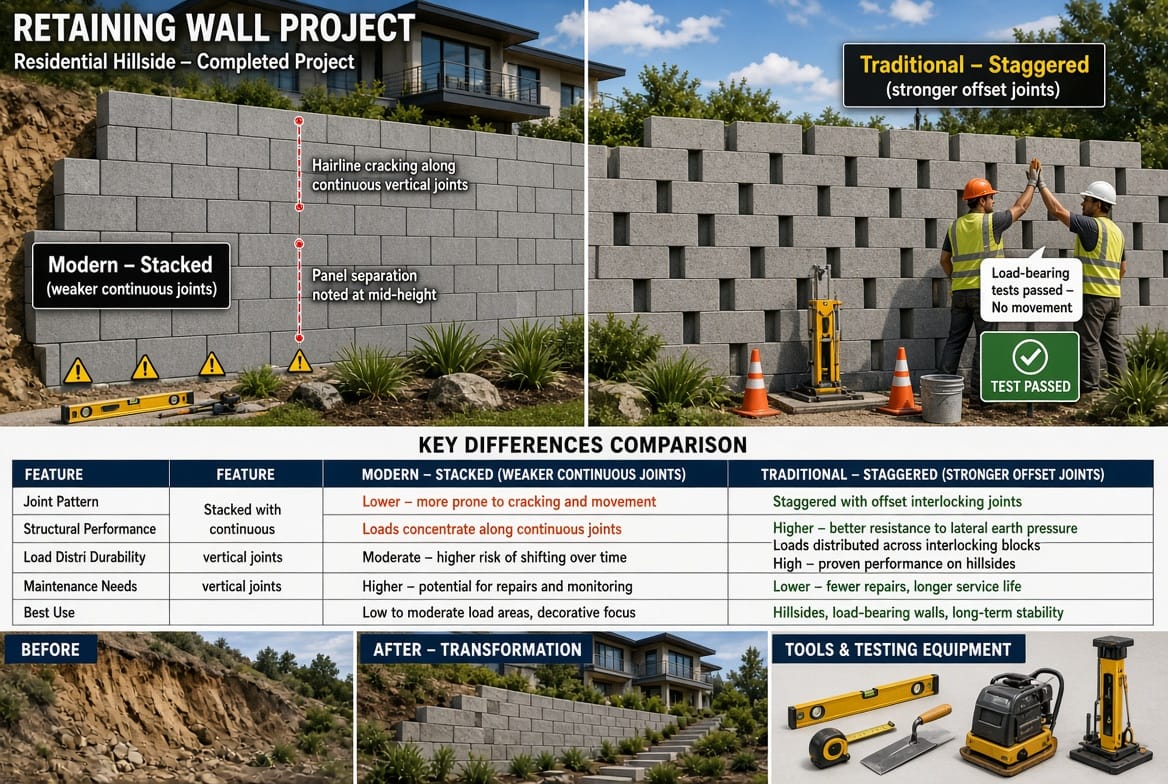
A stacked pattern, sometimes called a stacked-bond or vertical-joint layout, places every concrete block directly above the one beneath it. The vertical joints align in continuous straight lines from the base of the wall all the way to the top. This creates a clean, modern grid-like appearance that many contemporary designs favor.
Because the joints run straight through the height of the wall, the blocks rely heavily on the interlocking features of the block system itself, the quality of the base, and any reinforcing elements such as geogrid. The visual result is orderly and geometric. Homeowners who prefer minimalist or architectural styles often appreciate the crisp vertical lines that the stacked pattern delivers.
What Exactly Is a Staggered Pattern?
A staggered pattern, also known as a running-bond or offset-joint layout, shifts each successive course of blocks by half a block length (or another consistent offset). The vertical joints never line up. Instead they break and interlock across the face of the wall, much like traditional brickwork.
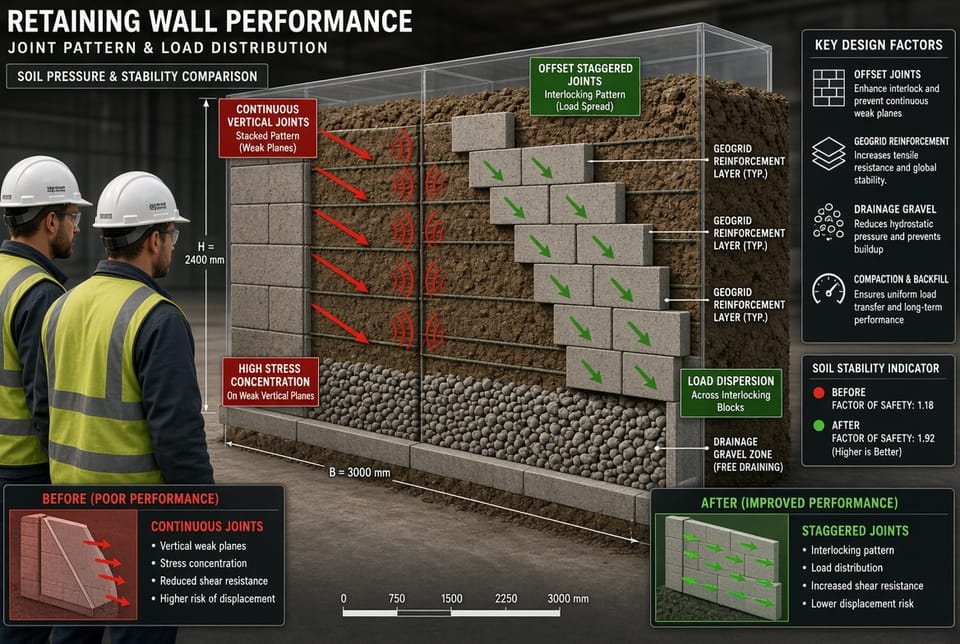
This offset arrangement creates a classic, textured look that feels more organic and time-tested. Beyond appearance, the staggered layout distributes loads more evenly and reduces the chance of continuous weak planes forming through the wall. For many engineers and experienced installers the staggered pattern remains the preferred choice when maximum structural performance is required.
Structural Considerations: Strength, Stability, and Load Distribution
Structural performance is the primary reason pattern selection matters so deeply. Retaining walls must resist soil pressure, water forces, and occasional surcharge loads from vehicles or structures above. The way blocks are arranged influences how these forces travel through the wall.
In a stacked pattern the continuous vertical joints create potential planes of weakness. Lateral soil pressure can more easily push against these aligned joints. When properly engineered with adequate base preparation, drainage, and geogrid reinforcement, a stacked wall can still perform well. However, the margin for error is smaller. Any settlement or movement tends to concentrate along those straight joints.
By contrast, a staggered pattern interrupts those vertical lines. Each block rests partially on two blocks below it, creating a natural interlocking effect. Forces are dispersed across a wider area of the wall face. This distribution improves resistance to shear and overturning. Independent testing and decades of field experience consistently show that staggered walls generally develop higher overall stability for the same block type and reinforcement schedule.
Key structural points to remember:
- Stacked walls depend more heavily on external reinforcement and precise installation tolerances.
- Staggered walls gain inherent strength from the offset joints themselves.
- Both patterns require a properly compacted gravel base, free-draining backfill, and correct batter (slight backward lean) for optimal performance.
- On taller walls or sites with poor soils, the staggered approach often allows designers to reduce the amount of geogrid needed while still meeting safety factors.
- Seismic or high-wind regions almost always favor staggered layouts because of the improved energy dissipation.
Choosing the stronger pattern is not merely about exceeding code requirements. It is about building lasting peace of mind. A wall that remains true and level after years of freeze-thaw cycles and heavy rains protects both your investment and the safety of anyone near it.
Aesthetic Considerations: Style, Texture, and Landscape Harmony
While structure must come first, appearance remains a major factor for most property owners. The pattern you choose shapes the entire visual character of the finished wall and how it interacts with surrounding plantings, hardscape, and architecture.
The stacked pattern produces a sleek, contemporary look. Straight vertical lines emphasize height and create a sense of order. This style pairs beautifully with modern homes, clean concrete paving, and minimalist plantings. Many designers use stacked walls when they want the retaining structure to feel intentional and architectural rather than purely functional. The uniform grid can also make the wall appear taller, which is useful when vertical emphasis is desired.
The staggered pattern delivers a warmer, more traditional texture. The broken joints create subtle shadow lines and a sense of movement across the face of the wall. This organic quality blends easily with natural stone accents, woodland gardens, or craftsman-style architecture. Because the eye travels across the offsets rather than up continuous lines, staggered walls often feel more grounded and less imposing, even when they are quite tall.
Additional aesthetic factors include:
- Color and texture of the concrete blocks interact differently with each pattern. Rough-faced blocks gain extra depth in a staggered layout, while smooth-faced blocks look especially crisp when stacked.
- Curves and corners are generally easier to execute cleanly with staggered courses because the offsets help hide joint irregularities.
- Lighting design benefits from staggered walls; the varied joint lines catch light and shadow in more interesting ways after dark.
- Planting pockets or cascading vegetation look more natural against a staggered face.
Neither pattern is inherently “better” looking. The right choice depends on the overall design vision for the property. A skilled designer can make either pattern appear intentional and refined.
Practical Installation Differences and Site Suitability
Beyond pure strength and looks, the two patterns behave differently during construction and suit different site conditions.
Stacked walls go up quickly because every course is identical and alignments are easy to check with a simple plumb line. However, any small error in the base course multiplies as the wall rises, so precision at the foundation level is critical. Stacked patterns also tend to require more careful attention to geogrid placement at every course to compensate for the continuous joints.
Staggered walls take slightly longer to lay because each course must be carefully offset. Yet the interlocking nature often forgives minor base irregularities better than a stacked layout. On sites with uneven topography or where the wall must step or curve, the staggered approach frequently proves more adaptable.
Site conditions that favor one pattern over the other include:
- Poorly draining or expansive soils — staggered walls handle differential movement more gracefully.
- High surcharge loads (driveways or buildings near the wall) — staggered patterns distribute those loads more effectively.
- Visible high-end residential projects seeking a modern statement — stacked patterns often win on style.
- Taller walls exceeding four or five feet — most engineers default to staggered for the added inherent stability.
- Budget-conscious projects — stacked walls can sometimes reduce labor time, while staggered walls may reduce material costs for reinforcement.
Proper drainage remains non-negotiable for both patterns. A continuous perforated pipe at the base, free-draining gravel backfill, and filter fabric are essential regardless of joint layout. Neglecting these elements will compromise even the strongest pattern.
Long-Term Performance, Maintenance, and Risk Factors
Over the life of a retaining wall the chosen pattern continues to influence performance and maintenance needs. Stacked walls that experience any settlement often develop more noticeable cracking along the continuous vertical joints. Staggered walls tend to develop smaller, more distributed cracks that are easier to monitor and repair if necessary.
Common risk factors to avoid with either pattern:
- Insufficient base preparation
- Inadequate or clogged drainage
- Missing or improperly placed geogrid
- Using the wrong block system for the height and soil type
- Ignoring local frost depth or seismic requirements
Regular visual inspections once or twice a year allow early detection of any movement. Looking for leaning, bulging, or separation at joints helps catch problems before they become costly. When a wall is built correctly from the start, both patterns can deliver decades of reliable service with minimal upkeep beyond occasional cleaning and vegetation control.
Making the Final Choice: Matching Pattern to Purpose
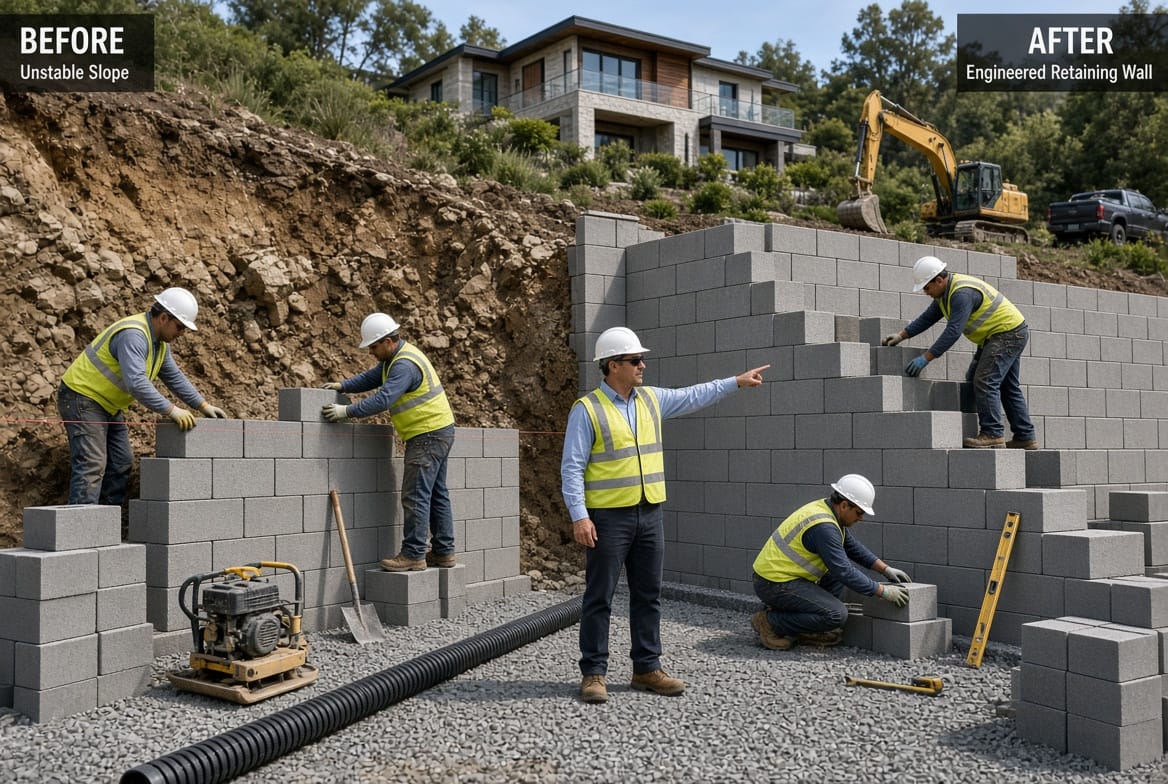
There is no universal “best” pattern. The right decision balances structural demands, aesthetic goals, site constraints, and budget. For most residential and light commercial projects where strength and longevity rank highest, the staggered pattern offers a reassuring combination of traditional reliability and proven performance. When a bold modern statement is the priority and the wall has been fully engineered with appropriate reinforcement, the stacked pattern can deliver striking results.
Work with an experienced retaining-wall specialist who understands both the engineering calculations and the practical realities of installation. A professional evaluation of your soil, slope, drainage, and design preferences ensures the chosen pattern will perform safely and look beautiful for years to come.
Conclusion: Choose the Right Wall Pattern with Confidence
Selecting between stacked and staggered concrete retaining wall block patterns is ultimately about matching the right solution to your specific needs. The staggered layout generally provides superior structural strength through its interlocking offset joints, while the stacked layout offers a clean modern aesthetic that many contemporary landscapes demand. Both can succeed when engineered and installed correctly, yet understanding their differences empowers you to make an informed, confident decision.
A well-built retaining wall does more than hold back soil. It protects property, creates usable outdoor living space, and becomes a lasting feature of the landscape. Taking the time to choose the appropriate pattern is an investment in safety, beauty, and long-term value.
If you are planning a new retaining wall or evaluating an existing one, professional guidance makes all the difference. Speak with a knowledgeable specialist who can assess your site and recommend the optimal pattern for your conditions. For expert advice on retaining walls.
Get Expert Guidance on Retaining Wall Patterns – Call Now!