The Concrete Driveway Thickness: How Thick Should It Be?
Choosing the correct concrete driveway thickness is one of the most important design decisions homeowners and property managers make. Get it right and your driveway will handle daily traffic, seasonal weather, and heavy loads for decades. Get it wrong and you risk cracking, settling, or costly early repairs. This guide walks through the practical requirements, the science behind them, and the steps that turn a simple slab into a durable investment.
Call Now for Expert Concrete Driveway Installation
Why Thickness Matters More Than Most People Realize
Concrete is strong in compression but relatively weak in tension. When a vehicle drives across a driveway, the slab bends slightly between support points. If the slab is too thin, those bending forces create tensile stress that exceeds the concrete’s capacity. The result is cracks that grow over time, especially under freeze-thaw cycles or repeated heavy loads.
Proper thickness distributes weight over a larger area, reduces deflection, and works together with the base and reinforcement to keep the surface flat and intact. Thickness also influences how the concrete cures and how it responds to temperature changes. A well-designed thickness is not about using more material for its own sake—it is about matching the structural demand of the site.
Standard Thickness for Residential Driveways
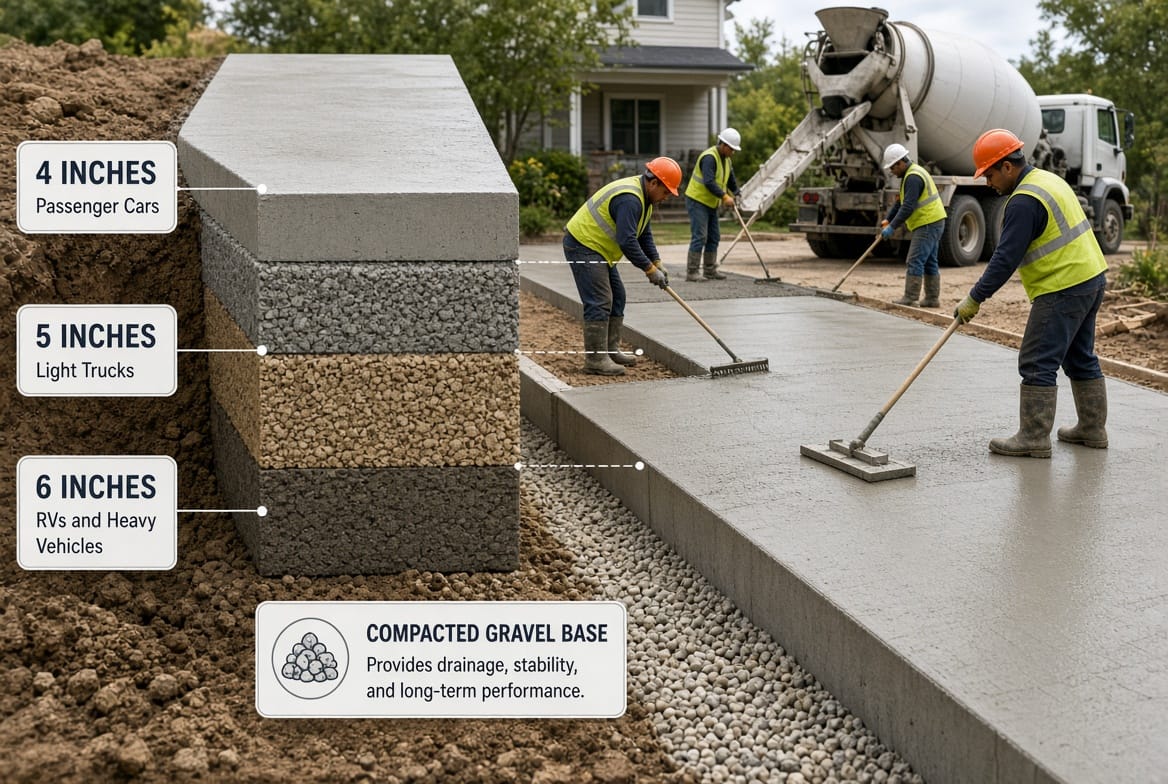
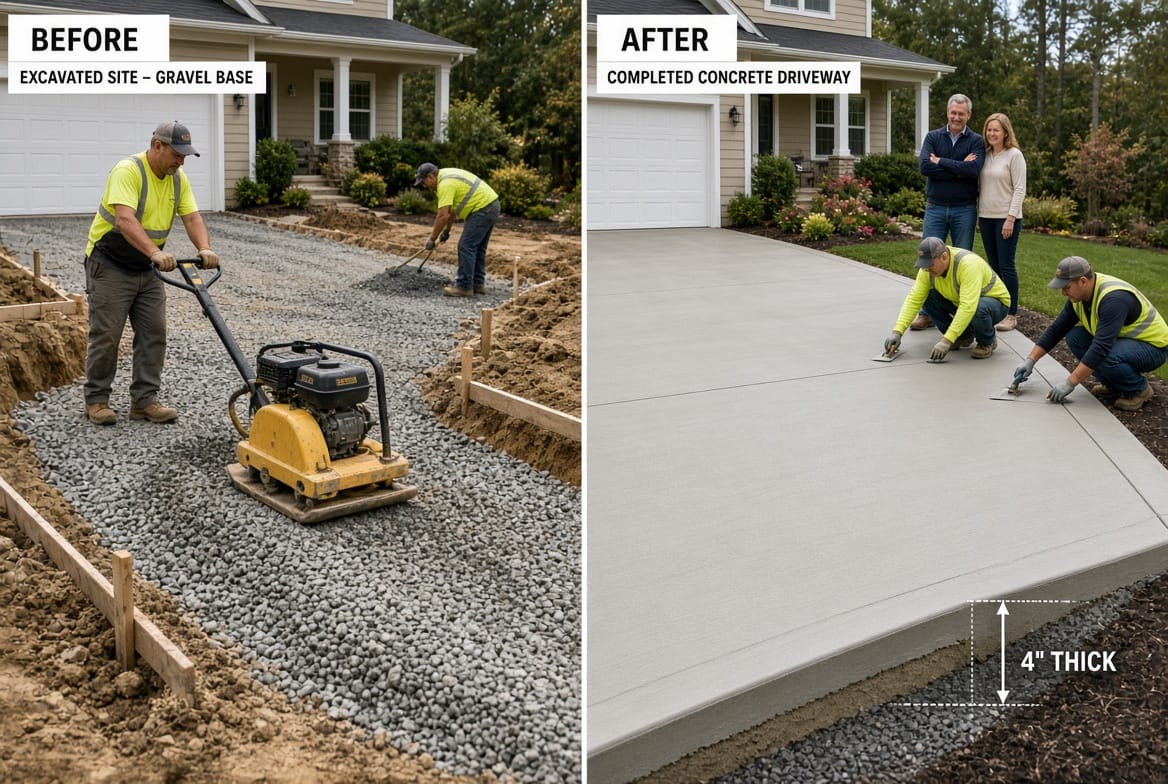
For typical passenger cars and light SUVs, the industry standard is a 4-inch thick concrete slab. This measurement is taken after the concrete has been placed and finished, not including the base layer beneath it. Four inches provides sufficient strength when the following conditions are met:
- The subgrade is properly prepared and compacted
- A clean, well-graded aggregate base is installed and compacted
- Reinforcement (wire mesh or rebar) is correctly positioned
- The concrete mix meets or exceeds the required compressive strength (usually 3,000–4,000 psi)
- Control joints are sawed or tooled at the proper spacing
Many reputable contractors still place residential driveways at 4 inches with reinforcement. The reinforcement does not increase the compressive strength of the concrete itself, but it holds the slab together if minor cracks form, keeping the surface serviceable and preventing differential settlement.
In regions with severe winters or expansive clay soils, some designers prefer a slightly thicker 4.5- to 5-inch slab even for standard cars. The extra thickness adds a safety margin against frost heave and soil movement.
When 5 to 6 Inches Becomes Necessary
Heavier vehicles change the equation. Pickup trucks, delivery vans, boats on trailers, recreational vehicles, and occasional construction equipment generate higher point loads and greater overall stress. In these cases, 5 to 6 inches of concrete is the safer and longer-lasting choice.
- 5 inches is appropriate for regular use by light trucks and occasional heavier vehicles.
- 6 inches is recommended when RVs, large SUVs, or commercial vehicles will park or travel across the driveway frequently.
The additional thickness significantly increases the slab’s moment of inertia—the geometric property that resists bending. Combined with proper reinforcement and a solid base, a 5- or 6-inch driveway can carry substantially higher loads without distress.
Commercial or multi-family properties often specify 6 inches or more, sometimes with heavier rebar grids, because traffic volume and vehicle weights are greater.
The Critical Role of Base Compaction
Thickness alone cannot save a driveway if the foundation underneath is weak. The base and subgrade must be dense, stable, and free of organic material. Base compaction is the step that most often separates a driveway that lasts thirty years from one that fails in five.
A typical high-quality section looks like this from the bottom up:
- Native subgrade excavated to the required depth and compacted to at least 95 percent of standard Proctor density
- 4 to 6 inches of crushed stone or gravel base, placed in lifts and compacted with a vibratory plate or roller
- Optional geotextile fabric if the soil is soft or poorly draining
- Concrete slab of the chosen thickness with reinforcement
Loose or poorly compacted base allows the concrete to settle unevenly. Even a perfectly thick slab will crack when one side drops relative to the other. Proper compaction creates a uniform support layer so the entire driveway acts as a single structural unit.
Moisture content during compaction is equally important. Soil that is too dry or too wet will not reach maximum density. Experienced crews test moisture and density on site rather than relying on guesswork.
Reinforcement and Jointing Work With Thickness
Thickness, reinforcement, and jointing form a three-part system. Wire mesh or rebar placed in the upper third of the slab (never on the bottom) helps control crack width. Control joints cut to one-quarter of the slab depth create planned weak planes so cracks occur in straight lines that can be sealed rather than random jagged breaks.
For a 4-inch slab, joints are typically spaced 8 to 12 feet apart. Thicker slabs can tolerate slightly wider spacing, but most professionals stay conservative. Isolation joints where the driveway meets the garage apron or sidewalk prevent the new concrete from bonding to existing structures and cracking under differential movement.
Climate and Soil Considerations That Influence Thickness
Local conditions often push designers toward the higher end of the thickness range. In freeze-thaw climates, water that enters tiny surface cracks expands when it freezes. A thicker slab has more mass and is less likely to heave or spall. In areas with expansive clay, extra thickness and a well-drained base reduce the risk of seasonal movement.
Coastal or high-water-table sites benefit from thicker slabs because the concrete itself acts as a barrier against moisture-related deterioration. Always check local building codes; some municipalities set minimum thickness requirements that exceed the general guidelines.
Mixing, Placement, and Curing Support the Design Thickness
Even the correct thickness will underperform if the concrete is poorly mixed or cured. A consistent water-cement ratio, proper air entrainment for freeze-thaw resistance, and thorough vibration or consolidation during placement ensure the slab achieves its design strength throughout its full depth.
Curing is critical in the first seven days. Keeping the surface moist or applying a curing compound prevents rapid moisture loss that can cause plastic shrinkage cracks and reduce long-term strength. A thicker slab retains internal moisture longer, which is an advantage when curing practices are carefully followed.
Common Mistakes That Undermine Thickness
Several recurring errors reduce the effective performance of an otherwise adequate thickness:
- Pouring on an uncompacted or wet base
- Allowing reinforcement to settle to the bottom of the form
- Omitting or incorrectly spacing control joints
- Using a mix that is too wet, which lowers strength and increases shrinkage
- Driving on the driveway before it has reached sufficient strength (usually 7 days minimum, longer in cool weather)
Avoiding these mistakes is as important as choosing the right number of inches.
Cost Versus Value of Adequate Thickness
Increasing from 4 to 5 or 6 inches adds material and labor cost, yet the difference is modest compared with the expense of removing and replacing a failed driveway years later. Most property owners find that the incremental investment in proper thickness pays for itself through reduced maintenance and extended service life.
When comparing bids, look beyond the unit price per square foot. Confirm that each proposal specifies the same thickness, base preparation, reinforcement, and jointing details. The lowest price sometimes reflects thinner concrete or skipped base work.
Practical Guidelines Summarized
- Standard residential (cars and light SUVs): 4 inches with reinforcement and proper base
- Regular light-truck or occasional heavier use: 5 inches
- Frequent RVs, large trucks, or commercial traffic: 5–6 inches
- Always pair thickness with thorough base compaction and correct jointing
- Adjust upward for severe climate or poor soil conditions
These ranges have been validated by decades of field performance across varied regions.
Long-Term Performance and Maintenance
A driveway built to the correct thickness still benefits from basic care. Seal the surface every few years if recommended for your climate, keep joints filled, and address any edge cracking promptly. Avoid de-icing salts that can accelerate surface wear, especially on newer concrete. With these simple steps, a properly thicknessed driveway routinely delivers 25 to 40 years of reliable service.
Choosing a Qualified Installer
The best thickness specification on paper is only as good as the crew that executes it. Look for contractors who:
- Discuss base preparation and compaction methods in detail
- Provide written specifications for thickness, reinforcement, and mix design
- Offer references of similar projects that have performed well over time
- Carry appropriate licensing and insurance
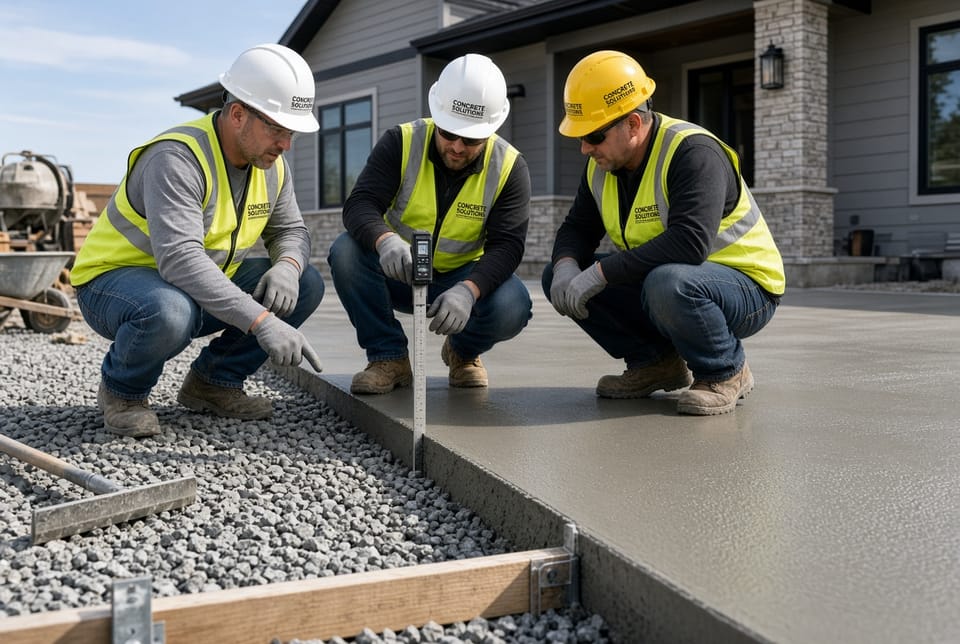
Ask how they verify thickness during the pour and what steps they take to ensure uniform depth across the entire area.
Final Thoughts on Design Confidence
Understanding concrete driveway thickness removes guesswork from one of the most visible and heavily used features of a property. Residential driveways typically perform well at 4 inches when reinforced and supported by a compacted base. Heavier traffic calls for 5 to 6 inches. In every case, base compaction is non-negotiable because it allows the chosen thickness to function as designed.
Proper thickness ensures a long-lasting driveway. When you are ready to discuss concrete installation for your property. Experienced professionals can evaluate your soil, traffic patterns, and climate to recommend the exact thickness and construction details that will deliver decades of dependable service.
Call for Professional Thickness Consultation Now